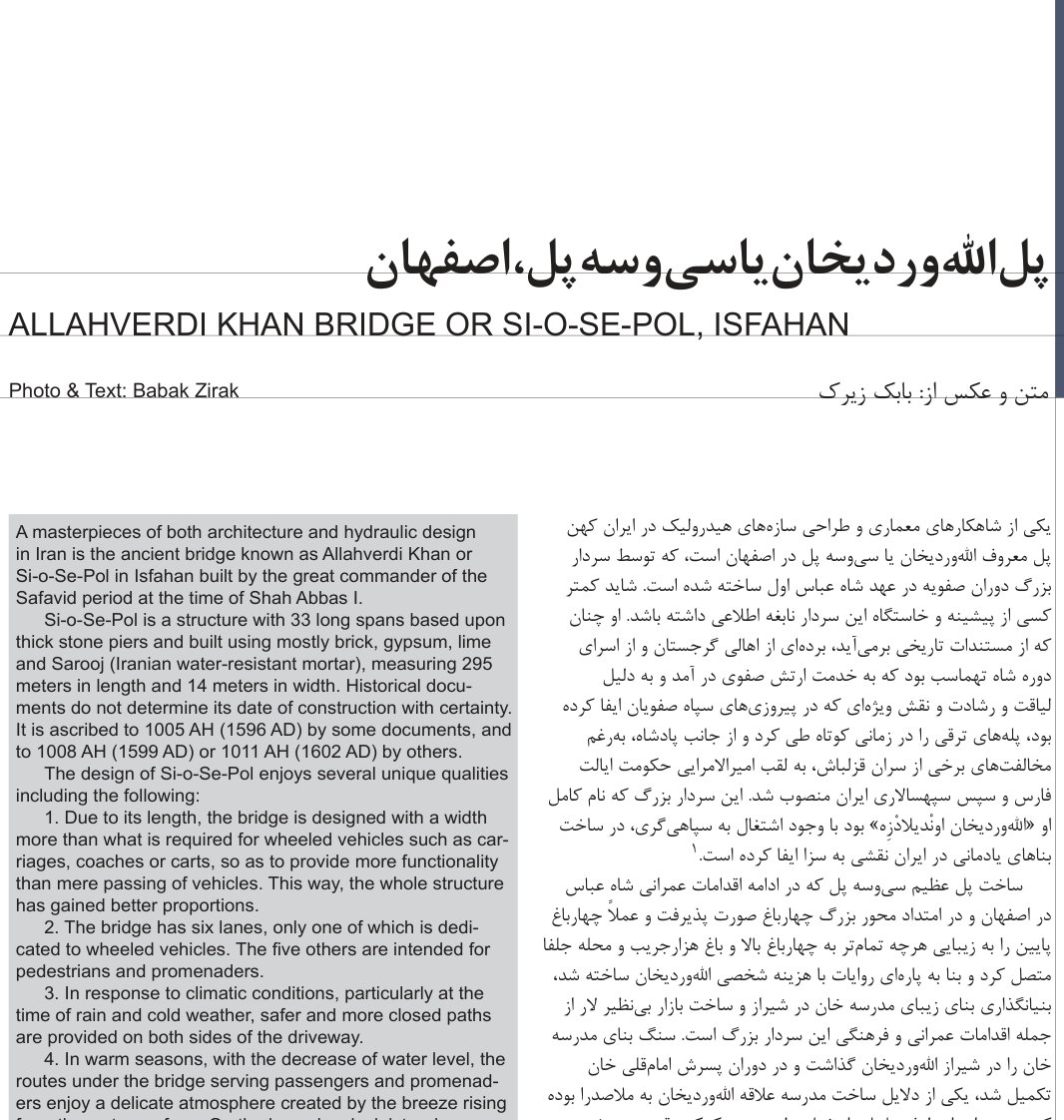
The Allahverdi Khan Bridge, or Si-o-Se Pol, Isfahan
One of the masterpieces of architecture and hydraulic structural design in ancient Iran is the famed Allahverdi Khan Bridge, or Si-o-Se Pol (the Bridge of Thirty-Three Arches) in Isfahan, built by the great commander of the Safavid era during the reign of Shah Abbas I. Perhaps few are aware of the background and origins of this brilliant commander. As historical documents attest, he was a slave from Georgia, one of the captives taken during the reign of Shah Tahmasp, who entered the service of the Safavid army and, owing to his competence, valor, and the special role he played in the Safavid army's victories, rose rapidly through the ranks. Despite the opposition of some Qizilbash chieftains, he was appointed by the king to the title of Amir al-Omara, the governorship of Fars province, and subsequently the supreme military command of Iran. This great commander, whose full name was "Allahverdi Khan Undiladze," despite his military career, played a significant role in the construction of monumental buildings in Iran. The building of the immense Si-o-Se Pol — which was carried out as part of Shah Abbas's urban development projects in Isfahan along the extension of the great Chahar Bagh axis, and in effect connected the Lower Chahar Bagh most beautifully to the Upper Chahar Bagh, the Hezar Jarib Garden, and the Julfa quarter, and was reportedly built at the personal expense of Allahverdi Khan — the founding of the beautiful Khan School in Shiraz, and the construction of the unparalleled bazaar of Lar are among the cultural and construction undertakings of this great commander. The cornerstone of the Khan School in Shiraz was laid by Allahverdi Khan, and it was completed during the time of his son, Imam Qoli Khan. One of the reasons for building the school was Allahverdi Khan's admiration for Mulla Sadra, who had at one point been expelled by the clerics of Isfahan and exiled to Kahak in Qom. Allahverdi Khan wrote a beautiful letter to Mulla Sadra: "I cannot come to Kahak to attend your lectures, and for this reason I have begun the construction of a school for you in Shiraz, and as soon as it is completed I shall inform you so that you may come and teach there." And thanks to this great Safavid commander, the most brilliant period of Mulla Sadra's life began, during which he authored numerous invaluable books and established the theory of "Transcendent Theosophy." In analyzing the unparalleled values of Si-o-Se Pol, it is necessary to note that among the most important construction undertakings of Iran's great kings — apart from the building of palaces, mosques, and other monumental urban buildings — the construction of roads and bridges was considered among the most strategically vital endeavors, since the creation of a comprehensive and secure network of communications was one of the pillars of their rule's survival; otherwise, the cities and major population centers of their kingdom would have become like isolated islands devoid of cohesive connections. Si-o-Se Pol was naturally no exception to this rule. Although this bridge played a vital role in establishing communication between the two distinct northern and southern sections of the Safavids' new capital, it also functioned magnificently as a space for the promenading and leisure of the people, the aristocracy, and the court. As historical documents attest, this bridge was the venue for
the beautiful Ab-Pashan ceremonies on the thirteenth of Tir each year, in which the city's people participated by splashing water and rosewater. Iranian Armenians also held the sacred Epiphany ceremony on the thirteenth of January beside Si-o-Se Pol. In the book The Life of Shah Abbas I, reference is made to a Nowruz celebration that the Shah held on Si-o-Se Pol in the year 1018 AH: "The Nowruz celebration generally lasted from three to seven days and nights. In addition to the Naqsh-e Jahan Garden, the Allahverdi Khan Bridge was also adorned and illuminated, and sometimes by the Shah's command a flower-strewing ceremony was held on the bridge, and abundant flowers were scattered in the path of the Shah and his companions. In the year 1018, although the beginning of Farvardin coincided with the month of Muharram, by the Shah's command seven days and nights of Nowruz celebration were held and flowers were strewn on the bridge. And since the people of Isfahan had displayed great artistry in the illumination
and decorations, the Shah remitted 500 tumans of that year's taxes for them." Sir Percy Sykes, in his memoirs, considered Si-o-Se Pol one of the world's first-class bridges. Don Garcia, the French traveler, counted it among the finest works of Iranian architecture, and Chardin also deemed it a masterpiece of architecture and a wonder. Lord Curzon wrote in part of his writings: "One has no expectation that to see what may altogether be called the most magnificent bridge in the world, one would have to travel to Iran." Mention should also be made of the writings of Pietro della Valle, the Italian who traveled to Iran in 1617. As the first foreign traveler after visiting this bridge, he described it thus: "Over this river (Zayandeh-Rud) there is a bridge made entirely of brick, wider than all the bridges of Rome, and its length is at least equal to three or four of those bridges. The architecture of this bridge is executed in a strange manner, and on both sides there are arcaded niches through which people pass above and below. What attracts the most attention are the corridors beneath the bridge, situated nearly at water level; the coolness and the murmur of the water on the lower level are most pleasant, especially in the hot summers. Furthermore, in the direction of the water's flow, near the bridge, small stone walls have been placed so that the water cascades over them, taking on the appearance of a small waterfall, and this spectacle is in itself very beautiful." Si-o-Se Pol is a structure with thirty-three tall arches resting on massive piers, built mainly of stone, brick, plaster, lime, and sarooj mortar, approximately 295 meters in length and 14 meters in width. Regarding the date of its construction, the necessary certainty does not exist in historical documents; the beginning of construction has been attributed to the year 1005 AH, and in some instances to the years 1008 and 1011 AH.
The design of Si-o-Se Pol possesses unmatched characteristics, among which the following can be noted: 1- The width of the bridge, given its great length, is designed wider than what is required merely for the passage of wheeled vehicles such as carriages, carts, and wagons, so that it practically provides greater functionality than mere vehicular passage, while at the same time achieving better proportions for its overall structure. 2- The bridge has six passageways, of which only one was designated for wheeled vehicle traffic, while the other five axes are entirely devoted to pedestrians and promenaders. 3- In accordance with weather conditions and during rain and cold, safer and more enclosed routes for pedestrian passage exist on both sides of the vehicular axis. 4- In summer, when the water level drops, the passages beneath the bridge — which enjoy a tempered atmosphere owing to the air currents rising from the water's surface — serve walkers and those viewing the scenery. On the lower level, four-part vaults have been used for the ceiling, which also constitutes the roof of the upper level. The bridge piers, which are of stone in their lower layers, are shaped as semicircular cutwaters. According to experts from the Cultural Heritage Organization and geologists, the resistance of the foundation and the strength of the bridge piers — built with a combination of stone and sarooj — increases with greater moisture. Consequently, should the dryness of Zayandeh-Rud continue over the long term, apart from the weakening of the bridge structure, because
the volume of the soil particles' molecules diminishes with the loss of water, the subsidence of the riverbed would be inevitable, and thus the possibility of irreparable damage to this historic bridge would exist. The naming of this bridge after Allahverdi Khan rather than Shah Abbas I is one of the rare instances in Iranian architecture where a powerful ruler refrained from naming a prominent work after himself, and in this particular case the king, out of respect for his beloved commander-in-chief, named the bridge after him. Unlike bridges that serve merely as crossing routes and are in a sense continuations of the road on both sides of the river, the simultaneous presence of vehicles and pedestrians on the two levels of Si-o-Se Pol, as well as groups of people who gather at various points of the bridge for recreation and to view the surrounding scenery, provides this bridge with great beauty and functional value. The body of the bridge is joined by two thin longitudinal walls with strong pointed arches that in practice serve the function of a much thicker wall, greatly aiding the bridge's stability against vibrations caused by the pressure of the water current and the movement of vehicles across it. The bridge has four round stone towers on its two ends, their height approximately equal to that of the upper parapet. Delicate staircases built within the diameter of the bridge piers provide access from the upper axis to the lower one.
In the same manner, stairs exist on both sides of the bridge providing access to the tops of the terraces above the corridors. At sunrise and sunset, the play of shadows and half-shadows on the eastern and western facades of the bridge, and images of people on horseback and on foot crossing through the various axes and levels, viewed through the numerous arched openings, lend this magnificent bridge a remarkably vivid and dynamic aspect. In the tumultuous history of Iran's numerous governments, one can rarely find a valiant and courageous commander who, apart from defending the homeland or waging wars of conquest, left such enduring marks in the grand endeavor of constructing valuable and lasting buildings on a national scale as did Allahverdi Khan.
Footnotes: 1- During one of the four campaigns of Shah Tahmasp to Georgia, Allahverdi Khan, who belonged to a notable feudal family in Georgia, was brought to Iran as a prisoner. In his youth, he was sold for thirty gold coins, and ultimately joined the Safavid army. Rising through various military ranks, he effectively attained the position of Qullar Aqasi, meaning Commander of the Royal Slaves, and later became governor of various provinces in Fars, Kohgiluyeh and Boyer-Ahmad, and the southern regions, coasts, and islands of the Persian Gulf.
2- Epiphany. 3- Sir Percy Molesworth Sykes (born February 1867): English general, writer, and geographer. Apart from several diplomatic missions in Iran on behalf of the British government, in 1916 he was tasked with suppressing the fighters and resistance of the people of the south of the country.
4- Garcia de Silva Figueroa (born December 1550): Ambassador of the King of Spain to the court of Shah Abbas Safavid and considered an important traveler of his time. 5- Jean Chardin (born November 1643): A French jeweler and traveler whose ten-volume book, The Travels of Sir Jean Chardin, is counted among the finest works of Western scholars on Iran and the Near East. This book was first published in Iran under the title Siyahatnameh-ye Chardin in 1335 SH (1956). 6- Lord George Nathaniel Curzon (born 1859): One of the renowned statesmen of the first twenty-five years of the twentieth century in Britain and an Iranologist. In 1886, he was first elected to the English Parliament, and a year later he began a journey around the world and became enchanted by Asia. 7- Pietro della Valle (born 1586): An Italian traveler who visited several Eastern countries. It is said that the first documented instance of bringing a Persian cat to Europe was by him.
His travelogue, titled Cose e Parole nei Viaggi di Pietro Della Valle, contains important documentation about Iran in the Safavid era.
Sources: Deputy for Education and Outreach, Cultural Heritage Organization. Archive of Aran Consulting Engineers. Pope, Arthur Upham. Iranian Architecture. Donya-ye Eqtesad newspaper, No. 4061.



