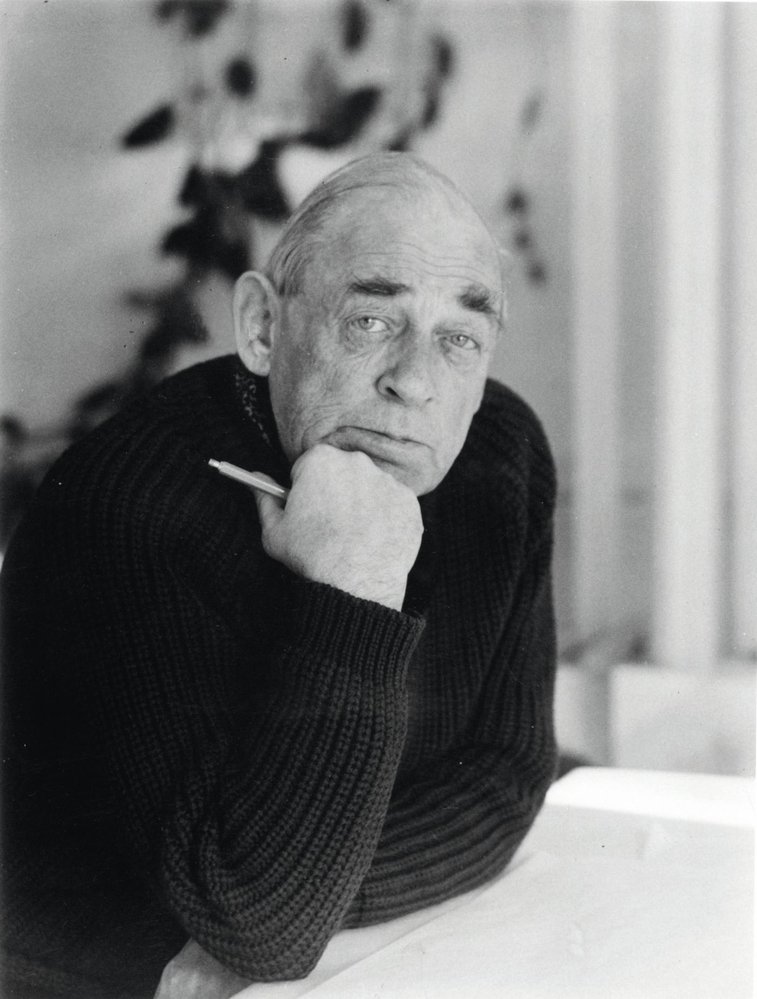
This year, on the occasion of the centennial of the birth of Alvar Aalto, the Finnish architect, and in order to honor his stature in contemporary architecture and re-examine the value of his works, ceremonies have been held in various countries and articles published in architectural journals. For this occasion, two texts — one by Alvar Aalto himself — are presented in this issue.
Humanizing Architecture
Excerpted from Alvar Aalto's article in Technology Review, 1940; reprinted in Domus, 801, February 1998.
The architecture we know by the name “functionalism” stands in contrast to an architecture whose principal concern is a formalist style that a building must don like a garment. The emergence of the functional idea and its expression in structures may well be the most invigorating event in the architecture of our time. And yet the precise interpretation of function in architecture — and likewise of functionalism — is by no means a simple matter. “Function” is the use, work, or action characteristic of an object. “Function” is at the same time an entity dependent upon another entity, varying with it. In dictionaries, functionalism is boldly defined as “the conscious adaptation of form to use.” Functionalism is both more and less than this, for both meanings of function must in truth be recognized and taken into account.
Architecture is a synthetic phenomenon covering, in practice, a field that may be functional from one viewpoint and non-functional from another. In recent decades, modern architecture has been principally functional in its technical aspect, with its main emphasis on the economic side of building activity. This emphasis is of course desirable, for the construction of good shelter for people is far more expensive than meeting other human needs. If architecture is to acquire greater human value, the first step is to organize its economic aspect. But because architecture covers every sphere of human life, a truly functional architecture must above all be functional from the human viewpoint.
If we cast a deeper glance at the processes of human life, we discover that technique is merely an auxiliary means, and not in itself an autonomous or definitive phenomenon. Technical functionalism cannot, on its own, create a definitive architecture. If there were a step-by-step path to the evolution of architecture, one could accept that the work might begin with economic and technical functionalism. But no such possibility exists. Architecture covers not only every sphere of human activity; it must even evolve simultaneously in all those spheres. Otherwise it will yield only one-sided and superficial results.
The term “rationalism” is associated with modern architecture almost as much as “functionalism.” Modern architecture has been principally rational on its technical side, in the same way that technical functions have been emphasized. Although in the period of pure rationalism in modern architecture, buildings appeared in which the rationalist technique was overstated and the human functions were not duly emphasized, this is no reason to do battle against rationalism in architecture. The trouble with the period of modern architecture's zenith and decline was not its being rational. The trouble was that rationalism had not gone deep enough. The newest phase of modern architecture seeks — instead of doing battle with the rationalist mind-set — to extend rationalist methods from the technical sphere into the human and psychological spheres […].
The present phase of modern architecture is undoubtedly a new phase, and its particular aim is the solution of humanistic and psychological problems. But this new phase does not stand in contradiction to the first phase, that of technical rationalization. In fact, to understand it one must see it as an extension of rationalist methods so as to encompass related spheres.
In decades past, architecture has often been compared with the sciences, and attempts have been made to render its methods more scientific. There have even been attempts to turn it into a pure science. But architecture is not a science. Architecture is still the same vast synthetic process that integrates thousands of definite human functions, and that same architecture endures. Its intent is still to create harmony between the material world and human life. To humanize architecture means to better it; it means a functionalism reaching far beyond mere technical functionalism. This aim cannot be reached except through architectural methods — the creation and synthesis of various technical things in such a way as to make possible the most harmonious life for the human being.
Architectural methods sometimes resemble scientific methods, and one may apply to architecture the same research process used in the sciences. Architectural research can be made ever more methodical, but its substance can never be purely analytic. In architectural research, instinct and art will always have the greater share.
Scientists customarily use exaggerated forms in their analyses in order to obtain clearer and more visible results — for instance, they stain bacteria, and so on. Such methods can also be used in architecture. In my personal experience with hospital buildings I was able to discover that certain physical and psychological reactions of patients yield good clues for the design of conventional dwellings. If our point of departure is technical functionalism, we discover that in our present-day architecture many things are not functional from a psychological standpoint, or from a combined psychological-physiological standpoint.
Technical functionalism is correct only insofar as it is extended so as to embrace even the psychological spheres. This is the only path to the humanization of architecture.
Matter, Meaning, and Mind in Architecture
Karsten Harries, “Matter, Meaning, and Mind in Architecture,” Domus, 801, February 1998.



