Location: Jahanshahr, West Mahan Boulevard, Arghavan Street, West Paeizan Alley, No. 8 | Client: Zahra Abrari | Execution: JAD Design and Build Office | Structure: Farid Askarinejad, Ali Tafreshi | Mechanical Systems: Mansour Gandomi | Electrical Systems: Esmaeil Gharedaghi | Project Manager: Farid Askarinejad | Supervision: Vahid Askarinejad | Graphic Design: Sahar Darab | Photography: Negar Sedighi, Navid Askarinejad | Built Area: 2,600 sq.m. | Site Area: 500 sq.m.
JAD OFFICE, NAVID ASKARINEJAD
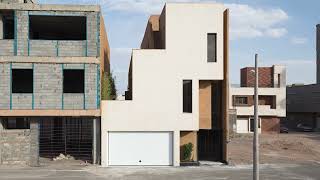
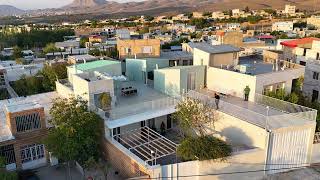
The project is situated on a plot within a conventional urban fabric and has been designed and constructed in a total of 7 stories: a basement (parking, mechanical systems, storage), a ground floor (lobby, community hall, caretaker's quarters, storage), and 5 residential floors (each floor containing two units of 150 and 190 square meters). The building's skeleton is reinforced concrete and the ceilings are joist-block; the cooling and heating system is duct split, and domestic hot water is supplied by wall-mounted boilers. Among the client's primary requirements was the uniformity of the floors and the division of units into east and west orientations (so that each unit could benefit from both northern and southern light), given a construction envelope of approximately 15 meters in width and 25 meters in length, resulting in units of roughly 25 meters in length and 7 meters in width. Thus, one of the initial challenges was resolving the relationships between the project's interior spaces. On the other hand, the project is located in the historic, characterful, and tree-lined Jahanshahr neighborhood, whose defining feature is its ancient plane trees and garden lanes that distinguish this area from other parts of the city of Karaj—though today, due to rampant construction, they are under threat of destruction. Among these, individual villa-type buildings with Bahmani brick and cement or metal-edged windows still remind us of the old character of the area and have, in a sense, preserved the neighborhood's identity. Thus the project's most important challenge and primary concept took shape for us: preserving and reviving the identity of the neighborhood and respecting its fabric and context.
By studying the typology of these individual buildings, frames took shape in our minds that became the cornerstone of the project's architectural formation: windows whose upper and lower edges protrude from the facade, sometimes extending to the end of the window and sometimes along the entire length of the facade, creating diverse compositions. Our entire effort in this project was to revive the same atmosphere that the residents of this neighborhood once had—that same sense of tranquility they experienced while strolling through the garden lanes, which today is vanishing: speaking less and listening more; socializing with neighbors but not loudly. All our decisions and discourse in this project were formed on this basis—to let the fabric and context tell us what to do and what not to do. The numerous setbacks in the volume on the ground floor and other floors were made out of respect for the neighborhood's fabric. On the ground floor, the entrance is defined as a recessed space serving as a pre-entry, creating a hierarchy for entering the building—a semi-open and semi-private space that can serve as a place for informal gatherings. All openings on the upper and ground floors are set back from the facade wall, and in front of them, spaces for planting vegetation have been provided. Additionally, generous terraces on all floors offer views of the plane trees before them, with handmade and latticed brick walls extending from the facade into the terraces, serving as a place for residents to rest.
Ostalak Family Complex, Tehran
Location: Lavasan, Imam Khomeini Boulevard, Varjin Street, Kouhpayeh Street | Client: Mehdi Ramezan | Design Team: Shiva Hosseini, Armen Hartounians, Saghar Kazemi, Sara Bakhshi, Naim Vahedi | Execution: Hossein Ramezan | Supervision: Kelias Kavir | Structure: Behrang Kashani, Arman Ahmadi Aria | Electrical Systems: Rafi Zarifian | Mechanical Systems: Razmik Zarifian | Photography: Did Studio, Siavash Bagheri | Built Area: 2,670 sq.m. | Site Area: 1,100 sq.m.
The Ostalak Family Complex is an exercise toward completing our design experiences in the organization and formation of the home's space. An exercise that began with the "Two Houses, Two Dwellings" project, emphasizing complete independence of spaces, and continued in the "Nazdelkadeh Family Complex" project with the interweaving of boundaries. The placement of this project at an elevation, along with the considerable slope of the land—with a difference of approximately three stories—created possibilities and constraints. We attempted to take advantage of these by employing familiar spatial elements such as the iwan, the sunken garden, and the void to create spatial desirability with regard to light, landscape, and vista in different sections, and to give a more evolved dimension to our previous exercises and experiences, which we present in a collection called Parallel Bridges. The main idea of the design is based on an axial extension that begins at the house's entrance and whose visual axis continues into the distance toward the Latian Dam reservoir. An axis that is repeated on other levels as a bridge or as a void with a view to the sky. The spaces of the complex are formed on either side of this extension on each floor, in a manner that evokes a concept of spatial unity combined with independence. In this complex, while we have three separate houses, the visual continuity of the complex from the outside and its conceptual continuity from within have made them appear as a unified home. Another part of this unity relates to the second skin of the facade, which through
wooden louvers has created, in addition to unity, a dynamic facade and a varied interior space through the control and modulation of light and landscape. But the most important issue was the subject of the house. The house has needs that are not necessarily compatible with an artistic approach to architecture. The house is designed for specific occupants, and they have needs and desires that can override the features the designer has envisioned for the project. The Ostalak Complex, with precise construction and delicacy in detail, includes a courtyard, exercise and swimming facilities, a guesthouse, a Sunken Garden House, a Vista House, and a Rooftop Garden Suite. Vista House: A house on two levels, whose first level from the north is at the same elevation as the main entrance. This house looks south toward the river and the Latian Dam, and connects to the sky through a void. Sunken Garden House: This house, whose northern side sits at a level lower than the street and the complex's main entrance, receives light and a beautiful landscape through the sunken garden, and once again looks south toward the river and the Latian Dam. A section of this house containing the master bedroom is situated at a lower level on the southern side. Rooftop Garden Suite: A suite apartment with a private courtyard on the roof, offering seclusion along with openness and generosity of space.
Afshar Family Residential Building, Tehran
Location: Shariati Street, beginning of Zafar Street, Sabr Alley, North Motahhari Alley, Mahshid Alley, Roya Alley, No. 1 | Client: Dr. Cyrus Afshar | Design Team: Ali Dehghani, Behnam Emami, Narges Badaghi | Supervision: Ayeneh Architecture Office | Structure and Mechanical and Electrical Systems: Niko Tarh Sepehr | Project Manager: Eng. Maziar Ganji Jam | Planning and Initial Physical Design: ESBAD Architecture Office (Sepideh Masoudinejad, Babak Gholizadeh) | Graphic Design: Narges Malek, Shadi Amirkaveh | Photography: Ali Gorjian | Built Area: 1,075 sq.m. | Site Area: 236 sq.m.
AYENEH OFFICE, ALI SOLTANI, ATEFEH KARBASI
Before the client proposed the project to us, the steel skeleton and columns had been ordered and were nearly ready for installation, and the location of the elevator shaft, fire escape stairwell, and light well (in its initial form under municipal regulations) was fixed and unchangeable. We emptied some sections of the previous ceiling, relocated the voids, and reconceived the meaning of the complex's light well. The clients are parents who wanted the complex to have three homes: one larger unit for their own residence and two units for their children. On floors one, two, and three, a total of two duplex units for the children are interlocked within each other, and on floors four and five—the top two floors—there is one duplex unit for the parents. Thus, a shared neighborhood space connecting all the homes became essential. On the other hand, the southern passage was not very wide and did not offer a good view. This led to the most important architectural decision in the project: creating inward-looking homes that maintain good neighborly relations with each other and a strong connection to the northern courtyard. The project conceals within itself a shared neighborhood space between floors, hidden from the view of the southern passage, and faces toward it. This means that the homes use the south side solely for the benefit of southern light, but in terms of quality, they face an internal neighborhood courtyard from which most of their interior spaces receive views and scenery. The internal courtyard is latticed toward the stairwell and elevator and open toward the other spaces of
the house, and the entrance to all duplex units on each of their two floors and mezzanine is through a semi-open space facing the interior courtyard. On the ground floor, the parking for all floors and the entrance lobby are located. The first floor and the eastern wing of the second floor form the duplex unit of one of the children: the guest room, living area, and kitchen are on the first floor, and from the east side, a staircase leads to the second floor comprising two bedrooms with separate bathrooms and a small hall overlooking the internal courtyard. The western wing of the second floor together with the third floor forms the other child's unit. The main entrance to this unit is from the third floor. The guest room, salon, and kitchen are on the third floor, and two bedrooms and a small hall with a view of the internal courtyard are on the second floor. The parents' unit has its main entrance on the fourth floor, containing the salon, guest room, and kitchen. On the fifth floor, three bedrooms, a bathroom, a toilet, a laundry room, and the main living room where the entire family gathers are situated, facing the northern courtyard. The volume of each duplex unit is distinct on the south facade and separated from the adjacent unit. The rough and latticed gray outer shell is the outermost part of the facade, and the inner skin comprising windows with the warm color and texture of brick emphasizes the inward-looking nature of the homes. Ultimately, it can be said that in this project, the concepts of the staircase and vertical connection, the light well, and the south facade have been transformed with the aim of enhancing quality and creating shared spaces for a family living in three homes within one complex.
Mika Residential Twin Towers, Tehran — MIKA TWIN TOWERS, TEHRAN
Location: West Hakim, Taavon Boulevard, Asia Boulevard, Alaleh Boulevard, corner of Niloufar Street | Client: Mika | Design Team: Amir Niknafs, Hamideh Raoufzadeh, Sahand Mohades, Parisa Soltani, Behnaz Behbahani, Hamed Bakhtiari, Ghasem Naeeji, Ilia Salek, Arash Daryaei, Mina Mehrdad, Aida Ehsani, Fateme Ebrahimi, Ehsan Danandeh | Execution, Structural Design, Electrical and Mechanical Systems Design and Execution: Mika | Photography: Masih Mostajeran, Parham Taghiof, Parham Raoufi | Built Area: 50,000 sq.m. | Site Area: 5,850 sq.m.
Alidoust and Associates [Shahab Alidoust and Sona Eftekhareazam], Mika
Many cities around the world house twin towers with various functions. Despite diversity in the skyline, most of these buildings have been designed and executed in identical forms: dual high-rise structures side by side with minor differences in facade design and details. Despite the variety in the form and shape of towers, the common denominator of most of them has been the imposition of a colossal and inhuman sense of scale against the surrounding urban space. In the Mika Residential Twin Towers project, the designers' effort has focused on changing this pattern and creating a new typology of twin structures with residential function. The main idea revolves around the use of a base module, which is in a sense derived from the concept of "Peymoun" in traditional Iranian architecture. Additionally, the use of setbacks in the volume to achieve more open spaces was considered a fundamental strategy by the designers. This idea led to the formation of private courtyards on the upper floors, and ultimately, the creation of a connection between the two structures in the middle section was employed to achieve volumetric unity. One can readily perceive that residential architectural typologies in Iran from long ago until the mid-twentieth century—despite some differences in form and detail—could be defined within a closed-open space duality. It goes without saying that with
the modernization of cities and the transformation of residential building forms into high-rise structures, the quality of life for citizens has to a great extent undergone change and decline. The design team, by employing the base module in their design, has not only borrowed the concept of "Peymoun" and small-scale modules from traditional Iranian architecture but has also, by creating courtyards (setbacks) on the upper floors, reintroduced the open-closed space duality, this time in a new form, to restore greenery and light to residential environments. The great challenge of this design is the use of units that have always expanded in two dimensions, but this time are arranged in a more complex three-dimensional form alongside one another. The outcome of this concept is the enhancement of citizens' quality of life through the microclimate created by greenery and sunlight. In practice, public spaces and plazas have been employed on a large scale to reduce the ground-floor footprint while emphasizing the hierarchy of movement from urban space toward residential use. Additionally, contrary to existing examples, the effort has been to shape the building's final form in greater interaction with the city. In this regard, two vertical towers have effectively been transformed into an integrated structure of residential and communal spaces, as well as open and closed spaces, to the extent that distinguishing between the two towers and identifying the boundary between them appears impossible. The outcome of
Second floor. Sixth floor. Seventh floor.
this unity is a departure from existing patterns and a move toward structures that have constructive interaction with the city. Furthermore, the use of the familiar form of courtyard houses in the residential twin tower serves to further emphasize the alignment between the residential function and the building's form. The project's location in the city has meant that its target community consists of middle-class users who practically cannot afford to live in large courtyard houses. The use of these units composed of house and courtyard on the upper floors not only does not violate the complex urban planning codes and regulations of Iran, but can serve as a model for enhancing the quality of life for citizens of large cities.
On the other hand, the placement of the hypermarket and other commercial spaces on the lower floors of the towers meets the daily needs of residents to a great extent and reduces residents' need to travel to other neighborhoods, consequently reducing traffic around the project and easing local congestion. It can be said that by altering the conventional structure of this type of twin tower, an effort has been made to define the Mika Twin Towers as a new interactive prototype in which residents have more open space in both public and private sections, and the project establishes better interaction with the urban environment through its skyline and volumetric strategies.
Sheikh Bahaei Residential Building, Tehran
Location: Sheikh Bahaei, Shahid Koulivand Street, No. 31 | Client: Mr. Amiri | Design Team: Amir Niknafs, Hamideh Raoufzadeh, Sahand Mohades, Hamed Bakhtiari, Mehrdad Karchani, Parisa Pouyafard, Sama Khaki, Mina Mehrdad, Aida Ehsani, Venus Entezami, Kourosh Amirshahi, Mozhgan Abdollahi, Mohammad Ali Izadi, Niloufar Mohammadzadeh, Ehsan Danandeh | Design Assistant: Amir Niknafs | Execution: Shahab Alidoust | Structure: Samad Aghazadeh | Project Manager: Arash Sheibani | Electrical and Mechanical Systems Design and Execution: ESCO Jam Company; Pouya Harandi, Amir Hedayat | Photography: Did Studio, Parham Taghiof | Built Area: 30,000 sq.m. | Site Area: 4,800 sq.m.
[Alidoust and Associates [Shahab Alidoust and Sona Eftekhareazam
The Vanak district, with its predominantly residential function, is considered one of the relatively valuable zones of metropolitan Tehran. This building comprises a ground floor with combined lobby, parking, and residential use, three basement levels for parking and part of the project's recreational amenities, and 7 residential floors. The project encompasses 77 residential units with areas ranging from 165 to 360 square meters. It should be noted that the project was referred to the consulting team for design and execution at a stage when its earthwork had been completed and its foundation had been fully constructed. The main design issue revolved around two matters: first, how, despite the multiplicity of residential units on each floor, the number of apartments neighboring one another could be reduced to preserve residents' tranquility; and second, how the issue of density of residential units in a multi-unit complex could manifest in the project's main facade as an element of identity and function, contributing to the integration of the building's interior and exterior. To address the first issue, given the relatively large width of the plot (approximately 75 meters), two completely separate zones (from the ground floor upward) were established, leading to the division of the residential floor plans into two blocks with 5 or 6 neighboring units alongside each other. This has resulted in better privacy for the units, quieter and less trafficked communal areas, and consequently greater tranquility for residents. Concurrently, and to represent the concept of density on the project's south side, the facade skin was augmented with semi-open spaces that effectively serve as a buffer between the open urban space and the closed residential units. By dividing this skin into small-scale pixels, not only is the multiplicity of residential units behind it made visible, but the creation of small-scale spaces within the volume enhances the visual and semantic connection of the building with the surrounding urban environment. The small-scale elements also increase the possibility of adding greenery within the volume and improve the residents' quality of life. Additionally, by varying the form and scale of the pixels, an effort has been made to achieve better harmony with the diverse typologies of residential units—for instance, creating courtyards with higher ceilings for duplex units or forming wider balconies for larger units. In this way, by making the facade skin flexible, this appendant element effectively
dissolves into the volume behind it, becoming an inseparable part of it. Furthermore, with minor modifications to the existing structure, a groove of considerable width and depth was formed between the two blocks, the consequence of which is a clearer separation of the blocks from one another. One of the interventions in the existing structural design process was the addition of an entrance space to the building, which in practice transforms the conventional entrance doorway of most residential projects into an intermediary space between the building's exterior and interior. The formation of a circulation path within this entrance space, along with the disabled-access ramp, creates a different experience of entering a residential building for the visitor, transforming it into an important subset with an identity independent of the building itself. Regarding the selection of facade materials—given the formal approach of the main facade and the existence of the intermediary balcony spaces that have been planned predominantly with shading value on the south facade—the use of a single dominant material (industrial brick measuring 20 × 90 centimeters) and the avoidance of color variety and visual chaos was adopted as the primary approach. It goes without saying that brick is significant both by virtue of Iranian architecture's brilliant legacy in previous eras and by virtue of its harmony and compatibility with modern architecture. Additionally, complementary and neutral materials such as glass and metal sheet in a smoky color have been used in the composition of this project's facade. Furthermore, regarding the design of details for the southern appendant skin, the louvers serve on one hand to control the climate and reduce southern and southwestern sun exposure, and on the other hand, by creating privacy in portions of the semi-open spaces (balconies), they fulfill some of the residents' comfort requirements. In the site design, water overflowing from an existing qanat line in the area—one of the enduring legacies of Iranian culture, architecture, and urbanism—has been utilized. Thus, the passage of qanat water through the site's landscape toward the building's exterior is displayed for the users. Above all, the design team's effort has been directed toward creating tranquility for the numerous residential units and enhancing the quality of light-transmitting walls through the porous facade skin, creating a small-scale proportionate to the urban image, and enabling the use of greenery in the residents' living environment.
Location: Hakim Nezami Street, Meydan Kouchak Alley | Client: Farshad Sarjoughian | Execution: Seyed Hossein Hosseini | Supervision: Amir Sabet Sarvestani, Hossein Sodavi | Structure: Mohammadreza Pazandeh | Mechanical Systems: Alireza Nader Tehrani | Graphic Design: Arefeh Ali Akbari | Photography: Kourosh Dabbaghi | Built Area: 1,100 sq.m. | Site Area: 420 sq.m.
Amir Sabet Sarvestani + Hossein Sodavi (Studio Tajrobeh)
The project site is a north-facing plot with access from two separate cul-de-sacs. The elongation along the length of the plot (35 meters) versus its narrow width (11 meters), as well as the execution of 3 out of 4 ceiling levels, were among the principal challenges shaping the concept of the Meydan Kouchak project. Confronting a concrete skeleton that had been formed based on prior approaches and created significant constraints for modification in any section was the project's initial challenge. In fact, the designer was initially hired to design the project's south facade, but due to the poor quality of the spaces on the north side, the changes permeated the entire project, and in the most fundamental decision, instead of designing the south facade,
the north facade of the project (northern void) was designed in such a way that, by allowing open space to penetrate the building mass through the creation of terraces extending deep into the building, the quality of the created spaces (rooms) on the north side would be ensured. The other fundamental decision for the project, in line with the penetration of outdoor space, was the creation of a courtyard within the project by opening the roof and pulling the exterior inward on the top floor. A place where the space can become an interior by closing the glass ceiling, while at the same time, by opening the glass ceiling, an unmediated connection to the sky is experienced from within the home's space. Additionally, through the use of a glass partition, the courtyard has placed itself amidst the living room and kitchen space.
Second floor. First floor. Ground floor.
Location: Sarcheshmeh neighborhood, Sarcheshmeh Street, Rahbar Alley | Client: Nexa Collection | Design Team: Mohammad Javad Bina, Hamidreza Shabani, Mahta Saadat, Milad Asadi, Habibeh Shabani, Mansour Heidari, Amirhossein Arab | Execution: Nexa Line | Supervision: Ashkan Bakhshi, Masoud Hatami | Structure: Omid Norouzi | Electrical Systems: Behnam Heidari | Mechanical Systems: Ali Abbaszadeh | Graphic Design: Ali Ghorbanali, Kimia Ziabari | Model: Mahta Saadat, Mozhgan Mahjoori, Mansour Heidari | Photography: Mohammad Hassan Etefagh, Did Studio | Built Area: 3,405 sq.m. | Site Area: 1,300 sq.m.
DIDA OFFICE, MASOUD HATAMI
Garden lanes have always been guides toward nature, and there is no sign of the ostentation of garden-house buildings. Lane connects to lane, and the beauty of deep perspectives is repeated. Adjacent buildings, as parts of the garden lane, calmly extend and complement the mood of the lane and the garden. The iwan of the house begins from these very lanes and ends at these very lanes. To arrive at an appropriate response to the site, the factors of scale, extension, and semi-open space were employed. Reducing the scale and transforming a large mass into a collection of smaller volumes was a strategy for the volume's dialogue with the adjacent fabric. The mass was divided into four smaller volumes, and the voids between them on one hand, and the elevation of the volume from the ground level on the other, provided a path for the garden context to penetrate the architecture. With the further subdivision of each of the four volumes through the creation of solids and voids and the scaling to the fabric, the dialogue between the building and its context was facilitated. Given the prominent presence of garden lanes, it was necessary for the alternative pattern of garden to take shape
through the sequence city-garden lane-courtyard (garden)-garden lane-house, by giving importance to the complex's landscape and defining public spaces in the voids between the four volumes. The garden, in accordance with the existing topography, has been made flexible, and by creating maximum openings in the walls facing the surrounding gardens, using water and plants, and employing materials homogeneous with the environment, it maintains its continuity with the context. Continuing from the courtyard, we enter stairs and corridors that, with every opportunity, have been opened further and have provided space for presence. Brick lanes that are defined by the garden at their beginning and end, and will carry a share of the garden's quality within them. A continuous extension from the garden lanes of Khansar to the project's lanes brings the garden to the doorstep of every home and makes the house a companion of the garden. The context of the Iwan House project is so actively present that one cannot overlook the role of semi-open spaces in the formation of the complex. Semi-open spaces, which we generally refer to as the iwan, are an intermediary between the interior of the house and the nature outside.
White Cubes House, Tehran — Bagh Darreh Residential Building
Location: Lavasan, Bagh Darreh, end of Negin Alley | Client: Mohammad Ali Saeedinejad | Design Team: Samaneh Sadat Mir, Sahar Jamali, Pourya Vakhshouri, Sanaz Nahalbar | Execution and Supervision: Mohammad Ali Saeedinejad | Structure: Bastan Pol Company | Mechanical Systems: Amin Arab | Graphic Design: Sanaz Nahalbar, Asal Karami | Photography: Amir Alimohammadi, Parisa Alimohammadi | Built Area: 959 sq.m. | Site Area: 480 sq.m.
Parisa Alimohammadi (Daya Studio), Mohammad Ali Saeedinejad
White Cubes House — Bagh Darreh Residential Building is a residential apartment in three stories above pilotis, with one basement level in Bagh Darreh, Lavasan. This plot, with its steep slope, has access to two non-coplanar axes on the north and south, and its placement on the slope has created a pleasant and expansive view to the south and a serene image of the heights and vegetation to the north. The design of this building is minimal, composed of cubes that have slid over one another on the slope, such that each represents a different spatial event for its users, and with or without boundaries, they come together to form a whole.
Minimal cubes. Equal value of parts. Minimal details and materials. Precise structure. In this idea and design, the white cubes, despite their equal formal value, each possess a different spatial position and possibility (with the definition of boundaries, continuities and adjacencies, changes in viewing angle and height, and facilities and access points), and for whoever occupies them, this difference and possibility is revealed.
Deux Loft Residential Building, Tehran — DEUX LOFT, TEHRAN
Location: Dolat Street, Akhlaghi Street, Motalabinejad Street, Laleh Cul-de-sac, No. 16 | Client: Alireza Sherafati | Design Collaborators: Jouya Javanshad, Maliheh Gholizadeh | Structural Engineer: Mohammad Javad Hamidia, Kiarash Dolatshahi | Mechanical Systems: Ali Ghanizadeh | Electrical Systems: Ali Piltan | Built Area: 400 sq.m. | Site Area: 120 sq.m.
Arsh Fourth Dimension of Space Company, Alireza Sherafati, Pantea Eslami
Can architecture influence the socio-cultural level of a neighborhood? The city of Tehran in recent decades has mainly experienced two types of construction in the housing sector: first, the construction of expensive housing in prime locations, and second, the mass construction of affordable housing on the city's periphery. The former due to the commodification of housing and speculation, and the latter due to political propaganda. Consequently, the urban middle class, which still constitutes a broad segment of the city, has never been addressed for housing provision. The designers of this project, years ago, due to the inability to find a suitable apartment unit (given budget constraints), decided to purchase a small plot of land with an area of less than 100 square meters. Contrary to the prevailing style of the housing market at that time, they designed and built the complex in a contemporary style, and after it was well received during occupancy, they proceeded to sell the existing project and build another small plot in the same neighborhood. This time too, the project's design, in addition to the acclaim of domestic professional circles, attracted the attention of reputable international circles, and finally after several years, a third plot in the same neighborhood (the present project) was designed and built. Over the years, notable findings emerged from the design and construction of this trilogy: 1- The small size of the plots introduced the idea of using height; consequently, most units inevitably became duplexes or triplexes, which in turn demanded a new lifestyle and a new social class. For example, the residents of these units have so far included graphic designers, sculptors, musicians, architects, café owners, and others. 2- Given the small number of units, roof and courtyard spaces were more frequently used, and the concept of living and neighborliness became more prominent. 3- The municipality's prevailing policy encourages the consolidation of small plots. Consolidation in such neighborhoods disrupts the traditional relationships of neighborhood residents and tradespeople, and the neighborhood becomes a playground for second- and third-rate builders who operate solely for greater profit. But
building small houses (not apartment complexes) fosters intimacy and strengthens neighborhood relations. 4- The construction of this trilogy led to the settlement of a more culturally oriented demographic in the neighborhood, and currently architects and individuals from the designers' circle of friends and acquaintances have begun purchasing and building on surrounding plots. 5- The perspective on life and the architectural style employed in these units have influenced public taste and even the neighborhood's lifestyle—for instance, creating green roofs and keeping plants on balconies. Therefore, over a 15-year period, in addition to providing housing for the middle class, the cultural standing of the neighborhood was also elevated. One of the most notable aspects of the project is its construction technology. In conventional Tehran construction, a great deal of energy is expended on transporting debris and materials, the primary cause of which is the use of traditional masonry systems. In this project, finishing on floors, walls, and ceilings has been eliminated, and all electrical and mechanical elements are embedded within the concrete structure, which, in addition to reducing labor and consequently material consumption, has given the interior architecture a distinct style. This technology is easily applicable to all affordable and quality buildings in Tehran. Due to the small dimensions of the plot, the project consists of two stacked duplex units. The lower unit benefits from the courtyard as green and activity space, and the upper unit from the roof. Skylighting from the roof has created a distinctive space through the use of light, while also creating cozy corners on the roof—owing to its varied volume—that offer residents and even household pets the opportunity for discovery and contemplation. In this way, the dead space of the roof is activated and new possibilities are provided to residents.
Second floor 63/63. Roof. First floor. Ground floor.
Half-Unbuilt Building (Taj Mansion), Isfahan
Location: Khayyam Highway, Alley No. 81 | Client: Ghasem Kiani | Design Collaborator: Setareh Soleimani | Execution: Executive Department, Zibasazan Company | Project Manager: Hiva Etemadi | Structure: Design Department, Zibasazan Company | Lighting Designer and Prototyper: Vazrik Malekian | Sign Design: Ali Sheikh-ol-Eslam | Graphic Design: ADD Studios | Photography: Ali Gorjian | Built Area: 1,995 sq.m. | Site Area: 475 sq.m.
There was a half-unbuilt building (at the skeleton stage) in one of the Pahlavi-era neighborhoods, and the client's request was to create a personality and identity for the building. A neighborhood in the process of renewal where neighborhood behaviors still persist. The project had a simple division, split down the middle into eastern and western halves. We decided not to demolish and to give identity to this logical organization. We tried to make neighbors share the common space; the light well between the two units would not merely be a light well, and each unit would have a presence in it. One unit with a terrace and planter, another with a floor-to-ceiling window, or a unit with a planter behind the window. Even the staircase became semi-open, and the lobby space of the complex was placed in direct connection with the light well and open space, linked to the units and transformed into a semi-open intermediary space.
"Pulling inward" the brick skin doubled the extent of the north facade and made additional light intake possible. In sections constrained by the neighbors' walls, it crystallized to preserve continuity in the interior space, which altogether establishes the identity of a brick architecture for the entire project. Given the neighborhood's density, in order to maximize the use of natural light while preserving privacy, the peripheral wall structure is visible everywhere: 1- Closed wall (wall). 2- Low-density wall (view frame). 3- Dense wall (lattice and mesh). Behind the brick skin (connecting exterior and interior): the second layer, with varying depths, creates habitable niches—with the presence of people between inside and outside, or with plant life to enhance the sense of interior spaces and influence the neighborhood's image. The lighting for communal spaces and the project's signage were designed and fabricated based on the project's idea, so that this identity-giving quality would be felt across all elements of the project.
Mahan Residential Building, Isfahan
Location: Isfahan House, Golestaneh Street | Client: Mr. Hamouleh | Execution and Supervision: Babak Karimpour, Mojtaba Khosravi | Structure: Soheil Oladnia | Graphic Design: Ramtin Mirmohammad Sadeghi | Photography: Mohammad Soroush Joushesh | Built Area: 3,200 sq.m. | Site Area: 650 sq.m.
B.A Architecture Studio, Babak Karimpour, Ali Shafigh
The project proposed for facade redesign was a 6-story building, 15 years old, that had been abandoned at the stage of rough construction. The existing structure had fundamental flaws that necessitated more serious intervention in the floor plans and existing structure. Therefore, the facade design was considered in alignment with the redesign of the floor plans and more fundamental changes. The project's challenges were: - The angular relationship between the alley's axis and the building - The irregular geometry of the existing volume - Fundamental floor plan defects including spatial relationships, the inefficiency of the central light well, and the geometry of the spaces
- Existing valuable trees - Isfahan's urban regulations, particularly for the north-facing frontage - The existing construction
Design considerations: - Limiting views toward northern plots and addressing the overlooking issue - Stepped facade geometry to correct the geometry of interior spaces and emphasize existing trees - Simplicity and legibility of surfaces - Creating visual unity of the facades
Location: Pasdaran Street, end of Fifth Boustan, Davoud Eslami Street, corner of Roz Alley, No. 15 | Client: Parseh Group | Landscape Designer: Mohsen Samiei | Execution Team: Mohammad Hossein Rouhani, Hossein Mousavi | Supervision: Ali Mousavi, Ghazal Amini | Wood: bmo-studio | Structure: Milad Houshmand Mohammadi | Electrical Systems: Mohammad Mohammadzadeh | Mechanical Systems: Amir Sedghi | Photography: Mohammad Hassan Etefagh | Built Area: 400 sq.m. | Site Area: 196 sq.m.
A three-story building consisting of a two-story house above an independent space — a home gym — facing a busy street. The infiltration of commercial fabric from busy streets into surrounding streets has changed the urban frontage. We encounter buildings at street level with commercial use of tall and transparent height, separated from the residential apartments above, whereas the walls of older buildings had a unified character. A house with diverse residential spaces that seeks to distance itself from the street, and on the other hand, a home gym integrated within a brick shell. Inside the house, diverse spaces have been created through cross-sectional manipulation
that have accommodated various functions on the second and third floors of the project. The interior spaces of the house, in proximity to the street, open onto terraces defined between inside and outside, creating an appropriate boundary for the home.
Access: On the alley side, an open metal staircase is placed within a setback from the street, which on the second floor is transferred inside the house and takes on a massive character. From the street side, the access to the gym is defined.
Thirty-Five, Shiraz — 35, SHIRAZ
Location: Enghelab Street, Javid Passage | Client: Saleknejad Trading | Lead Architect: Farshid Rouzi Talab | Management and Execution Supervision: Mohammad Hassan Tajik | Execution: Shid Construction Group | Phase Two: Alireza Rezaei | Design and Build Collaboration: Honarvar Studio | Artist and Designer: Ali Honarvar | Light Object Construction Collaborators: Nastaran Jalalian, Elahe Khoshrang | Modeling: Abbas Hojjati | Presentation: Ahmadreza Dehghani, Sedigheh Nasibi | Photography: Arash Okhtaran | Built Area: 55 sq.m. | Site Area: 35 sq.m.
"Shid" Architecture Studio (Farshid Rouzi Talab, Mohammad Hassan Tajik)
"35" is the result of the collaboration between an architecture group and a sculpture group. The goal of design and construction in this project was to find meaningful points at the intersection of two concepts—past and future—in the form of an interdisciplinary exercise. The project is an abandoned warehouse in an old passage in a Pahlavi-era neighborhood in the city of Shiraz. The client's request was to transform it into a commercial unit and to create and program two sections: management and a sales unit. Given the inadequacy of the project's area, our proposal—considering the six-meter ceiling height—was to add surface area on one hand, and on the other, in confronting new elements and details, to create distinction in their juxtaposition with the identity and antiquity of the place. We allocated the upper space to the management section and the ground floor to sales. We defined the connection between them in the entry space with a staircase. To create contrast between the two concepts of old and new, we proposed a distinct geometric pattern for the staircase that was formed through sculptural techniques. Its complement was a lighting element that
accompanied the staircase in terms of the quality and energy of its lines, creating a symbolic condition in the entrance space. Given requirements such as the need for lightness and the achievement of free form, the light fixtures were made from papier-mâché. In treating the surfaces, we tried to reach a suitable condition by removing worn coverings, so that with minimal intervention we could also reference the building's age. So we scraped the plaster from the intermediate walls, structural elements, and columns, and left them in an acceptable state. The results obtained, as the point of intersection between the project's past and future, take on a fresh and inviting personality from the outside and offer a poetic arrangement to the interior. This mode of intervention and collaboration, combined with valuing interdisciplinary dialogues, can bring fresh results to the world of design.
Location: Bozorgmehr Street, next to Shahid Moradi Alley, Sahel Commercial Complex, Basement Level, Unit 12 | Client: Nahid Eftekhari | Design Team: Mahsa Maghool, Atefeh Arzi, Yeganeh Yektaeian | Execution and Supervision: Mahsa Maghool, Atefeh Arzi | Electrical Systems: Erfan Jafari | Graphic Design: Yeganeh Yektaeian | Photography: Afsaneh Alam, Kourosh Dabbaghi | Area: 20 sq.m.
ON OFFICE
"Plato Studio" — Architecture of Today for a Brighter Tomorrow. "I have seen no light brighter than extinction / I have heard no speech better than silence" — Bayazid Bastami. Our goal was to launch a place for collective work in a distinctive environment, so that artists and architects could test their creativity in creating forward-looking spaces on the "metaverse platform." Constraints helped us identify the challenges in the project program and transform them into opportunities. A space of 20 square meters in the corner of the basement of the Sahel Commercial Complex, and its transformation into Plato Studio, was among the fundamental challenges. In a languishing complex adjacent to one of Isfahan's main thoroughfares, Bozorgmehr, it could serve as a catalyst for revitalizing this place. We sought to enliven this place, and this studio could serve as a factor for attracting people, especially young people. The existing condition indicated that the value of this space for its previous occupants had been that of a storage warehouse, and we redefined this value in a different way. This unit was at the lowest elevation level, remote from foot traffic and deprived of natural light, and what could give it new value was introducing the concept of work in the information age. With the transition from the information age to the post-information age—one of whose fruits was the AI "artificial intelligence" foundation—the possibility arose that the question of place would become boundless not in the real world but in the virtual world. Thus one can expect that with minimal space in the real world (read: work environment), we would be summoned to this world brimming with diversity and create a gateway to the "metaverse" world. One of the catalysts for the development of these work environments was the spread of the coronavirus worldwide, which brought about many changes in the concept of work. Approaches such as remote work or working in small
decentralized offices emerged, and terms such as NFT, metaverse platforms, virtual galleries, and so on gained wider currency. We resolved that this place would be reconstructed so that the new program would enable the presence of diverse groups of young artists and architects, who could use it as a workspace, for holding in-person and virtual meetings, for presenting artworks and NFTs, and so on. Our reconstruction was based on creating event and occurrence: event meaning the presence of light as the primary material of design, and occurrence meaning ideation in a limited space, with a modest budget and the possibility of minimal intervention, by making visible that very concept of "light." Our guiding principle in this work was a verse by Bayazid Bastami: "I have seen no light brighter than extinction." The absence of darkness is light, and the absence of light is darkness. We blended the essence of Iranian mysticism with a modern concept and blackened the walls to show that very darkness. Now we arrived at a "darkroom" where light was appointed as the storyteller. The program of the place enabled three activities: "a space for work," "a space for discourse," and "a space for presentation." To achieve this in a limited area, we proposed minimum mass and maximum space. Light, as the primary material, defined the boundaries of these spaces. The boundaries were repeatedly formed through trial and error and the testing of light sources, and the result was distinct work spaces for each individual. The extent of the discourse space was defined by a rotating light at ground level, evoking a communal space. The ceiling became a projection screen, and the knowledge of ergonomics created the only fixed furniture: a backrest aligned with the ceiling's break. We created a shell that was itself a complete "media," and the walls realized the connection with the metaverse world, and thus we brought the story of Plato Studio's formation to completion. In the story of Plato Studio, light is the primary and foremost function of space.