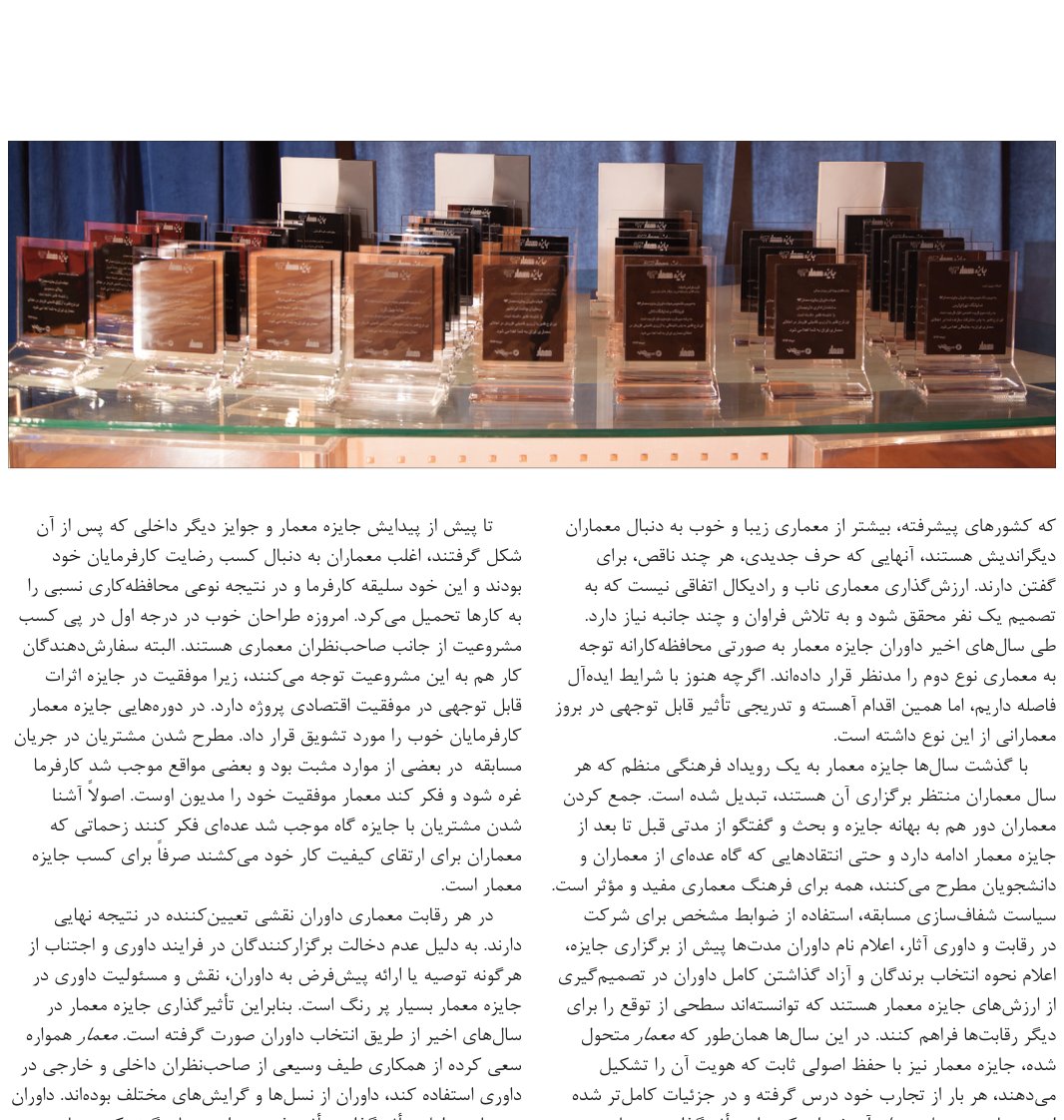
Advanced countries are more interested in architects who think differently than in merely beautiful and good architecture — those who have something new to say, however imperfect. Valuing pure and radical architecture is not something that can be realized by the decision of a single individual; it requires extensive and multifaceted effort. In recent years, the Memar Award jury has adopted a conservative approach in directing attention toward this second type of architecture. Although we are still far from ideal conditions, even this slow and gradual initiative has had a notable effect on the emergence of architects of this kind. Over the years, the Memar Award has become a regular cultural event that architects look forward to each year. The gathering of architects around the occasion of the award, and the discussions that continue from well before to long after the ceremony, and even the criticisms sometimes raised by architects and students — all of these are beneficial and effective for architectural culture. The policy of transparency in the competition, the use of specific criteria for participation and judging, the announcement of jurors' names long before the event, the disclosure of the selection process, and the complete freedom granted to jurors in their decision-making are among the values of the Memar Award that have established a standard of expectation for other competitions. Over these years, just as Memar magazine has evolved, the Memar Award too, while maintaining the fixed principles that constitute its identity, has learned from its own experience each time and become more refined in its details. The award and the magazine have learned that to be influential, one must be open to influence. One of the effects of the Memar Award — positive in one respect and negative in another — has been the gradual emergence of an award-oriented tendency among some of today's leading architects. Initially, architects were skeptical of the award. Some were reluctant to submit their work; others lacked a suitable method of presentation; they rarely employed professional photographers for their submissions, and the graphic design of competition sheets was generally not very compelling. Gradually, architects improved their presentation methods and simultaneously adapted their working methods to the competition's conditions. Today, some design their work to be photogenic, to offer good angles for photography, to make the process of arriving at the project's main form clear and illustrated, to emphasize the design process in their sheets rather than idealistic, utilitarian, or metaphorical intentions, to submit their work to the Memar Award on time, and to ensure that the program or location of the project engages the jurors' sympathies (addressing disadvantaged neighborhoods or areas, pursuing social themes, being unpretentious and so-called "low-tech"). Comparing the Memar Award with architectural design competitions led some to invest more in the Memar Award and other domestic and international architecture prizes than in competitions. The steadily growing attention to awards versus architectural competitions in recent years is noteworthy.
Before the advent of the Memar Award and other domestic awards that followed it, most architects sought the satisfaction of their clients, which itself imposed client taste and consequently a certain relative conservatism on the work. Today, good designers primarily seek legitimacy from architectural authorities. Clients too pay attention to this legitimacy, as success in the award has considerable effects on a project's economic success. In certain periods, the Memar Award encouraged good clients. The prominence of clients during the competition process was positive in some cases, but in others it caused clients to become conceited and think that the architect owed their success to them. In general, clients' familiarity with the award sometimes led some to think that the efforts architects make to improve the quality of their work are solely for the purpose of winning the Memar Award. In any architectural competition, the jurors play a decisive role in the final outcome. Due to the organizers' non-interference in the judging process and the avoidance of any recommendations or presuppositions offered to the jurors, the role and responsibility of judging in the Memar Award is particularly significant. Therefore, the Memar Award's influence in recent years has been exercised through the selection of jurors. Memar has always sought the collaboration of a wide range of domestic and international experts in the jury, and the jurors have been from different generations and tendencies. The jurors have simultaneously been agents of influence and influenced by the process. Just as architecture has evolved in recent years, jurors — even those from previous generations, or those who over these years have involuntarily shifted from the younger generation to the older — have revised their views in both judging and professional practice. The selection of winners by the jury is a relative matter and, like any opinion, is open to criticism. The validity of judging is not achieved through debating the jurors' opinions; rather, what matters is that the judging and the jurors' votes are transparent and each juror is obliged to take responsibility for their vote. The diversity of opinion in Memar's judging panels and the multiplicity of jurors have ensured that a relative balance has always been maintained in the process. Although scoring is entirely in the hands of the jurors and their preferences, they — always selected from among distinguished experts — have never voted for mediocre works, and in the author's view it has never happened that a distinguished work failed to reach the final round. Of course, it has occurred that due to the large number of entries, some works possessing valuable qualities and a level above the country's prevalent standard did not reach the winners' podium. For some time now, Memar magazine has acknowledged these worthy works that did not reach the final round through their publication and introduction to the public — which appears to be this award's most important attribute. In this issue as well, a selection of such works has been published so that they may be subjected to public judgment and their positive aspects recognized.
In post-revolutionary Iran, from the early 1990s, architectural competitions — and primarily design competitions — became widespread, and despite the abundant criticism from professionals regarding the methods of organizing and judging most competitions, designers and clients have embraced the institution of the competition increasingly with each passing day. The vast volume of construction carried out in these years without attention to architectural quality standards, and the refuge that leading architects sought in design competitions, awards, and the limited projects of particular clients, caused architecture to lean toward pragmatism, with theoretical aspects and architectural literature receiving less attention. Today, when even in architectural magazines the boundary between quantitative and qualitative work, commercial and artistic, is blurred and indistinct, good architectural criticism holds a special place. Unfortunately, in our country, criticism is a second-tier activity (or lower) compared to design. Stars, awards, and recognitions are directed solely at designers. Although no one denies the importance and influence of good criticism in advancing architecture, and all prominent designers today owe part of their success to the discovery of their talent and the positive critique of their work in newspapers, magazines, television, and radio, no institution has yet emerged to identify and promote good criticism. The judging of competitions, too — which plays a fateful role in shaping trends and guiding public taste toward superior architecture — is an activity of the same nature as architectural criticism. One of the reasons for the neglect of criticism and the emphasis on design stems from the superiority of visual messages over written concepts in the present age. This is a matter that, at least in Iran, has little historical precedent. In the past, Iranians valued written documents more than drawings. For this reason, illustrated books were extremely rare in old Iran. Today, the scant attention to criticism has caused, on the one hand, few to pursue this specialization, and on the other, no one — except for purely personal reasons — to worry about the quality of their critical and theoretical writings. Criticism, like design, requires ideas, creativity, and expertise, and good criticism, like good architecture, is a rare phenomenon. The profession of criticism does not meet the needs of those who have devoted their lives to it. The remuneration for criticism is such that if one chooses criticism as a profession, one will become impoverished. Thus, our critics are forced to devote only a small part of their lives to this work and earn their living by other means. If the benefits of criticism for the critic are negligible, the damages that can result from it are considerable. If appreciation for positive criticism ultimately amounts to a verbal thank-you, negative criticism on the other hand often brings very prolonged negative consequences for the writer. We who consider ourselves advocates of architectural culture should ask ourselves: what positive action have we taken so far to encourage, at least morally, good critical works? It is clear that architectural criticism pursues cultural motivations and for this reason requires cultural recognition and appreciation even more than design does.
A designer needs a good critic in many ways: for their talent to be recognized early in their professional career, for the value of their work to be identified, for the strengths and weaknesses of their work to be pointed out, for their work to be introduced to others, and to draw upon positive descriptive criticism when preparing explanatory texts for clients, competitions, and publications in books and magazines. The critic's work is to defend good architects and to counter their rivals, and in return for this highly responsible work they receive very meager moral and material reward. Good architects, too, are focused on promoting themselves, and their gratitude for good criticism and the moral support of critics amounts, in the best of circumstances (which do not occur often), to a word of thanks. In any case, given that creating an economic market for critics is beyond the capacity of architects, a form of cultural recognition of diligent and effective individuals is a professional and ethical necessity. The architectural critic does not seek individual thanks from anyone; rather, because their thinking about the profession is critical in nature, they need expert evaluation of their works and appreciation for them (provided they are indeed valuable) by a cultural institution. The critic, like the designer, in the atmosphere of competition and