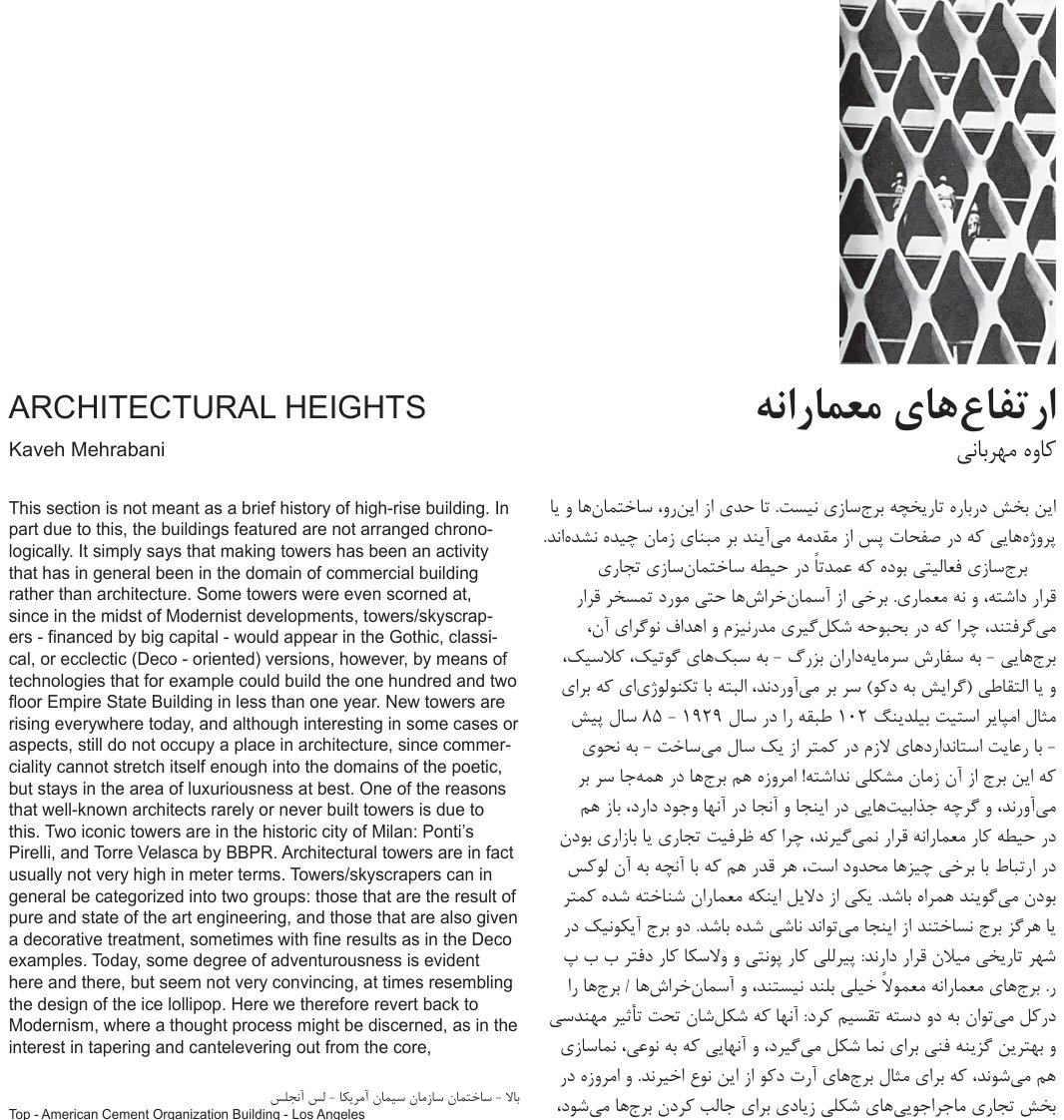
This section is not meant as a brief history of high-rise building. In part due to this, the buildings featured are not arranged chrono- logically. It simply says that making towers has been an activity that has in general been in the domain of commercial building rather than architecture. Some towers were even scorned at, since in the midst of Modernist developments, towers/skyscrap- ers - financed by big capital - would appear in the Gothic, classi- cal, or ecclectic (Deco - oriented) versions, however, by means of technologies that for example could build the one hundred and two floor Empire State Building in less than one year. New towers are rising everywhere today, and although interesting in some cases or aspects, still do not occupy a place in architecture, since commer- ciality cannot stretch itself enough into the domains of the poetic, but stays in the area of luxuriousness at best. One of the reasons that well-known architects rarely or never built towers is due to this. Two iconic towers are in the historic city of Milan: Ponti’s Pirelli, and Torre Velasca by BBPR. Architectural towers are in fact usually not very high in meter terms. Towers/skyscrapers can in general be categorized into two groups: those that are the result of pure and state of the art engineering, and those that are also given a decorative treatment, sometimes with fine results as in the Deco examples. Today, some degree of adventurousness is evident here and there, but seem not very convincing, at times resembling the design of the ice lollipop. Here we therefore revert back to Modernism, where a thought process might be discerned, as in the interest in tapering and cantelevering out from the core,
Top - American Cement Organization Building - Los Angeles
Left - Wall lamp by Arteluce, Milan, 1950 - An elegant vertical composition that can be not only a wall lamp.
which had interested Wright, Utzon, and Mangiarotti. Architecture was not involved in the design of skyscrapers at all, and high-rise buildings were in general the result of pure engi- neering, such as the optimum structure, safety, a reliable envelope and the like. Of course not only is nothing wrong with this solely engineering characteristic, but is often preferable to decorated tow- ers. However, here the assertion is that high-rise buildings should be rarely brought into the discussion on architecture just because of their considerable sizes and costs as buildings. Although the most notable architects were not directly involved in high-rises on the whole, emphasis on the vertical dimension has in some cases been primary, even when the actual size was not very much, and there have been a number of notable high-rises as presented here. Still, the input of quality architecture has not been so great even in low-rise buildings, which leaves us with the question of the meagre influence of architecture on the built environment as a whole. As featured in a number of cases here, architectural towers usually have more complex and interesting plans than the usually square or rectangular ones plans used in towers..
D. Stone, art gallery (project), New York, 1957 - A pergo- rated first layer of the building envelope as a solution
First International Building, Dallas - the simplest form, clad in an advanced form of curtain walling that presents nearly even surfaces can be considered as an elegant solution.
The Times Building, New York, 1903 - This iconic tower’s impact seems to be greatly due to its site configuration that generated the narrow corner. However, the heavy ornamentations seem to work with the slim mass.
Ponti, tall version lamp for Fontana Arte, 1967 - resembling the Pirelli tower in form.
Mackintosh bedroom chair for Hill House, 1902 - unusual high back of a chair for a purely visual reason.
،جوزف البرس، تمرين برش كاغذ در باهاس 1927 Joseph Albers, Bauhaus cutting exercise, 1927
Right - Theo van Doesburg, Rythm of a Russian Dance, 1918 - a verti- cal composition.
Rodchenko, kiosk, 1919 - In spite of the small height of this structure and being just a kiosk, there is tremendous energy expressed vertically. Something which is com- pletely absent in many very tall structures.
Pagano, interior of the aeronautics exhibition space, Milan, 1934 - a form spiralling vertically.
Pica, exhibition of flight in Italian art, Rome, 1939 1939 ،پيكا، نمايشگاه پرواز در هنر ايتاليا، رم



