



The article below presents the impressions of the late English architect James Stirling on the Second International Congress of Architecture of Iran, held at Persepolis in 1353 SH (1974 CE). On a careful reading, one understands why this text — despite Stirling's renown and importance in world architecture — was not picked up by the architecture circles of Iran at that time.
Twenty-seven years have now passed since the holding of that congress. The substance of Stirling's article — for all its barbs and slights, from the title (originally the name of the sporting events held at the opening of the Aryamehr/Azadi Stadium) through to the denials and double-edged compliments of the text — paints a clear picture of the back-room affairs of the congress, and from that point of view it can be instructive for the present generation of architects.
Out of respect for the standing of Mr James Stirling, and on account of the candour present in much of his text, we do not doubt his keen observations and the points he picks up. Yet, although we are now out of his reach and he out of ours, the question still stands: had his name appeared on the list of those who took something from the congress, would his judgement still have run the same way…?
It must also be said: bravo to the mosques and bazaars and squares and bridges and palaces and the matchless faces of Isfahan, that they could leave even a stern figure like Mr Stirling speechless!
The Second International Congress of Architecture of Iran was held at the end of September 1974, hosted by the government of Iran, at Persepolis. The architects invited were: Fuller, Sert, Soltan, Soleri, Rapson, Blake and Ungers from the United States; Tange, Maki and Kikutake from Japan; Bakema and van Eyck from the Netherlands; Safdie and Erickson from Canada; Doshi and Sabikhi from India; Zevi, Quaroni and Benevolo from Italy; Schelhase and Hahn from Germany; Candilis and Auzelle from France; Fathy from Egypt; Hollein from Austria; Candela from Spain; Yusinov from Russia; Schnebli from Switzerland; Cresswell and Stirling from England.
The invitation of Mrs Kahn — special guest, whose late husband had made a heroic showing at the first congress — was a happy gesture. The congress's theme was “The Role of Architecture and Urbanism in Industrialised Countries,” with the following sub-headings:
- Continuity and Change
- Natural Climate and the Man-made Environment
- Optimal Housing
- Materials and the Modes of Expression Arising from Them
The venue was a grand hotel1, air-conditioned, originally built for the guests of the 2,500-year celebrations (1971) on the plain of Marvdasht, and at a distance — probably with the intent that the visiting superstars should feel themselves in some sort of trap, since there was nowhere to escape (after all, getting away from the conference colleagues was sometimes a necessity). Even so, the Iranian food at the hotel was without parallel in quality.
Since many of the guests, while attending the congress, set off to see the great works of Iranian architecture, they were taken to Isfahan; better still would have been to hold this congress, like the first (1970), in that very city.
We had hoped to be able to tell the Iranians what mistakes we have made in the West over the past thirty years, and what untainted things they should attempt to do over the next thirty. Yet our hosts never made it clear to us where, in their view, we had gone astray. As a result, the doubt arose in us that perhaps, in this age of neon lights, skyscrapers, motorways, traffic jams and the unpleasant smell of petrol, they too did not really wish to lose any of these things. The city of Tehran is, even now, a mirror of the worst that Los Angeles has to offer, with the additional bonus of the worst driving I have ever seen. If the same conditions hold in Isfahan and Shiraz too, then alas. Tehran, with the abundant presence of free-spending Western travellers and 100% bookings of all the hotels and aircraft seats, has been turned into a new gold mine.
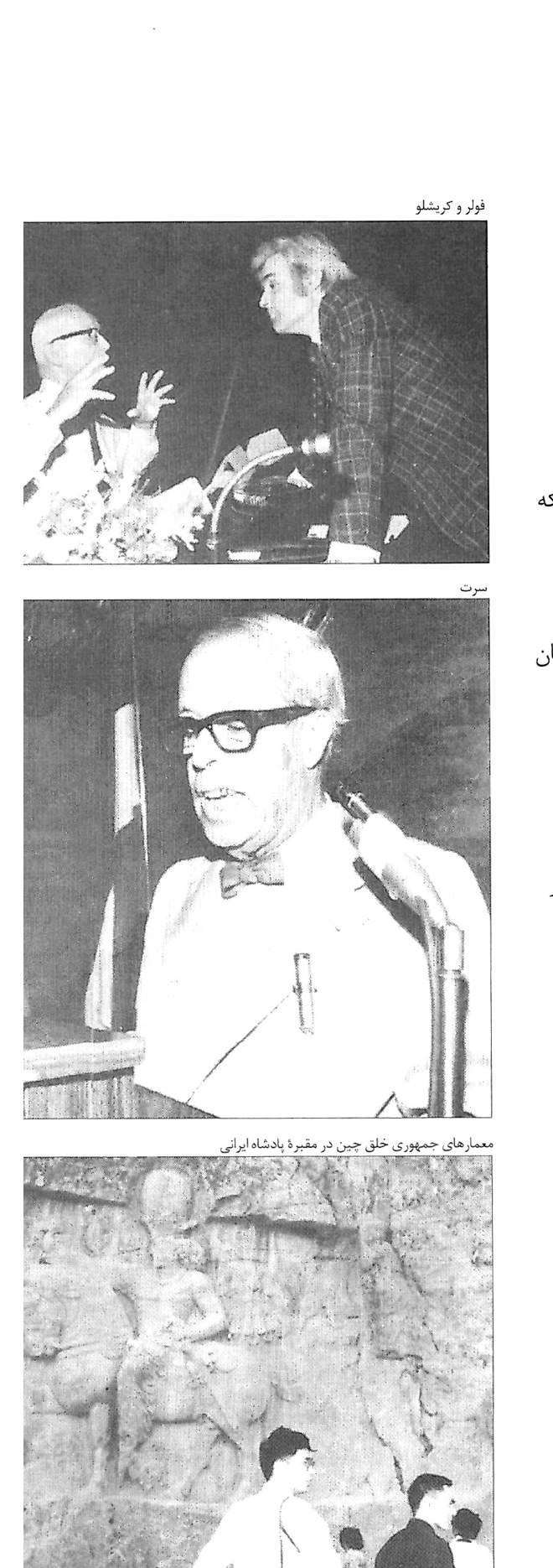
The presence of more than forty architectural superstars seemed excessive both for the smooth running of the congress and for any real influence. Some spent up to two hours reading the pre-distributed papers — papers that scrambled the last two days of the congress. And since the speeches were limited to twenty minutes, none of the participants knew whether, in the rain of remarks from the talkative competition, they would have a chance to speak at all.
It was strange that forty architects should be gathered together and the only subject of debate be social questions. (One must ask: of all this number, how many were occupied with their professional speciality, namely building?) Unhappily, the attention paid to questions of design seemed even less. The old men of group X — about appointments, repeated meetings and mud villages (probably the only subject the Iranian architects and urbanists had no inclination to hear about) — what whispers and pronouncements they put forth! Watching hundreds of slides of the “old and new” of “old and new” adobe villages, and looking at Hollein's very skilful photographs, was as relaxing as ever (and so were the strange contrivances of his wife). At night, Fuller and Soleri were the chief runners on the field, since one could catch them both shuttling between the dining hall and the hotel bar — the scene of the Arabic-dance performance.
I was greatly surprised by the manner in which many of the superstars, in the company of well-pressed embassy staff, were obsequiously presented in various cities to high-level officials and signed contracts. The Canadians (Safdie and Erickson) in particular were passed from hand to hand like fragile bargain pieces. In the end I too came face to face with a member of the British embassy — by chance, at one of those evening receptions which our ever-generous Iranian hosts laid on.
Conversation in an Iranian garden2:
Erickson: Allow me to introduce you to the English architect James Stirling.
British embassy member: (taking the pipe from his mouth) I had no idea that any English architects had come to the congress. (Turning to me) I'm sorry, I don't know your name.
James Stirling: No matter. What about Basil Spence? You must have heard of him.
Embassy member: No, I'm sorry, nothing comes to mind.
James Stirling: Edwin Lutyens? Christopher Wren?
Embassy member: Oh, no. Well… I don't know… you seem to be teasing me.
If you still hold to that old conviction — that an architect is a builder of buildings — go to Iran. The country's construction programmes are immense, and the general belief in the air of the congress was that some of the participants would be given commissions. We placed bets on which of the new arrivals at this congress would have the better chance from this point of view. Everyone rated Sert's, Erickson's and Safdie's chances above the others. Many of the participants of the first congress — Kahn, Tange, Rudolph and others — had already taken their share. Which of these figures was really an important person could be told from the number of days he stayed at the congress.
The mosques and bazaars, the squares and bridges, the palaces — indeed, all the faces of Isfahan — are dazzling; and our two-day stop in this city on the way back was worth enduring the boredom of the congress. Iranians are a calm, kind people; we can only wish them safety through the consumption-laden years ahead.
Notes:
1. The Daryush Hotel, which since the victory of the Revolution is reported to have changed function.
2. Setting aside Mr Stirling's irony and double-edged barbs, we now stand at the close of this thirty-year period, and an inclusive, comparative look at our own work is in order.
3. The Afifabad Garden in Shiraz and the kushak it contains, which is now a museum.