


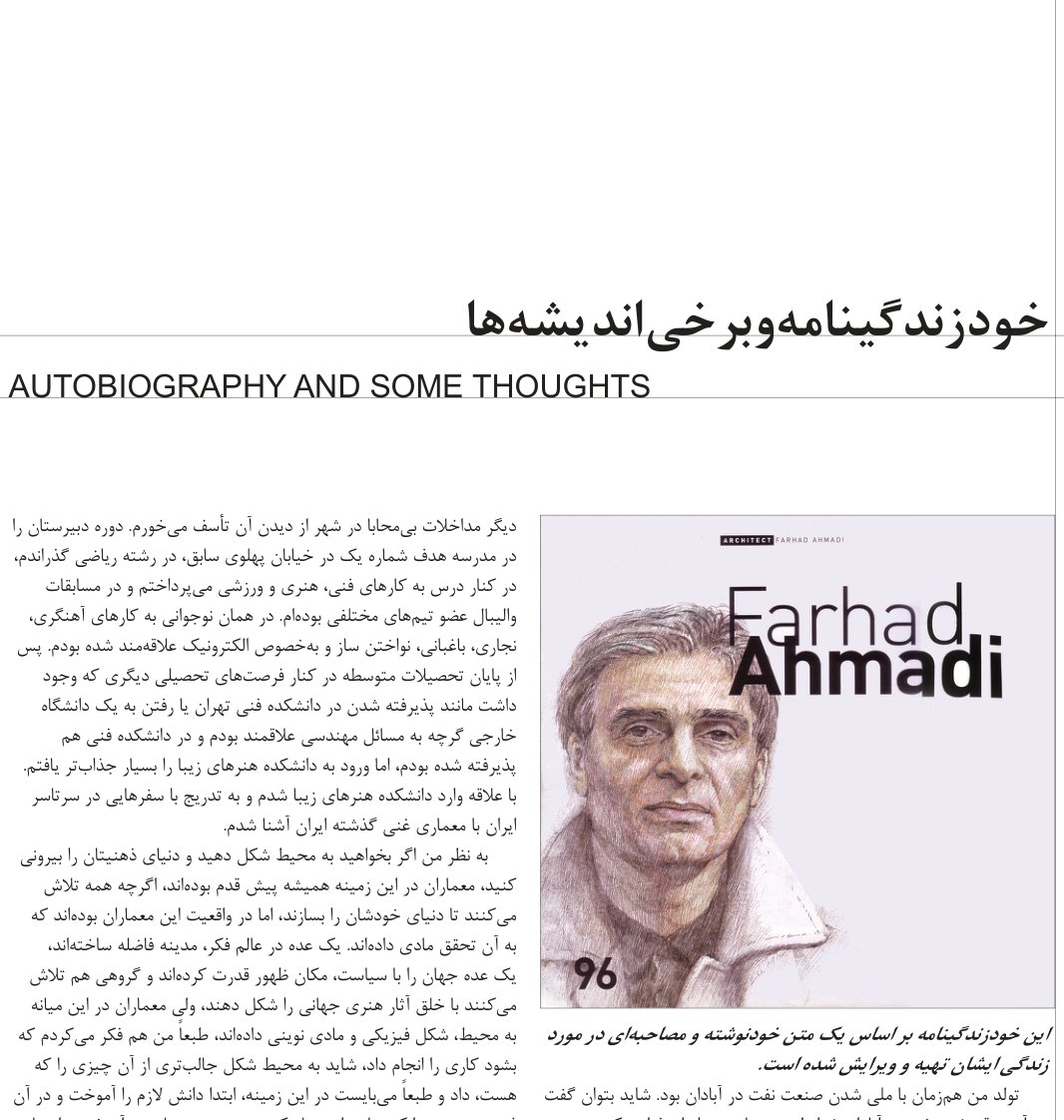
This autobiography was prepared and edited on the basis of a self-written text and an interview about the author's life. My birth coincided with the nationalization of the oil industry in Abadan. One might say that at that moment the oil city of Abadan offered conditions unique in Iran: it attracted reform-minded modernists, the petroleum university provided forward-looking educational opportunities, and the city itself offered a modest but genuine prosperity alongside the possibility of modern activity. Intellectual, artistic, political, and social events, as well as professional opportunities, were among the city's attractions. It was for these reasons that my family — Tehranis who had lived in the city for several generations — relocated to Abadan, and my birth certificate was accordingly issued there. I spent my childhood in a villa-style house in the manner of Abadan's brick institutional homes, where I had been born, then grew up in the north of Tehran. Perhaps the only trace of tradition in the house was carpets with Tabriz brick-pattern, Qom geometric designs, and Kerman boteh motifs — designs that occupied my mind and left a deep impression on me. I grew up in an environment that belonged to the modern segment of society: seeing photography books of semi-dark spaces and works of 1950s architecture, alongside images of nature, classical music, and painting books such as the Impressionists, had shaped my mind. I attended Ferdowsi Elementary School on Takht-e Jamshid Street in Tehran — a building constructed in the Art Deco style of the Reza Shah era — which unfortunately, after the revolution, suffered severe damage to its facade due to multiple construction projects on its spacious grounds. Every time I pass it now I feel sorrow, as I do for other reckless interventions in the city. I spent my high school years at Target School No. 1 on former Pahlavi Street, studying mathematics; alongside my studies I engaged in technical, artistic, and athletic activities, and was a member of various volleyball teams. Even as an adolescent I had developed a passion for metalworking, carpentry, gardening, playing music, and especially electronics. After completing my secondary education, alongside other academic opportunities that existed — such as acceptance to the Faculty of Technical Sciences in Tehran or going abroad to a foreign university — although I was interested in engineering and had been accepted to the technical faculty, I found entry into the Faculty of Fine Arts far more appealing. I entered the Faculty of Fine Arts with great enthusiasm and gradually became acquainted with the rich architecture of Iran's past through travels across the country. It seemed to me that if you wished to give form to the environment and bring the world of your mind into physical reality, architects had always been in the vanguard of this endeavor: though all people try to build their own world, in reality it has been architects who have given it material expression. Some have constructed utopias in the realm of thought, some have made the world a theater of power through politics, and others try to give form to the world through artistic creation — but architects, in the midst of all this, have given the environment a new physical and material form. Naturally I also thought it might be possible to do something, perhaps to give the environment a more interesting form than what already existed; and naturally one first had to learn the necessary knowledge in this field, gain understanding and mastery, and then act — continuing to learn throughout the process of action. For this reason I chose the Faculty of Fine Arts and the field of architecture. In the 1970s, Hi-Tech was at the vanguard of progressive world architecture. I too — for reasons of my own technical interests — was often pursuing designs that, with considerable distance from the prevailing educational current, followed a technical perspective. The centrality of technology in architecture was a matter of great importance to me during this period. Three-dimensional, tensile, pneumatic, and dynamic structures formed the basis of my designs; and in order to ensure the work did not remain purely illustrative, and despite the absence of much information that is now accessible to all, I sought out factories and importers of technical components and produced highly detailed and complex but executable designs — rigid or flexible panels that, with hydraulic jacks and pneumatic pumps, could be positioned in their final configuration, creating a distinct spatial quality. The role of imagination and architectural design within every part of a megastructure — whose imaginary form was offered by Yona Friedman and whose practical solutions were provided by Kenzo Tange — had a profound influence on me. They presented a new conception of habitation, the like of which we have not yet seen. In my designs I strove intensely to capture the essential nature of objects and materials and represent it in my drawings. From Jackson Pollock's work, or the kind of abstraction present in Mondrian's paintings, I drew ideas; and the rhythmic music of jazz and blues, and Rachmaninoff, Mahler, and Schoenberg's atonals, and Pierre Boulez's electroacoustic music created a complex mental space for me, even as I also followed the music of peoples and Iranian folk melodies.
The question of looking at intrinsic urban regeneration — superimposing a megastructure and linking it to the urban fabric, densifying urban axes in place of occupying interstitial spaces, and reserving urban interior spaces for the development of the city's natural sections — was an engaging subject for my final thesis, and since I was pursuing the regeneration of an active urban axis in Tehran, it was necessary to subject all macro-level decision-making in the country — within the spatial planning frameworks related to settlement and production systems — to study and critique. During my years at the faculty I encountered instructors such as Mirfendereski, Bavar, Diba, and Ardalan. From my second year I did an apprenticeship at Kourosh Farzami's office, and from my fourth year became chief draftsman at Moayyed Ahd's studio. Although — like any young person of any era — I was seeking new approaches, as I gradually entered the world of professional practice I learned more and more from Iranian architects: the works of Siahoun, Farzami, Kalantari, Ardalan, and Diba were instructive to me. I must mention here my father's constructive influence throughout his short life on my work: he not only endeavored to build our family's residential and summer houses but gave urban form to the neighborhood and sought public participation. After his retirement he built a major portion of the Sarakhs oil refinery and then a large residential complex in the north, and despite repeated strokes he did not stop working until his last moment. While I was still a student, in 1971, my family asked me to design a summer house in Darband. This land — of very irregular shape, elevated and facing the Darband River, separated from the neighbors by a water channel — had a view of the river that was somewhat restricted at the start of the lot by the adjacent single-story building; moreover, because of the proximity of Sa'dabad Palace, a permit for more than two stories was not possible at the time. Along the length of the lot I designed two villas that slid over each other, with skylights resembling wind catchers. The first villa had a limited view but compensated with a tall interior space, achieved through two mezzanine levels I incorporated within it; the other villa — with an open view, designed on one-and-a-half levels — had terraces facing in two directions on the roof. The villas had sloping roofs and facades of white cement, and the outer layer of their double-paned windows was of wood. The masonry materials and human-scale spaces gave them a distinctive character; the staircase in these two villas played a special role. Wall fireplaces and central heating — at the time unseen in Darband's summer residences — made these villas usable even in the snowiest winters. During my military service, after a long and arduous training period, I was assigned to the Army Engineering Corps, and in the military housing settlements I was responsible for designing, I pursued the same ideas. With the advent of the revolution and the halt of developmental projects and construction across the country, unlike the many friends and relatives who emigrated, I remained in Iran — hoping perhaps to make some small contribution to the country's growth and development. Since there was not much work, I turned to experimental pursuits. I had many discussions with Engineer Khalili, who was exploring rammed-earth construction. I was seeking to make large, unified ceramic modules that could be joined to create space: in repeated experiments, I managed to produce surfaces 10 by 100 by 200 centimeters thick, and conceived the idea of building a factory to produce these components — to this end I read many books on ceramics and their production and visited many factories, examining their machinery. I even obtained preliminary approval for building the factory, but the project was halted due to the wartime conditions of those years, and as a result I gradually became more aware of the realities of society and its limitations. After the revolution, with friends and colleagues I rushed to assist the earthquake victims in Khorasan; with the help of donors, and with construction equipment lent by the Army Engineering Corps, I created temporary shelter for two villages. I then joined the Reconstruction Jihad and rushed to assist villagers — helping them harvest crops and providing them with bath facilities and drinking water. After completing several projects in villages around Tehran, Shahid Beheshti University invited me to participate in a revision of its curriculum, and then I was asked to go to the university to teach. Initially I taught technical courses and design, and then for fifteen years took on responsibility for design in historic urban fabric. War broke out, and in the years 1981–1984 I found a responsibility in the reconstruction of war-ravaged areas. It was there that in devastated villages, with the help of the people, we established new residential settlements with simple, principled, and hygienic designs, a number of which were built on the Azadegan plain. The livelihood of these communities was mostly animal husbandry and agriculture. In the villages I designed, I sought to separate the spaces for keeping livestock from the spaces of human habitation, and I organized the routes of livestock herds and their pens adjacent to but separate from human traffic routes, in order to create more hygienic conditions. Lanes in the village led to a central square around which service facilities, a market, school, and clinic were designed — thereby creating settlements that could serve as the nucleus of future towns and the seedbed of developmental catalysts.
While still working in the war zones, in 1984 the question of Iran's participation in the World Expo in Japan was raised, and through Dr. Hadi Nadimi, then dean of the Faculty of Architecture, I was given responsibility for designing the pavilion within the framework of the faculty's technical office. For this project, a covered hall in the form of a rectangular cuboid of approximately 1,000 square meters and a space of approximately 200 square meters as a terrace facing it was allotted to the Iranian pavilion. Dr. Nadimi decided that the design should take the form of two intersecting bazaars, and at the crossroads — the chahar-suq — a skylight would be placed, and accordingly a skylight opening was also planned in the roof structure. I preserved the position of the roof skylight at the center of the design, and beneath it placed a muqarnas medallion in the form of a shamseh covering a domed chamber. For the design of this shamseh, I drew inspiration from one of the famous vaulted ceilings of the Jami Mosque of Isfahan. Beneath it was placed a reflective pool — this time made of mirror — that reflected the light. To me, this space was like a temple of Anahita — the most spiritually significant element in Iran's semi-arid landscape. Since images from the sacred book were to be displayed in this space, I created screens in the form of back-projection in eight facets around the perimeter of the dome chamber's walls, and between them eight vertical slits — seven of which, while circumambulating the chamber, permitted views inward; and the eighth, an enlarged slit, permitted entry into the space through an entrance threshold or hashtii. In the design, after passing through a garden pattern on the floor, one entered an entrance vestibule; passing through several arches, one would go past something resembling the outer antechamber of traditional bathhouses — which served as a tea house — and then through the threshold space to reach the main sanctuary. The space in fact traced a journey from the relationship and intervention in nature to provide favorable conditions for habitation, culminating in the elevation of interior perception. In this project, by simplifying dozens of types of vaulted units connected by framing — with vault elements of lozenge, paw-shaped, and lily forms as self-supporting three-dimensional elements — arches were formed whose joining created a unified roof. Preparing three-dimensional technical drawings for these was an immense challenge given that at the time neither computers nor three-dimensional drawing software were available. Obtaining the numerical coordinates of these geometric forms in space required writing trigonometric equations with precision to at least ten decimal places and repeated multiplication and division operations, making the work very difficult. Furthermore, since a hemisphere could only be achieved by joining dozens of pieces, the smallest dimensional error — in either calculation or execution — would prevent the dome from closing; though fortunately the Japanese contractor was able to execute them with precision. For this design, several layers of documents were prepared for the structure, skins, partitions, floors, walls, and lighting; and the conceptual two- and three-dimensional designs were produced by artist colleagues and calligraphers Parviz Kalantari, Farshid Mosaqqali, Bijan Sharifi Tehrani, and Hamid Nadimi and incorporated into the work. The pavilion stall designs were prepared drawing on simplified and modernized historical elements and spatial arrangements. For this project we worked for at least six months in Tehran and Japan; although collaboration with the Japanese counterpart provided an opportunity to see at close hand the works of Japan's leading contemporary architects, in reality I was obliged to work through the problems and issues single-handedly — the equivalent of ten Japanese counterparts — while Tehran was being bombed. I therefore returned to Tehran immediately upon completing the work.
Drawing on the experience I had gained in the war zones of Khuzestan — knowing its social and natural fabric quite well, and especially its architecture — I became engaged with a new project. Fakhruddin Anvar, the cinema deputy of the Ministry of Culture, and Mohammad Beheshti, head of the Farabi Foundation, were thinking in the early 1980s about developing affordable cinemas. In my view cinema suffered more from cultural than from economic difficulties; I therefore proposed that the problem be approached in the framework of a cultural center. And since the Ministry of Culture had budget allocations under this name for other projects that also included administrative centers, these complexes were named cinema-cultural centers, and cinema education was also to be pursued within them. In terms of program, three sizes were envisioned — small, medium, and large — proportional to the population and importance of cities. Although the projects had no approved budget line, through the relationships these friends had with other officials, land and budget were made available to us through Mr. Anvar. In 1986, they asked me to build the first project in Dezful, in recognition of that city's remarkable resistance during the war and the persistent enthusiasm of its youth cinema association. For this project, a site in the park facing the Vahdati Air Base in the city's future development zone was designated. The park's design consisted of an elongated central axis and two sections subdivided by octagonal and square forms, with one octagonal and one square plot designated for the building and another for the surroundings. Dezful's architecture — shaped in harmony with its natural setting — has particular characteristics: the use of earthen materials, especially brick; sinking into the ground by creating basements and shavadan (sunken courtyards); using rooftops and creating terraces for nighttime use; creating lattice walls in the form of pigeon holes along the walls' upper edges to allow air circulation; and in the spatial organization of complexes, using a central courtyard and a dual-axis spatial disposition with spaces placed at ground, basement, and elevated levels. All of these were devices I borrowed from Dezful's architecture for this design. One of the problems I pursued in this design was the use of geometric patterns in spatial organization. I performed various studies on the octagonal ground and its adjacent squares. In fact, the geometric forms that were in the context led me to select the desired geometry; the plan, and then the interior spaces and volumes, were shaped under the influence of that geometry — an approach that was also pursued in the structural framework or architectural decorations, in order to demonstrate a symbolic unity. The major portion of the building was formed underground, and only the projection of the roofs and some functions were placed at ground level — in such a manner that the building had neither front nor back. The roof became part of the landscaping, gradually rising from ground level to roof level. The spatial narrative of this building relies on a type of movement that runs continuously from the point of entry through to the interior of the functional "grains." Visitors enter through the main circular gate into a square courtyard with a reflecting pool at its center and seating platforms at its four corners. On the entry axis, the main hall ceiling — in the form of a stepped octagon — is framed; and in a spiraling descending movement, users pass first through seven bays of a bazaar, then with a turn around the axis of a minaret, reach the prayer hall and restaurant, and then, passing through an entrance door fashioned like the gilded borders of miniature painting frames, they reach, on one side, the upper floor housing the cinema education section arranged around a central courtyard, and on the other side, descending a helical ramp with a waterfall above it, into the underground. Water flows among stones, creating water-covered stepping stones through which visitors pass in symbolic ablution before entering an octagonal courtyard with the main reflecting pool at its center.
From the outside the building resembles a miniature walled city that can be penetrated through its gate, ascended via its battlements — battlements that resemble the sleeping porches of Dezful houses. Along the path of movement are placed functional spaces and various urban grains — bazaar, prayer hall, minaret, passages, turrets, tea house, school, workshops, central square, and finally galleries and theaters — from which, after exiting, one can re-enter the entrance courtyard through another route and exit through its gate. Above the galleries is a tall and elongated space with rooftop wind catchers that generate a powerful vertical draw inside the space. In the building's walls and surroundings are the axes of water, garden, a soldiers' ablution area, reflecting pools, and promenade routes. Alongside these characteristics, a veiled philosophical dimension or conceptual perspective is present within the form of the spatial organization — expressed through geometric elements and forms. The use of a square courtyard with the four cardinal directions — symbolizing the earthly world — continues with a spiral movement toward an octagonal courtyard that has no directional orientation and symbolizes paradise or heaven: this is in truth the fundamental basis of the building's formation. The twist in the path of main movement suggests an experience of torsion on a small scale, tangible and palpable; and the passing through water evokes a ritual of ablution or immersion as symbolic preparation for entering a sacred space. The role of the shamseh medallion on the floor and the placement of the reflecting pool at the center of the octagonal courtyard refer to a water temple, while the eye, turning upward toward the sky, perceives the rhythmic expansion of the walls' surfaces — at whose ends four wind catchers with their rotating and soaring square coverings pull the eye beyond the sky. These four elements had archetypal significance, symbolizing the four pillars of the universe, the four elements, and all that pertains to such forms. Slits in the walls in the form of the Mithraic cross, along with borders of golden, turquoise, and lapis-lazuli tiles, are symbols of light, sky, water, and earth — visible at first glance. Materials in this design were chosen from two perspectives: on one hand, the materials forming the building's structure — a combination of steel and concrete — are visible and exposed in the interior spaces. The concrete, particularly in the halls' large-span ceilings, was prefabricated on site under limited conditions, combined with steel beams and trusses to erect the building. The building was constructed in the ground's depth, with monolithic concrete retaining walls forming a unified vessel. On the other hand, the exterior walls and roofs are covered in brick, with turquoise, lapis-lazuli, and golden tile patterns in combination with brick texture visible on the borders of windows and niches, around the muqarnas vaults, on the turret skylights, and on the minaret. The building's sinking into the ground and the use of earthen materials give it a human scale and accessibility. Floors are covered with hand-hewn limestone in white, red, and gray, as well as combinations of brick and pebble found on site; the reflecting pools are built of thick single-piece hand-hewn white stones. Mechanical air conditioning in the warm seasons provides suitable conditions in the interior. The use of wooden elements — employing the same external geometric forms in the hall ceilings — creates a unified identity for the building. This building, after being reviewed by invited guests from around the world who had come to see Iran's reconstruction activities, was selected by the Norwegian jury as the chosen design from Asia for the Norwegian Biennial — exhibited not only in Rorros but also in Trondheim and Bergen; through it, Iranian architecture was also introduced. This introduction — at a time when negative propaganda against Iran was at its height — was also seen as a form of constructive communication.
After the war, with the emergence of the discourse of reconstruction, an enormous volume of interventions in the country's territorial environment began, and the goal or strategy of politicians was less the creation of a pleasant living environment for the people than the activation of the economy and commerce. Design, architecture, and above all urban planning were reduced to construction, and building-making became more of a speculative enterprise than an idealistic endeavor — something that might have led a designer toward improving the environment. Perhaps due to historical habits, perhaps due to inadequate social education, or perhaps due to the unaccounted revenues of oil, our pockets grew fatter than our minds, and we did not know what to do with money — which is in truth an instrument of power and can generate change and transformation in society in any form desired. In the past forty years, the thinking of speculation and wealth accumulation has grown so dominant that everything is overshadowed by it, and the ideals of environment-makers have been relegated to the shadows. The construction boom — and in its wake, phenomena such as signature-selling — may have been among the reasons architecture became popular among young people and their families, and in response to this demand, architecture schools such as the Free University, non-profit universities, and various institutes also entered architectural education — education that naturally also became a one-dimensional commercial enterprise, substantially reducing the quality of instruction and awareness in the architectural profession. This matter, alongside factors such as professional publications that appeared in large numbers during this period, gave shape to architecture in the post-reconstruction era. Profit-minded thinking — the notion that one can make a living this way — transformed the architectural profession into a speculative trade. The maximum aspiration of the time was for us to have architects of good taste — architects who make good selections, and through these selections produce appealing works that presumably have an impact on society. But that we paid equally little attention to the question of the city, the environment, and citizens' rights is entirely clear. The reality is that the matter of architecture, engagement with the environment, and the solution of major challenges cannot be resolved through good taste alone. Architecture is not an abstract category that comes into being or resolves its own problems in isolation. If architecture is placed in a mutual relationship — simple, unadorned, logical, and responsive to conditions of comfort — it gives meaning to the city. The word maskan [dwelling, in Persian] means a place of tranquility; yet through disproportionate interventions, conditions have been created in the environment where this tranquility has been transformed into tension and destruction. We have expanded our cities, but we have not thought about how to interconnect their valuable grains. We continued the same horse-and-carriage communication system in its automotive form, and while these days we have learned to dress it up and record some achievements — double-deck highways, wide and sprawling flyovers — the fact that we are recklessly working to destroy our environment is entirely clear and evident.
From right to left: Nayer Tahoori, Darab Diba, Dana Ahmadi, Farhad Ahmadi.
In this non-expert development without regard for its consequences, during the reconstruction period permits were issued for speculative interventions, and this multiplied exponentially — green lands became the targets of this assault. The conversion of the first gardens into massive construction drew others into this race for wealth accumulation, and as a result all the important and necessary green spaces and gardens of cities like Tehran became targets for this sweeping construction, to the point where the city was transformed into an enormous construction site with all its harmful pollutants, and the resulting necessity of access to this volume of construction multiplied the number and frequency of vehicles — in turn transforming the city into a parking lot, a fog of traffic, and an environment of pollution in which everything could be found except tranquility. Following this path of development, parts of the country became intensely wealthy and parts intensely poor, creating a severe class divide with serious social tensions — disillusionment, addiction, and rebellion as its consequences. All these challenges were shaped by the lack of a correct vision for habitation in this country, and intensified especially in these past four decades. These problems began before the revolution, subsided somewhat during the war, then resumed with force after reconstruction. It seems that in the past there was more wisdom — at least a comprehensive urban master plan governed the city. During those same years of reconstruction, a municipality official came to Tehran — having previously been governor of Isfahan — and decided at once to set aside the master plan and reshape the city according to his personal preferences. This expert-free decision did not produce a replacement plan; no alternative plan went to parliament for approval. The result was that this precedent and its continuation by subsequent municipal officials not only destroyed the capital but led to the annihilation of all of Iran's cities and even its villages. During this period I was pursuing, at Shahid Beheshti University, the discourse of anti-architecture — arguing that it was better to set aside conventional architectural methods and, in the existing conditions, do as little as possible, which was far more honorable. By practicing this kind of architecture we were feeding the existing chaos; and if we were going to do anything, it should at least have no environmental impact, or no perceptible environmental trace. In most of my designs I have tried to ensure that the architecture and designed space are not too conspicuous — that the architecture dissolves into its context as much as possible; and indeed, the best state, in my view, was not to intervene in the environment at all. We pursue policies of population growth without understanding their consequences; this increased population must live in this country and needs water and food. Now, if it has no work, if it does not produce, if it lives off oil revenues, the current unsustainable conditions will persist and even intensify. Today I feel deeply that we are threatened by various dangers — something that specialists and intellectuals have been discussing for a long time, and I have continuously engaged with these matters in debate.
I have been speaking about sustainability for approximately twenty years — that is, from around 2001. Despite the inclination and planning done at the faculty and the enthusiasm of students, I introduced the sustainability perspective into master's thesis designs and final design projects, and seriously developed a context-sensitive orientation in education. At the time, colleagues at Shahid Beheshti University were asking: what does sustainability mean? We teach climatic design and that is enough. I said: sustainability is a more comprehensive concept, related to how peoples can live a balanced and continuous existence on a land. But colleagues confined themselves to technique. In the sustainability perspective, one argument concerns how insulation, shading elements, or double-pane windows in buildings should be designed and installed — this is the technical and simple dimension of the question, also pursued in universities under the heading of climatic design. But behind the discourse of sustainability there are newer forms of thinking — in the green philosophical perspective it even takes on an ethical dimension. In certain respects, sustainability is a product of the intelligent perspective of capitalism, which can adapt itself to different conditions; and since capitalism views everything as a commodity, the emphasis on being sustainable and green is transformed into new products competing with previous productions, to display itself as progressive. This too pursues a speculative mode of thinking: if, for example, all windows are made double-pane, this creates work for some people and a measure of wealth for others. Thus all these matters are intertwined with a profit-oriented perspective, although it may also have positive environmental effects. Capitalism has the motivation to create transformation and development — but it destroys more than it transforms, and it promotes consumption, which is an anti-ecological matter. In any case, profit is capitalism's essential concern.
Over these thirty-odd years perhaps only a small number of my projects have been built, some of which also took many years to construct. But architecture no longer matters so much to me, because I believe that today we are facing crises of a different kind that must occupy us and for which we must find solutions. In the journal Memar and the journal Farhang va Memari [Culture and Architecture], I have opened discussions on these matters. Imitating a current approach in architecture that, in the market of certain neoliberal societies, goes by the name of avant-gardism, plays no role in resolving the current crisis of our inhabited environment. And we need say nothing about the fact that the orientations taught in universities do not educate students to question how this country is being developed — so that these young people might try to understand at what price and by what methods these important problems can be resolved. But we feel pride that we have educated architects capable of designing complex formal compositions, when the question should properly be: how can something be created that endures in the history of this land? When a work of architecture comes into being, it is not like a commodity that can be discarded after some time. Of course, this planned obsolescence is itself one of the consequences of modernity. We have invested trillions in our cities for buildings that often would have been better had they not existed at all — and it must be noted that the opportunity for such investment is not repeatable. When I am given an opportunity to design, I try to pursue a minimal expression; one must exercise some restraint. In my view, green thinking goes even beyond the question of sustainability and is a new conviction that can, to a very large degree, be considered an ethical matter. Not being greedy, thinking of future generations, spending the revenues from oil — an exhaustible resource — on current expenses instead of long-term investments is, in truth, a threat to social justice. With these policies, some have become wealthy and many more are below the poverty line; we have disrupted the environment, created drought, and generated population growth disproportionate to the carrying capacity of the land. If we wish to think about these matters, we need an ethical vision rooted in foresight — a vision necessarily different from the vision of power and the powerful. The nature of power and wealth is incompatible with ethics, and to the same degree that wealth and power grow, ethics recedes. This is true at all levels. In some cases, certain architects are like this too — they cannot tolerate each other, and in reviewing their path they have neither the patience nor the opportunity to receive criticism, nor do they wish to impart their knowledge to others — either they are disinclined or they accept so much work that no time remains. To understand the principles of sustainability it is not necessarily required to teach parametric geometry or Ecotect and CFD software. I believe our problem, in the first instance, is a problem arising from our own worldview. If you wish to reform a society, the development of awareness and understanding is the first thing that must be addressed; awareness is the foundation and basis of development. Based on this awareness, a vision must be offered — which of course has not always been clear to society. Society is so absorbed in providing for daily life that it cannot necessarily seek its own future vision. In fact the principal slogan of sustainability is: the issue of sustainability is that of responsibility — something to which less attention is paid in our society. Many speak of it, even managers and officials who are themselves critics of the existing situation, but they offer no solution. I believe we must move in the direction of reducing the degree of intervention in our work. One way is for architecture and urban planning not to be sacrificed at the altar of an economy based on construction, and for architecture education — given actual real-world capacities — not to be carried on across eight hundred schools, so that those who graduate from these universities and institutes receive the right to practice only under strictly controlled conditions. The specialized advancement of society through good higher education is desirable, provided it does not become a superficiality and oversimplification in these specializations, and that those who wish to have an impact on building the country or constructing buildings must demonstrate that they are pursuing the quality of the built space and its natural surroundings, and practically understand the limitations of resources and the environment. Of course, municipalities must also not administer cities by selling citizens' rights through density sales, and must prevent, as much as possible, this level of construction. They should grant permits for construction and the development of urban space only after careful consideration of specific cases. In many cities governed by rule of law, this is precisely what is done, and they do not permit a bizarre tower to be built just anywhere and on any land. These laws must change; in truth, this building and population density must be stopped. With ever-increasing population growth, exploitation of the last remnants of natural opportunities, exhaustion of oil reserves in the not-too-distant future, intensifying water scarcity, desertification, extreme pollution, and the absence of financial resources for importing food, nothing will remain for future generations.
Except widespread social disillusionment and despair. From the standpoint of population, the Iranian plateau — with all its appendages on the external slopes of the Alborz and Zagros ranges — has a specific capacity for human habitation, as historical experience in the region has clearly demonstrated. If industrialization and the deployment of opportunities had been pursued sustainably, conditions might have changed to some degree — but certainly this capacity cannot be increased without limit. Especially in conditions where precipitation levels and underground resources are no longer what they once were, and we know that these capacities have been reduced by at least half. In truth, the country's sustainable resources — without oil and even in conditions of development — could perhaps barely sustain adequate living conditions for half the current population. Regarding the necessity of decentralization from specific territorial points, it must be said that historical precedent shows that on this plateau we have had something close to one hundred thousand inhabited points, but the number of households in most of them was not large — because precipitation and fertile land suitable for agriculture are limited throughout the Iranian plateau, and the desert conditions of this country have always made habitation difficult, which is why habitation capacities have generally been small and dispersed. The fact that today megacities in every corner of the country are forming in imitation of Tehran means an intensification of environmental threats to this fragile nature — as efforts to supply the needs of these megacities from other parts of the country drive those parts also toward environmental bankruptcy. Technology — which appears to improve conditions — in many instances works against sustainable development through the exploitation of water and soil. These days, with the critique of large-scale industrial production methods, we seek cost-benefit analyses, but what we gain and what we lose in producing more agriculture is not adequately examined. In critiquing this volume of interventions, chronic consumerism must be targeted; there must be less appetite for consuming non-replaceable resources. There is no need for meat consumption to be this high. Eating meat once a week is even healthier; this volume of consumption disrupts the biological system's cycle. We must understand that technology itself is not something that can comprehensively resolve these crises. In Iran's neighborhood, the Turks industrialized despite lacking oil's energy and wealth; whereas we too — with our high capacities in mining and fossil and solar energy — could have invested our oil revenues and built foundational industries. Before the revolution we were part of a camp within the capitalist and industrial world community, in whose shadow we could have grown and industrialized well; but serious obstacles deprived us of that opportunity. The non-realization of this was partly due to our habits and character and partly because the political structure of the time had no realistic grasp of internal social transformations and world events. The point is that industrialization requires particular qualities of spirit that were not found in this land at that time — and indeed have still not fully materialized even now — which is why our current industry will not help us much either; if it solves anything at all, it is either so polluting that it increases our environmental and quality-of-life problems, or so costly that it closes the door to development of other necessary domains. In this country, for example, automobiles are manufactured — but they are mostly incompatible with the environment; whereas in developed countries, automotive technology has undergone fundamental changes, with most cars running on hybrid and new energies or on electricity. Yet our vehicles today remain the leading cause of urban air pollution. Similarly, our construction industry, agriculture, and steel industry operate with old methods and machinery that have had harmful consequences for our environment. These all indicate that we have no clear vision before us to move toward, and beyond this, it does not appear that we have the will to reach it. We must revive within ourselves the enthusiasm for reforming current practice and the desire for collective wellbeing. But unfortunately in our society, instead of this, it is speculative and power-oriented goals that are pursued in place of these aspirations for reform and advancement.
In my roughly twenty-odd years of experience at the university — despite management-imposed restrictions — the enthusiasm of students has been the primary motivation for my search for and implementation of contemporary perspectives in the university, in the hope that I might make some contribution, however small, to the reform of these matters. Teaching means feeling a sense of responsibility. Even after retiring from academic work, I have continued this sense of responsibility through writing, speaking, and participating in workshops and juries. The generation of the era of transformation — to which I too belonged — was an idealistic generation, gradually fading. Idealism springs from value-laden thinking, and since values have come under doubt in the plural postmodern world, idealism is also on the wane. The person of ideals believes they can and have a vocation to change the world; they therefore transmit their message as far as they understand it, and the vehicle of this vocation is of course always education. In architectural education one must ask about the nature of architecture and how it should be approached: we must see it as something potential rather than actual. What happens in education is that we ultimately learn design either through professional architects and through form and technique, or in a theoretical manner divorced from design outcomes, going through this experience without really engaging with it. Among these, only a few designers genuinely try to understand the category of architecture, pass through it, interrogate it, and then from this vantage point teach and pose different questions. This is what we need today. In recent years I have focused more on architectural sessions with young architects — in a suitable space made available through the generosity of a friend, we discuss and critique architectural designs. I always tried, in my professional work, to learn as much as I could and then share that learning unstintingly in the educational environment. Throughout all these years I have believed in thinking in architecture, because I studied in a school that had evolved in this direction. Initially the teachers were prominent professionals, and they taught the techniques of design through approval or rejection of exercises. Until the late 1960s, the teachers were artists and technocrats, and there were no philosophical or analytical discussions. But in 1968, transformations outside Iran in the mode of education occurred that, some years later, reached Iran as well. The teaching staff changed and new discussions were introduced. For instance, Mirfendereski, who came to Tehran University, was a philosophically minded individual; or Sirus Bavar, who was interested in history and discussed the transformation of architecture. Discussions outside architecture are of great importance. I believe these discussions provide the ground for architecture and articulate the foundations of architectural work — on what is architectural work essentially based? Works of architecture must be analyzed with precision and sensitivity. One must be creative even while decisions are grounded in thought. It is important for the teacher to demonstrate their own commitment to the path they prescribe. If they say thinking must be dynamic, they themselves must have the capacity for transformation in their work and must not be satisfied with clichéd outcomes. In this way a person can chart the right course; one must be honest enough to say unstintingly what is in one's mind. In education one must not be merely an intermediary — not content with the transmission of clichés — but must teach thinking itself. Repetition can be useful in the initial stages, but at a higher stage it closes the path of thought. Precisely because of this commitment to what I prescribed, I was not, in truth, particularly successful at convincing my clients. Better to say I was not lucky: some colleagues in the same period produced seven hundred to eight hundred architectural designs, many of which were built. But in this time I may have drawn only about forty designs, not all of which were built. And I must add that in some cases I drew each of these projects multiple times to arrive at my ideal design. These projects — mostly public in nature — were primarily of cultural and civic function, at various scales. The best part of this experience was that through the process of carrying out this work I gained unique experiences that influenced my subsequent works. Whether these are outstanding artistic creations, I do not know and make no such claim; but I was seeking thoughtfulness and civic-mindedness in architecture. In my works I have always sought to ensure that there is a perceptible idea and process of development. Perhaps it was because of teaching at the university, or perhaps because I simply believe that architecture carries a conceptual weight that emerges through a process. Attention to the environment — alongside a conceptual gaze — is another important principle I have always observed, and I have always pursued these principles as far as possible.
Although I have had no luck in competitions, I have always participated in them to express my perspectives. In many cases I have drawn works that were never built. A large portion of my work has been public, with municipalities and ministries as my clients. A few clients have also been from the private sector, but in general I have faced many difficulties in executing each of my works with both the public and private sectors. The private sector never enters into cultural and civic work, which is why I have designed only two works for the private sector in this category — the Fereshte Office Building about twenty years ago, and two years ago a tourist township in Taleghan. Given the idealistic perspective I held — in tension with prevailing conditions — relations with clients were often fraught with intense conflict. Over these thirty-odd years I truly suffered, and the result is this illness that apparently has been and will be the fate of most of my friends. During the reform era, a group of capable engineers — including Hadi Mirimiran, Hossein Sheikh Zein al-Din, Ali Akbar Saremi, and myself — formed a group to redesign Iranian embassies in other countries. We saw these new buildings as a beginning for a new period of contemporary political history. The Ministry of Foreign Affairs initially entrusted the designs of three embassies in Asia to Sheikh Zein al-Din, Hadi Mirimiran, and myself, and asked us to introduce others. We proposed Saremi, Shirdel, Safamanesh, Kalantari, Pakdaman, and Behrooz Ahmadi, and held sessions with them on architecture. In these projects, despite the different thinking each of us held, we were in fact all assembled to accomplish the country's most serious projects with an international dimension. This matter generated a new relationship within the architectural community. In these sessions — where each time someone would speak about their work and discussions about architecture took place — we would often invite philosophers such as Dariush Shayegan to speak about Iran, Iranian traditions, and being contemporary in the current world, especially Asia and Europe, which Shayegan knew well. Engineer Kazerooni, who was at the time the Minister of Housing and Urban Development, was pursuing two axes in governmental projects: first the Foreign Ministry projects, and second technology parks that began with the Presidential Office. Subsequently, research townships in Tehran and Isfahan were proposed; in these technology centers he tried, in consultation with us, to invite younger architects belonging to the generation after ours to carry out the work — which in my view provided fertile ground for unique experiences for these young people. In every work I have done I see many shortcomings; if there were perfection in the works, the next attempt would become meaningless. I pursued a mode of thinking that could be refined through continuous professional experiences. These days in society — outside a group immersed in the current of rootless speculation — most of us are a kind of dual beings: part of our existence is connected to seven-thousand years of history, some people deeply embedded in that era, others unquestioning imitators of the prevailing current, and only a few subjecting it to scrutiny and analysis, extracting values from it. The other existential dimension of ours is something influenced by global events, connecting us to modern society — and thus holding us in suspension between tradition and modernity. Values and qualities have emerged in modern society that make it deeply valuable and must not be ignored: values such as democracy and civic mindedness, or the welfare state, freedom of exchange of ideas, social rights and opportunity, and class mobility — education, choice of profession, the question of human development based on intelligence. These are all interesting and important matters, consequences of modernity. The fact that in a welfare society — especially in the realm of architecture — appropriate housing conditions are provided for the middle class, urban spaces and cultural spaces participate in this process, new construction techniques emerge, and buildings safer and more comfortable and more resistant to natural conditions and disasters are built — this is very praiseworthy and a good opportunity for society. Critiquing and moderating the hierarchical system — which, in the era of tradition, existed in social structure and resulted in paternalism — will certainly make our society better. These are important matters that are also the fruit of modern transformation. For this reason, on one hand I believe in the modern current, and on the other I believe in the values embedded in historical experience accumulated within the tradition of this land — not because I am a reactionary, but because through the solutions we have found over the course of history, we have been able to remain on this land sustainably. The central courtyard in the spatial organization of the architecture of this land has sustained habitation; many people in this region have, over the centuries, been sheltered from cold and heat in adobe houses. Attention to the environment that existed in tradition is immensely valuable — and in this country it went beyond mere functionality to become a concept and a conviction.
I think that roots are very important. In the film "The Great Beauty," the main actor interviews a fasting, earth-sleeping mother superior and asks her: why do you eat roots and sleep on the earth? The holy old woman replies: I eat roots because roots are very important and nourishing. If in a portion of our current society there is a kind of confusion, it is because it is inattentive to its roots. This is not reactionism; roots are what feed from the earth and nurture branches and fruit. If the root dries up, though it exists it is no longer productive. A living root makes the plant flourish. I respect historical heritage for this reason: because I learn from it. I have always thought simultaneously about the question of technology and the question of historical experience, and my effort has been to build a bridge between them so that the weakness of each is turned into strength. For example, in the competition for the National Oil Company headquarters, my design had eco-tech characteristics and was structurally modern — because it was arrived at through a process of problem-solving and scientific methodology in response to the text and natural environment. It could therefore be seen as a type of architecture relevant to this land, because its concern was not formal design. In fact, while it responded to engineering questions and constraints, there was meaning within it, and in its simplicity it also pursued a harmonious compositional quality. I generally pursue a dual approach or simultaneous contrast and harmony in my architectural works. In the recently completed library of Iran University of Science and Technology, I have tried to experience this matter again. The project's overall space consists of several different spaces: on one hand, interconnectedness is visible in its totality, and on the other, through the cutting and differentiated treatment of the separated volumes, an independent identity has been given to each. Lanes that reach a central courtyard through colonnaded arcades have been created for concentrated access and separation of functions, while the arcade around the central courtyard connects the volumes to each other. Each portion of the project has independent access. Two strong central spaces with two different treatments are visible in the work. The building is clad on the outside with earthen materials (Gandamak stone), while its composite structure — of reinforced concrete and steel — along with the building's systems are exposed and visible in the interior. These combinations exist in my mind in an intertwined form, arrived at through continuous, back-and-forth design between the influential factors of composition, and through repeated trial and error. My goal in reaching the fundamental wisdom of architecture is to extend the past into the present and into each other — or better said, I am more interested in the intertwined relationship between them than in extending one into the other. I cannot claim it, but I can say I am in the process of working on this. My problem has been that the projects I have had became very prolonged. Another of my particular works is the Isfahan Cultural Center — later named the Farshchian Center — which, after its opening, underwent many changes and suffered much damage. The construction of this building took seventeen years. I have photographs from before its occupancy that are very different from current conditions. Similarly, the interventions in the Dezful Cultural Center caused serious damage to the building and its various spaces. The Experimental Theater Center in Tehran — whose name was changed to the Ritual Performances Center — perhaps the first green building under construction in Iran, is now fourteen years into construction from its start and there is still no telling when it will be completed; it has been halted for years.
Although the embassies were built more quickly, interventions occurred there as well. The Iranian Embassy in Seoul, South Korea, won the award for small buildings and was published in Space magazine, issue 33, where they examined my body of work in considerable detail — this despite the fact that what was spent on that embassy was not even equal to the cost of the glass cladding over the greenhouse space in one of the consulates. I worked very hard to ensure the embassy and residence buildings were completed at low cost; everyone asked: why have you left the concrete exposed? When are you going to clad it in stone? They did not notice that the work was minimal and simple — that I had designed it as a cultural bridge between the minimalism of the East, which progressive Korean architects were also pursuing, and the spatial organization and architectural concepts of Iran. Another embassy in Sweden, in Stockholm, I also designed; the government halted it. And this was at a time when we were in the process of finding a contractor for the project's construction and had already received the construction permit. In any case, these friends put the work on hold. Despite the fact that this building was to be constructed in Sweden — a country where rules normally prevail over relationships — I had managed to convince the authorities to agree to building this design in a protected green landscape, because my design was humble and created no disturbance to the landscape; it was, in a word, an environmental design. Over these years of experiencing architecture and culture, I have come to believe that an architect can be a thinker and a holder of views. There are those who pursue philosophical thinking in architecture, but not all are sufficiently capable of translating this thinking into an architectural work. Among the new generation of our architects, there are many good-thinking and good-taste designers — but perhaps for most of these designers it is very difficult to challenge what they have learned or what they have been immersed in. Transformation must be valued; we must see what can necessarily continue in design and what must change. The concept of emulating historical experience is not a formal matter to serve as our present-day prescription. The architectural act — in the long run, beyond these kinds of interventions — pursues the question of survival on a land. We must also think of the future. The future before us — in the aftermath of the damage we have inflicted on our environment — is very dangerous. The belief that everything will sort itself out on its own is not a sound belief. Those who have thought this way could not produce transformation in society. Fear, pain, and anxiety about the future lead to growth in society. When a human being is afraid, they find a way, they exercise creativity. We must feel the pain and the fear and seek solutions — as Rumi says: Seek not water; bring thirst into your hand, so that water may well up from above and below.