An interview with Engineer Abdolreza Zokaii, designer and project manager.
Foreword
The new building of Iran Islamic Parliament in Baharestan complex is located between the administrative building in the north and the commissions' building in the south. The main concern in designing this building (which began in 1973-4) was to create a hall that could accommodate near 300 members of parliament, 800 spectators, and other additional spaces, as well as adopting a proper relation with the 40-meter high administrative building, and the 14-meter high 150-meter long commissions' building. The design was also intended to preserve the impact of the commissions' building main elevation. The hall's width — the north-south distance between the two buildings — reaches up to 90 meters. The triangle shape was selected regarding to its formal resistance, its allusion to the three powers of the government, and its geometrical expandability. The administrative building is located at the triangle's head with the two wings opening towards the commissions' building, which forms the base of the triangle. The pyramid built on this triangle rises up from the administrative building's side until it reaches the height of 45 meters from ground level at the commissions' building point. This difference of altitude allows both buildings at north and south to be seen.
This project was set up in 1973-4, before the revolution, but was put into construction after the revolution, at the time of Hashemi Rafsanjani's presidency. Before realization, many changes were made in the programming and executive aspects of the project, as well as its external elevation. The project was finally finished last year. The northern building and the commissions' building were built beforehand and in order to respect the new structure, both — especially the latter — had to be greatly modified. The hall's managing-committee entrance is through the commissions' building, and so is the ceremonial entrance from Baharestan, but the public entrance can be reached through the administrative building.
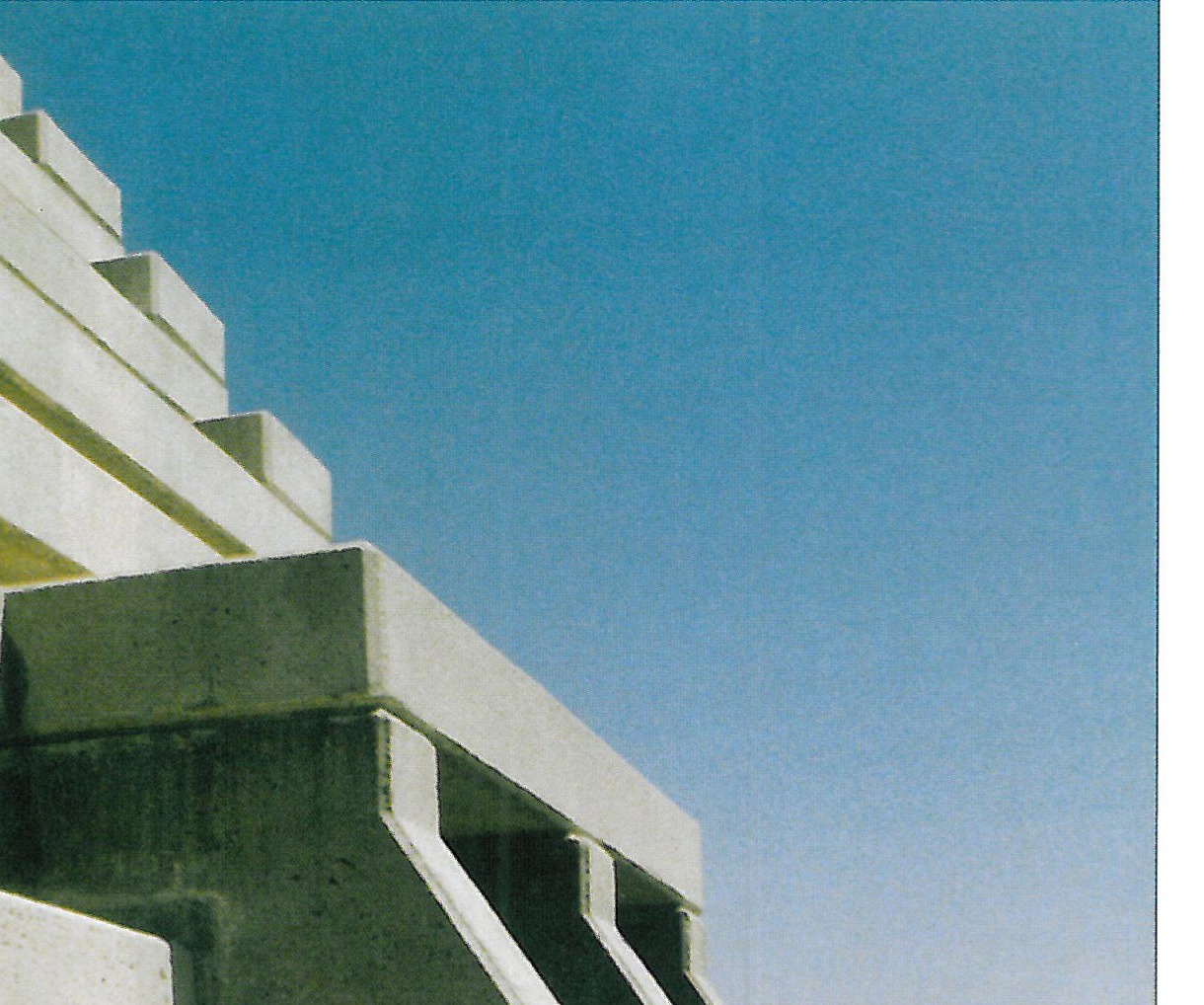
The pyramid's head leans on an oblique compound post which acts as a tent pole, lifting the entire structure — without it the whole building would collapse. Trusses, as deep as 7 metres, hold the roof and at the same time make mechanical and lighting equipment easily accessible. Although this building was designed before the Louvre's pyramid, the idea of a glass roof was rejected due to such resemblance. Many investigations were made for a proper choice of material, and stone was finally selected. A strip of light marks the intersection of the two wings of the roof, also acting as the structure's expansion joint. This gap is covered with 3 to 12 metre long glass panes, emitting a very diffused illumination into the hall. Roofs are inspired with Persian architecture and are rendered in gypsum carefully by hand, and contain mukarnas. They are designed in extendable patterns consisting of triangular forms — the project's main geometry. The most skilled wood and stone craftsmen have participated in this project.
The story of the project
Design was about 30-40 % through the second phase when, in mid-1356 (1977-8), we sent a copy of the drawings to the Ministry of Housing and Urban Development. The continuation faced the Revolution and the project was effectively halted. In 1361 (1982), under President Hashemi Rafsanjani's presidency, the project came up again. The Ministry of Housing asked us to write the project brief, and a competition was held. We — as Polmir Consultants — entered, and pursued the same idea of inverted height; we placed wind-towers similar to those of Yazd, trying to capture the essence of a desert architecture. The result was announced after seven or eight months and we finally won the first prize. Then the war came and the project was again halted. After the war, Engineer Akhondi, the then minister of Housing and Urban Development, made great efforts to have the project built. It was finally accepted that the original design be carried out. Many things changed: the structural calculations were redone for the new earthquake code, and the steel and certain primary materials, which had been imported, were changed to domestic.
The administrative building and the commissions' building
Q: Whose design were these two buildings?
A: The tall administrative building — we never found out who designed it; its calculations had been done by foreigners. The commissions' building was attributed to Mo'ayyed-Ahd, but he himself denied it, saying it was Sayhoun's work. While we were designing the hall, we considered adding three floors to the administrative building. We took advice from Arup; this was 1354 (1975); they saw the building and gave permission to add three floors. Bavand Consultants, who completed the work and added floors, probably relied on the same study. It is a strong, well-boned building; even a helicopter pad had been provided on its roof.
The commissions' building, built in 1351 (1972), was a good building. We removed all the windows of the façade — whose divisions and execution were not good — and put in single fixed glazing; the services had been wholly destroyed; the internal divisions did not answer the work of the commissions. So everything was redesigned. This building was also the route of the speaker-of-the-house entrance, and of the ceremonial entrance to the hall, from the Baharestan compound. We were forced to make a fitting connection, both at ground level and on the floor above, between the two buildings: we added two pieces — one for the connecting lift and stair, and one for going down to the basement restaurant.
Structure
Q: What is the principal structure?
A: The main structure is concrete, and the roof is steel. We sank about 50 piles, 20 to 25 metres deep; we carried all the load to a depth of 20 metres so that no harm would come to the neighbouring buildings. In this project we have a single principal column — or rather two crossed columns — which carries the whole load of the two roof wings. The remaining trusses are secondary, with a depth of up to 7 metres; inside them run stairs and gangways for access to services and equipment. The structure of this project is a very strong structure.
We had taken the original calculations with about ten per cent design margin. A group from the University of Tehran, Sharif University of Technology, and Amir Kabir University reviewed the structural calculations and, after five or six months, said only that it was a little on the heavy side.
The façade, the light-strip, and the mukarnas ceiling
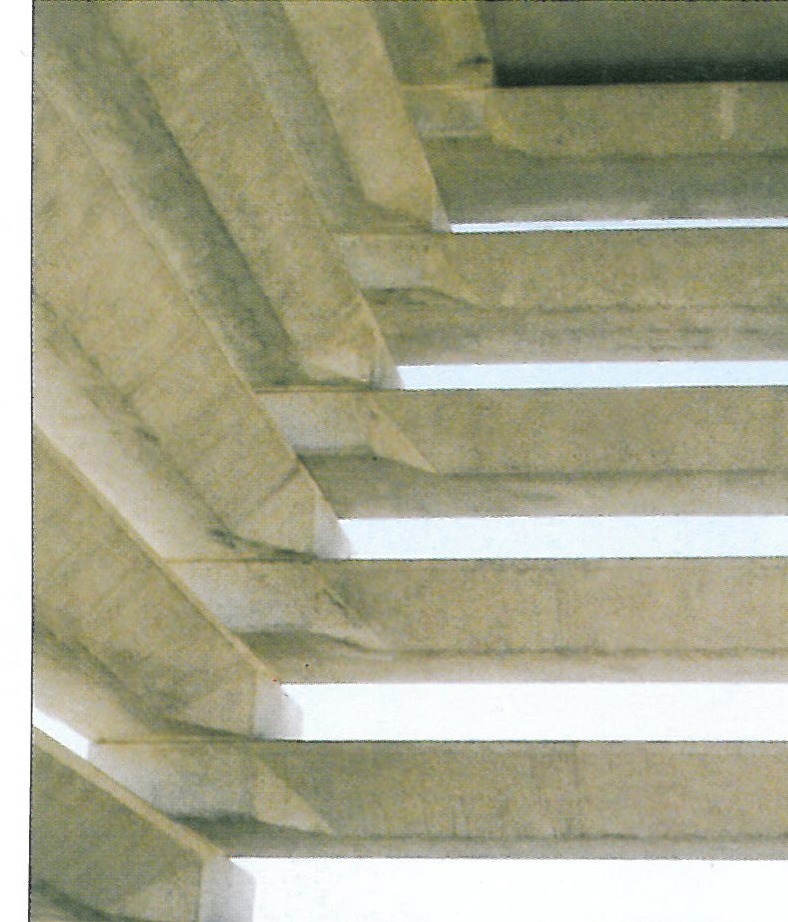
Originally the façade was to have been glazed, which faced great objection — particularly because the building took the form of a pyramid. People said that such a pyramid had been built at the Louvre — although, first, our project is not a pyramid but resembles one; and, second, when this project was first designed, the Louvre's glass pyramid had not yet been built. In any case, those years were the beginnings of such architectures: glass was being raised seriously in architecture. In the end we made the façade in stone. When you look at it from Baharestan, it does not appear to you a giant building.
The line between the two roof wings is a light-strip, set exactly at the expansion joint. This gap, between 3 and 12 metres of glass, lets a very gentle light into the hall. We did the same thing in the deputies' antechamber; the light there is like the light of bazaar skylights, soft and quiet. The ceilings, drawing on Persian architecture, are made in gypsum, carefully and by hand, with mukarnas designed in extendable patterns sharing the project's principal triangular geometry. The most skilled wood and stone craftsmen took part in this work.
Services and acoustics
This building has a smart-building management system (BIS); all services and the lighting system are controlled by the smart system. The audio-visual broadcast system has been installed at the lower end of the hall, from where one can see all the activity of the hall. For air-conditioning the jet-diffuser method was used, since the air had to be thrown a distance of 30 metres to reach the centre of the hall. The other systems are of the customary kinds.
There are arguments on the acoustic and electro-acoustic sides. The audio work was done by Soroush (an IRIB-affiliated company), who also gave the acoustic schemes and instructions. Soroush said the acoustics had a fault, while in our view the electro-acoustics had the fault. From a British company called Sandy Brown — which leads in this field — we invited a study. They came to Iran twice, brought acoustic and electro-acoustic measuring equipment, and finally said the acoustics were correct and the electro-acoustics were the trouble. On this basis we sent a long report to the Ministry of Housing.
Project credits
Architect: Polmir Consultants. Designer and project manager: Abdolreza Zokaii. Design team: Ali Sardarafkhami, Abbas Gharib, Masood Ghazi-zahedi, Mansoor Vakili, Daryoosh Firoozli, Behrooz Ahmadi. Client: Ministry of Housing and Urban Development. Structural: Yaghisheh Gholtoghchian, Masood Ghiasabadi. Mechanical and electrical: Energy Consulting Engineers. Audiovisual equipment: Soroush Audiovisual Company. Furniture equipment: Maliheh Karimi. Interior design: Hassan Mottaghi and partners. Construction Manager: Jalal Sadeghi. Structural contractor: Mana, Development and Modernization of Iran Industries. Mechanical and electrical contractor: Moonir Co. Built area: main hall 25,000 m²; administrative 24,000 m²; commissions 15,000 m²; underground parking 13,500 m².