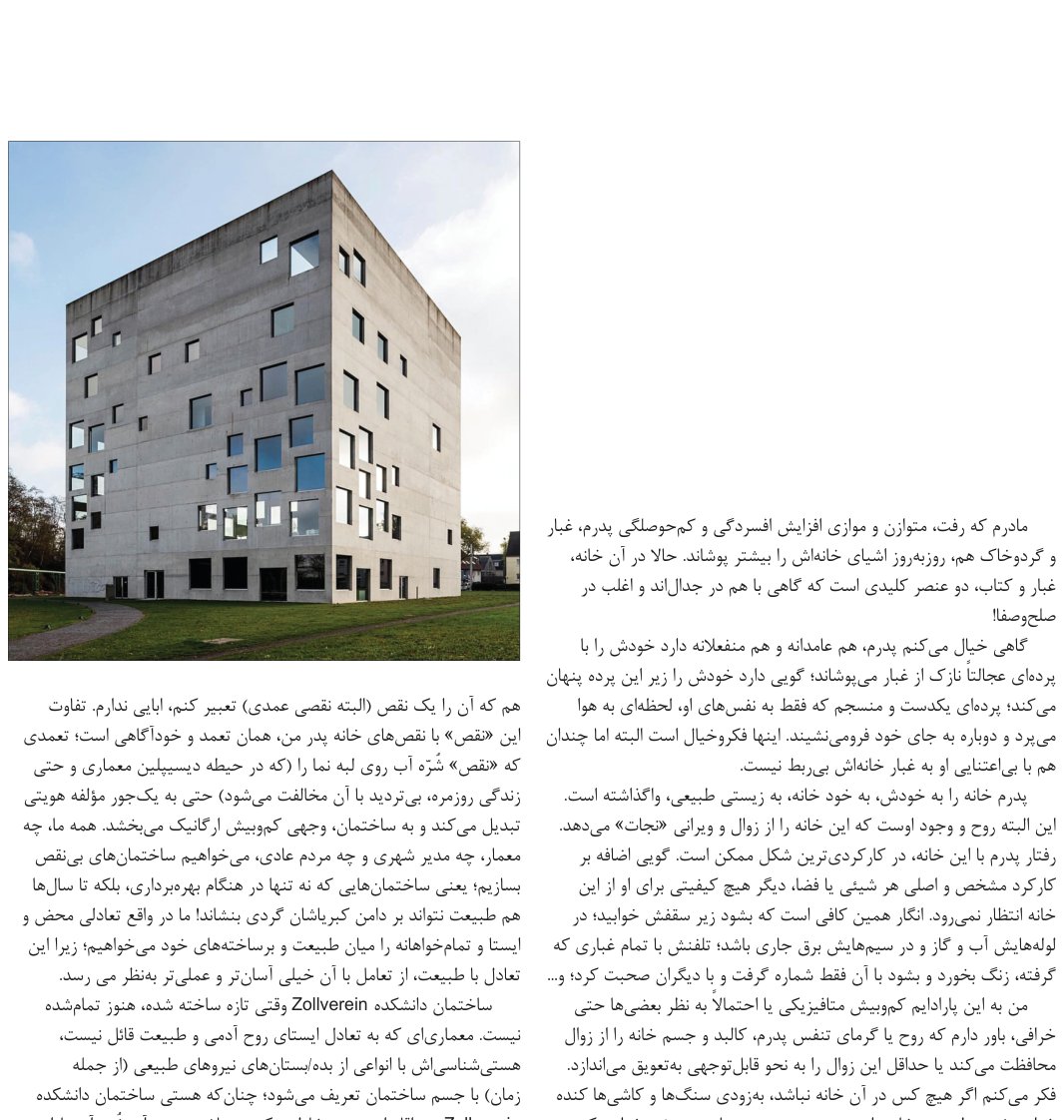
When my mother passed away, in proportion to the steady rise of my father's depression and restlessness, dust and grime, too, day by day covered the objects of his house ever more thickly. Now in that house, dust and books are the two key elements — sometimes at war with one another, and more often in peace and harmony! At times I imagine that my father, both deliberately and passively, is covering himself with a veil — for now, a thin one — of dust; as though he is hiding himself beneath this curtain; a uniform and cohesive veil that only at the rhythm of his breathing momentarily lifts into the air and settles back into place. These are fancies, of course, but they are not entirely unrelated to his indifference toward the dust in his house. My father has surrendered the house to itself, to the house's own being, to a natural existence. It is, of course, his spirit and presence that "saves" this house from decay and ruin. My father's relationship with this house operates at its most functional level. As though beyond the defined and primary function of each object or space, no other quality is expected of this house for him. As if it is enough simply to sleep beneath its roof; for water and gas to flow through its pipes and electricity through its wires; for its telephone, despite all the dust it has gathered, to ring and to be used only for dialing numbers and speaking with others; and so on. I believe in this more or less metaphysical paradigm — or perhaps, as some might consider, even a superstitious one — that the spirit or the warmth of my father's breathing protects the body and shell of the house from decay, or at least postpones that decay to a remarkable degree. I think that if no one were in that house, the stones and tiles would soon come loose, and nature would confiscate and consume the house at a far greater speed. My father's life in this house now is a kind of agreement or peaceful coexistence — largely unintentional and perhaps even unconscious — with nature, and specifically with the passage of time. It is as though my father sits in his house and says to time, to dust, to nature: come and go from this house, nest in any corner you wish and do whatever you please, but do not interfere with my use of this place and its objects. He only thinks of restoring that "balance" and restraining the forces of nature and time when those forces disrupt the function of objects and spaces for him. In truth, my father, for whatever reason, lives in his house with a collection of "defects" — defects that emerge one after another, gradually, owing to the building's state of abandonment. This abandonment, this peaceful coexistence of my father with the defects of his house, has reasons beyond depression — the most relevant to this discussion being, first, his indifference to qualities (from food to clothing, from objects to space and place); and second, his extreme disinterest in, or rather his aversion to, any kind or degree of architectural embellishment and showiness. In my view, this constellation of reasons and others has, in a paradoxical and ironic fashion, compelled him — a man who happens (or perhaps not entirely by chance) to be a perfectionist — perhaps unconsciously, to accept these defects. In that SANAA building, the trickle at the edge of the roof is also a kind of "defect," but I interpret it as a form of engagement with nature; although from this
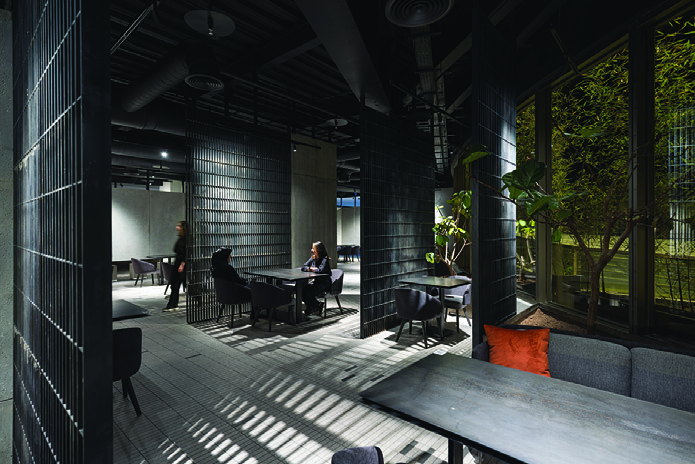
Bahonar House, Malayer, Reza Koulivand, Memar Award 2019 First Place