



Jury Discussion
Hadi Tehrani: In this project, many commendable things have happened, but when you do something this small, the matter of details becomes very important, and the ordinariness of some details and things like wall lamps raises questions for me.
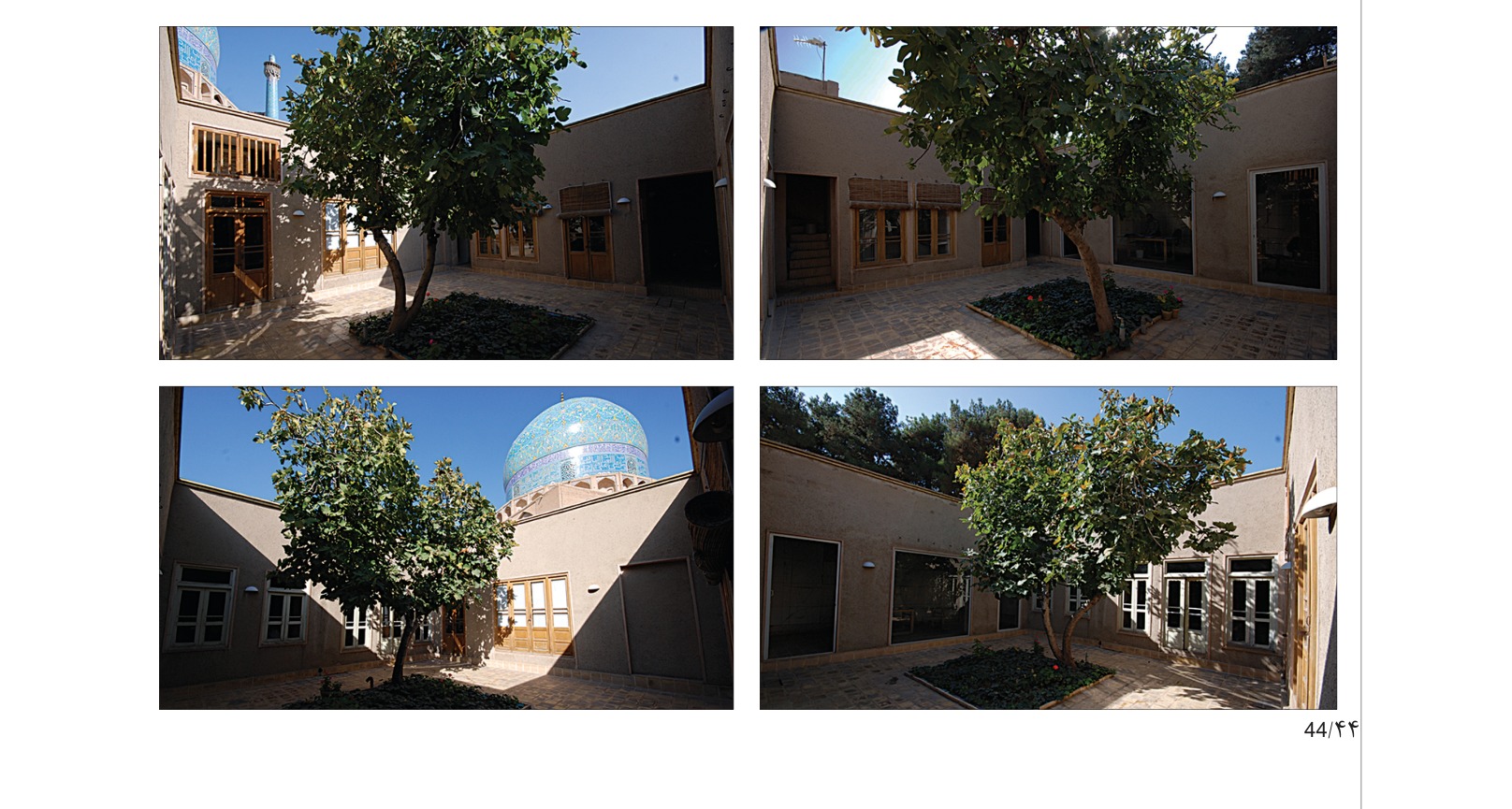
Nasrin Seraji: I too wished that just as they have shown attention to the central courtyard, to the tree, and to the proportions, they would also have paid attention to details, for example the construction of window frames.
Nader Tehrani: When you change the dimensions of a window, you cannot use exactly the same details. How do you decide when to restore old windows exactly as they were and when to change them?
Nasrin Seraji: In my opinion, here they have made this decision based on the interior space dimensions. In places where spaces are divided and smaller, they have preserved the small divisions of old windows, but where the interior space is larger and unified, they have also made the window large and uniform. In the photos, it appears that there was an intention behind changing the color of window frames and their dimensions, which unfortunately is not legible in the presentation panels. At the same time, it is interesting that in this project, the focal point is neither the courtyard, nor the tree, nor the interior space, but the dome of Shah Mosque.
Nader Tehrani: Another interesting point about the project is that it has gone through the process of defining restoration, remodeling, and new construction. Theoretically, it is stronger than the Sistan & Balouchestan project. But my problem with the project is that in all the presented images, too much attention has been paid to form.
Gisue Hariri: The project's sensitivity to the old building and the central courtyard is very high and good. But the presentation of the project is not very clear.
Nader Tehrani: As an architect, I am drawn to this project (though not as a first or second place winner) because of its attention to form and culture. In these juried competitions, sometimes the results are non-ideal, because the jurors are not necessarily looking for the best volume. Sometimes other criteria play a role that are more theoretically provocative and more relevant to the current era.
