Right - Abooreihan [ W ]+ Shohadaye Gendarmerie [ N ].
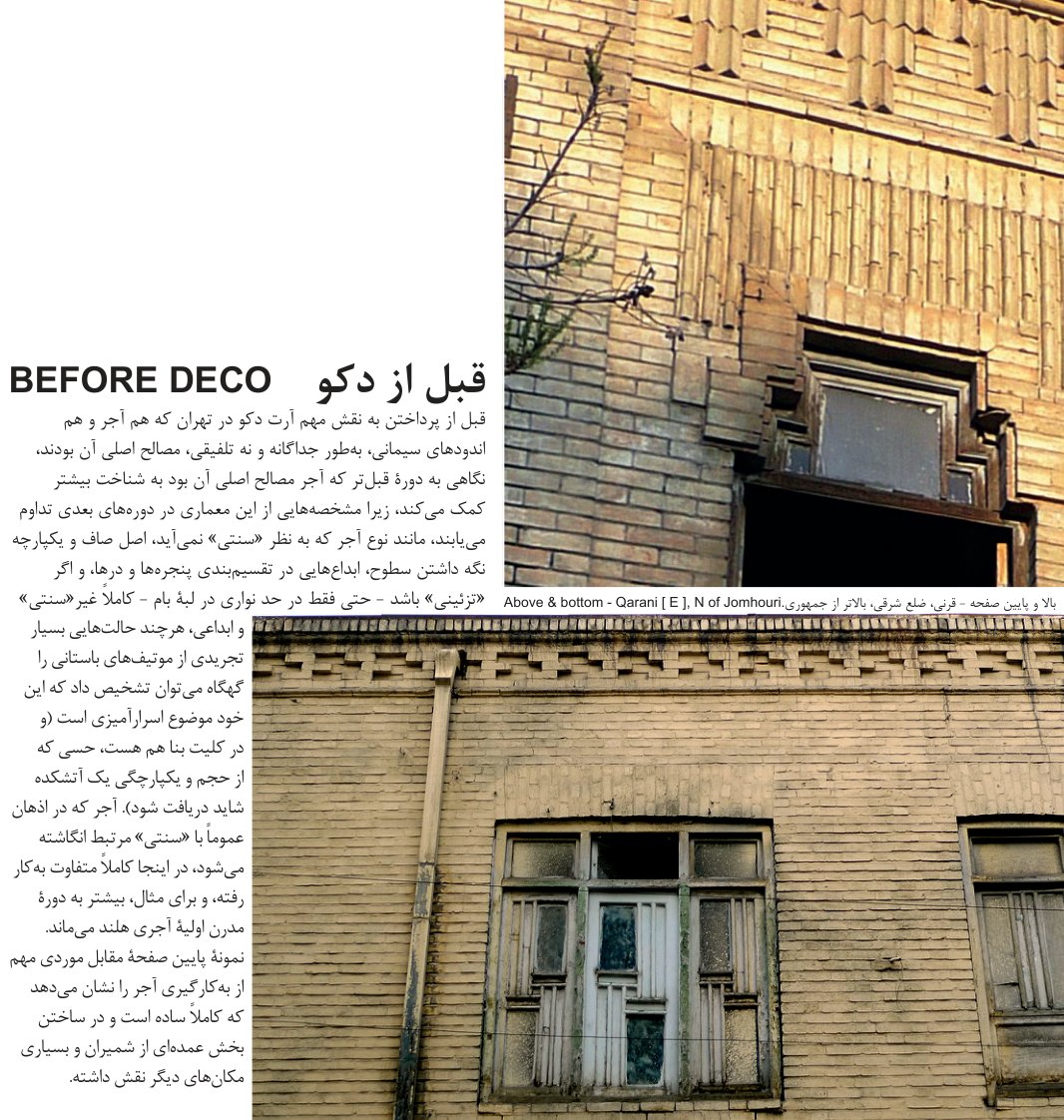
Before presenting Art Deco in Tehran, in which brick and cement render were the main materials - but used quite separately - a glance at the prior brick period can help, since certain characteris- tics remained, such as the non-traditional brick types, the principle of plain sufaces, creative dividing of doors and windows, and total- ly non-traditional and invented decorations - if any at all - although quite mysteriously, an aura of what might emanate from ancient Persian architecture, such as from Zoroasthrian fire temples, might be percieved. Here brick is rather reminiscent of let’s say Dutch Early Modernism. On the left is a completely plain brick surface type example that was used extensively for quite some time, in particular in shaping north Tehran.
Below - Hosseini [ S ] - off Valiasr [ E ] - A continuous brick surface - augmented by the external ceiling in brick too - from which only a small balcony juts out above the door. The balcony con- nects on the left with the equally prominent feature of the L shaped cement screen. An arch to the unroofed side terrace can just be discerned from this angle. The cement screen could not possibly work in any other material. It recesses about 2 cm, and juts up a brick height at the top.
َAbove - ceiling plasterwork projecting out only minutely.
Opposite page top, middlle - Amir Kabir [N] + Toopkhaneh Sq [ E ].
Opposite page top and middlle - Enghelab [ N ] + Khaqani [ E ] - The new role of brick in city building. It seems that it has been painted over recently, but is attractive nonetheless. Brick and stone can be painted, both in terms of absorbtion and feel. This wide front- age mixed “passage” block tilts toward the Modernistic, and is reminiscent of Red Vienna. The corner shop sign says Kalay Tchek (Czech) - “ kala ” meaning goods - which might be a key to its origin.
Bozorgmehr [ S ] - Corner windows - One round window - Combin- ing a balcony with the volume of the room - Placing three bands of brick at the corners tends to Art Deco. Here too brick has been painted over recently.
Above, left, bottom - Boulevard Keshavarz [S] - west of Vesal - Probably by Armenian Iranian Paul Abkar, the fourth in the row remaining at this location west of Vesal of the extensive demolitions in the area immediately north of Tehran University. The colour of recessed pointing was to be appropriately always black at the time. The plane of brick projects out minutely. The heights of stone block rows vary to accomodate the horizon- tal basement window. The image on the left is important because it shows one of the very positive planning principles of the time in detatching buildings. A great advantage of this was that it allowed putting windows on the sides. The first narrow stone band above ground extends left to form a head to the door from the street to the eastern side passage of the house.
Right - Villa [W], Moalleme Shahid # 10
Opposite page - Unknown location in North Tehran - The garden wall capping extends left onto the elevation and under arched windows, then becomes vertical at reaching the entrance recess. A sensuous curve at the top, set against the rectilinearity of the main form.
Note the large perforated plane above the terrace. This thick plane has been subdivided and, as it were, hollowed out by means of triangular divisions. It is a brise soleil. However, its real function is surely architectural. At the junction with the heavy freestanding stone wall on the right the plane below becomes brick set inside the stone wall, however, the left hand corner is in brick. به صفحة مشبك بزرگ روى تراس توجه كنيد. اين صفحة ضخيم با ضربدرى هايى تقسيم بندى و خالى شده. اين يك سايه انداز است، اما عملكرد واقعى آن مسلماً معمارانه است. به ديوار سنگى سمت راست كه مى رسد، زيرش سطحى آجرى مى شود كه در سنگ فرورفته، اما گوشة چپ آجرى است.
غير از تصوير پايين صفحه كه در خيابان مازندران، جنوب ميدان امام حسين است، تصاوير متعلق هستند عمدتاً آجر دو رنگة بهمنى كه حسى از جنس بافته دارد و در سقف هاى - به كوچة بامداد، ضلع شرقى، ظفر خارجى هم به كار رفته ، و جزئياتى از سنگ خشن برجسته و سيمان در ورودى. اصل بر اين بوده كه سطوح صاف و يكپارچه غالب باشند. مسلماً اين دو خانه بدون به كارگيرى آزادانة كنسول چنين كيفيتي پيدا نمي كردند. Besides the bottom left image that belongs to Mazandaran, a street to the south of Imam Hussein Square, the images are of Bamdad, Zafar. One material, the two coloured “Bahmani” brick on all of the planes including the undersides, expresses the evenness of the surfaces, suggestive of knitted texture. Certainly both houses would not have accomplished the same level of architectural ex- pression without freely employing the cantilever device.
نماى رو به خيابان كاملاً معمارانه است، زيرا از تركيب سطوح پر تشكيل شده. يكپارچگى فرمى با به كارگيرى فقط يك مصالح ساختماني، آجر بهمنى، تأمين شده و فقط در ورودى- 203 وصال شيرازى، ضلع شرقى، شماره است كه سنگ وارد كار مى شود. Vesal [E] # 203 - The elevation facing the street is purely architectural, since it is composed of solid planes. Formal homogeneity is provided by the use of one material - brick, and stone is introduced only around the entrance.
Somayeh [S] #158 - A bow window combined with a balcony - Stone slabs about 12 cm thick form screens for the stair windows.
Kargar [ W ]: This example, because of the simplicity of its form and especially in its use of a sweeping curve on the corner is reminiscent of Mendelsohn.
Below - Somayeh [ S ] - The main feature here is a pointed but asymmetrical projection on the right hand side. The colour of the finish is attractive, and importantly, does not show stain as easily. Interestingly, on its left hand side, the building keeps the distance of the width of the garage door from its eastern neighbour.
Bozorgmehr [ S ]+Fariman [ E ]: The use of travertine for the external finish here suggests that this building should belong to the final stages of transition to the purer cubic Modernism. The division pattern of the tall stair window, with curves and angles, points to its roots in Art Deco, although the design is quite unique.
Strange that wherever you look (for as long as it lasts) you will find somethig interesting, in this case (below) a wall that resembles Mondrian and (on the opposite page) a grille that looks like a 1950s painting.
The main feature of the house is its stair box, which stands in its small northern yard. The box forms a glazed corner protrusion composed of a complex pattern of straight and circular wooden segments..
Vesal [ W ] + Farre Danesh [ S ]
Another feature is that the building proper is set back from the northern and eastern walls by a few meters. The reddish paint on the garden wall is an arbitrary intervention by the municipality.
A corner window with sun shield external wooden vertically folding louvres in a room with a pink and red color theme. The floor is seamless. Vesal [ W ] + Farre Danesh [ S ]
A high level of craftsmanship is evident in the making of this wooden stair handrail.
Opposite page - The common method for protecting staircase or corridor walls was to apply usually gloss paint to a height of the lower section. Even, only this part could be repainted if damage occured! Often a line of a few milimeters would be drawn with great accuracy on the border between the upper and lower sections. The overall flush surface helped greatly. The wooden handrail stops a few centi- meters short of the floor.
Each area of glass constitues a separate piece.
نمونه اى نزديك به آرت دكو به خاطر پرداختن بيشتر به نما. در وسط- 33 فرصت، ضلع شرقى، شمارة بالاترين طبقه در بالاى جعبة پلة سيمانى، دو سطح طرفين پنجرة پله با برجستگى هاى نيم استوانه اى باريك پرداخت شده اند و در سطح بام دو مجسمه در دو گوشه قرار دارد. نكته اى جالب، كه كمتر ديده شده، اين است كه در اينجا از سه رنگ و نوع سيمان استفاده شده: دو رنگ زرد و صورتى براى نماهاى اصلى و خاكسترى خشن براى جعبة پله. Forsat [E] # 33 - َA case close to Art Deco because of the greater elaboration of the exterior. The two panels on either side of the upper level staircase window are given a treatment of vertical tube-like bands, establishing contrast with the evenness of the other surfaces; A rare case is that three colors and two types of render have been used here: smooth peach and pink for the main planes and a rough grey one for the stair box. Uniquely for Tehran, there are two free-standing statues attached to the roof parapet. اين نيمه استوانه كوچك پنجره به خاطر كوچك بودنش از- 648 انقلاب ضلع جنوبى شمارة-صفحة مقابل گيرايى مضاعفى برخوردار شده. طرح برجستگى هاى عمودى نيمه استوانه اى كه در اينجا روى سطوح نيمه استوانه زير و بالاى پنحره اجرا شده از جزئيات آرت دكو است. بايد توجه كرد كه پنجرة نيمه استوانه بخشى از يك پنجرة بزرگ تر نامتقارن است، يعنى در طرف راست آن، بخش همباد با نماى پنجره قرار دارد و تأكيد تركيب نما بر نا متقارن بودن است كه زيربناى كيفيت معمارانه آن است. همه اجزاى همسايگى ها و تابلو و از اين نوع، به نظر مى آيد كه به طور اسرارآميزى با هم در ارتباط معناداري هستند. Opposite page - Enghelab [S] # 648 - This small bow window section of the composite window has acquired an additional charm because of its small size. The treatment of the curved surfaces below and above the bow window, with vertically arranged semi-cylindrical bands is Deco. The small bow window is part of a composite, asymmetrical window and an elevation that emphasizes asym- metry. Everything else, to the left, right, and below, including the green glazing system, the shapes of the shoes on the digital print, the graphics of VIDA, the shop’s name set inside a black L-shaped background, the three parallel bands on the curved cream coloured sign base, the black and white part frame of the sign of the shop on the left, with the fragment’s perfect proportions and the perfectly narrow widths of the black and white stripes, and the invert stepped sides, and ... seem all to be connected in a mysterious way .
As in the previous page, the one even dark plane is key here. The implementation of a semi-cylindrical protrusion on the balcony in this manner is quite rare. Photo by Triti Mavandadi and Rozita Behbehani.
Opposite page - Mahshahr [ W ] + Malekian [ S ] - South of Karim Khan - All of the windows on both sides of this corner house are square in shape. Unlike most of the buildings of this period distinction is not made between the staircase and the rooms in terms of aperture and glazing. Note the way a chimney stack has been integrated with the eastern elevation, as well as the window iron grille design. The entrance on the northern elevation is exceptional, and a great deal of its appeal is because of the thinness of the protruding zig zag cover and side to the doors and the ground floor windows. The evenness and colour of the rendered surface is important for the overall effect.
That Modernistic buildings often had one round window perhaps referred to the portholes in ships or aircrafts. However, here it is eliptical.
Khomeini / ex-Sepah [ S ], west of Hassana- bad Sq, Nobahar St. The impression here derives, among others, and in particular, from the way a balcony that typically faces a south facing garden extends over the pavement in a semi-cylinderical mass. An architectural gesture that would be prohibited by the un- reasonable and restrictive regulations today. The stone skirting has been buried under succesive Layers of asphalt, causing moisture absorbtion. Plain surfaces impress the one significant move. The balcony soffit is brick too, in herringbone pattern.
Opposite page - Taleqani [ S ] # 514 - By Vartan, a floating beam end at what was the roof level in this house loops in to make a large and strong feature, similar to some of his other work, for example in Lalezar’s Hotel Laleh. Fine metalwork was especially impor- tant to Vartan who, as the story goes, was in- fluenced in this by his mother’s embroideries.
در اينجا منحنى كردن- 519 انقلاب، ضلع شمالى شمارة نه فقط در يك جا، بلكه در اغلب گوشه هاى خارحى اعمال شده. لبه هاى اجزاى قاب بندى پنجره هاى بزرگ پله هم گرد و نرم شده اند. Enghelab [N] # 519 - Rounding off of a corner has been implemented here in many locations, contrary to the usual preference of the period in utilizing only one large curve. The edges of the wooden members of the large openings for the staircase glazing have also been rounded and smoothened.
Taleqani [N] - A building type of Tehran that has been important in shaping the streets because of its wide frontage. The height is four floors or less because lifts were not yet commonly used. The aim seems to have been a very three dimentional front. This has been achived by combining balconies with protrusions in interesting ways, as well as turning windows at angle. Note that the surface material is only one, and even, which makes every large or small and subtle event as visible and impressive as possible. In addition, balcony soffits seems quite high because of the much lower levels of window heads; since ceilings were much higher then, and windows heights were kept at managable levels. Two similar buildings on Ferdossi Street are shown - opposite page - top and middle. Implementing corner windows was also an impor- tant preference.
Villa [E] + Khossro [S] - A quality derived from the evenness and continuity of the surface by means of curving the corner, augmented by the fine quality of the brickwork. The position of the staircase at the corner has resulted in a higher mass. The three windows of each floor on the western elevation are set within a delicate ce- ment frame, the lower member of which extends right to become the parapet capping of the can- tileverd balcony, while the frame sides taper top to bottom. Brick is laid vertically on the panels between the windows. At the corner, halfway up on the uppermost curved area, a thin horizontal plane curved laterrally and resembling a device to throw off rainwater but clearly for a meaningful aesthetic purpose, projects out .
Roudaki [ٌW] + Mohammadi [N] - This building is exceptional in that the three curved and rendered sections - concave at the corner and convex in the middle and on the right - slant out upwards. Window pairs have horizontal rectangular frames. The bricks on the panels between the windows on the brick surfaces are laid vertically. Note that the mass containing the upper two level is cantilevered. The eventful and dynamic ironwork belong to the corner shop. The below and opposite page images are of the same neighbourhood which is not central, which shows how widespresd the Deco influence was.
. مراد بخت، ضلع شمالي، ضلع شرقي رودكي- بالا و صفحة مقابل، وسط چپAbove and opposite page, middle left - Moradbakht [ N ], Roudaki [ E ].
Nobakht [ E ] - 12th [ N ] - Three exceptional cases of metalwork design, including the plant holders formed with thin curved rods.
Above and below - The small width of the steel flats and their flushness with the glazing are key aspects for the feeling of delicacy and appeal in this stair- case glazing box. Symmetry has been broken by the glazing turning in only on one side. The design itself is clearly exceptional at mysterious levels.
Top left - Si e Tir [W] + Saleh [S] - A reminder about staircases of the period, that their location in plan would ensure natural light and ventilation. Here the stair fits inside the internal triangle at the meeting point of the two wings of the corner building, forming a narrow tall window to the back. The stair parapet is in masonry, as was common, but its covered on the top with painted wood rather than the direct gloss paint that was the norm.
Left - Enghelab [S] opposite Tehran University - The narrow horizontal windows turn in on the left hand side of the staircase box, while on the right brick contin- ues bottom up. Deep set balconies are cantileverd to the same plane as that of the staircase box front.
تخريب شده.- كريم خان، ضلع جنوبى- صفحة مقابل Azaadikhah # 88 - Cantilever and window on a curved plan - varied brick patterns. Note the three dimentional terrazzo panel between the two ground floor windows, as well as the wooden shutters. Opposite page - Karim Khan [S] - Demolished.
Felestin # 352 - corner stair in glass blocks and exterior in cement render - the house itself is set a few meters away from the eastern street wall. There are three planes, each projecting out about 8 centimeters. The outermost plane is flush with the semi-cylindrical form on the left. To the right, the curve leads to the eastern entrance of the house. The staircase box is glazed on two sides. Such glass blocks are not available now, and they are set without visible joints, and with a fine cement corner finish.
Opposite page - To the right of the entrance, a detail composed of three small upright projections can be seen that hangs lower than the horizontal edge of the floor, meaning that it could not have been positioned symmetrically in relation to the horizontal edge. Further up, there is a similar feature, but horizontal. Clearly, it could not be the same vertical, as the one below! This detail, composed of nearly always three blade-like elements, which cannot really be called ornamental, can be found both in Deco objects and Deco buildings. However, its origin is not clear. Note also the distinctive design of the door.
Purpose designed light box in translucet textured glass and metal.
Torabi [ E ] + Ardalan [ S ] - Railing above the door in a complicated design, painting like design of the metal screen on balcony side - simmetry is broken here by intro- ducing a slant on the left hand side of the door. The white travertine is executed such that the plane has a texture composed of overlapping upright stripes. The screen on the side of the balcony is delicate and enigmatic. There is only one crescent shaped element on the right hand side, but it is horizontal.
Amir Kabir [N] + Toopkhaneh [E] - The images in these two pages are of an elaborate and profusely detailed building that occupies an important corner location in the city. Below the balconies are rows of stone blades that form brise soleils, and seem to rest on a lenght of steel profile. In fact a cutout on the underside of each stone blade saddles over the profile. Spectacularly complicated designs have been employed in the variety of metalwork used in the building. This detailing seems to effortlessly ap- propriate adhoc add-ons.
Opposite page - The period of the use of steel flats in metalwork - Amir Kabir [ N ] + Toopkhaneh Sq - Nothing is known of the people who were actually able to make these things with such finesse.
Left - The period of the use of steel flats in metalwork - Shariati [ W ] + Andisheh-ye Sheshom - Multiple folding or “accordion” door.
Below - The period of the use of steel flats in metalwork - The geometry of the terrazzo render divisions, as well as the colours and their paleness reminds me of De Chirico - e.g. The pool setting in Milan.
Jomhouri [S] - Passage Shirvani -. All in brick. The small, usually two floor “passage” type building has been instrumental in shaping the streets of Tehran.
Below and opposite page below - Manouchehri [S] # 196 - Passage - Note the way the first floor balconies finish in a tapered shape. The design and details of each “pas- sage” building was unique, and this would greatly enrich personal experience. Doors and windows in this period were in wood. The edges of each member would usually be sanded down and smoothened. While the main frame elements were sturdy and bulky, the members that divided glass panes were as fine and thin as possible. Wood would always be painted, as in this beige, or in grey or white, in gloss or satin.
Jomhouri [ S ] - west of Lalezar - To the left of this “passage” is the small frontage and tall elevation of Cinema Mayak which was demolished recently..
Below - Manouchehri [ S ] - near Ferdossi - Passage - SEE ALSO OPPOSITE PAGE. Each floor is different in plan.
Above, below, and left - Si-e Tir [ W ] opposite Iran Bastan Museum - The small atriums of this period offered cosy spaces that were cool in summer and warm in winter. The glazed roof, if one was included, would have a delicate structure. The sign below from above the side door to the upper floors shows an engraved red windmill, with the Persian writing: “the office of the Red Windmill” (Moulin Rouge). Right - Jomhouri [ N ] Passage Mekaleum - Another very interesting detail in the form of this small semi-cylindrical balcony above the western entrance to the upper two floors.The eastern entrance oppo- site mirrors this. Its attraction for me is in its mass and sharp edges.
Right - Saraye Mozaffarian, Marvi [ S ] 1937 - Domed “passage” atrium.
Below right - Jomhouri [ N ] - Passage Elmi -1955.
Below and opposite page - Jomhouri [N] # 110 - The smallest “passage”- Here the stair is an integral part of the tiny atrium. The thinness and small height of the stair parapet and its curving have given the architecture great finesse.
Right and opposite page - Cinema METROPOLE - Lalezar [ W ] - Art Deco seems to have been fond of mixing usually large letters with architecture. An important category in this was writing words vertically. Cinema METROPOLE, designed by VARTAN, is a case in Tehran where the name of the cinema stands out in large letters on two sides of an aeroplane tail like element two floors in height, and whose outer edge resembles the curvy edges of old photographs. These can be seen from distances up and down the street. METROPOLE was in the cinema building category that included office or even residential floors above. Another cinema in this category is Cinema Royal on Enghelab, not far from the street’s junction with the northern end of Lalezar.
Below - Hotel Laleh - Lalezar [ E ] - Also by VARTAN, the elevation of this ex-hotel is all in terrazzo, however, how such a finely built and complexly detailed thing was built is not quite clear. Because of the durability of terrazzo this exterior seems to have not deteriorated at all. A rare case of Art Deco Baroque, if there might be such a term.
َAbove - Ferdossi Roundabout [ N ] - The balcony parapet meets the semi-cylindrical cantilever tangentially.
Below left - Enghelab [ S ] - opposite Tehran University - Wooden stair window: windows were in wood in the earlier periods and would be painted in the colour here or similar. Such a finely designed and dexteriously made window cannot be found anywhere else.
َبالا – نبش ضلع شمالي انقلاب و شرقي بهار. Above - Hafez [ E ] - Note the side by side bay windows. Internal plan can only be imagined.
Above - Street off Enghelab [ N ] - East of Valiasr - Double round columns support balcony on street side.
Left - Adibi [ E ] + Haeri Yekom [ S ] - Note the roof level edge detail of this western elevation, as well as the way the corner tip finishes. The lattice design of the door is interesting, and that this side consists mainly of a plain brick surface.
َAbove - Enghelab [ N ] + Bahar [ E ].
Above and left - Enghelab [ S ] + Abureihan [ W ] - The middle section of the window is certainly extraordinary. How- ever, the simpler side sections are very fine too. This method of dividing panes by means of closely placed horizontal members (three instead of two as in here was also used) is something that I have not encountered anywhere else.
Right - Enghelab [ N ] - East of Shariati - No- bakht [ W ] - Implement- ing the curve in plan was an important device in Deco and Early Modern. Again, the key role of the plain surface should be noted. Unlike the usual, the wooden division members of the stair window are fairly chunky here, which set against to the fineness of the lines and the delicacy of the ironwork, undoubtedly works.
Opposite page - Kesh- vad [ S ] + Karimi [ E ] - This image is about the superlative treatment of a corner, however, if the inexplicable one brick drop of the stone section on the right had not occured, the same enigmatic quality would not exist.
Below - Zibaye Shomali [ E ] - A very three dimentional composition - only one curved form, only one round window, only one column.
Above: Bank Sepah, Panzdahe Khordad St, bazaar area, by Vartan. Concealed lighting within the undersides of a stair. Such detailing was favoured in Deco which was highly active in schemes such as department stores and luxury hotels. Below: Enghelab [N], east of Villa, Niaii St [E]. Control and continuity of form by means of surface homogeneity and curving - Being visible from Enghelab St at- taches greater importance to this house. A sure would be candidate for Tehran’s best building. According to Manouchehr Ansari (the client’s son) in Architecture & Culture, No. 52, 2013, guest-edited by Mandana Yazdanshenas, it was designed by Russian Alexandre Belin who was an employee of Danish KAMPSAX railroad building company around 1933. A complexly fascinating but unwritten history in which not well known individuals, possibly not even architect by profession, engaged themselves in unrestricted architecture, even having come up with superlative works like this.
آدرس- بالا و بالاي صفحه اين خانه دقيقاً معلوم نيست نمونه اى از جنبة غيرقابل - پيش بينى بودن تهران. خود خانه حاوى مشخصه هاى معمارى ا ست كه داريم با آن آشنا مى شويم، و ناگهان اين در كه اصلاً قابل توضيح نيست. Above and top - Address unknown - This case demonstrates the unpredictable trait in Tehran. While the house is a sober case of the features in the architecture we are becoming familiar with, all of a sudden this door appears that simply cannot be explained.
Zahiroleslam [W] # 234 - The corner glazing of the cantilevered stair turns left at the roof level to construct another smaller corner glazing. Slants are effective at window frame sides and balcony side wall. As in all cases from this period, the homogeneiety of mass and surface is observed with the use of only one material, even on most of the undersides, and maintaining the surfaces even. The slightly chunky feel of the massing is expressed against the thin bands of the detailing around the apertures and the fine and flush metal trellise of the stair glazing.



