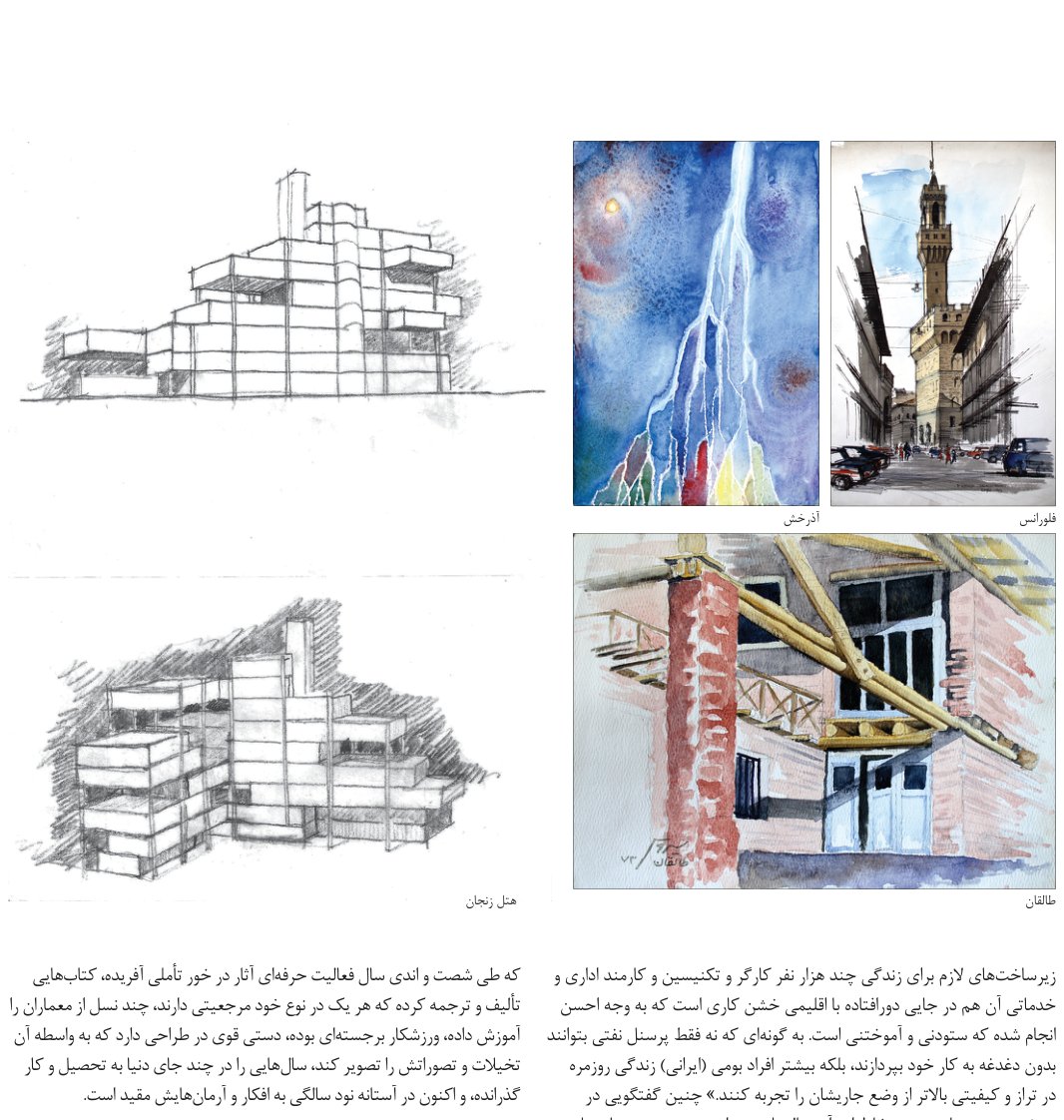
The infrastructure necessary for the lives of several thousand workers, technicians, administrative staff, and service personnel — in a remote location with a harsh climate, no less — was carried out in an exemplary fashion that is both commendable and instructive. It was done in such a way that not only could the oil company personnel attend to their work without worry, but most of the local (Iranian) inhabitants could experience daily life at a standard and quality higher than their prevailing conditions." Such a conversation in the presence of Cyrus Bavar and a review of the memories of those years cannot take place without a discussion of the nationalization of oil and the "plundering of the country's resources by foreigners": "I have always said, stop repeating that foreigners came and exploited and plundered, because the implication of that statement is that we were so incompetent that a group of people from the other side of the world came and took and carried off, and we just watched and could do nothing more than grumble. The quality of the design and construction of the buildings in these facilities — after some eighty years of looking at them — is of such a high caliber, and there are so many subtleties and refinements in them, that it speaks to the architectural conscience of their designers and builders, who constructed buildings in a remote land — buildings that were meant to have a lifespan no greater than the economic life of the oil reservoir — with such care and beauty." Cyrus Bavar, drawing on his firsthand experience of that environment, does not view the presence of the English "foreigners" and the Iranians' association and working for them as negative in that particular historical moment, because being present in their working environment as well as the schools they established was an opportunity to learn skills and crafts in which we had absolutely no knowledge or experience — from technical skills to administrative and service work. Beyond these, these interactions were an opportunity to become acquainted with the way of life of a society that was scientifically, industrially, and consequently in terms of social relations at a more advanced level — one in which there were certainly positive and useful things to observe and learn.
In the speech and manner of Cyrus Bavar, one senses a kind of optimism and hopefulness that stems not from naivete or simple-mindedness but from maturity and erudition: a man
who over more than sixty years of professional activity has created works worthy of contemplation; who has authored and translated books, each an authority in its own right; who has trained several generations of architects; who was a distinguished athlete; who possesses a powerful hand in drawing, through which he renders his imaginings and visions; who spent years in several parts of the world studying and working; and who now, on the threshold of ninety, remains committed to his ideas and ideals.
Footnote: 1. In 1927, Mohammad-Taqi Bahar, accompanied by a group of cabinet ministers and members of parliament and at the invitation of the oil company, visited the oil installations and facilities of Abadan and Masjed Soleyman. He rendered his observations in a qasida beginning with "The pious of old have shown the way." We quote a few verses of that qasida pertinent to the subject, with the reminder that these lines were not composed by an unsophisticated person quick to excitement — one who catches cold from a sour grape and heats up from a raisin — but rather by one who inherited the title of Poet Laureate of the Astan-e Quds-e Razavi from his father, who possesses vast knowledge of Iran's history and literature and is at home in both, and whose love of freedom and patriotism are matters upon which all agree: ... Lest you call it miracle or grace or sorcery / With the force of knowledge they have wrought this and that / If fire became a garden for the son of Azar, no wonder / See how they have made the thorny wastes of "Naftun" a garden / The power plant of "Tembi" is truly a spinning wheel / Whose turning force has set all other wheels in motion / The ruined village of "Abadan," once proverbial / They have now filled its town with palaces and boulevards / Like two hells, two blazing infernos I saw from afar / Whose flames and blaze have made hell itself tremble / You would say this is the Fire of Barzin and that the Fire of Gushnasp / Built for the exaltation of the Lord by the Zoroastrians / What orderliness I saw in that province — oh marvel! / For years the people of Tehran have yearned for the same / Time in Iran is plentiful and cheap, yet knowledge / Is scarce and dear — these men have done differently / You ask me for rice, O claimant — be not offended / These artisans have done a kindness in their age
Dehkhoda defines aghazidan as: commencement, inauguration, beginning, laying a foundation, initiating, and establishing. In truth, the teaching of architecture through modern methods, despite certain differences from other forms of education during Iran's modernization period, should naturally have been a kind of initiation — or the laying of new education upon the foundation of previous indigenous methods — a necessity that never came to pass. For the founders of modern architectural education in Iran, though themselves aware of the capabilities of Iranian architecture, apparently did not consider its teaching methods suitable for training today's architects. Andre Godard, who himself designed the Iran Bastan Museum, the Iranshahr School, and the Tomb of Hafez in such harmony with Iranian architecture, did not draw upon this architecture in the education of young architects. Why? Fundamentally, traditional education and modern education had taken shape along different paths and in different worlds that seemed irreconcilable. For example, the teaching of children through new methods was so different from traditional and maktab-khaneh approaches that Mirza Hassan Khan Roshdiyeh — the founder of such education in Iran — would organize a showcase at the end of each school year to encourage the local populations in the cities where he built schools, having children of six or seven read aloud texts that even older children, despite the rod, the stick, and the falak of the maktab master, could not read. This astonished the parents and naturally encouraged Mirza Hassan Khan to expand his services in Iran. Maktab-khaneh education — which began with traditional methods, teaching Arabic grammar and syntax and the reading of difficult and formidable literary texts such as Saadi's Bustan and Golestan, Kalileh and Dimneh, and certain Arabic texts — was not so easy that all could endure the continuation of maktab studies. Those who remained either intended to continue on to the seminaries and don the clerical garb, or by dint of their intelligence and talent and the blows of pomegranate switches managed to devour Saadi's Golestan and the rhymed prose of other books. And this manner of training applied to those students who, through memory and perseverance, could prepare the mullah's lessons; otherwise, the majority of children entering the maktab would, in the early days or first years, give up the maktab's bounty for its freedom and, following another of Saadi's counsels — "If you desire your father's inheritance, learn your father's craft" — take up their father's trade. The account of ruling, landowning, and aristocratic families was separate; in partnership with the clergy, they essentially monopolized literacy and knowledge, while the common people — the proverbial unwashed masses — spent century after century with their eyes fixed on the hands and lips of these two classes. The history of Iran after the Sassanids — insofar as we can trace it through surviving writings or their reflection in the works of our Indian, Greek, and Arab neighbors — attests that in Iran, knowledge was fundamentally not a public commodity but was monopolized by the first and second tiers of the social caste. This is why Mirza Hassan Roshdiyeh's efforts, despite all the obstacles those two partners in power placed in his path, appear so valuable. What Roshdiyeh does in the expansion of modern education in the country is to break the monopoly on literacy and, of course, to simplify it — leading to public education. Shortly thereafter, with the change of dynasty from Qajar to Pahlavi, the country's modernization was essentially founded upon public literacy, making education compulsory for all children. But the point is this: while knowledge in the pure and foundational sciences and the literacy of reading and writing in pre-modern Iran was, in a sense, monopolized, literacy in practical and vocational fields was not monopolized in the same way — or at least it persisted from generation to generation within families of craftsmen, and through the master-apprentice model, there existed the possibility of teaching these skills to the general public. At the very least, compared to the literacy of reading, writing, and the rational and transmitted sciences, greater public access to these existed. This greater access was, of course, itself a consequence of society's need for practical skills of this kind. For this reason, professions such as agriculture, animal husbandry, pottery, weaving, and architecture in pre-modern Iran had their own standing and had managed not only to meet the diverse needs of traditional society across all classes and in all their variety, but in certain cases such as weaving or architecture, to attain such lofty heights in the pre-modern Middle East and the Indian subcontinent that velvet became the exclusive commodity of Kashan, or Iranian architects were summoned deep into the Indian subcontinent to build madrasas, mosques, and royal palaces. Therefore, at the outset of modern architectural education, our knowledge in the field of architecture was not like our knowledge of child-rearing — which for centuries, per Saadi's dictum, "A teacher who is gentle — the children will play truant in the bazaar," was driven forward by the wet pomegranate switch and the falak. How much literacy was needed for daily life, after all? Today, in the twenty-first century, when humanity harbors dreams of traveling to Mars and the metaverse, what knowledge do our twelve years of schooling impart to students beyond the multiplication table and sight-reading of texts that is actually applicable and useful in life? So why, at the outset of modern architectural education in Iran, did our architectural knowledge count for nothing? Was it truly all due to colonial influence and the malice of foreign governments and the incompetence and treachery of rulers? And if so, why — forty-two years after the Islamic Revolution — does everything still revolve on the same hinge? In truth, the academic persona of Dr. Cyrus Bavar and his teaching experience at Tehran's universities reveal facets of the problem of modern architectural education in Iran that demand attention. With the accession of Reza Shah Pahlavi, the modernization of the country was placed on the government's agenda, and shortly after the establishment of the University of Tehran — which was meant to supply the indigenous workforce for this modernization — in 1949 the Faculty of Fine Arts was established as the university's sixth faculty, based on the educational system of the Ecole des Beaux-Arts in Paris, and its first directorship fell to Andre Godard, the director of the Department of Archaeology and Antiquities, who insisted on implementing the Beaux-Arts program at this newly founded faculty. This insistence went so far as to displease the renowned sculptor Abolhasan Khan Sadiqi, who believed that the experiences of other European nations should also be drawn upon, causing him to withdraw from teaching at the faculty. Consequently,
the curriculum for modern architectural education at the country's first Faculty of Fine Arts was modeled on that of the Ecole des Beaux-Arts in Paris. This program, despite certain modifications — themselves inspired by curriculum changes and the conversion of the atelier system to the semester system following the May 1968 student revolution in France and the feminist movement — did not change significantly. This program continued and was replicated in several other newly established faculties and institutions of higher education, such as the National University, until the Islamic Revolution toppled the Pahlavi regime — which the revolutionaries deemed Western-oriented. With the Cultural Revolution and the closure of universities, many religious youths who, as revolutionary students, had taken charge of transforming the universities, added a few new courses to the curriculum in the direction of Islamicizing the curricula of Western-oriented universities. Perhaps the most recognizable — and also the most incomplete — of these can be identified as Islamic Architecture. After which, they apparently claimed the sufficiency of their reforms. But as all architects of the past four decades know, across all 820 faculties and institutions of higher education in the country — a number that is a world record of sorts — it is still essentially the same artist-oriented Beaux-Arts educational program that is taught. Perhaps it is due to the laxity and, it seems, the shallowness of those who were supposed to Islamicize these curricula during the Cultural Revolution that the officials in charge have now realized that these courses and these universities were not sufficiently Islamicized, and presumably, with new waves of faculty purges and superficial, slogan-driven changes to the curriculum, the same vicious cycle that once led to the departure of figures like Dr. Bavar from the universities will be repeated, so that the past recurs and the frail frame of architectural education grows even weaker than it already is. If our revolutionary and reform-seeking friends had thought a little more deeply, if they had been committed to their claims, and above all if they had possessed the knowledge commensurate with such claims, perhaps they would have asked themselves: How can this educational program — designed to train our architects as artists — prove useful across a land so vast and climatically diverse and, most importantly, so exposed to natural hazards? Why, throughout the long years of study at architectural faculties, do our architects learn nothing about the importance of water management across the territory? Why is the earthquake menace — so present and ever-watchful on this plateau — not taken seriously in the architectural faculties? Why are those Iranian architectural techniques that could be offered within the modern architectural context not identified and introduced? And, of course, why should our students not learn contemporary architectural techniques from the finest Iranian and international instructors, so as to prevent the waste of thousands of tons of materials, equipment, and the wealth of the country and of Iranian families? As with all those other claims, the easiest and most readily available solution for grandiose claimants is the most slogan-ridden of actions. This is how, despite all the damage that this educational program — so unsuited to our climate, our plateau, and our resources — inflicts, and while completely ignoring the essential needs of settlement construction in Iran, this program — impoverished in contemporary architectural technique and knowledge and incapable of confronting geographical hazards, resource and material scarcity, and the imperative of energy conservation — is today the educational program of all 820 faculties and institutions of higher education, and our talented young people, unaware of the depth of this program's inadequacy, spend the irretrievable years of their educational lives in an environment quarantined from Iran's society and geography — and even then, in complete deprivation of the facilities necessary for realizing even the goals of that same Beaux-Arts program. Everyone who has seen the Beaux-Arts school at 14 Rue Bonaparte in Paris or studied there knows well how that school is surrounded by the Louvre Museum, the Academie Francaise, and an extensive collection of private art galleries. It is well known that although the world's most important works of art were accessible to the students of this school, it was incapable of training competent architects who could, in the modern era, lay the groundwork for the transformations needed by society and the building industry; and those capable French architects who did demonstrate artistry and substance were either, like Le Corbusier, not French at all, or had been educated in a system other than that of the Beaux-Arts. Meanwhile, this school's rival — the Bauhaus — in its brief period of activity managed not only to revolutionize world architecture and elevate architectural education to higher levels, but also to create the conditions for the globalization of modern architecture. If the Beaux-Arts educational system in Paris could not produce competent and worthy architects, how can it be expected to do so in a city like Lar,



