From high above, Berlin is a solid expanse of dark green, punctuated by small fragments whose colors are barely distinguishable. As one descends, the variations in hue become clearer — patches of red rooftops emerging amid the grey-green canopy of forests, interspersed with green belts that together compose something resembling a modern painting. These forests carry echoes of ancient woodlands and bring with them other, deeper memories.
Berlin's airport is compact, like the city itself — small and unassuming. Smaller than Tehran's Mehrabad. With few entry gates and arrivals close together, the central courtyard resembles a scene from an automobile film. One descends to the underground parking and finds oneself circling a pedestrian loop. The buildings form a ring around movement — passengers and luggage in constant flow.
The Old City
Upon entering the old district, delivered by a Mercedes limousine from the airport, one immediately senses the intimate scale of this city. Narrow streets, buildings of moderate height — not particularly tall — and an abundance of trees and green spaces. The old city is like a robust oak tree with warm autumn leaves. Buildings and streets are immaculately maintained.
Amid the construction phases and grey-toned buildings, there exists a striking sense of harmony — a quality that demands attention. This is not merely aesthetic; it speaks to something deeper in the city's character. One cannot help but sense the enormous opportunity this city has afforded for remembrance and reflection.
What cannot be ignored is the other reality plainly displayed in the buildings and streets and throughout the entire city — a story of industry, culture, and resilience. A narrative of power and triumph over catastrophe, of literature and art and industry bound together in a uniquely German sensibility that pervades everything.
West Berlin
The friend's home where we are staying is an apartment in an old three-story complex on a street branching off the Kurfurstendamm, in the center of West Berlin. These are the old apartments with 150-year histories — the kind one might have seen in countless films about the Nazi era, when the SS would raid them at night to arrest dissidents, the sound of their boots on the five-flight staircases echoing in memory.
These complexes have twin central courtyards with limited but picturesque views. The buildings are remarkably clean, bright, and dignified. Very tall oak and acacia trees grace the neighborhoods, spread throughout the urban landscape.
The side streets are of the same character, but even more fascinating. On the main streets, one finds a profusion of high-tech metallic and glass structures — strange, colorful, cartoonish postmodern buildings. Some of the grandest examples of modern architecture are found right here: the C&A department store and several large European retailers, situated across from the Kaiser Wilhelm Memorial Church — one of the most important tourist attractions. This church, deliberately left unrepaired as a memorial to World War II bombing, possesses a strikingly modern quality. A modern companion church beside it draws equal attention from visitors.
Near the church stands a high-tech passage with very tall glass-curtain buildings — reportedly over 20 stories, apparently designed by Helmut Jahn — with massive advertising displays among the most modern and eye-catching commercial installations one has ever seen.
From this district, one can reach all the sightseeing destinations via the unparalleled urban transit systems and open-top tourist buses. The itinerary includes the famous buildings referenced in every architecture book: masterworks of early, middle, and late modernism — Mies van der Rohe's National Gallery, Scharoun's Philharmonie, works by Peter Behrens, the Shell House by Emil Fahren Kamp — and finally the gigantic structures of today's high-tech architecture: Libeskind's Jewish Museum, Eisenman's Holocaust Memorial, I.M. Pei's modern additions to the German Historical Museum, the embassy complex, Foster's Reichstag, Frank Gehry's DG Bank, and the famous Potsdamer Platz.
East Berlin
Entering East Berlin means crossing through the remnants of the historic wall. The western sector showed little interest in replanting trees lost during the war — those destroyed by bombs or consumed for firewood. The city here is essentially rows of tall multi-story buildings behind which people seem to hide. The deeper one ventures, the less grand the city becomes, though the general atmosphere remains unchanged.
Apparently, the residents of East Berlin, whether out of necessity or genuine attachment, have preserved the historical and artistic value of the old buildings that survived the wartime bombings. Here one finds the authentic charms of older Germany — massive university buildings, recently restored sections alongside enormous government structures from the Communist era, all forming a striking architectural timeline of power and ideology.
The Jewish Museum
In the Jewish Museum, Libeskind deploys an accessible, populist exhibition language — the deft use of easily understood metaphors rendered through enclosed spaces with small windows symbolizing prison windows, and the stunning use of computer effects and unsettling visual projections. The Topography of Terror exhibition, situated nearby, consists of very large black-and-white photographs: profoundly disturbing images of arrests, trials, and the persecution of Nazi opponents, including those who refused to carry out orders and the judges who signed death warrants. These old photographs capture the finest nuances of human emotion in postures, gazes, and faces. This exhibition is a window into what was pure, noble, and humane in Germany.
Potsdamer Platz and the National Gallery
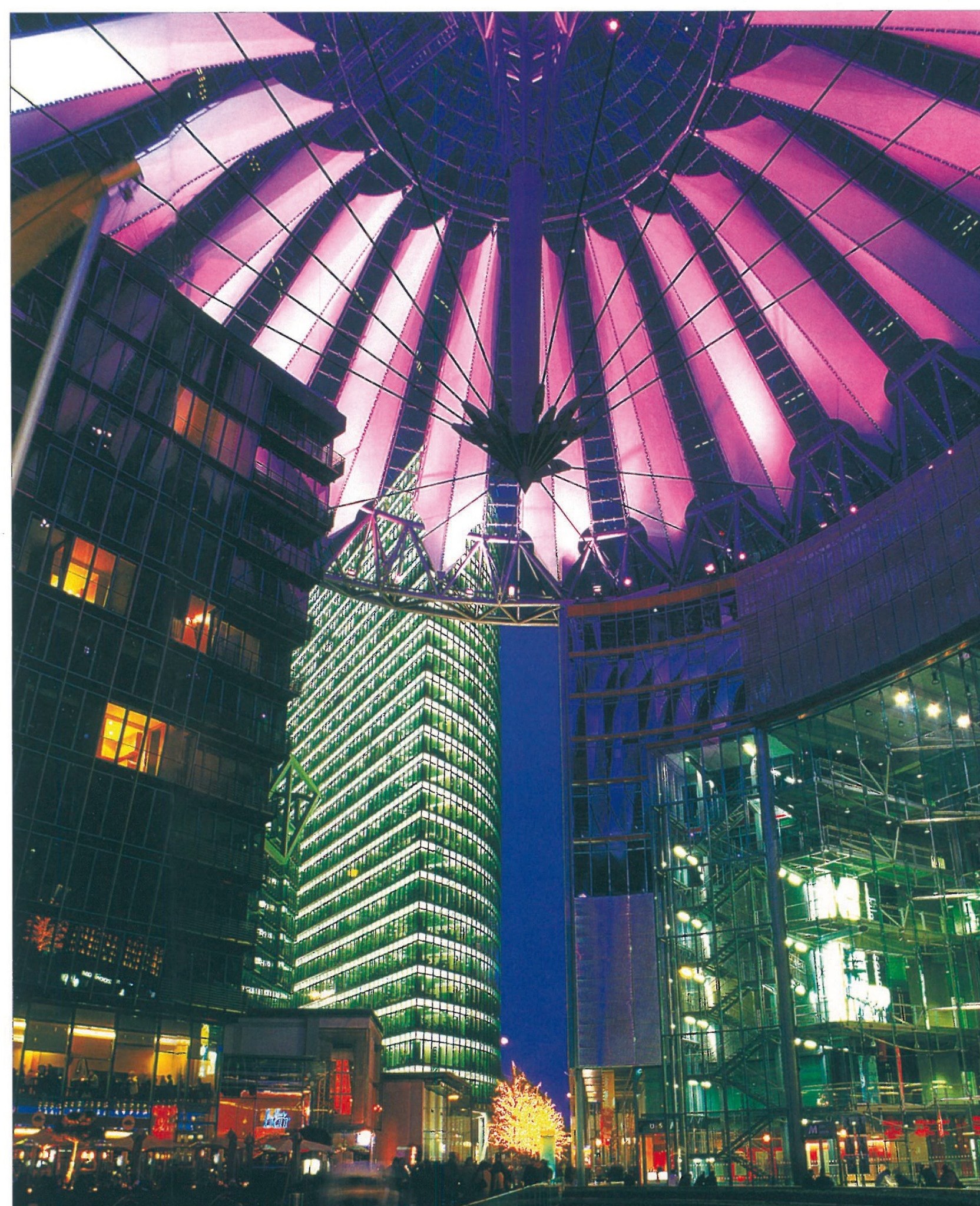
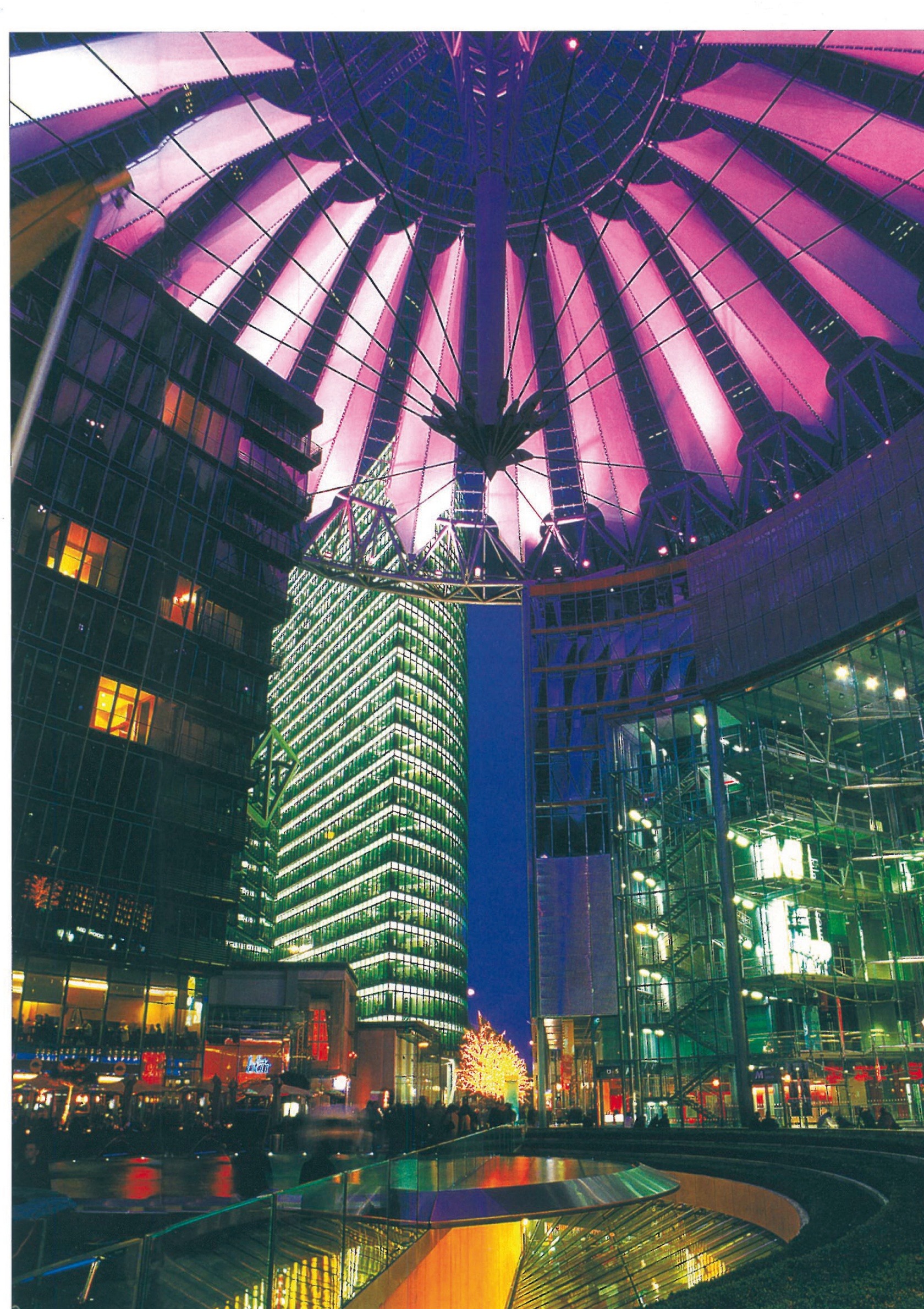
One of the most beautiful architectural ensembles can be found at Potsdamer Platz, where the Daimler-Benz buildings stand. Here the commercial spectacle reaches its zenith — an intelligent environment with display screens showing live events, suspended automobile prototypes hovering in space like spacecraft.
But among the countless masterworks and outstanding examples of architecture in Berlin, none is more impressive than Mies van der Rohe's National Gallery. During our visit, it was hosting the modern painting collection of MoMA, and one had to wait eight hours for admission. The building is indescribable: large without appearing large, magnificent without striving for magnificence, and delicately, masterfully crafted in an engineering simplicity that catches the eye. It is a building that achieves grandeur through restraint.
The MoMA painting collection itself, compared to what one might see in France, was not particularly striking. Apparently, it is the name "Museum of Modern Art of New York" that draws such crowds — a testament to branding power in the art world.
A City Between Past and Future
Berlin is a city of contrasts and convergences — where the scars of history are neither hidden nor forgotten, but woven into the fabric of a relentlessly forward-looking urban environment. From the preserved ruins of the Kaiser Wilhelm Memorial Church to the soaring glass canopy of the Sony Center, from the haunting corridors of the Jewish Museum to the sleek embassies lining the Tiergarten, Berlin presents architecture not merely as shelter or spectacle, but as a living record of human aspiration, failure, and renewal.
For the visiting architect or the attentive traveler, Berlin offers an education in how a city can simultaneously honor its past and embrace its future — making it, as the title suggests, a place perpetually looking on to what comes next.



