


The architectural community has long been mourning the widening gap between post-structuralist theory and practice [Architectural Record, March 1998, p. 62; Farsi translation in Memar 2, p. 18]. Now, with the accelerating globalisation of capitalism, more and more architects and academics — as Michael Speaks has noted on page 19 of this very issue — are engaged in studying this condition. One clear recent sign of this was the conference of 9-10 November 2000 at the Museum of Modern Art in New York, titled "The Process of Evolution: Contemporary Architecture and Pragmatic Imagination," at which not a chair remained empty.
The conference, organised by Joan Ockman, director of the Buell Center at Columbia, and Terence Riley, chief of the Department of Architecture and Design at the Museum of Modern Art in New York, sought to find ways by which American pragmatism might bring thinkers and practitioners together. There was a time when the philosophical approach of pragmatism — given its name by Charles S. Peirce in the late nineteenth century and revived over the past twenty years by Richard Rorty of Stanford and Cornel West of Harvard — was reproached for its American instrumentalist bent. This approach paid much attention to action but not so much to the question of how we think and know. Nevertheless, as West has written, pragmatism should be regarded not as a philosophy but more as "an always-present cultural interpretation that seeks to explain America to itself at a specific historical moment."
The truth is that had the conference been limited to such charismatic figures as Peter Eisenman and Richard Rorty, and to Cornel West and Rem Koolhaas, half a day would have been enough. Stan Allen, to clarify matters, drawing on his own experience as both architect and thinker, offered the finest summing-up of the appeal of pragmatism. These five speakers drove the discussion along paths that no other thinker or architect could have so well.
Still, I have to say — in both the Eisenman-Rorty debate and the West-Koolhaas one — one had the feeling of returning from a spirited wrestling match between architects and philosophers. In this particular contest the match between Eisenman and Rorty was lively and fairly sharp, but there was no clear winner. Rorty was disinclined to play in the way Eisenman was trying to press — by using high-theory words like "criticality." In the bout between West and Koolhaas, Koolhaas kept stepping into every trap West laid for him, making their debate resemble a dance — sometimes with heavy foot-stamping, sometimes with a soft pirouette on tiptoe.
What came out of this performance? A few moments of sharp insight. Rorty began by marvelling that architects should need philosophy so much in order to design well. He said the choice was theirs, but it was unlikely that they would benefit from it. He was genuinely pessimistic about architecture expecting great answers from philosophy, and held that architecture should look to philosophy as a source of inspiration, not of instruction.
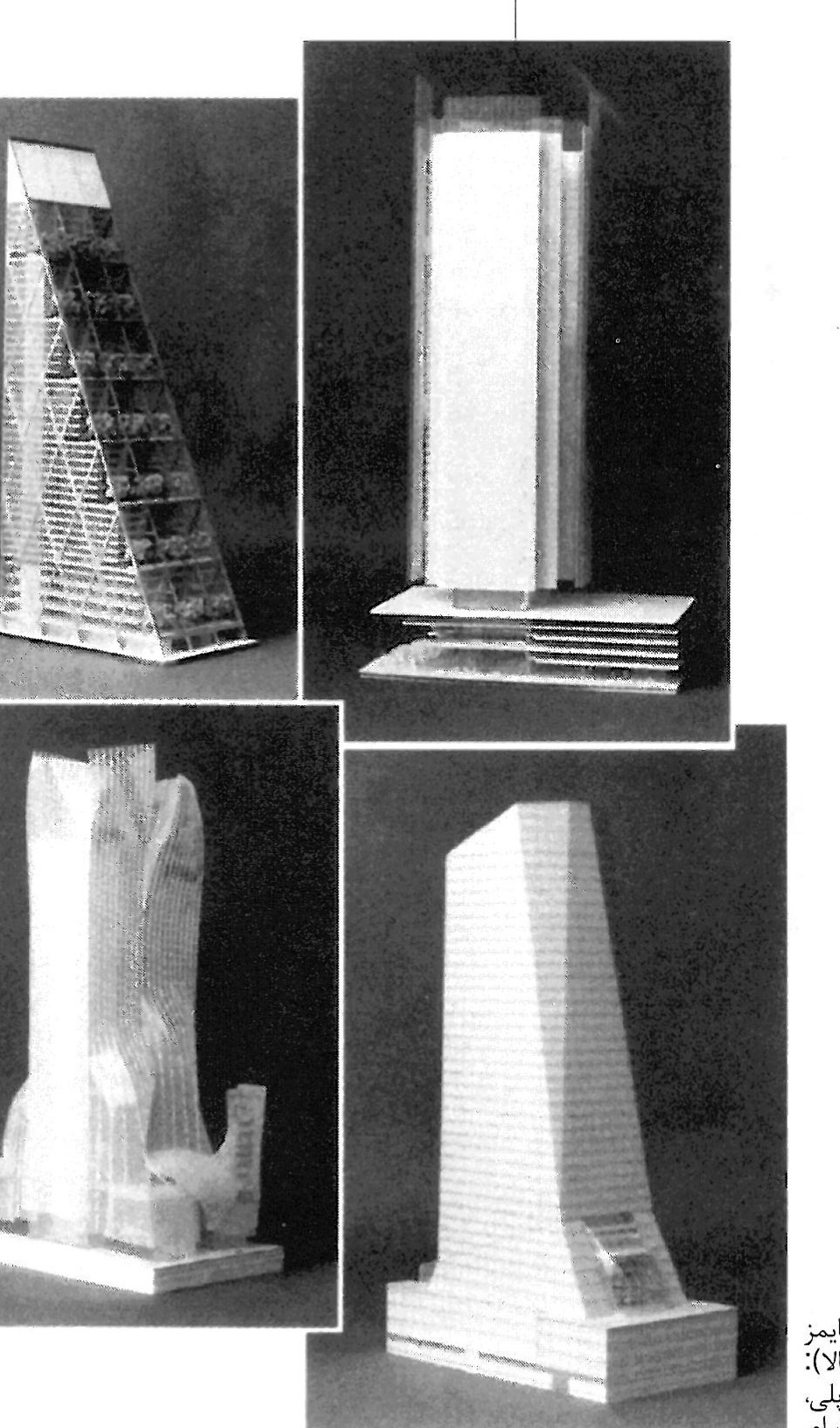
In defence of his claim that architects need a "critical sense" in design — that is, questioning assumptions and, by means of form, resisting the customary way — Eisenman cited the New York Times Tower competition. The Gehry and SOM schemes, he argued, exhibit critical sense, while Renzo Piano's entry shows excessive deference to the client's taste. Rorty, who seemed not to care for the term "critical sense," used his own term — "novelty for architects" — which he thought somewhat low-grade. In his view, architects who design something new and original have a critical view of the prevailing convention. But Rorty had no concern with what novelty the Gehry/SOM scheme had that the Piano one lacked; his opinion was rather that an architect should do what he feels. If public reception is zero, the architect's scheme turns out to be nothing more than a personal self-expression; if others follow him, it turns out that he has answered the spirit of the age.
When Eisenman also put "accountability" on the architect's agenda, Rorty again looked doubtful: he did not believe that an architect's "sense of responsibility" would satisfy all his audiences. Rorty said, with a paternal (or an "earnest psychoanalyst's") air, that the preoccupation with "criticality" and "accountability" arises from the motive of "shake them up so that people do not think your imagination has run out." He added that "if you do not excite society today, it's not clear that future societies will be excited by the same work."
Unlike the theory-minded Eisenman, Koolhaas showed a more pragmatist enchantment with capitalism, though the trace of pessimism and anti-rationalism was apparent in him. But West paid that no mind: he called Koolhaas' research in the far corners of the world — in places like Lagos — into question with the question, "What sort of compromise will this yield in these places, with the colonial forces? What opposing role will your work in Nigeria play in the world?" He did not seem satisfied with Koolhaas' answer — that his work was only research, i.e., documenting findings.
Among the conference's architect-speakers, Stan Allen, who teaches at Columbia, offered the most fitting summation of pragmatism's appeal. Allen, with a firm grounding in the theory and criticism of the 1970s and 1980s, leaned upon theory, not practice, for a part of architecture's intellectual foundation that had been lost by the previous decades' excess of instrumentalism. At the same time his view of "criticality" differed from Eisenman's: for Allen architecture has never been a specifically effective vehicle for critique. In saying that "architecture does not comment on the world, but acts within it," Allen showed he would like "the present conversation" to continue so that working and thinking may proceed together. In his view, pragmatism is worth another look philosophically: it is not — as some assume — wholly instrumentalist; with its sceptical and rebellious method it wants to test every norm in practice. Allen held that pragmatism is partisan of being "soft and sensitive" but not "capricious and fickle." As he added, "productivity requires that architects set aside obsolete mental strategies so that the way may open to fresh techniques."
After all that has been noted, one should say — if nothing else came out of this conference — what one typically hopes to get from a two-day discussion, namely an occasion for thought, was indeed obtained.