Carlo Scarpa
This family tomb, dating from the death of Augusto1 Capovilla (September 1943), was Scarpa's second design for a cemetery memorial. A few years earlier Scarpa had designed the first tomb, for Vettore Rizzo2, in the same cemetery (1940–41, now demolished), from which this one distances itself by reconciling the first example's explicit references to perception and awareness after death with Italian monumental traditions.
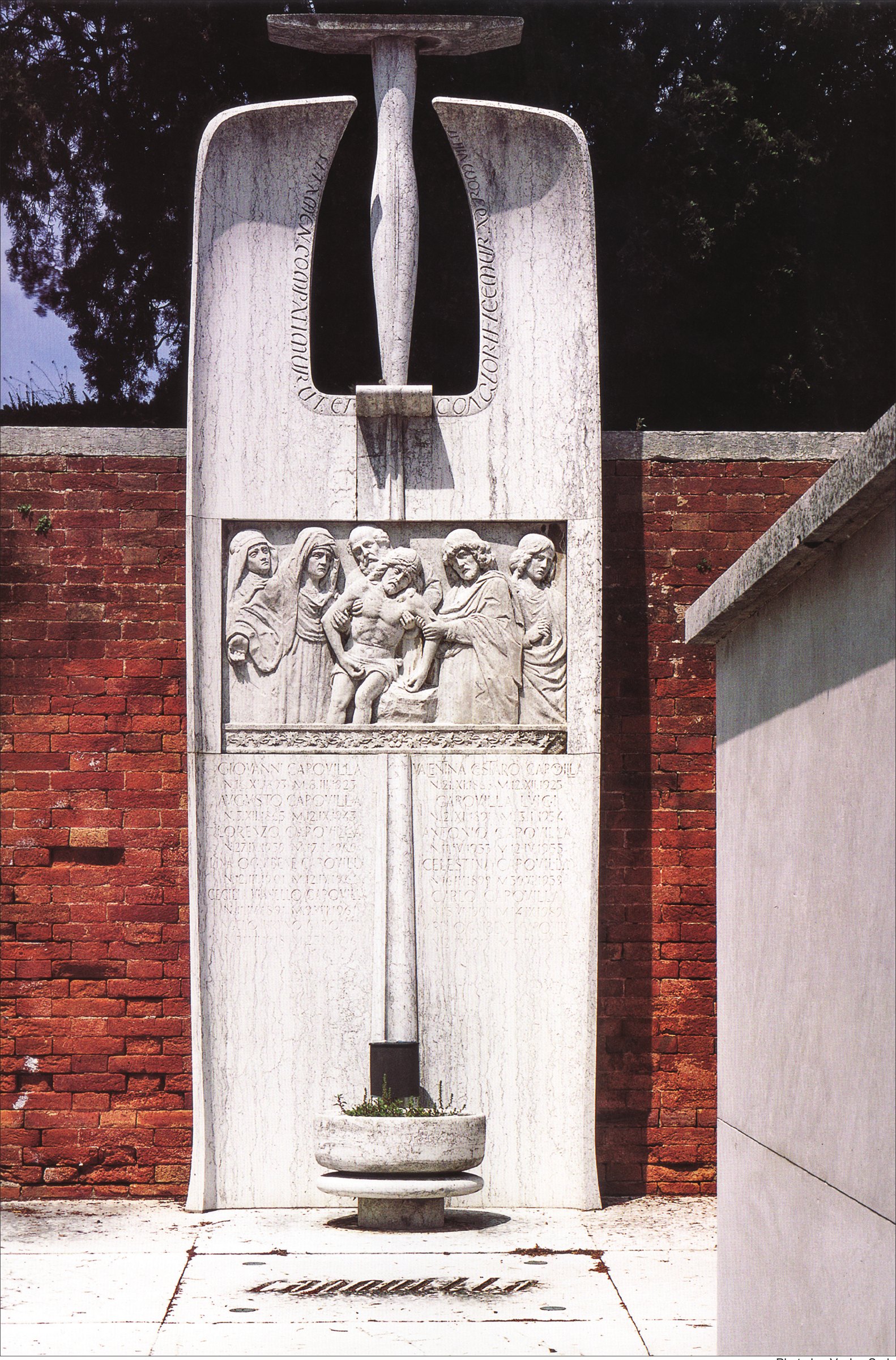
The memorial is a tall stone stele of Botticino3 marble, slightly recessed, and it frames a testimonial belonging to the clients that, holding the light within a quiet play of shadows, invites the viewer to contemplation. At the top it divides into two curved wings, with a slender urn between them that stands out against the dark background of the cypress trees and catches the eye, without the marble band in some of the drawings that seems to surround its back; the composition is enclosed by the polygonal cladding of the vase. The pencil drawing "foreground elevation", published in the GA document (1988) and A+U (1985), is noteworthy: a pictorial composition almost independent of the design, recalling both metaphysical painting - de Chirico's mannequins4 - and some pieces of Scarpa's own glasswork contemporary with the Venetian memorial (see the clear glass cup with blue spots in the middle, and the black decorative piece made by Venini & Co.5 in 1942, in Barovier6 1999).
This tomb is fundamentally different from the neoclassical tombs around it, above all because of Scarpa's design with a wholly vertical line. Not merely because its stone stele rises above the back wall by a third of its height, but because of the tapering of the stone (beginning at a thickness of about 7 centimetres at the base), the composition's clearly axial nature, its lightness and slight pressure on the ground, and its distance from the cemetery wall, to which it is anchored at only one point, at the top of the wall.
A conical stone element, grooved at the centre, marks the vertical axis of the composition, passing neatly through the figure of Christ and reaching the niche at the top, before continuing symbolically in a slight cut - a very small wound with raised edges - inside the urn. The inner curve of the wings holds a carved inscription. The family name is also engraved in the paving in front of the tomb in italic letters in the style of Le Corbusier.
Footnotes:
1- Augusto Capovilla
2- Vettore Rizzo
3- Botticino marble
4- De Chirico’s mannequins
5- Venini & Co.
6- Barovier
Carlo Scarpa: Architecture and Design