Whatever historical means or other justification we use, it is because we do not want to accept the existing situation that plagues us. I believe this should be the fundamental premise of this session. Let us accept this reality and speak based on the current state of affairs. Perhaps in Isfahan, our situation regarding facades is more complicated, given that 90 percent of urban spaces and urban design are shaped by facades. For instance, we have the issue of overlooking. Below 75 centimeters and 1 meter for a facade, we cannot have a view into the neighbor's house, which inevitably pushes our design toward shell design. In my opinion, the question can be formulated as follows: Can the facade, as the primary design subject of projects that form the city's body, bear the burden of the lost issues of urban design and urbanism in the present era? That is, the work that we have been compelled to think about because of Isfahan's urban fabric, its urban body, and the existing regulations. We must both accept the existing situation and be responsible toward it and offer solutions. In our office, we are very interested in the subject of facades and have frequently undertaken such work. When the foundation of architectural issues is shaped by a kind of cultural and economic conditions and people's way of life, and the subject has been narrowed down to the facade—whether we like it or not—we must see what should be done about this existing situation. Sherafati: I even believe our approach should be more pragmatic and the scope of discussion more limited, confined to a few things, of which urban image may be one. We are accustomed to viewing the facade as something very personal, thinking we are permitted to do anything within this domain. But perhaps the subject is not inherently so. I do not think, as Ilkhani said, that if all facades were given to architects, they would build them very well. There are many villages, or perhaps all of them, whose buildings are not built by architects at all, yet they have very uniform and homogeneous facades. In Europe, there are places that architects have built, yet nothing harmonizes with anything else. Perhaps the cause is not architecture. There are cities that have urban frontage, and that frontage is harmonious throughout its entire length. But we have no frontage. If, for example, they gave all of us an alley to work on, each of our individual buildings would turn out very well, but there is no chance we would be pleased with that frontage. Why is this so? Mohammadzadeh: Because there is no consensus. We act based on individuality, doing things that are good in themselves, but the collective result may not be desirable. Taghaboni: Let me be clear; my view is that the strategy can be urbanistic, meaning if we work together, we can hold sessions and coordinate our strategies. In that case, why would we not be pleased with that alley? I believe we would be. Sherafati: You cannot gather all the architects of a city to arrive at a single strategy. Mohammadzadeh: This subject is becoming a phenomenon that is beyond everyone's control—like some other phenomena in culture. Dabbagh: I think this subject is like fashion or taste. For instance, at one time three-centimeter brick and aluminum windows were in fashion; the entire middle class built that way, lived in it, and was fond of it, and a kind of urban image had emerged. Or currently, at the speculative builder level, in the luxury and expensive and ostentatious type of city buildings, Roman facades have become prevalent, and the municipality's facade committee in District 1 is trying to suppress this type of facade. Whether this committee itself has the ability to reform this tendency and create a new model, or to correct facades one by one, is another discussion. The negotiation you say should happen among architects, say at the scale of an alley, must also exist systematically at the societal level—for instance, through the municipality or the Ministry of Roads and Urban Development. Because in any case, when this discussion is raised at a social level and moves beyond the domain of various individuals with various tastes, it can reach a conclusion. In my opinion, this gathering can be a beginning for us to say we are sensitive about the issue of our urban facades and that these things need to happen. Nabian: The urban facade is not the sum of architectural facades. The urban facade is directly influenced by the city's morphology. For example, when we walk along Fifth Avenue in New York, do we not see classical facades? 70 to 80 percent of what we call the urban facade on this street belongs to neoclassical buildings of the 16th—why do we not have a problem with that there, but we do in Tehran? Tehranchí: We always say that those who draw classical facades do poor work. But in my opinion, these are good—what is wrong with them? In fact, these represent a kind of architecture that has discipline, has standards, and follows certain rules and principles. Nabian: The facade you speak of is a facade, not the facade that Nasiri spoke about earlier. Tehranchí: I am speaking of the urban facade; I have nothing to do with approving or rejecting the classical facade. Building 93, Tehranpars. Alireza Taghaboni: • Recognizing pluralism • Strategy and critique of strategy [BW7, Arad Design Company] Korush residential building. Dabbagh: • The domain of the facade is the city, which is beyond the architect's control.
I have no opinion on that, but it seems to me that these individuals have unconsciously arrived at principles and rules that both satisfy the user from a psychological standpoint and possess an inherent discipline. That user would no longer allow themselves to tell the builder to construct their facade with cement; a classical facade must be built with stone materials. I do not endorse the classical facade, but I say it has one positive aspect: it is not arbitrary—there are principles behind it. Nabian: In my view, in improving the urban frontage that forms the city's image, none of us who work on individual projects are influential. It is a matter of regulations, just as a city like Stockholm is shaped by regulations, not because it has good architects in 100. The source of these regulations is architectural discipline, and within that, an individual's architectural discipline, like Arash Nasiri, must come and lay out the critical substance of this assessment on the table, so that we can then see how those we call architects can influence the architecture of the frontage, which has never been a subject of architecture. Are the architects building Toronto, which you cite as an example? It is the regulations that have made Toronto take that proper form—70 years of critical history. These regulations rest upon modern architecture, rest upon the Seagram Building. The reason we do not have proper regulations is that even if we have our own Seagram, we have not properly analyzed and critiqued it. Sherafati: Regulations address codes and technical issues. When we have an architectural style, it is much easier to create a kind of harmony using a style. For instance, in the past, because there was style, this happened; but now we are in an era where style is dead, and there are so many styles that practically anyone can say they have their own style or have no style at all. So how is it possible, in the absence of style, to arrive at a specific style? In modernism and classicism, such a thing occurred. In our time, style is dead. Farzin: In my opinion, style and regulations alone cannot save the facade either. Navab is a project that had regulations. Mohammadreza Roudneshin: As Tehranchí said, regarding Roman and classical facades, a group of people—whether they were architects or not—were able to assemble a set of principles and, considering the fashion of the day and public taste, create a discipline that works from the north of the city to Shoush. Near Aran-o-Bidgol, a new township has recently been built that is not an apartment complex but consists of single-story buildings. The units are very small, the street layout is a grid, and each person built independently for themselves. But they set only one regulation for the facade, and that is the type of material. They said the material type is only brick. But diversity in form, design, color, and type of brick is free. Yet the fabric that has formed there on the edge of the desert is entirely tolerable and to some degree beautiful. This township, with only one regulation, has achieved favorable conditions in terms of climate and culture alongside the traditional fabric. We, as architects, must open these discussions and influence those who determine these disciplines. Mehran Haghbin: Since I have a fondness for classification, I will categorize this discussion into several areas. If we consult books on facade design, these books speak of no more than three subjects: 1- Materials, 2- Proportions, 3- Technique. Much has been discussed about these three approaches until today, and beyond these, the books say nothing about taste and laws and regulations. I consider three periods for the facade: classical, modern, and contemporary. Where the facade's function is specifically to separate the boundary between outside and inside refers to the classical era. The modern era goes further and acquires a somewhat critical outlook, and its subject becomes breaking rules and saying new things with the technology at its disposal—from what perspective? From the perspective of aesthetics. Today, the facade is a matter of function. What previously had meaning only as an appearance to be seen now transforms into something that has a function within the building. This function is partly about energy and partly about the placement of architectural elements, such as doors, windows, and changing proportions between them. These are subjects that, if we take a material-based approach to the facade—whether it has thickness or not—the facade itself can have much to say, whether from this perspective or the perspective of urban regulations, or from an architect's viewpoint, or from a larger framework such as the city's form. Each can have its own particular appeal. We as architects should examine one aspect, and other colleagues should be able to examine it from the standpoint of law and urban regulations, or technical dimensions and building services, and yet other colleagues from the standpoint of materials used or ecology. We can cite very good examples of vernacular and local facades that, by merely using one type of technique, can work for us, and there are quite a few. Nabian: I am not saying that we as architects make decisions for the city or determine— Sam Tehranchí, Telemetry Building: • Urban discipline and social receptiveness to discipline • The facade is the most technical and most economical part of a building.
—we dictate. I am saying that, for our part, we need to do what Nasiri or Taghaboni does. Nasiri: In my opinion, Haghbin's point was also correct, and what I said was my angle of view toward the facade. The point that was interesting to me is the question of performance, which is a functional matter. Function is a strategic issue, not an aesthetic one. Therefore, how interesting it is that the facade in the contemporary era has a strategic function, rather than an aesthetic one. And when we look at the history of Western thought, we see how strategic function relates to techniques that maintain the balance of power in society. In fact, the balance of power in the contemporary era is established through strategic function, not through aesthetic issues. Thus, being strategic in the contemporary period is an important matter. For this reason, the facade shifts from being a battleground over aesthetics—shortness and tallness, historicism and modernism—to a site for engaging with various functional issues. For example, synchronization with the environment is a strategic function, not an aesthetic one. The intelligence or flexibility of the facade, or the facade's responsiveness to the environment, is a strategic function, not an aesthetic subject. And if we do not understand this, we think the variable facade is an aesthetic subject. Hashemi: How does the facade respond to the environment? Nasiri: We have understood that strategic function is what plays a role in the transfer of power and the cycle of authority and style. We have understood that what causes a social structure to form is our understanding that the equalization of power in society proceeds through strategic function. Likewise, in the domain of architecture, the building's shell, the building's facade, and this outer skin of the building serve a strategic function, not an aesthetic one. That is, for instance, if you are in Times Square in New York or any capitalist center of the world, what speaks to you are the functions of affairs, not their aesthetic aspect. The function of a neoclassical building on Fifth Avenue in New York is no longer a classical function in the manner of wall and structure, but rather a message from the capitalist system to whoever passes through that street. Hashemi: You may call the building's envelope a shell or give it any other name and definition, and all sorts of factors may be effective in shaping it. But none of these are the facade. The facade is something that is designed. The designer, consciously or unconsciously, is influenced by all these factors and ultimately designs it so that it will be seen in a particular way. This has nothing to do with past and present; from the beginning of history, the facade has been this. It is true that technology has now changed the conditions for forming today's facade, but still, the facade is built so that it will be seen. Sometimes the facade is seen within a limited field of vision, and sometimes in a public urban space. But in any case, it is built so that it will be seen. Because the facade is not for the person living in the building but for the population outside. Nasiri: How is it not? Like Jean Nouvel's project in Paris, which opens and closes—it was among the first facades that have a strategic function, meaning instead of designing it, they thought this facade could have a function, and this shifting has been formed in that same direction. Hashemi: In old envelopes too, windows opened and closed and air currents passed through them. In my opinion, the facade is the display face of the building's exterior. Among both experts and the general public, when they say facade, they have no concern with its technology and functional discussion—they mean what is seen, and it is certainly designed. Energy calculations and all the functional relationships between inside and outside have their place and must be applied in design. But design is ultimately what is seen from the outside. What is wrong with the facade being seen from the outside? Qodusi: Nasiri is saying that the aesthetics of the facade can be the product of decisions whose effects are simply beyond taste. Hashemi: I know, but those do not manifest in the facade. All those functions are for the interior. Energy is for the interior, not the exterior. Qodusi: For instance, you could turn your entire building facade into an advertising billboard and say my facade is a large billboard and I sell it. Hashemi: Again, that advertising has no relation to the interior function and is independent. I do not know why we are afraid to say that the facade is designed to be a facade and to be seen. Qodusi: We are saying the facade is a discipline. Hashemi: The discipline does its work; if the discipline were the ultimate determinant, there would be no need for a designer. These are factors that influence the limitation of facade design, but ultimately someone must design the facade. First-place winner, Mehrshahr Residential Complex design competition, Karaj. Contemporary Structural Designers, Ali Garmaroudi and Mohammadreza Roudneshin. Mohammadreza Roudneshin: • Discipline to whatever extent is feasible.
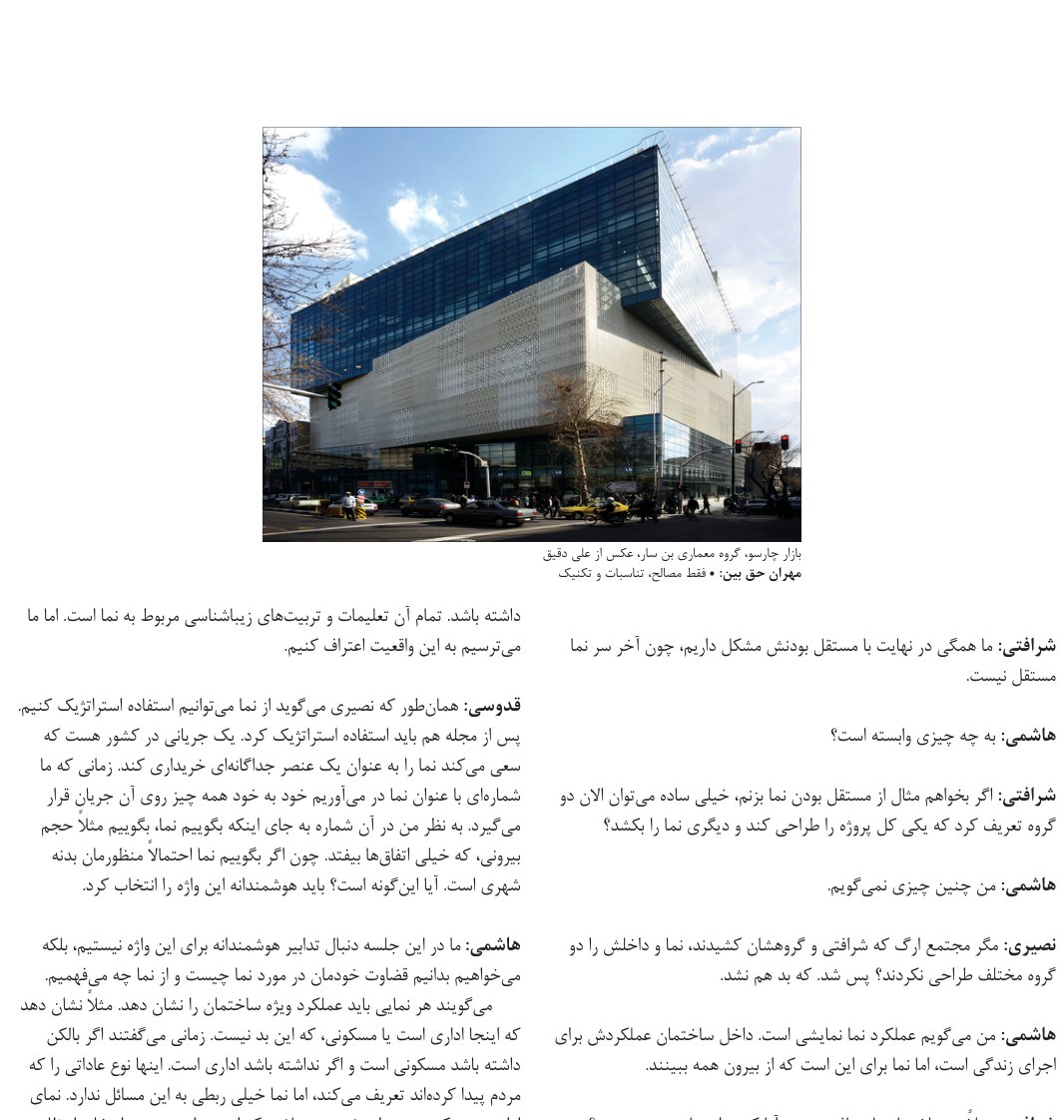
Sherafati: In the end, we all have a problem with its independence, because ultimately the facade is not independent. Hashemi: On what is it dependent? Sherafati: If I want to give an example of facade independence, can we very simply now define two groups where one designs the entire project and the other draws the facade? Hashemi: I am not saying such a thing. Nasiri: Did not the Arg Complex, which Sherafati and his group designed—were not the facade and the interior designed by two different groups? So it was done. And it did not turn out badly either. Hashemi: I say the function of the facade is display. The interior of the building functions for the conduct of life, but the facade exists so that everyone sees it from outside. Sherafati: For instance, in buildings of the traditional fabric, does anyone see anything of the facade? Hashemi: That is a separate discussion. At one time, in Iranian cities, apart from certain distinguished points—such as the square, the bazaarche, and the neighborhood center—we had nothing. There was no insistence that urban frontage exist everywhere. Like all the alleys and back alleys that existed in our traditional fabrics, which were merely corridors we passed through, with nothing to display, and the entire building facade was inside the courtyard. But now we too have acquired an urban facade. You have all been on juries. The major decision of jurors is about the exterior volume, and the exterior volume is shown through the facade. Why do they not render the plan but render the facade? Because the plan is not seen, but the facade is seen, and they want the facade to look good and to be seen the way they intend. Farzin: I think you have in mind a tension between designing from the interior side and designing from the exterior side of the building. When we design, it often happens that from the interior view, we want to make the window large, but when we go to the exterior, we want it to be small, and this conflict always exists. Hashemi: The facade is a unified image—meaning it must have a complete composition. All those teachings and aesthetic training pertain to the facade. But we are afraid to acknowledge this reality. Qodusi: As Nasiri says, we can make strategic use of the facade. So we must also make strategic use of the magazine. There is a movement in the country that tries to purchase the facade as a separate element. When we publish an issue titled "Facade," everything automatically falls on that movement. In my opinion, in that issue, instead of saying facade, we should say something like exterior volume, so that much happens. Because if we say facade, we probably mean urban frontage. Is it so? This term must be chosen intelligently. Hashemi: In this session, we are not seeking intelligent measures for this term; rather, we want to know what our own judgment about the facade is and what we understand from it. They say every facade must show the building's specific function. For instance, it should show whether this is an office or residential building—which is not bad. At one time, they said if it has a balcony, it is residential, and if it does not, it is an office. These define the kind of habits people have acquired, but the facade has very little to do with these matters. An office facade and a residential facade can look alike, which is bad, because from a home we expect more vitality and from an office more dignity and seriousness. But facade design is not much governed by its interior function. Of course, that envelope must have all the qualities you mention, because someone might fault you, asking why your facade is beautiful from the outside but the rooms inside are dark. Nabian: In my view, it is the standard of the market. In the Iranian market in current conditions, residential buildings are marketed through their facades. But right now a movement has begun toward selection based on common amenities and the quality of building services. Hashemi: But the same building that has all the advantages of amenities and services—if it also has a facade to the public's taste, it will be purchased at a higher price, and the facade will not be eliminated at the cost of those factors. Nabian: In my view, it will be. Footnote: 1- Performance. Charsou Bazaar, Bonsar Architecture Group, photo by Ali Daghigh. Mehran Haghbin: • Only materials, proportions, and technique.
Ziggurats have always been testimony to the settled human's enduring desire for movement toward the beyond and ascent to the heavens. Until recently, archaeological studies indicated that the era of ziggurat construction belonged to a specific period spanning from 2200 to 550 BCE. Based on this, the oldest among them was believed to be the Ziggurat of Ur in southern Mesopotamia (located in present-day Iraq), dating to approximately 2110 BCE. However, recent discoveries by Iranian archaeologists have refuted this hypothesis, revealing that the Tepe Sialk of Kashan contains the remains of a vast and far more ancient ziggurat, dating back some 4,700 years. Nevertheless, the largest ziggurat built in the ancient world remains the Ziggurat of Chogha Zanbil. Among the peoples of Mesopotamia—one of the earliest regions where humanity experienced settled life through agricultural production—it was believed that multiple gods governed the world, and that each city also had its own particular deity. Based on this belief, the people built a tall structure in the city center for their god to dwell in, and in smaller temples they presented their offerings and tributes to that god. Archaeological studies, prior to the discovery of the Sialk Ziggurat in Kashan, indicated that the construction of ziggurat-form sanctuaries had become commonplace primarily in the lands of Mesopotamia from the dawn of civilization. The Sumerians were the first to build them, followed by the peoples of Babylon and Assyria in their wake. Subsequently, the Elamites too, influenced by the surrounding civilizations, adopted this method for constructing their sacred spaces. This edifice was built by the command of the great Elamite king Untash-Gal for the worship and praise of the deity Inshushinak, meaning the guardian goddess of Susa. In an ancient text attributed to him as the founder of this temple, it is written: "After I obtained building materials, I erected the city of Untash and the sacred precinct here, and enclosed it within an outer wall and an inner wall. I built a tall temple unlike anything that previous kings had built, and I dedicated it to the god Inshushinak and the god Humban. May my construction and labor become their endowment, and may the grace and justice of Humban and Inshushinak endure here." The Elamites held a beautiful, mystical belief that at sunset, their god Inshushinak ascended from the highest point of the ziggurat toward the heavens, and the next day, with the sun's return to the sky, he returned to the sanctuary. In the Louvre Museum in Paris, there exists a stone-carved image of Untash-Gal, the king who founded Chogha Zanbil, as well as a bronze statue of Queen Napirasu, the king's consort, depicted performing a ritual ceremony with cuneiform inscriptions on her garment, in the presence of the gods. These finds, along with several other artifacts—the most important being the beautiful glazed ceramic bull figurine serving as the guardian deity of Chogha Zanbil (in the National Museum of Iran)—are among the remains recovered from the prolonged excavations of Professor Ghirshman in this archaeological site. What is considered a unique and unprecedented innovation in the architectural body and the very philosophy of Chogha Zanbil's construction is the method of building and the manner in which the platforms and various levels of this towering temple were formed—levels whose construction through to the final stage was undoubtedly regarded as an emphasis on ascending degrees of transcendence in space. ... A few remarks about the architectural characteristics and water supply installations of this ziggurat can further justify its enigmatic nature: The foundation of the ziggurat is an immense square, encircled by three circular ramparts at various distances, which served as a form of protection for the temple, the city's inhabitants, and pilgrims. The fundamental four-sided nature of the structure—maintained with particular precision from base to summit through the construction of stories as exact squares in plan—is an indication of the special attention that has long been expressed toward the value of the number four in the design and construction of buildings. General view. General view.
The number four in the ancient world symbolized the four cardinal directions, the four seasons, the four pillars of existence, the four stations of the moon, the four rivers flowing in paradise, and more—ultimately considered a sacred number in architecture. The Ziggurat of Chogha Zanbil, which was in a sense humanity's ladder of ascent to the heavens, followed the sanctity of the number four by having four gates oriented in each of its four cardinal directions. Without doubt, the absence of high mountains in the low-lying lands and the vast plains of Khuzestan and the Mesopotamian floodplains was one of the primary reasons for constructing such structures in this region. Another distinguishing feature of this ziggurat is the construction of its five stories, as evidence shows that in the first phase of the temple's construction, only the first two stories were built as quadrilaterals enclosing a vast courtyard within them, and subsequently three additional stories were constructed, completing the temple's total of five levels. As is apparent, these concentric stories were founded upon a single platform at the ziggurat's base and were built independently to reach the intended height. In other words, each story was enclosed within the preceding one. Atop the last level—the fifth story—a temple undoubtedly stood. According to archaeological hypotheses, the total height of the structure, including the upper temple, was 53 meters, and this height was equal to half the ziggurat's base, or 105.10 meters. In this manner, the ziggurat's elevation forms an isosceles triangle resulting from the combination of two smaller isosceles triangles with sides measuring 53 meters. In the open space before the temple, on the main floor, there are two circular platforms that some archaeologists have identified as sacrificial platforms, while others have associated them with the Elamites' astronomical knowledge and solar calendar.
What has been stated regarding the architectural features, the exceptional construction method, and the dimensions of the ziggurat in terms of its base and height are signs of the existence of an intelligent knowledge and vision in the design of this immense temple. In addition to the use of precise mathematical logic and geometry, the employment of a unique method for constructing the stories distinguishes this structure from other great heritage monuments—although the reason for adopting such a method for building the temple's ascending stories remains unknown and may be regarded as a sealed secret. Among the other astonishing features of the temple are the utterly unconventional innovations in the means of access for worshippers to the various stories, and a singular and unimaginable example of the design thinking behind this colossal edifice. The first story of the ziggurat has a height of approximately 1 meter and a width of 3 meters, built entirely of brick, with access provided by inclined surfaces constructed solely for reaching this story and not connecting to the upper levels. The second story, whose construction also began from ground level—the same elevation as the first story—with a height of approximately 8 meters, has its own specific access route and has no connection whatsoever to the first story. This story contains roofed chambers of special dimensions and proportions, numbering seven, each measuring 10 meters in length, 2.10 meters in width, and approximately 6 meters in height, and remarkably, they have no connection to one another. The walls of the chambers were whitewashed with lime with great precision, and in each one, a row of exit stairs was built with raw mudbrick. The existence of additional parallel chambers in the northeastern section, the use of brick coverings, and the employment of turnip-shaped arches—previously thought to be a Parthian invention from a period much later than the Elamite civilization—along with the discovery of remnants of glazed tiles in green and
white, which occasionally reflect traces of gold and silver mosaic tile, are among the other hidden marvels within this sanctuary. It should be noted that the fired bricks of Chogha Zanbil measure 37 × 37 × 7 centimeters, and on the top of many of them, cuneiform inscriptions have been written like a special inscription. Unfortunately, during the early excavation digs, many of these small and precious inscriptions were used 120 years ago by Jacques de Morgan in constructing the fortress of Susa, embedded in the high walls of the fortress, and were forever separated from the ziggurat's original body. ... And finally, the water supply and purification system of the city and temple of Chogha Zanbil is another of the astonishing innovations of the Elamite civilization that merits a brief mention: Although Chogha Zanbil is located near the great Dez River, due to the considerable depth of this river in its natural bed, even in that era it was impossible to use the water for the city and temple. For this reason, the Elamite king ordered the excavation of a very long canal extending approximately 50 kilometers to supply the needed water from a different elevation on the Karkheh River. Since the muddy water of the Karkheh was unsuitable for the city's inhabitants, remarkable measures were devised to purify the water that had been channeled with great difficulty to Chogha Zanbil—measures considered highly ingenious for their time. Thus, in front of the city's rampart, advanced hydraulic facilities were constructed, consisting of a large reservoir excavated in the ground outside the rampart and a small basin connected to it inside the rampart. Water was directed to this section through a system of small canals and, after settling and clarifying in the reservoir, was transferred to the small basin. Through a masterful process, the filtered and clear water was ultimately made available for the city's residents. Surveys show that the large reservoir measured 10.7 meters in length, 25.7 meters in width, and 35.4 meters in depth, with a capacity of approximately 350 cubic meters. The floor of the reservoir was paved with fired brick and very hard lime. Two side walls of the reservoir were also constructed of fired brick and lime. The fourth wall of the reservoir, facing the city, was built of thoroughly fired brick and lime. The installation of the clear-water basin, the various holes and canals designed for water intake, the provision of level differences for sediment settlement, and many other measures all attest to the extensive mastery of the designers of the Chogha Zanbil sanctuary and city over the laws of hydraulics and physics. In the realm of construction and the effort toward the permanence of a structure from which 3,500 years have now passed—and which, despite attack, destruction, plunder, and natural disasters, has still preserved a large portion of its body—the ingenuity of its builders is evident. The masterful use of raw mudbrick, various types of fired and thoroughly fired brick, natural bitite (bitumen), lime, and sarooj are all undeniable proof in support of this claim. Unfortunately, during the bloody invasion of the city and sanctuary of Chogha Zanbil by Ashurbanipal, the ruler of Babylon, in 640 BCE, irreparable damage was inflicted upon this immense structure. He recalls this horrific act with particular pride in an inscription: "I conquered fourteen cities and their palaces, along with numerous small villages in the region of Elam, plundered them, destroyed them, and burned them with fire, and reduced them to ruins, and killed a great number of their warriors." After this deadly assault, Chogha Zanbil was never again occupied or given attention during the Achaemenid dynasty, and during the Parthian era, only shepherds occasionally camped there in favorable seasons to graze their sheep. Over a period of more than three thousand years, Chogha Zanbil was buried under a mound of earth, until in 1890 CE, the renowned French geologist Jacques de Morgan prepared and presented a report on the existence of petroleum in the Chogha Zanbil area. Fifty years later, engineers who were working on oil exploration in Chogha Zanbil discovered a brick inscribed with writing in that region. This discovery became the starting point for the excavations of archaeologists working in the Susa area, until finally the French archaeologist Roman Ghirshman, during the second Pahlavi era, unearthed this unique structure through extensive excavations. Professor Arthur Upham Pope, in his book on Iranian architecture, writes in praise of this immense ziggurat: "The Ziggurat of Chogha Zanbil, in a flat area near the Mesopotamian plain, is an imposing artificial mountain—not a mass of earth, but a planned complex demonstrating structural competence, a vast effort over a prolonged period, extravagant expense, and emotional commitment..." And in another passage, he states: "This oldest known historical monument in Iran, possessing a remarkable nature and dimensions, rivals the pyramids of Egypt..." The vision of civilization and prosperity of the Elamite capital in the zenith of its power, and the grandeur and majesty of this immense ziggurat with its three concentric ramparts that served as its protection, during the ceremonies and religious rituals honoring the gods, with the large gatherings of worshippers and priests surrounding it—even now



