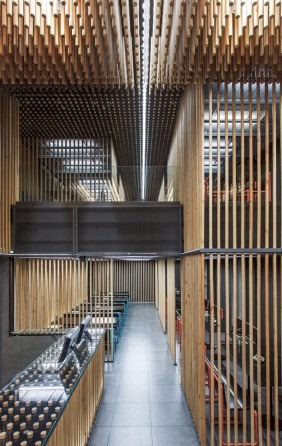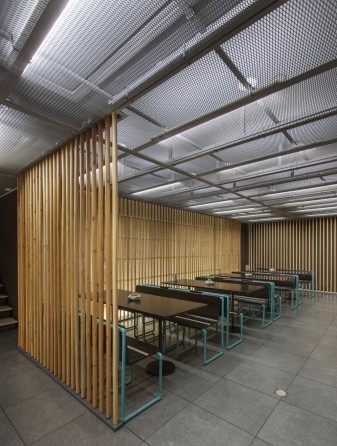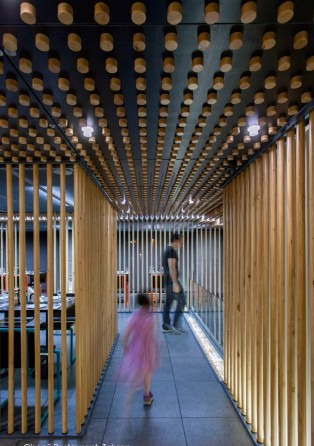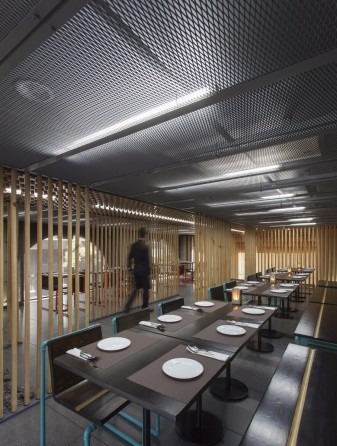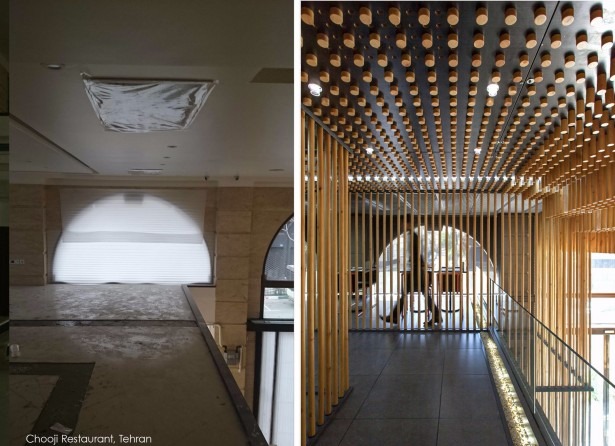
The restaurant's existing interior featured cream travertine stone, cream ceramics, arched and occasionally plain windows in the identity-less classical style common in today's Iran. The client's brief was to design a restaurant for serving organic food with the potential for future franchise expansion. Meanwhile, the restaurant space had been leased for a limited term and did not seem suited to a restaurant.
Most interior projects result from demolishing the existing structure and replacing it with a new design, which causes harmful environmental impacts. Minimizing the negative effects of demolition, selecting materials that can return to the life cycle, and preventing the waste of capital and resources were the central concerns in the restaurant's interior design. Preserving the existing partitions, leaving wall surfaces exposed, and covering them with a transparent enclosure to establish a dialogue between the old and new spaces were prioritized. By stepping back from the original partition, a new enclosure was created within the space that, while establishing a new identity, also divided the space according to its varying needs.
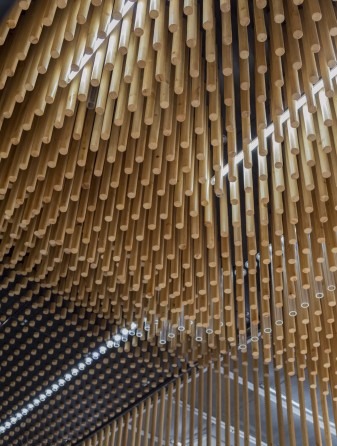
We wanted the restaurant to befriend nature. So we used wood and iron as the primary elements in forming the partitions, and the relationship with trees within the communal spaces and along the restaurant's pathways took on a fresh spirit.
In designing every detail, the capacity for relocation and assembly-disassembly was considered, which itself led to the creation of continuous micro-modules throughout the space as a whole and in its parts, with minimal damage to spatial unity. This approach also made it possible to transfer the existing sharp-cornered space to diverse and even irregular future venues after the lease expires, ensuring that as the restaurant grows, the space guarantees its own longevity through conscious transformation.