We are all familiar with the pronouncement that our people have no inclination to live in residential complexes and shared (communal) units, and that each unit must be planned and designed separately and independently. This view is heard especially, at the time of preparing land-preparation schemes in small cities, from the client and particularly from the officials of the Urban Land Organization. But what is the reality? In this article we examine this question in two dimensions — the economic and the cultural.
The economic means of the applicants for urban land in Shushtar and Ardabil are not such that they can pay the cost of preparing even a hundred square metres of land, let alone the cost of suitable land. The statistics of the housing applicants' questionnaires in Ardabil show that among the applicants there are four groups — low-income, lower-middle-income, upper-middle-income, and high-income — who can afford to acquire, respectively, about 41, 55, 66, and 82 square metres of land. For each of them, economically, the price of the land can take up only about 40 per cent of the total cost of the residential unit. In Shushtar, a large part of the applicant households live in housing shared with another family. The study carried out in Miyaneh shows that 22.8 per cent of households live in a house with two or more families, of whom 24 per cent have no bathroom and 22 per cent no kitchen, or use a bathroom and kitchen shared with another household.
Many applicants who, by bearing heavy loans, obtain a plot of land — despite all the restrictions on selling — sell the ceded land by informal agreement and with the money provide themselves with shelter. Among the households studied, sometimes the members of a family live with the parents of one of the two sides, and sometimes there is no kinship at all between the households and they have only, out of necessity, come to share a house. In the past generation we saw the coexistence of extended families in a single residential unit. The reality is that today the extended families have broken up and the inclination to have an independent living space has become general; but how great is the need for this independence? Is it right that meeting this need should come at the cost of the collapse of planning for the provision of housing? Is there no middle solution for providing housing with acceptable independence for each household? A study of vernacular housing in various parts of Iran, and an examination of its social, economic, political, and defensive dimensions, brings us closer to the answer to this question.
A study of several examples of communal housing in the villages of the district of Tabas — including Pey-Estan, Hormok, Dehno, Zenaghan, Dehteh, and Naybandan — may perhaps open a way. The villages of Tabas can be divided into two groups: mountain villages and plain villages. The first group, being on a thoroughfare and owing to the particular conditions of the natural environment, were not exposed to invaders and had no need to build a fortress; but the second group are villages whose inhabitants, for defence and self-protection, were obliged to build a fortress. Each household had two rooms in the fortress, in which they hid during the raids of the Baloch and the Hasanis and preserved their valuable property from the plunder of the invaders. This fortress was sometimes built complete, with a rampart and an entrance. The study of the composition of the fortresses is an interesting subject that requires an independent study.
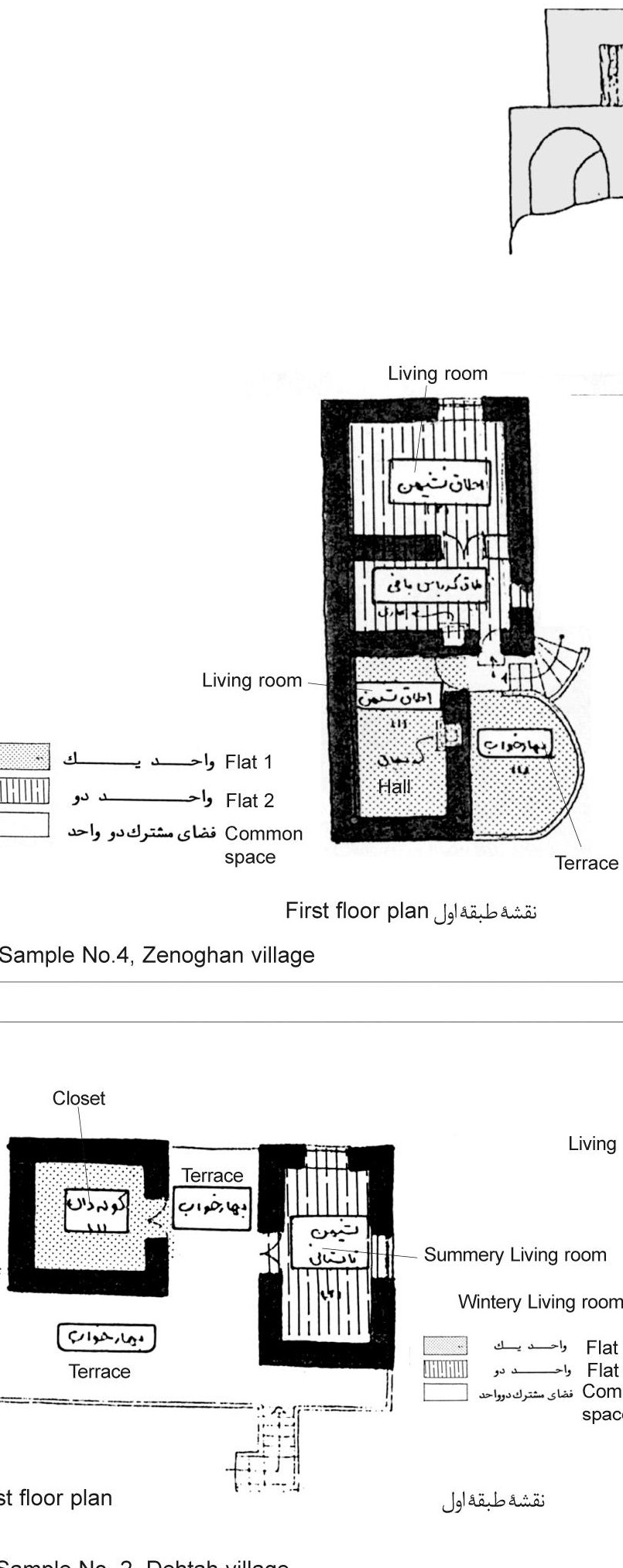
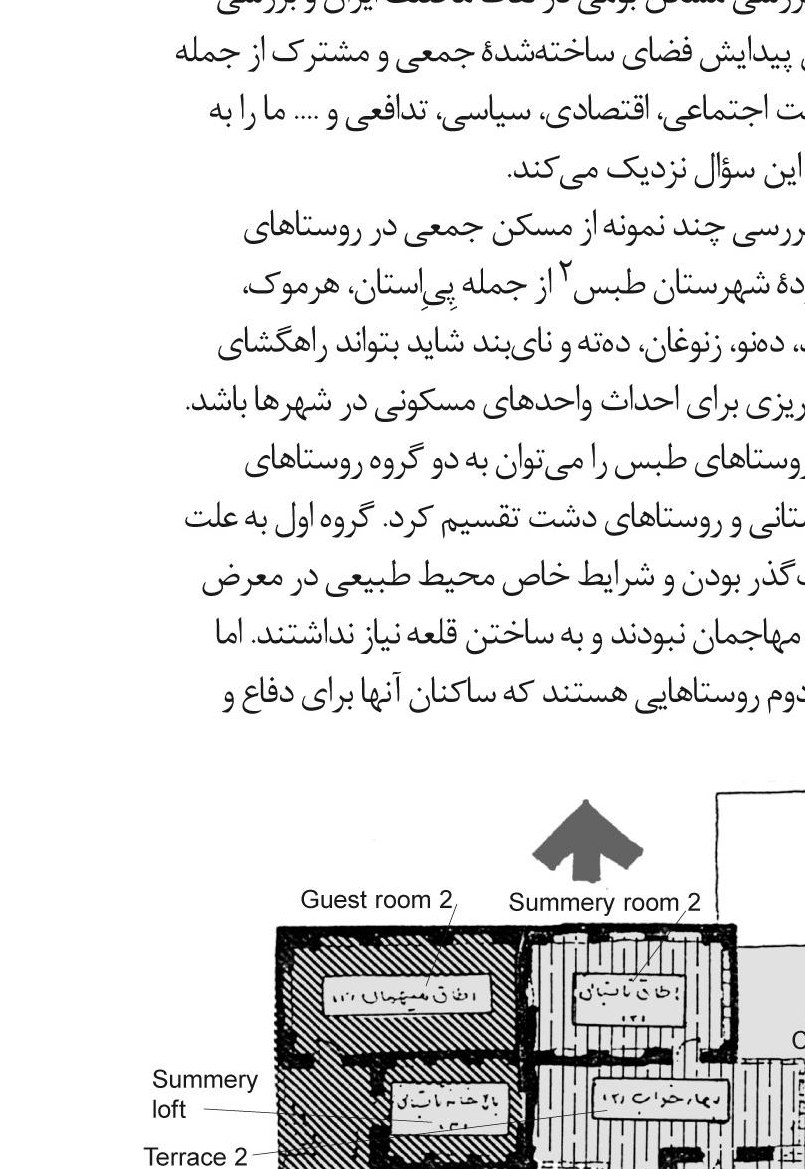
The village of Pey-Estan lies 24 kilometres from Halvan, in the north-west of the district of Tabas. In this village we come upon very interesting examples of communal life, of which we introduce here only one. In this example, the residential complex consists of three residential units; a single-courtyard unit is on the ground floor, and unit three, which has no courtyard, has on the ground floor two rooms, between which stand the entrance corridor of all three units and the staircase to the upper floor of unit three. Unit one, on the upper floor, has a portico, a rooftop sleeping-space (behar-khab), and a summer kitchen, of which the kitchen and one of the two rooms rest upon spaces of another house. This overlapping of spaces — in which the roof of one house is the sleeping-terrace of another — is among the chief features of these rural residential complexes.
The village of Hormok, of the sub-district of the environs of Tabas, lies 15 kilometres from Tabas, on the foothills of the Shotori mountain range. In this village, the composition of the old houses is open on the north side and bounded by a palm grove. This half-fortress has three residential units, with a stable and an oven, facing one another; the [shared] courtyard lies between the rooms, and behind one of the rooms is a space called a “kuledan” (a private store and stable). The village of Dehno, of the sub-district of Dihook, lies 39 kilometres from Dihook and three kilometres from the Ravar–Dihook road. The ground floor of all the residential buildings in this village is given over to the stable and hay-store, and the living space is on the first floor; in the example studied, three households live there, each having two rooms on the first floor, with a shared entrance, lavatory, oven, wood-store, and staircase.
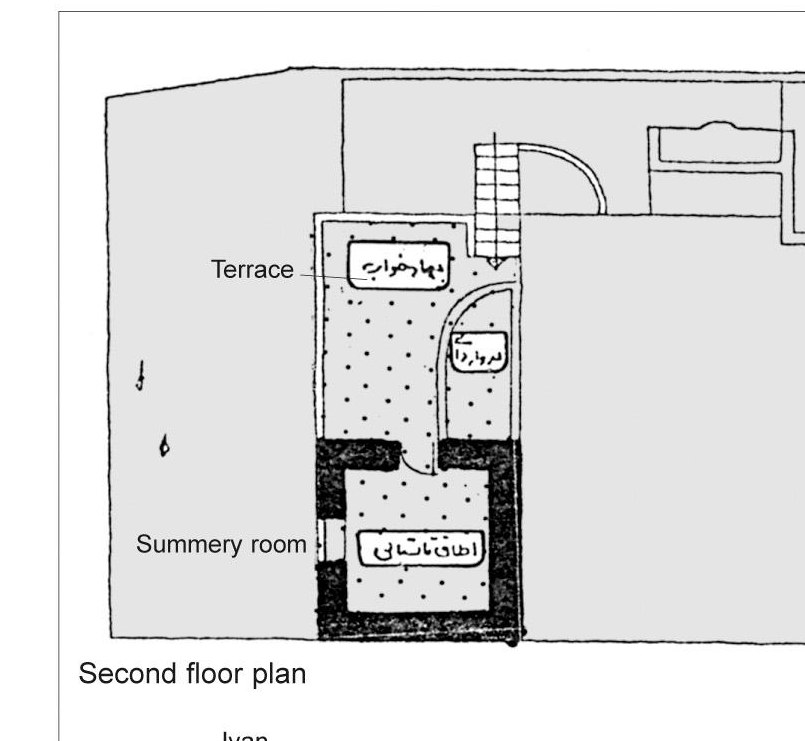
The village of Zenaghan, of the sub-district of Dihook, lies 5 kilometres south of the connecting road of Dehno and to the east of the Ravar road. This village consists of a large fortress built on two storeys, and in some parts on three or four; in it, the roof of each house is the sleeping-terrace of another, and this example is one of the most complete and beautiful rural residential complexes in this region; the general circulation of the complex is provided by several entrance staircases. These examples show that communal life and the sharing of spaces have a long precedent in the vernacular architecture of Iran's villages, and can offer a model for providing suitable, affordable housing while preserving the relative independence of each household. Notes: 1. Based on the writer's field studies in the villages of the district of Tabas, including Pey-Estan, Hormok, Dehno, Zenaghan, Dehteh, and Naybandan.