Editorial Editorial Magical Realism Lessons from Urban and Architectural Experiences in Latin America The dominant intellectual tradition in the West, in describing or justifying phenomena, tends to categorize the broad and diverse range of ideas and experiences into binary, irreconcilable, and homogeneous frameworks, as well as to simplify complex issues and contradictory situations, reducing their solutions or methods of analysis to antagonistic polarities that often become the sites of absolutist partisanships and irresolvable disputes that do not correspond to reality or to the relativities and non-simple conditions at hand. Meanwhile, a wide spectrum of ideas, experiences, or phenomena can be described or justified through the synthesis, aggregation, and alignment of opposites, and if placed in synergistic relations with one another, they can, while preserving their capacities and capabilities, become a sum greater than their algebraic total — enriched in richer dimensions. The practical and theoretical inadequacies of binary outlooks and homogenizing beliefs have given rise to new theoretical speculations aimed at enabling fundamental and comprehensive revisions of previous modes of thought in the sciences, philosophy, art, and other disciplines, to help overcome existing impasses and enable new readings and explanations of new issues, or re-readings and re-explanations of existing subjects — thus opening new horizons and pathways. Based on this understanding, re-reading the contemporary and present-day achievements of the countries of the Latin American region in the fields of urban and architectural issues provides a perfect and comprehensive example of the coexistence of challenging yet conciliatory and synergistic tensions and disputes between polarities such as modern and traditional, global and local, individual and collective, elite and popular, idealist and realist, abstract and concrete, self-referential and hybrid, as well as a worthy and synergistic struggle and compromise between these aspects in the domain of urbanism and architecture — even between the two disciplines themselves. Unique experiences in dealing with the city and architecture have emerged in these countries over roughly the past century, against the backdrop of deep historical roots and ancient cultures, the experience of colonial rule by Europeans, predominantly collectivist inclinations, intense cultural and geographical diversity, the transition to modernity in the post-colonial era alongside and concurrent with the expansion of urbanization, industrialization, the establishment of new civic foundations including modern healthcare and education and the creation of necessary infrastructure for them, the discovery and extraction of oil (not in all countries) and the acquisition of oil wealth as well as the establishment of industrial economies, confrontation with challenges such as severe political unrest, social instabilities and deep economic inequalities, poverty, insecurity, crime and violence, and also extensive marginalization. These experiences have evolved alongside these developments up to the present day, and various types of these experiences, appropriate to each of these conditions and in each period, have been presented as new solutions by urbanists and architects in these countries. The urbanism and architecture of the countries of Latin America is, in reality, the product of responding to this ensemble of conditions and the result of a synthesis born from the effort to integrate opposites or binaries that I mentioned earlier — a process that, in transitioning from the first half of the twentieth century to the second, and in stepping across the threshold of the twenty-first century, reveals gradual changes at each stage, such that the second side of the scale of these polarities progressively outweighs the first, gaining more weight as we move forward. Generally, the northern parts of the Latin American region looked toward North America, and the southern parts toward Europe, and as noted, these countries are highly diverse and varied in cultural and geographical terms; at the same time, many common characteristics exist among them, including the warm temperament of the people, passionate art, the benefit of an extraordinarily beautiful natural setting, and intense sunlight. All these characteristics have, in one way or another, been reflected in the cities and architecture of this region, lending them a distinctive atmosphere. The fundamental distinctions between the diverse cultures and geographies of this region compared to other parts of the world, as well as the particular challenges that have always confronted these societies, set them sharply apart from other parts of the world, in a manner that is prominently and distinctively present and reflected in urban life, architectural space, and their art — even in the temperament of the people. It is precisely on the basis of these distinctions that this vibrant and pulsating center of contemporary design has been recognized, praised, or critiqued in the world, and has always offered worthy achievements and diverse and instructive experiences to this field. Continuing this tradition, and concurrent with the re-emergence and collective growth of the countries of this region — with a combined population of approximately half a billion people, a GDP in 2009 that placed them among the world's growing economies (for example, with Brazil as one of the ten emerging economies in the world) — today, the urban experiences, architectural productions, and architects of these countries have increasingly attracted attention beyond their borders and, by playing an active role in shaping part of contemporary urban and architectural culture, are taking ever firmer steps on the path of engagement with the global network of designers. As previously noted, the urban and architectural experiences of Latin America, while heterogeneous and diverse, share many commonalities, chief among which is their success in presenting a new position or a third way out of the difficulty of confronting contemporary doubts and dilemmas, coinciding with the revealed inefficiency of rigid assumptions, radical discourses, and binary outlooks that prevailed in the modern era. Examples of this approach in the contemporary and present-day experiences of this region are numerous, including the two dominant discourses in twentieth-century Brazilian architecture and urbanism — the cosmopolitan tendency of Costa, Niemeyer, and Reidy in Carioca Modernism, and the vernacular tendency of Bardi, Artigas, and da Rocha in Paulist Brutalism — or the rivalry between the two tendencies of rationalist functionalism and organic regionalism in Colombia. Likewise, experiences related to the era of state developmentalism in Brazil, including voluntarist design, modernist urban planning, and the monumental, elitist, and abstract building projects of New Brasilia — the work of Costa and Niemeyer in the mid-twentieth century — and in contrast, the urban civic movements of Brazil at the beginning of the URBAN PLANNING AND ARCHITECTURAL EXPERIENCES IN LATIN AMERICA MAGICAL REALISM Mohammad Mohammadzadeh
twenty-first century that led to changes in urban laws toward the democratic administration of the city, the promotion of social urbanism through the guarantee that urban land functions on the basis of public interest (meaning prioritizing use value over exchange value) with the activism and participation of citizens and civil society. Also, the experience of building social housing for low-income populations and protecting it against real estate speculation — to which must be added ingenious plans and programs for addressing the problems of impoverished neighborhoods and informal settlements through the participation of local communities for their comprehensive cultural, social, and livelihood advancement, without the need to segregate these groups or physically eliminate their neighborhoods as manifestations of poverty, or gentrify these areas by building luxury and expensive commercial complexes — which, as tested experiences attest, itself fuels inequality. Among the most prominent examples of the latter, in the form of urban actions and projects, one can point to architectural works containing programs capable of attracting the participation of people and local communities (in the form of bottom-up activism, as opposed to idealistic, technocratic, bureaucratic, and authoritarian top-down plans and programs) in addressing the social, cultural, and livelihood problems of troubled, impoverished, and disadvantaged slums on the urban periphery (typically in the suburbs), with the motto "the best for the most disadvantaged." For example, through establishing physical connections and creating contact and interaction between their residents and the more privileged parts of the city (such as stitching these zones together through a public transportation system like cable cars, as in the cities of Rio or Medellin, which, by facilitating commuting and enabling cultural and social contact and class mixing, have improved the conditions of disadvantaged areas, including in the field of employment). Or another example in the construction of community centers in the form of cultural or educational buildings with multi-purpose capabilities, beyond the primary and fixed program envisioned for them, operating at all hours of the day, with the capacity to serve the general public and not merely specific users. Examples of these actions, referred to as "social urbanism," have in recent years produced successful results in the cities of Bogota and Medellin in Colombia that have achieved worldwide fame. These impacts are, in fact, the product of realistic, practical, and small-scale plans and programs with reasonable budgets, aimed at realizing non-utopian aspirations (in contrast to large-scale plans and programs such as New Brasilia by Costa and Niemeyer some fifty years earlier), with a wide range of effectiveness and quick returns, creatively devised by distinguished designers of these countries — among the most notable of whom is Mazzanti and his work in Colombia. In the field of planning, design, and construction of housing for low-income classes, and ideas such as enabling the gradual, phase-by-phase expansion of each unit through incremental intervention by the users themselves over the course of occupancy, effective and fascinating initiatives have been undertaken in these countries, the most famous of which is the work of Aravena in Chile, which has achieved worldwide renown. In what follows, I will address the design tendencies in Latin America from another important and interesting angle. Realism, at the turn of the nineteenth and twentieth centuries, arose against Romanticism, which was individualistic and aristocratic, to champion the valuation of real and everyday life of the people and to reflect the state of society in literature and the arts — a considerable portion of this tendency stemming from left-leaning political aspirations of that time. Concurrent with these changes, the accelerating pace of industrialization, mechanization, and rationalization of space, as well as the increasing emphasis of the moderns on abstract innovations and their severance from previous intellectual and cultural sources of nourishment and the promotion of self-referentiality in modern art and architecture, caused the space of art, architecture, and even the cities of the modern era to suffer from a kind of emotional and substantive void. The term "magical realism," first used to describe the literary style of contemporary Latin American writers such as the Colombian Gabriel Garcia Marquez in the novel One Hundred Years of Solitude and the Mexican Carlos Fuentes in the story Aura, refers to a space in which reality and the everyday life of the people are astonishingly blended with legend (myth or history) without appearing unnatural. This subject, in a way, signifies the mentalities and experiences of the people of Latin America and their perpetually unstable conditions, in which wonder and reality have had a simultaneous and ordinary presence. Perhaps the emergence of "magical realism" can be seen as a preemptive effort against the formation or growth of the emotional and substantive voids created in modern art and architecture in the West, within the artistic and architectural products of the countries of this region. Architecture theorists, in describing the works of certain Latin American designers, have employed this same term "magical realism," among the most important of which are the works of Oscar Niemeyer and the curvilinear quality of some of his works, which, inspired by the female form, reflect an erotic quality, an organic character, and a spirit that is imaginative, poetic, and brimming with emotional passion and human content. In describing these works, they have been referred to as real structures manifested in a dreamlike form. Perhaps this quality can be considered one of the distinguishing aspects of Latin modernists compared to the modern current in Europe and North America (which were the primary sources of modernism's entry into Latin America), whose works are intensely rational and cold. This characteristic can be described as a conscious or unconscious (yet critical) resistance by the architects of this region against global modernism. A quality that, though from the perspective of the hierarchical and canonical mentality of the radical theorists of the twentieth century in America and Europe, judged by the dogmatic principles of the homogeneous and pure modernism of that era and the prevailing modernist assumptions, has been assessed as lacking sufficient authenticity, derivative, and second-hand compared to the original European or American versions — when viewed through the lens of today's theoretical changes and conscious revisions, the latent quality in these experiences reveals a more balanced, more moderate, more multifaceted, and more holistic face of modernization in these countries. While attending to growth and transformation in architecture (or the city) itself, by testing different and new paths, these architects have engaged in a conscious and critical exchange with the social, cultural, and geographical materials (and/or obstacles and problems), and through synergistic and astute synthesis of these aspects, they have succeeded in achieving richer dimensions beyond them. In what follows and in the collection of articles in this issue, you will become acquainted with only glimpses of the vast range of diverse urban and architectural experiences in the Latin American region, as well as the tendencies and aspirations latent in these experiences. * Special gratitude to Reza Asgari for assistance in reviewing and offering comments, Sarvenaz Emtiazi as editorial assistant and direct collaborator throughout all stages of the work, all the writers, and likewise the incomparable and constant colleagues of the magazine.
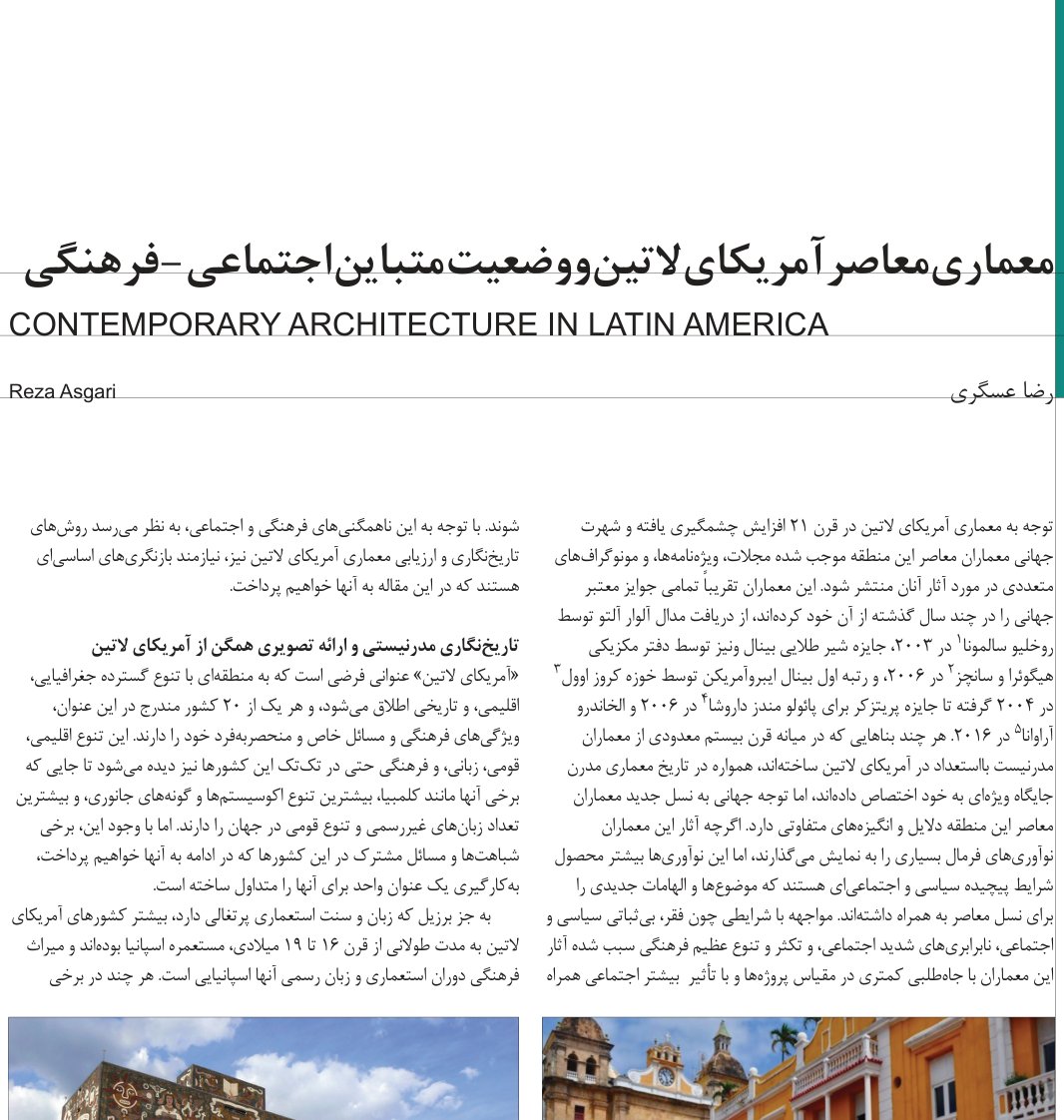
Contemporary Architecture in Latin America and Divergent Social Conditions Attention to Latin American architecture has increased dramatically in the twenty-first century, and the global fame of contemporary architects from this region has led to the publication of numerous magazines, special issues, and monographs about their works. These architects have won nearly all major international awards in recent years, from the Aalto Medal received by Rogelio Salmona in 2003, to the Golden Lion at the Venice Biennale by the Mexican office Higuera y Sanchez in 2006, and the first prize at the Ibero-American Biennale by Jose Cruz Ovalle in 2004, to the Pritzker Prize for Paulo Mendes da Rocha in 2006 and Alejandro Aravena in 2016. Although the buildings constructed by a handful of talented modernist architects in Latin America in the mid-twentieth century have always held a special place in the history of modern architecture, global attention to the new generation of contemporary architects from this region has different reasons and motivations. Although the works of these architects display considerable formal innovations, these innovations are largely the product of complex political and social conditions that have brought new subjects and inspirations to the contemporary generation. Confronting conditions such as poverty, political and social instability, severe social inequalities, and immense cultural plurality and diversity has caused the works of these architects to be accompanied by less ambition in project scale and greater social impact. Given these cultural and social heterogeneities, it appears that the methods of historiography and evaluation of Latin American architecture also require fundamental revisions, which we will address in this article. Modernist Historiography and the Presentation of a Homogeneous Image of Latin America "Latin America" is a hypothetical title applied to a region of vast geographical, climatic, and historical diversity, and each of the twenty countries subsumed under this title has its own unique cultural characteristics and specific issues. This climatic, ethnic, linguistic, and cultural diversity is evident even within each of these countries individually, to the extent that some of them, such as Colombia, have the greatest diversity of ecosystems and animal species and the greatest number of unofficial languages and ethnic diversity in the world. Yet despite this, certain similarities and common issues in these countries, which we will address below, have made the use of a single title for them customary. Except for Brazil, which has the Portuguese colonial language and tradition, most Latin American countries were Spanish colonies for an extended period from the sixteenth to the nineteenth centuries, and their colonial-era cultural heritage and official language is Spanish. Although in some CONTEMPORARY ARCHITECTURE IN LATIN AMERICA Reza Asgari 1- Cartagena, Colombia 2- UNAM Library, Juan O'Gorman 3- San Cristobal Blocks, Mexico City, Luis Barragan 4- Water House, Ricardo Legorreta
of these countries, vestiges of pre-historic and pre-colonial cultures (such as the Aztecs, Mayas, and others) remain, which have always been a source of inspiration for the artists of this region in shaping their national identity, yet it is the cultural traditions and specifically settlement patterns shaped during the colonial era that constitute the major part of the historical heritage still visible in the cores of large and small cities of this region with their network of old streets (Figure 1). This colonial heritage, with its emphasis on indigenous handicraft and manual skill and its decorative aspects such as the use of Baroque motifs, the use of mosaic and colorful decorations in the Iberian tradition of southern Spain, has always lent a unique taste and aesthetics to the works of artists from this region. So much so that even during the dominance of white-colored modernist architecture in Europe in the twentieth century, we witness the masterful use of color in the works of Latin American architects and artists such as Juan O'Gorman, Luis Barragan, and Ricardo Legorreta (Figures 2 through 4). With the gradual independence of these countries in the nineteenth century, the newly established republics turned to supporting French ideals and traditions as a break from Spanish ones. The first schools and universities of art and architecture were also founded on two French models: the Ecole des Beaux-Arts and the Ecole Polytechnique of Paris. In architecture too, influenced by French art, the official taste until the early decades of the twentieth century was the Beaux-Arts tradition, although Latin American architects always showed great enthusiasm for acquaintance with structural innovations, especially in working with traditional masonry materials such as Catalan vaulting systems and the works of Gaudi. This, the natural result of limited available building materials in this region (the absence of timber and limited metal production) and the heavy cost of imports due to the great distance from countries exporting these materials, led to the prevalence of masonry materials such as brick and stone (often with colored plaster coating), and the use of vaults and domes in most areas. Therefore, by necessity and through indigenous construction techniques, a rich tradition of using curvilinear forms and parabolic vaults took shape in these countries, which was later innovatively continued in the works of prominent architects such as Eladio Dieste. Another prominent example in this field is the National Art Schools of Cuba by Ricardo Porro, Roberto Gottardi, and Vittorio Garatti, which I have previously discussed in another article (Figures 5 and 6). This formal language of Latin American architects and their inclination toward curvilinear forms was further pursued with greater innovations following the spread of reinforced concrete in the twentieth century and through the presence of distinguished Spanish architects such as Felix Candela in Mexico and his experiments with concrete shells. In describing this formal language in the works of architects such as Oscar Niemeyer, some historians have used the term "magical realism," likening these works to frozen dreams and magical structures (Figures 7 and 8). In addition to these technical and aesthetic issues, the countries of Latin America share similar climatic concerns, such as intense sunlight in most regions, which, besides the use of color for its control, has led to the development of diverse devices and fascinating inventions in building facades for controlling light and glare, and has even perpetuated in some regions the tradition of creating interior patios and using tall, windowless walls in historical houses — the introverted typology. Thus, the encounter with common cultural factors (such as the shared Iberian and Catholic background and the intermingling of European colonial cultures with indigenous cultures), and common climatic and technical factors, has led to the formation of unique characteristics and relative independence of Latin American architecture 5- Church in Atlantida, Eladio Dieste 6- National Art Schools of Cuba, Ricardo Porro, Roberto Gottardi, Vittorio Garatti 7- Casino de la Selva Hotel, Mexico, Felix Candela 8- Museum of Contemporary Art, Rio de Janeiro, Brazil, Oscar Niemeyer
and has caused many historians to present a homogeneous image of the traditions of this region. In addition to the challenge of confronting a rich and diverse cultural-historical heritage, another common issue among the countries of Latin America was confronting uneven development with the arrival of modernism in these countries. The years 1929 to 1960 were a period of immense transformation and transition for most Latin American nations, in which the previous feudal-agricultural economic system was asymmetrically replaced by a peculiar form of industrialization. This process of industrialization did not occur simultaneously and symmetrically across all nations or even within the internal regions of each country, and ultimately produced a new economic system that resulted in enormous economic-social inequality and political instability and volatility. In most of these countries, extensive political tensions existed between various reactionary, modernist, and socialist groups, which sometimes escalated into violence and even civil wars between discontented political groups and partisans and far-right regimes. Furthermore, massive migration from rural areas to the main cities, alongside rapid population growth in Latin American countries that was approximately double the global average, resulted in extensive urban problems. A large part of these problems stemmed from the formation of informal and impoverished settlements and marginalization on the peripheries of major cities, known by various names such as Favela, Invasion, and Barrio. During this period of political-social instability, many liberal governments in the region turned to promoting and supporting modern architecture as a symbol of progress, considering it a guarantee for providing adequate living standards for all members of society. Politicians' conception of modernity as industrialization, economic growth, and cultural dynamism fueled their inclination toward modern architecture. This, alongside the economic prosperity of these countries after World War II — owing to their having been spared from this devastating war — enabled the region's governments to undertake the construction of large-scale projects that seemed impossible elsewhere in the world. For this reason, Latin America became a destination for prominent European and American architects seeking an opportunity to realize their projects. Among these, perhaps Le Corbusier's presence in Rio and his design for the Ministry of Education and Public Health had the greatest impact on the new generation of Latin American architects and figures such as Lucio Costa, Oscar Niemeyer, Affonso Reidy, and Jorge Moreira (Figure 9). The grand, optimistic, and developmentalist programs of governments in constructing government buildings, university campuses, social housing, airports, museums, stadiums, and even building new cities gave architects an unparalleled opportunity to freely pursue their aesthetic, technical, functional, and urban ideals. Although from the mid-1950s, as the problems and challenges of state developmentalism became apparent, fundamental criticisms of modern architecture in Latin America took shape, the prominent architects recognized as modernist masters and founding figures of architecture in each of these countries each continued their work in a uniquely individual manner, including: Luis Barragan and Juan O'Gorman in Mexico. Carlos Raul Villanueva and Tomas Jose Sanabria in Venezuela (Figures 10 through 12). Rogelio Salmona in Colombia (Figures 13 through 15). Eladio Dieste and Mario Payssee in Uruguay (Figure 16). Cristian de Groote, Emilio Duhart, and Hermano Martin Correa in Chile (Figures 17 through 20). Clorindo Testa and Amancio Williams in Argentina (Figures 21 through 24). Ricardo Porro, Mario Romanach, and Vittorio Garatti in Cuba (Figures 25 and 26). Lucio Costa, Oscar Niemeyer, Affonso Eduardo Reidy, Jorge Machado Moreira, Joao Batista Vilanova Artigas, and Paulo Mendes da Rocha in Brazil (Figures 27 and 28). 9- Ministry of Education and Health Building, Brazil, Le Corbusier 10- University City, Caracas, Venezuela, Carlos Raul Villanueva 11- Hotel Humboldt, Caracas, Tomas Jose Sanabria 12- Helicoide, Caracas 13- Virgilio Barco Library, Colombia, Rogelio Salmona 14- Torres del Parque, Rogelio Salmona 15- Virgilio Barco Library, Colombia, Rogelio Salmona
16- Pension Fund, Uruguay, Mario Payssee 17- United Nations Building, Santiago, Chile, Cristian de Groote and Emilio Duhart 18- United Nations Building, Santiago, Chile, Cristian de Groote and Emilio Duhart 19- Ralum Hotel, Chile, Cristian de Groote and Emilio Duhart 20- Benedictine Monastery Chapel, Chile, Hermano Martin Correa 21- Bank of London and South America, Buenos Aires, Clorindo Testa 22- Bank of London and South America, Buenos Aires, Clorindo Testa 23- House Over the Stream, Argentina, Amancio Williams 24- Hospital, Argentina, Amancio Williams
These architects, on the one hand, were interested in modern architecture and the idea of technological and industrial progress through their particular formal language and specific design and construction techniques, and on the other hand, had a great enthusiasm for preserving and drawing inspiration from indigenous and pre-colonial traditions in order to strengthen the national identity of their country. For example, O'Gorman in designing the National University of Mexico employed the urban planning principles of the CIAM congress and Le Corbusier's five points of modern architecture alongside indigenous decorative motifs in the facade and pre-colonial strategies for terracing and land occupation. Emilio Duhart and Cristian de Groote as well, in the building of the Economic Commission for Latin America in Chile, while adhering to the principles of modern architecture, created a conical volume in the project's central courtyard connected to other sections by colonnade, making references to indigenous and tribal methods of organization. Of course, in some countries such as Venezuela that lacked a powerful historical tradition and had acquired great wealth through the oil economy, the advancement of modern architecture in projects such as the University of Caracas by Villanueva was undertaken more with inspiration from North American ideas and European avant-gardes, rather than with references to indigenous and pre-colonial architecture. The largest and most important project of this era was undoubtedly the construction of Brasilia as a new capital and a symbol of progress and economic development, national confidence and pride, and the cultural dynamism of Brazil, which Costa and Niemeyer designed in 1956 and whose construction began in 1960 (Figure 29). The designers of this city pursued the realization of their ideas on three general levels: urban design and provision of public infrastructure; construction of iconic and grand buildings such as ministries, congress, cathedral, and so on; and provision of mass housing for the city's inhabitants. James Holston, who has leveled the most severe criticisms against Brasilia, points out that in the official narratives of the era regarding progress and nationalism, with the slogan of "complete social coexistence," people were regarded as a homogeneous society, separated from their historical past and irrespective of their ethnic-linguistic diversity. From his perspective, the physical dimensions of the city of Brasilia and its plan are such that it always appears empty, and consequently, people and the city's inhabitants are considered only in a negative fashion, as opposing elements. These inhabitants, through the alterations they make for their daily practices and for carrying out uses not foreseen in the original plan or overturning its proposed zoning, prevent the complete realization of the architects' designs. Thus, in this view, subsequent changes to the city by its inhabitants are described as damaging, and the emergence of satellite cities and informal, spontaneous settlements is considered the weakness of the original master plan and a sign of its failure. It is obvious that such judgments have been formed by ignoring the political and social agency of people in constructing their own habitable spaces and by separating architecture from the social domain, and in the direction of perpetuating modern narratives of progress and globalization, they reduce the value of Brasilia to its modern formal language in its grand buildings and its adherence to modernist urban planning principles and the Athens Charter. In contrast, some contemporary historians such as Felipe Hernandez emphasize that popular interventions and the emergence of satellite cities and informal settlements are part of the process of "appropriation" of the city by the people and a sign of the city of Brasilia's success. Through this process, people seek the social manifestation of their diverse cultural traditions in a city that has been, in a sense, redesigned to accommodate heterogeneity. Therefore, from Hernandez's perspective, the value and success of Brasilia lies in demonstrating the impossibility of realizing homogenizing discourses in an imaginary and contradiction-free society, which is formed by eliminating the tensions between different social groups and classes and their contradictory political-social interests. Brasilia is a display of historical ruptures, heterogeneity, and cultural dynamism of the city's inhabitants as the primary producers of physical, cultural, and social spaces, who, in their struggle for survival, give themselves identity through the changes they make in their environment. This discussion is an example of the fundamental changes that have occurred in contemporary historiographical method compared to modern historiography. Although the flourishing era of modern architecture in Latin America brought global fame to the architects of this region and established their names in the history of modern architecture, this evaluation has always been carried out by the prevailing European and American criteria. In the works of most prominent historians of modern architecture, such as Leonardo Benevolo, William Curtis, Kenneth Frampton, and Nikolaus Pevsner, the value of Latin American architecture is primarily seen in the deployment of the formal treasury of modern architecture. For them, a hierarchical structure exists in the world of architecture that has formed around the main canon or the meta-narrative of modern architecture in Europe and North America, and 25- Casa Noval, Havana, Cuba, Mario Romanach 26- Cuba Pavilion, Expo 67, Montreal, Vittorio Garatti 27- University of Sao Paulo, Joao Batista Vilanova Artigas 28- Athletic Club Sports Hall, Sao Paulo, Paulo Mendes da Rocha
therefore, in evaluating the architecture of any region of the world, the standard of measurement is the degree of conscious and deliberate reference to this main canon and conformity to its established standards. For example, Henry Russell Hitchcock in his book Latin American Architecture Since 1945 refers to the spread of air travel as an important factor in the progress and development of modern architecture in these countries, which, owing to their separation and remoteness from the Western world, had previously lacked a notable and valuable architectural tradition. William Curtis, too, views the reception and absorption of modern architecture in developing countries after 1900 as accompanied by distortions, deviations, and devaluations relative to the original and prior version in Europe, especially the works of Le Corbusier. He even goes so far in his dismissal of non-Western architecture that in his analysis of modern forms in the architecture of developing countries in the 1940s and 1950s, he considers them to lack the poetic quality and semantic depth of the masterpieces of the modern movement in Europe. Although this position is somewhat tempered at the end of his book, where he regards the efforts of Latin American architects as "reasonable adaptations of the authentic characteristics of modernism to the climate, culture, memories, and aspirations of the respective societies," his methodology is accompanied by "a strategy of denial and delegitimization of the 'other,'" assigning a subordinate position to Latin American architecture in the hierarchical system of the history of modern architecture. These historiographical approaches regarding modern Latin American architecture have been critiqued in numerous books in recent decades. As an example, Valerie Fraser writes: "Modern Latin American architecture [...] is not an uncritical re-reading of European modernism with the addition of some decorative indigenous colors, but rather a deliberate and profound modification, or even a challenge and struggle against European models." Therefore, in contemporary historiography, the discussion concerns a particular kind of modernization in Latin America that is not merely a belated reflection of European and American models and may even be instructive for the developed world in various respects: from formal innovations to new approaches to social housing and avant-garde visions of future cities. Furthermore, the new historiography, instead of presenting a coherent, linear, and homogeneous image of the history of Latin American architecture — which does not correspond to the diversity of works and the realities of architectural production in their cultural and social contexts — points to a broad spectrum of tendencies, orientations, and perspectives in the intellectual space of Latin countries, particularly after 1955. One of the successful exhibitions that, with this same approach, opened new horizons for subsequent discussions was an exhibition titled Latin America in Construction: Architecture 1955–1980 at the Museum of Modern Art (MOMA) in New York, which, by emphasizing the unique characteristics of architecture in each country and presenting a heterogeneous image of different urban cultures, displayed a vast panorama of new ideas and different critical perspectives from architects. In this exhibition, we are confronted not with a single phenomenon but with entirely different approaches among Latin American architects in the twentieth century: from resistance against the demands of dictatorship in the Sao Paulo school and the works of Vilanova Artigas and Mendes da Rocha, to the official and utopian architecture of Castro in Cuba; from attention to indigenous and Afro-Brazilian cultures in the work of Lina Bo Bardi to the open school models in Chile; and from the search for a bond between handicraft with traditional materials and new technologies in the works of Eladio Dieste, to the brutal works of Clorindo Testa in Argentina. On another front, from the 1980s onward, with the growth of the neoliberal economy and the questioning of the developmentalist doctrine in some Latin American countries, the unavoidable challenges embedded in the ideological assumptions of mid-century received greater attention. Issues such as the lack of urban safety, severe poverty and growing class divide, mass housing and occupied and informal settlements, and weak urban infrastructure made a fundamental transformation in the view of architecture's role in the growing urban culture inevitable. Thus, it may be said that a new generation of architects took shape with concerns and perspectives different from their modernist masters, which we will explain below. Contemporary Architecture and a Heterogeneous Image of Latin America Just as contemporary historians have noted in contrast to the incomplete image of modern narratives, it appears that contemporary Latin American architects have chosen other strategies for confronting cultural differences and their effects on the construction of cities and buildings, and these architects have developed them with a kind of implicit resistance against modern narratives of progress and globalization. Eagerly and yet critically, they accept the cultural-social heterogeneity of their societies and view the constant changes in political and economic conditions in the lives of the people of this region as a source of inspiration for their typological innovations. For this reason, in recent years, a notable change has been observed in the scale of national and governmental projects as well as in the interests of the new generation of architects. Design for the entire city and megaprojects that were commonplace in the modern era have given way to efforts to solve specific problems in particular areas of cities and to respond to the social and cultural needs of local communities and specific social groups. These particular social and political conditions have allowed these architects to build buildings that connect more closely with the people. The political-social diversity, distinctiveness, and heterogeneity of these countries compel architects to employ diverse design methods. They are obliged to adapt themselves to new forms of professional practice that are increasingly constrained by new laws, social responsibility, and severe financial fluctuations. Consequently, individual work rapidly gives way to teamwork and interdisciplinary exchanges, collaborations between different offices on projects, and even transnational collaborations among architects of neighboring countries. Unlike the modernist masters, the current generation of architects does not seek individual expression through a unique formal language or the development of a personal style. Their works encompass a broad and varied spectrum of typologies, subjects, and design methods that sometimes pursue formal experiments using new technologies and sometimes work with traditional materials and limited available resources and local artisans. Yet most of these works share an emphasis on each project as an exercise in a specific site, an attention to historical, cultural, political-social aspects, and a study of form in relation to its context. 29- National Congress, Brasilia, Oscar Niemeyer
Furthermore, many contemporary Latin American architects, such as Alejandro Aravena, in their effort to respond to the changing and unstable conditions of the poor people of this region, seek to create equal opportunities for people to play an active role in completing, redesigning, appropriating, and building their settlements and public spaces to their own liking. In this way, these architects grant agency to people as the primary producers of their own habitable space and, by guaranteeing creative mechanisms for public participation, in addition to public welfare, strengthen the sense of belonging to the environment and social justice in the city. This often manifests not from the political support of governments and municipalities but from the architects themselves as a kind of mediation between public interests and the client's interests, and is sometimes accompanied by political will for changing and improving the urban environment and making it more democratic. In the second case, political actions may take the form of participatory planning in Brazil through the formulation and adoption of laws, or, as in "social urbanism" in Colombia, may be realized through investment in the public realm and urban projects in impoverished areas, strengthening public transportation systems, reviving urban plazas and developing parks and cultural centers, and methodically utilizing architectural capabilities in combating violence, poverty, and social inequality. In what follows, in introducing the broad spectrum of contemporary Latin American projects, we will address several fundamental challenges and intellectual priorities of contemporary architects and their methods and ideas in some projects. New Strategies for Intervention in the Informal Periphery and Public Spaces of the City The rapid development of Latin American cities in the mid-twentieth century and the formation of impoverished settlements on the peripheries of major cities proved that the prevailing urban design strategies of that era were insufficient and ineffective for responding to rapid changes and the innovations of ordinary people in building parts of the city. In the 1960s and 1970s, the governments of Brazil, Chile, Colombia, Ecuador, Peru, and Venezuela sought to "eradicate" the informal and spontaneous settlements by relocating their poor inhabitants to designed neighborhoods in the suburbs. With this method, without addressing the causes and grounds of poverty, what was eradicated was not poverty itself but the poor, and the only issue was preventing the poor from being seen in the city and advancing gentrification by building large commercial arcades in the liberated urban spaces. With the failure of these programs, new strategies were gradually developed for improving the living conditions of the poor without resorting to mass and often violent displacement, which, instead of trying to hide the poor, turned to planning for increasing the presence of these people in the city through creating public amenities and multi-purpose educational, recreational, and gathering spaces. Thus, in many cities such as Bogota and Medellin in Colombia, impactful and high-quality buildings were constructed at the peripheral borders of the city that both, in line with encouraging cultural development, brought the most amenities and benefits to impoverished areas and local communities, and also became urban landmarks that today have taken on a touristic dimension. In other words, with the slogan "the most beautiful for the most humble," architecture and aesthetics were deployed as instruments for social reform and for creating a sense of human dignity and a sense of belonging to the city. The most important issue in these buildings is the increase of functional flexibility so as to enable residents and local users to engage in diverse activities beyond the specific program of the project, and in this way, architecture becomes a means of encouraging social interactions. The architects of these buildings, by enabling users to overturn the project's program, strive to avoid imposed aesthetic, functional, technical, or political ideologies, and instead of attempting to resolve social tensions and cultural differences and reaching a calm consensus, seek to display these tensions and differences in the social space of the city. In this regard, one can point to the design of numerous schools and libraries throughout Latin America that, given the shortage of parks, public spaces, and recreational spaces in the dense and deprived areas on the city's periphery, are designed in these areas in such a way that, in addition to their primary educational uses, they enable the formation of other activities for residents and become the cultural and social focal point of their area. For example, in the design of the FDE school in Sao Paulo, Brazil, classrooms are placed as suspended volumes above ground level so that the sports and gathering spaces of the complex at grade level are flush with the city and can serve as public space and a center for social interactions on holidays (Figure 30). 30- FDE School, Sao Paulo, Brazil, Angelo Bucci, Alvaro Puntoni 31- Gerardo Molina School, Bogota, Giancarlo Mazzanti 32- Leon de Greiff Library, Medellin, Giancarlo Mazzanti 33- Santo Domingo Library, Medellin, Giancarlo Mazzanti
Another strategy of some architects such as Giancarlo Mazzanti is the fragmentation of the main function of the building into discrete and separate volumes. For example, in the Gerardo Molina school, instead of the traditional method of designing schools as a closed fortress that repels everyone except students, the entire building is designed as interconnected serpentine strips that twist and turn in response to the adjacent urban fabric, and alongside its central courtyard, it provides diverse outdoor spaces as parks and public squares for all citizens (Figure 31). The main functional parts are dispersed in cubic volumes throughout the site and connected by asymmetric circulation paths with ceilings lower than the main volumes. This non-linear and dynamic organization, with changes in levels, ramps and stairs, and variety in materials, does not create a definitive boundary between the school space and the urban environment, and even shares some amenities such as the assembly hall of the complex with local residents. This same strategy is also evident in the libraries designed by Mazzanti. In the Leon de Greiff Library, three main volumes of the complex are suspended above the adjacent park and connected by a curvilinear circulation space that houses an exhibition space, cafe, and sunken gardens. This connecting space enables diverse views of the city, and at the same time its roof becomes a public space and a platform for viewing the city that provides access to three open-air theaters on the rooftops of the main volumes (Figure 32). Another successful example among these works is perhaps the Santo Domingo Library in Medellin (Figure 33). The assembly hall, library, and community center are housed in three fragmented volumes, and once again, the circulation space at grade level and the lower floors connects them. This intermediate space, by providing alternating views from the edges of the project's main volumes, has defined a public plaza for the city that has become one of the main focal points of social activity in this city neighborhood and won the award for best building at the 2008 Ibero-American Architecture Biennale. As seen in these projects, the emphasis on the social dimension of architecture has not kept Latin American architects from attractive formal experiments; rather, the analysis of complex political and social conditions and harsh economic circumstances has promoted plurality in subjects and diversity in formal explorations. These conditions have even led in some of Mazzanti's projects to the formation of a new kindergarten typology using various combinations and multiplications of a prefabricated form (Figures 34 through 36). Another issue in contemporary Latin American architecture is the search for alternative ways for social interactions and resistance against the theory that the only way to activate public spaces is through creating commercial spaces and shops. In many cities, the boulevards and wide streets that in previous decades had cut through the urban fabric were converted into pedestrian spaces and routes. For example, in Ecuador, by transforming the old 24 de Mayo Boulevard into pedestrian paths and bridges, several pedestrian urban squares were created with spaces for hosting theater, concerts, and political and religious gatherings in the city, and spaces for local street vendors. Another example is a square by Felipe Uribe de Bedout in a neighborhood of Medellin that until the 1990s was a center of insecurity and violence, but by building an open plaza that enables people to sit, stroll, and enjoy various urban events, it brought about a fundamental change in this urban district (Figure 37). Another successful project is the Water Park by Lorenzo Castro in Colombia, in whose design definitive and fixed functions were deliberately avoided and instead, a system of paths and non-functional spaces was proposed that, with variety in scale, materials, and atmosphere, allows users to determine for themselves how to occupy the space. A point noticeable in all these projects is the separation of function from space in order to strengthen users' right to choose and their agency, and to consolidate the relationship between architecture and the people. From Designing for the Poor to Designing Private Houses Given the sharp increase in urban population, the provision and construction of social housing became one of the urgent needs of Latin America in the mid-twentieth century, which received the support of 34- Kindergarten, Bogota, Giancarlo Mazzanti 35- Kindergarten, Bogota, Giancarlo Mazzanti 36- Kindergarten, Bogota, Giancarlo Mazzanti 37- Park, Medellin, Felipe Uribe de Bedout
governments as well. But most of these buildings were constructed by anonymous architects who, employing modern urban planning principles, thought in terms of rationalizing society and imposing behavioral patterns aimed at optimizing economic production. The often poor inhabitants of these projects were regarded as a homogeneous and undifferentiated mass and as ideal human beings in an imaginary society, without regard for their social, cultural, ethnic, religious, and class distinctions. Given the many obstacles involved in the bureaucratic processes of social housing, many prominent architects including Niemeyer and Barragan preferred not to be involved in designing such complexes. One of the few architects who critiqued his colleagues and their indifference to the issue of social housing was Affonso Eduardo Reidy. Pointing to the negative effects of concentrating the poor in peripheral areas and impoverished inner-city neighborhoods, he called upon Brazilian architects to participate actively in house-building for the poor. But his views were often ignored among his colleagues, and consequently, apart from a few cases such as the Pedregulho housing complex in Rio de Janeiro by Affonso Reidy and the 23 de Enero complex by Carlos Raul Villanueva in Caracas, prominent examples of social housing in the history of Latin American modernism are scarce (Figure 38). In the contemporary period, however, with the transformation of fundamental attitudes, alternative strategies in the discussion of social housing and house-building for low-income classes have been developed that correspond more precisely to the volatile economic and social conditions of Latin American countries. With the recognition of cultural distinctions, the interaction of different groups of people in the continuous redefinition of cities, neighborhoods, and buildings has received greater attention. For example, at the ELEMENTAL office in Chile, Alejandro Aravena has developed an innovative approach to housing for low-income classes that has become a successful model worldwide (Figure 39). This office has endeavored to design homes for low-income households unable to repay heavy loans and consequently unable to provide adequate living standards for themselves. In the design of these housing units, with a limited budget (on average ten thousand dollars), an initial unit including kitchen, bathroom, and exterior walls is designed that is better and larger than standard social housing units. Although the units are incomplete, they are designed in such a way as to enable residents to make future changes and expansions appropriate to their fluctuating needs and incomes. This approach, by regarding users as the primary producers of habitable space, adds an important political dimension to building design. In this way, a separation between the author (architect) and the work (building) is established that recognizes the subsequent changes made by residents to the initially incomplete image of the project. Another architect who, in the contemporary period, has endeavored to improve the quality of housing for low-income classes is Ana Elvira Velez in Colombia, who, by creating collective spaces among linearly organized affordable housing units, has experimented with new models that, compared to conventional models, have better and more diverse spatial and formal quality (Figure 40). The sharp contrast between the living conditions of the impoverished majority and the wealthy minority in Latin American countries, in addition to the spatial qualities of buildings, is also reflected in the form of land ownership. According to statistics, in countries such as Argentina, Chile, Colombia, Mexico, and Uruguay, seventy-five percent of high-income or middle-income individuals and families have private homes in the city and thirty-five percent of them have recreational homes outside the city. Therefore, the design of single-family houses and recreational and villa-style houses is one of the most common commissions for contemporary architects in these countries. These small projects are an ideal venue for the display of the greatest diversity and creativity, especially for young architects. These urban, coastal, or country houses display a vast diversity of forms, typologies, materials, and cultural identities. In urban houses, most innovations are directed toward redefining typologies that have taken shape over time in response to climatic issues and the shape and density of urban lots. For example, many urban neighborhoods in Colombia, Brazil, and Mexico that were formed in the early twentieth century have houses 38- Housing Complex, Rio de Janeiro, Affonso Reidy 39- Monterrey Complex, Chile, Alejandro Aravena 39- Monterrey Complex, Chile, Alejandro Aravena 40- Canaverales Housing, Medellin, Ana Elvira Velez



