The Embassy of Iran in Tokyo: Cultural Ambassador
The Embassy of Iran in Tokyo was built in 1383 (2004), during a period when the design of Iranian government representations abroad was entrusted to distinguished Iranian architects. The site is part of the Minato district, one of the prominent administrative areas of Tokyo and the location of the headquarters of some of Japan's largest and most renowned multinational corporations. Tokyo ranks alongside cities such as London and New York as one of the world's major financial centers, and Japan's enormous economy, predominantly based on foreign trade, naturally requires that the embassies of other nations in this city be active and bustling places. The Embassy of Iran in Tokyo is situated at the corner of two relatively secondary streets, and the most conspicuous element shaping its exterior form is, first, a large vault that in cross-section resembles an inverted U, sheltering the entire building beneath its canopy. Second, there is a tall curved wall along the south side, running parallel to the street and without any openings, which by receding several meters from the street creates an open space in front of the building. On the north side of the building is a courtyard with a vehicular entrance onto the eastern street and a sunken garden that brings natural light to the basement spaces. Two sections of the building are accessible to non-diplomatic, non-guest visitors: first, the consular section, whose entrance on the southwest is where the curved wall ducks beneath the vault. It has a round, unhidden, unattended door that opens directly onto the exterior, with a simple and unadorned interior space where, in keeping with the tradition of hospitality, complimentary tea and coffee are laid out, and a spotless toilet equipped with a water hose. The other entrance through which one may enter is at the southeast corner (the intersection of the two streets), where the continuation of the curved wall meets the glass skin beneath the vault; after passing the guard, one can descend by a staircase to the reception and banquet hall on
the minus-one level, whose tall glass ceiling beautifully illuminates the space with indirect light. Beside the reception area are several meeting rooms, which on the other side open onto the sunken garden, with glass walls on both sides facing the hall and the garden. The hall is a serene and stately space, and on its walls hang two paintings by Mohammad Ehsai and Iran Daroudi, whose small dimensions are incongruous with the grandeur of the hall. The building has two floors above the ground level, which house the embassy's administrative sections and are not open to visitors. The Embassy of Iran in Tokyo is a fine building. It has a beautiful volumetric composition; its interior spaces are pleasant and inviting and apparently function well; its details are carefully and proportionately designed; and its construction quality is excellent—not by our own standards of building, but by the measure of Japan's highly distinguished construction industry. All these merits have made this building noteworthy, and even in Tokyo, where good buildings are plentiful, it catches the eye. Yet among the thousands of eyes that see this building daily, perhaps no one—before catching sight of the flag or the sign—can guess which country's embassy it is, because it bears no resemblance at all to the repetitive, postcard-like images of Iran, and none of
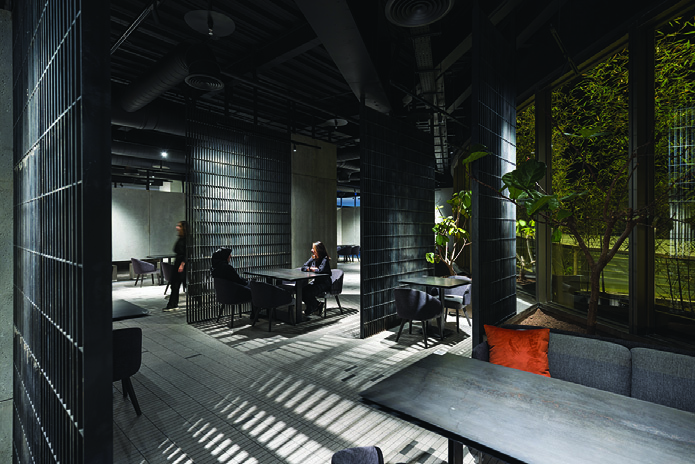
Entrance to the consular section — Meeting space — Entrance to the multipurpose hall from the reception area
the elements upon which the burden of "Iranianness" has been placed (the arch, tilework, dome, geometric symmetry, and so forth) are present. At the same time, it lacks the cliched, closed, fortress-like appearance of embassies, and its novel volumetric composition, open demeanor, and simply granite-clad walls make it resemble something more like a museum or art gallery. Over the years since this building was constructed, these realities have repeatedly been cited as its flaw, premised on the assumption that an embassy building must be recognizable at a glance as to its country of origin, evoking the familiar images constructed in people's minds of that land's architecture, and of course putting its cultural "identity" on display. But this premise was unacceptable to Hossein Sheikh Zeinoddin, and he did not bind himself to it: apart from the fact that notions such as identity or the Iranian spirit are floating, interpretable concepts—and in the words of Iraj Mirza, "they take any form, like wax"—and even assuming they could be defined, and that hypothetical definition were not as pliable as wax but as hard and decisive as the steel monolith that falls from the sky among the apes in Stanley Kubrick's Odyssey, the question still remains: which divine verse, and from where, has decreed that an embassy must necessarily express the identity of the guest and rely on familiar, repetitive elements to do so? Hossein Sheikh Zeinoddin, with the importance he assigns in most of his works to the building site and its context of placement, holds that if a country's embassy in another country wishes to say something about its homeland (or anything else), it should say it in the language of the host. If, hypothetically, the Embassy of Iran in the urban fabric of Minato in Tokyo were to be adorned with tilework, muqarnas, karbandi, and such things, it would be as though the Japanese or Chinese were to erect a pagoda opposite the Shams ol-Emareh—a proposition that, even assuming municipal regulations posed no obstacle, would be simply wrong. This viewpoint of Hossein Sheikh Zeinoddin can also be seen in his competition entry for the Qatar Embassy in Tehran: the building's exterior is not devoid of the familiar visage of Iranian architecture, particularly that of Iran's southern coast, which has led some to accuse him of offering Iranian identity as a gift to the Arabs. But Hossein Sheikh Zeinoddin considers the parade of Arab elements in the urban fabric of Tehran, justified by the notion that everyone should recognize it as the Embassy of Qatar or that the building should have an Arab appearance, to be simply
wrong. For by such logic, a country's embassy anywhere in the world ought to look more or less the same, and extending this logic to other domains, one could arrive at conclusions such as: the staff of the Japanese embassy anywhere in the world should wear kimonos, or the smell of fried onions should waft from the kitchen of the Iranian embassy in every corner of the globe at noon. The form and space of any country's embassy in any location, like any other building, is not unaffected by its function: a function that, for at least the past century, regardless of nationality, culture, origin, and destination, has been more or less the same for all nations. But the notion that an embassy building, like any other building, must—beyond fulfilling its function, which is a basic given—also carry meaning and thought and possess creativity, is apparently a proposition all agree upon. In the words of Hossein Sheikh Zeinoddin, one can drink water from an empty tin can, or one can drink water from a beautifully designed, creatively crafted glass. But that the glass must not have a hole in it in order to serve its function is self-evident, and one cannot count the absence of a hole as a design feature. By the same token, fulfilling administrative functions and security requirements is the bare minimum expected of an embassy, and it is from this point onward that the weighty debate arises: must the building of an embassy express the cultural characteristics and identity of its country of origin, so that all who see it know whose embassy it is? Or is such an endeavor essentially futile, and should one liberate oneself from such constraints? Or, as Hossein Sheikh Zeinoddin puts it, should the guest's words be spoken in the host's language? (And the matter of identifying nationality be left to the flag on the roof and the sign by the door.) An embassy building, both sentimentally and emotionally as well as legally and juridically, can be regarded as a piece of the homeland. Such metaphors may in certain places have practical functions as well: reportedly, aviation security personnel are coached during training that the aircraft is like a piece of national territory, and they should show the same sensitivity, zeal, and decisiveness against hijackers as they would against enemy invaders of
their homeland. But from the proposition "the embassy is a piece of the motherland," one cannot extract architectural design directives and conclude that the embassy's architecture must be this way and not that way. We can briefly survey several embassies built in recent years, all of them noteworthy works, and observe what diverse viewpoints their designers held and what different paths they followed: the building of the Iranian Consulate in Frankfurt by Hadi Mirmiran, which despite the explanations given at the time of presentation to introduce the building, is Mirmiran's personal and creative interpretation of certain forms from Iran's historic architecture (such as the shadow-casting wall of the ice house, its shadow, and the ice-making pool), expressed in a technical language whose spatial concepts and results are not entirely aligned with Iran's traditional architecture. Yet it is a beautiful building that functions beautifully, and moreover links the interior space to the city, its transparency challenging the assumption that an embassy (or consulate) is a hidden, security-bound place. The second is the Embassy of the Netherlands in Berlin by OMA, which above all expresses Rem Koolhaas's essentially global preoccupations, devoid of any national or vernacular connotation. As a result, one cannot tell at all that this is the Embassy of the Netherlands—there is no allusion to tulips, cheese, windmills, canals, Philips, or Fokker—and moreover, despite Berlin's urban regulations mandating conformity to the building typology of the surrounding context (which was in former East Berlin), its appearance differs from the surrounding socialist-era buildings. And then there is the Embassy of Iran in Beijing by Hossein Amanat, with a geometric design and an atmosphere not unlike his other work, the Cultural Heritage building on Azadi Street. Some advocates of the view that Iran's embassy should look Iranian cite this building as a good example of their position. But because I have not seen it in person, and no useful documentation of it could be found on the internet, I could not determine how it sits within the urban fabric and how it converses with its surroundings. Another building also comes to mind that, while lacking the architectural qualities of the previous three, announces from afar which country's embassy it is: the Chinese Embassy in Tehran, whose distinctive appearance (best viewed from the upper floors of the adjacent shopping center) is such that one cannot attribute it to any country other than China, or with some lenience, North Korea (it personally reminds me of the workshop buildings of the Chinese contractor for the Shahrestan Tunnel, perched on a mountain pass on the road from Khujand to Dushanbe in Tajikistan). Its Chineseness is unmistakable, but it evokes a Chinese military or security compound more than an embassy.
It is not only embassies that are caught up in such debates; the intensity of this discussion is even greater when it comes to national pavilions at Expos: at the 2010 Shanghai Expo, two pavilions attracted the most debate in architectural circles. One was the Iranian pavilion, which had apparently been built on the basis of these pointless identity debates and more closely resembled the houses of the newly affluent in Tehran's uptown neighborhoods, and reportedly within its interior, to further emphasize and underscore Iranian identity, a number of carpets—presented as iconic examples of Iranian art—bearing the images of Mickey Mouse and Donald Duck were put on display. The other was the British pavilion: a building with a strange, hedgehog-like exterior composed of thousands of transparent rods that beautifully brought daylight inside and created a dreamlike image of the building at night. Its designer, in response to the question of its connection to Britain, said: "Everyone remembers London with its red telephone booths, red fire hydrants, and red double-decker buses and black taxis. Instead of repeating those, I preferred to say: we are a creative nation, that's all."
For further reading on diplomatic architecture, see Memar magazine, issue 55.
Footnotes: 1- The Embassy of Iran in Tokyo was introduced more comprehensively in Memar magazine, issue 32. 2- A story with a roughly similar theme about the coaching of goalkeepers has been attributed to Ali Parvin, but is not suitable for citation here. 3- Memar magazine, issue 30. 4- Memar magazine, issues 55 and 72. 5- During the days when the debate over the 25-year agreement with China was heated and on two occasions people tried to hold protests in front of it, a friend dubbed this building "the Dragon's Nest," in the manner of "the Den of Spies." 6- In the words of Hossein Sheikh Zeinoddin: debates with grand titles and small outcomes.
Embassy of Iran, Beijing — British Pavilion at the Shanghai Expo
British Pavilion at the Shanghai Expo — Plan of the Embassy of Iran, Beijing
Iranian Pavilion at the Shanghai Expo