



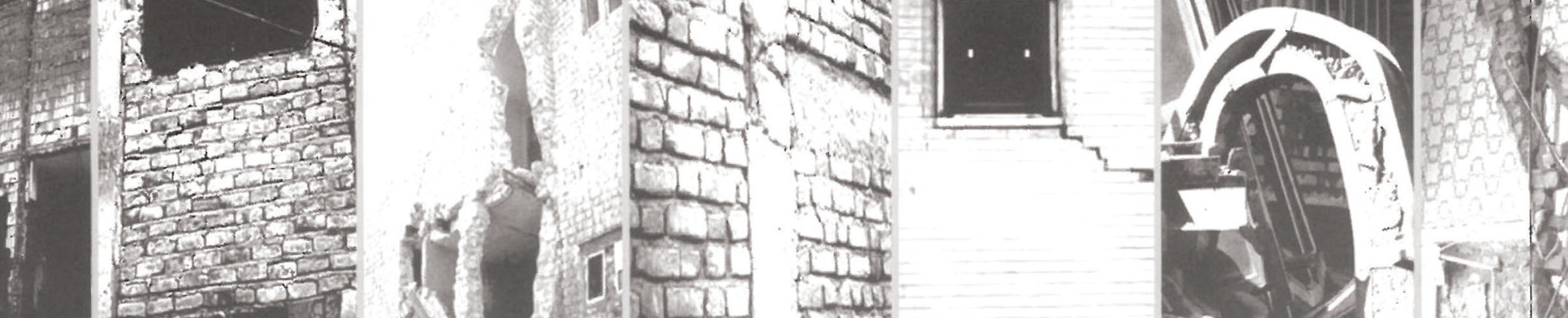
In this edition, "In Bam," we focus on the rapid visual screening report on damaged buildings referred to as "Project 2," which was carried out free of charge by a group of structural and seismic engineers, under the supervision of Aliagbar Taheri Behbahani and Abdolreza Sarvghad Moghadam, in collaboration with the "Bam Project Group." The engineering group was composed of: Maneli Ariel Esfandiari, Alireza Aghababaiee Mobarakeh, Abdol Mahdi Hossein, Mozafar Hossein, Mehdi Dashtgard, Ismail Habibi, Ramin Ruzbeh, Gholamreza Salehpakho, Morteza Soonaki, Masoud Salehi, Amin Azimnejad, Sayyed Ali Moayednejad, Hamdallah Farshchi, Ahmadreza Gervayel, Macoir Modanlou, Mohammadreza Maamourian, and Dara Naeinizadeh.
This report is the result of the rapid visual screening of nearly 400 buildings damaged in the Bam earthquake. The owners had persistently requested the assessment of their buildings in order to know how to deal with them.
In this edition, there is a short column on Bam's structural plan, and we also refer to the completion of four sanitary complexes (conveniences for Bam's public parks), photos of which are also published.
The method chosen for carrying out the rapid visual screening of earthquake-damaged buildings was one that had previously been used with success in the United States and other countries. Called "Rapid Visual Screenings" in its original form, it had been adapted for conditions in Iran. This approach enabled a large number of buildings to be assessed quickly and systematically, providing crucial information for both the building owners and the authorities responsible for reconstruction.
The Bam earthquake of 5 Dey 1382 (December 26, 2003) was one of the most devastating natural disasters in Iran's recent history. The ancient citadel of Arg-e Bam, a UNESCO World Heritage Site and one of the largest adobe structures in the world, suffered catastrophic damage. The earthquake, measuring 6.6 on the Richter scale, killed over 26,000 people and left tens of thousands homeless, destroying approximately 85 percent of the city's buildings.
The engineering assessment was crucial not only for the immediate recovery efforts but also for informing future building codes and construction practices in seismic zones. The volunteer engineers documented structural failures across hundreds of residential and commercial buildings, providing invaluable data for understanding how traditional and modern construction methods performed under severe seismic loading.
The publication of this report in Memar represented an important contribution by the architectural and engineering community to the disaster response, bridging the gap between technical analysis and public awareness. It served both as a resource for building owners seeking to understand the condition of their properties and as a call to the profession to engage more deeply with issues of seismic resilience in Iran's built environment.