Dwelling Places in the Historical Texture of Babol
Mansions with architectural and historical value reflect the lifestyle of inhabitants in the old quarters of Babol, near the Caspian Sea. This essay examines seven cases of the town's residences, documenting their spatial organization, construction techniques, and decorative elements that characterize the vernacular architecture of the Mazandaran region.
Zoroastrian House
Located in the historical quarter of Babol, this house follows the traditional courtyard plan typical of the region. The ground floor plan shows an iwan and rooms arranged around a central courtyard. The building features a basement level and ground floor with rooms on either side of the central axis, employing local materials including red brick with wooden structural elements, and clay tile roofing characteristic of the humid Caspian climate.
Tabarsaran House
This house is located in the Tabarsaran quarter. On the ground floor, the building comprises a kitchen, sitting room, storage, and guest room. Part of the second floor has been added at a later date. The building is notable for its brick construction with tile roofing, wooden window frames, and the courtyard arrangement providing ventilation in the humid climate.
Khalil Rahmani House
Situated in the Afshaniyeh quarter near the bazaar, the Rahmani house plan reveals an iwan with a balcony at center and two rooms on either side. The entrance arch is ornamental with segmental and horseshoe forms. The iwan windows on the first floor feature stained glass panels with decorative woodwork. The roof is made of wood with tile covering, and the facade is of red brick with colored ornaments and white mortar joints.
Hassanpour House
Also in the Naghib Kola quarter, this Qajar-period house features an iwan and balcony in the center with rooms on either side. A large cypress tree stands at the height of the two-story building, with a sun motif at its apex decorating the facade. The flooring is paved with hand-molded brick. The area is approximately 347 square meters.
Naqdi House
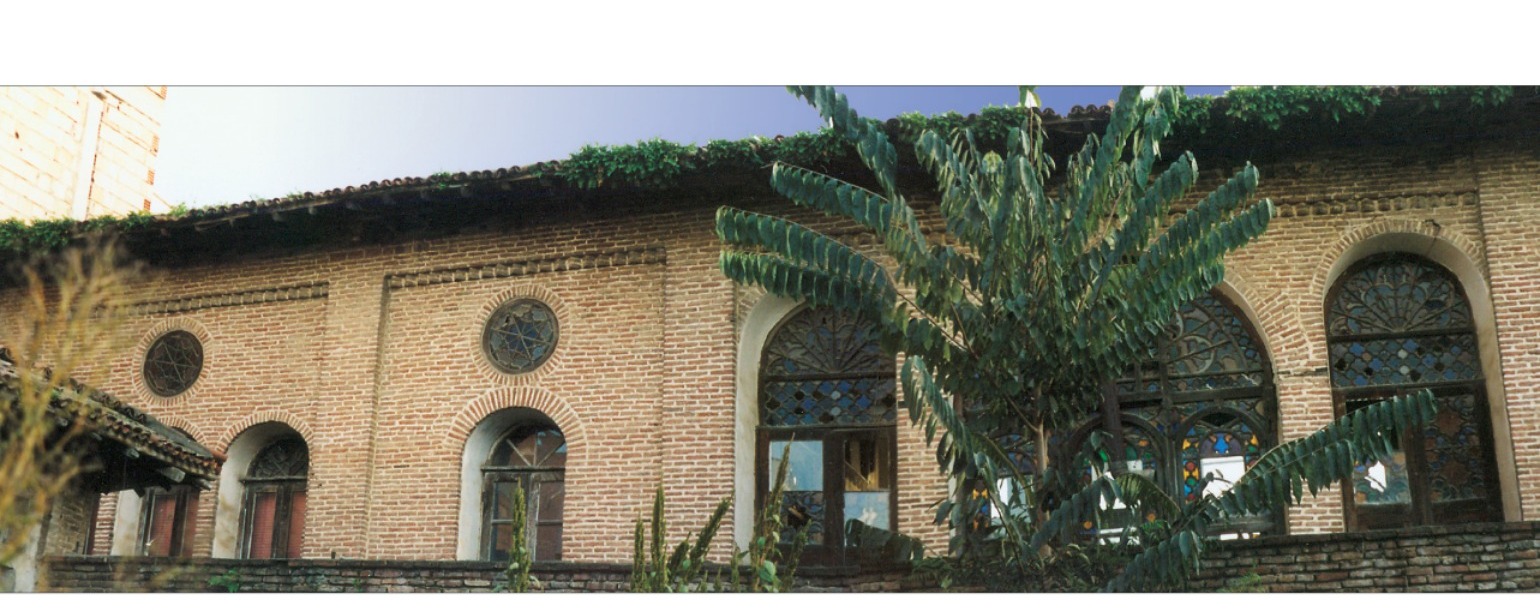
Located in the Naghib Kola quarter, the Naqdi house is distinguished by its extraordinary stained glass windows -- large arched panels with intricate geometric and floral patterns in vibrant colors. The courtyard features a central pool and tall vegetation. The facade demonstrates excellent brickwork with arched windows at multiple levels and circular rosette windows. The building dates to the Qajar period.
Osia and Jahan Houses
The Osia house in the Panjshanbeh Bazaar quarter features a courtyard with a pool and well. After renovation, the brick facade with its tiled roof, palm tree, and wooden elements has been preserved.
Architectural Summary
All the examined houses share common spatial characteristics: a central courtyard (nafas-kesh) providing ventilation, most with basements. Kitchens are typically in the semi-basement, with living spaces under the iwan. Entrances feature tile canopies with decorative brickwork. Facades of wealthier houses are of red brick with colored ornaments and white mortar joints. The spatial organization reflects a coherent vernacular tradition adapted to the humid Caspian climate of northern Iran.