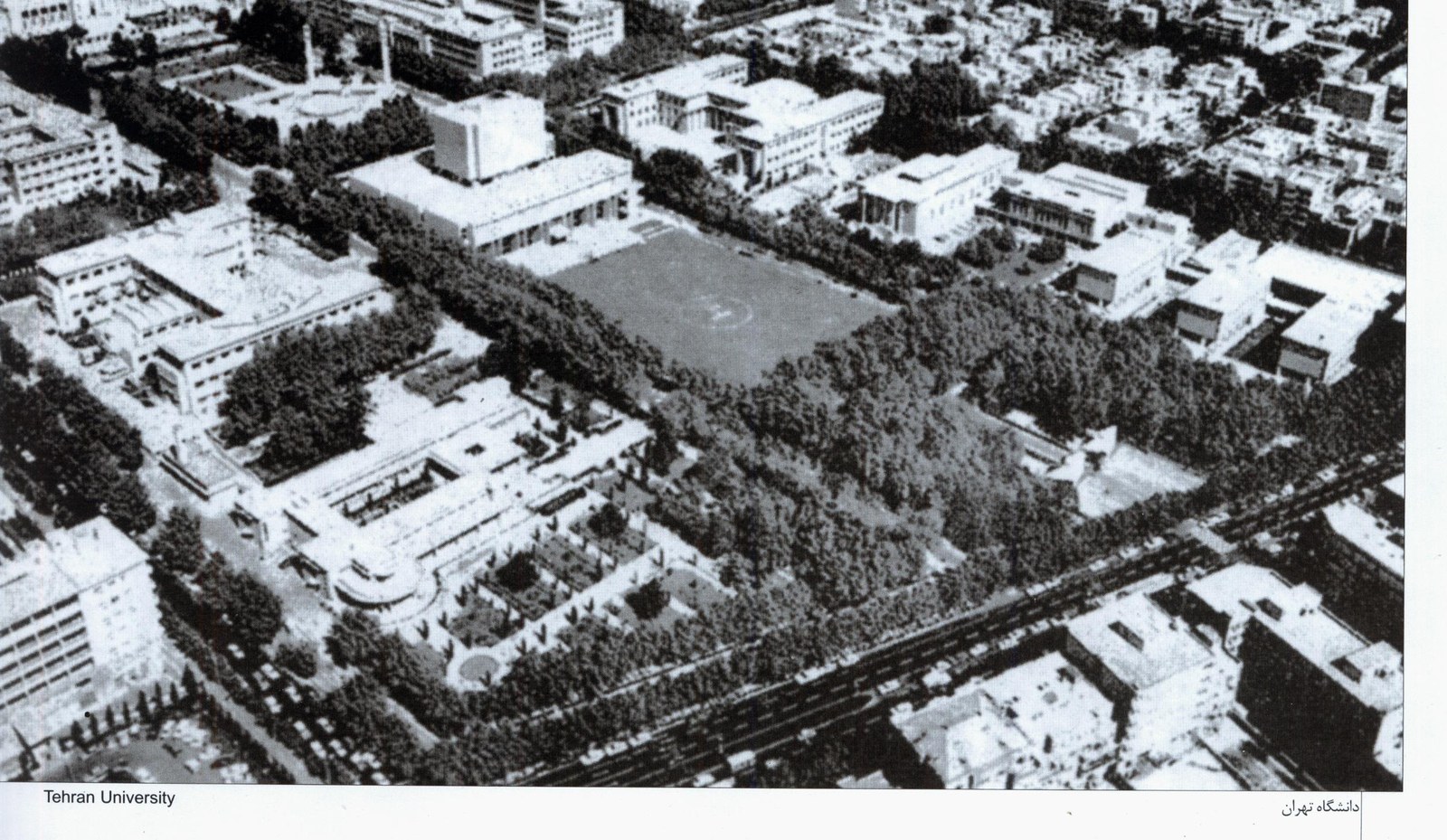
Tehran University
For those of us over fifty, the university still means Tehran University — even if we never studied there ourselves. Even if the appearance and form of Tehran University today has been shaped by images from our youth, and when we go there, amid the rush of Friday prayer shelters, placards, murals, and the ugly, poorly constructed buildings awkwardly inserted between the old original structures that were once properly defined and accounted for, we still cannot truly come to terms with it. And even if our image of the university has been distorted by rented residential buildings and the ugly, hastily built Islamic Azad University branches in the suburbs and outskirts of cities.
I do not know what a generation that studied architecture in, say, the Islamic Azad University downtown building on Chaharbagh-e Felestin — which they say was a prison before the revolution, later a security building — would feel, after years of passing through it, compared to what they have read of architecture.
In any case, we know that this quality of the passage of years causes us to feel a sense of attachment even to places we did not love in our own time — perhaps because pieces of ourselves remain there and pieces of those places remain lodged like shrapnel within us, physically even in...
But we who still remember the echo of the bustling halls beneath the tall ceilings of Tehran University's handsome and well-proportioned faculty buildings — the sound of footsteps on wide stairs with golden metallic edges, the heaviness of copper-colored metal doors and their large saucer-shaped handles that open and close calmly and silently, the gentle murmur of the stream at the feet of ancient plane trees, and the enchantment and allure of the sacred thing behind those green tables whose intoxicating discovery was a source of pride — we cannot believe that the absence of such memories, mixed with a sense of honor and self-respect and pride in one's place of study, could be anything but an irreparable loss for the young generation.
In this issue, we have brought you a collection of university campus designs, old and new, with the hope that it provides an opportunity for comparison and raises questions about the performance of university officials — especially those of Islamic Azad universities — who, despite receiving considerable tuition fees from students and benefiting from special facilities for acquiring land and resources, have built the worst examples of university architecture in this land.