



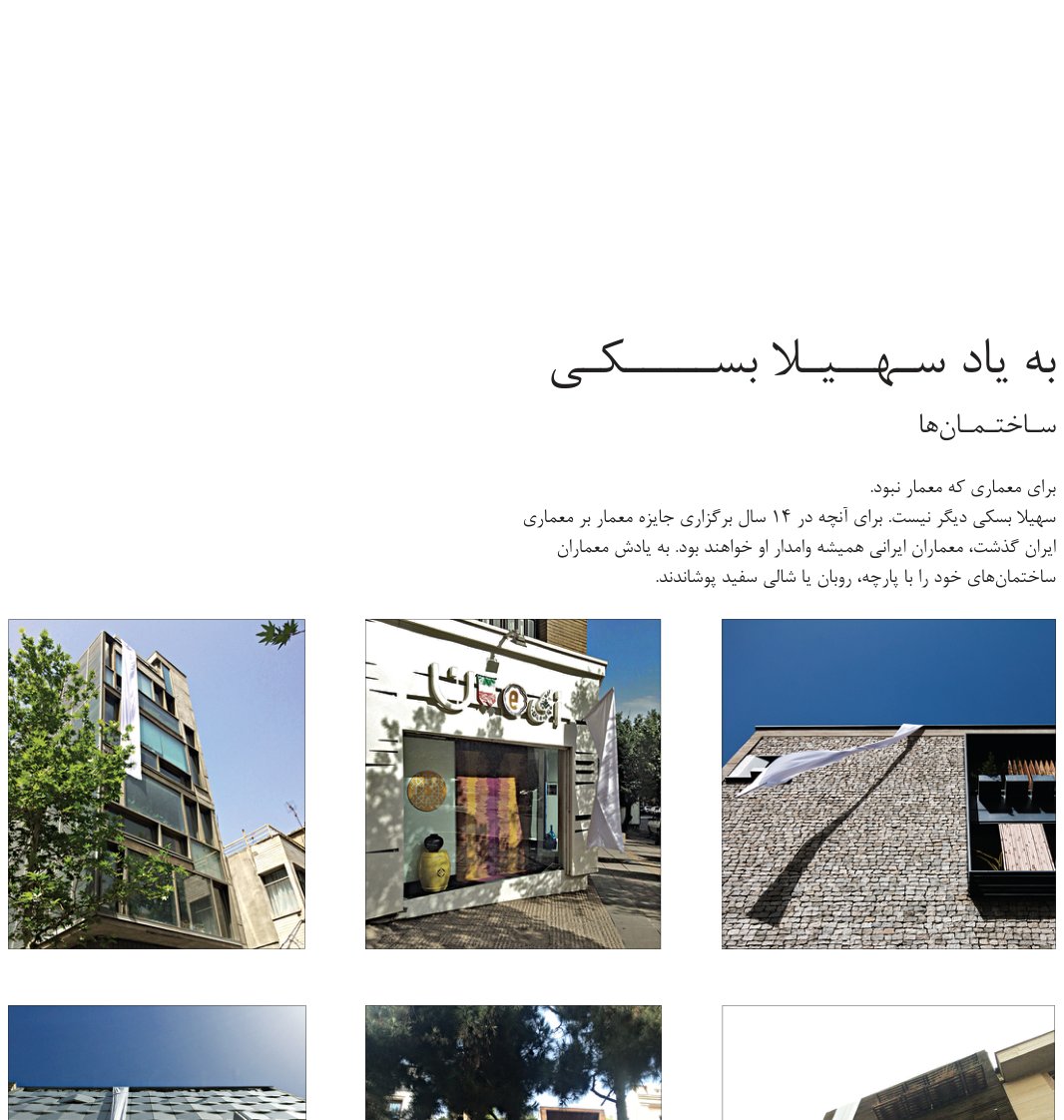
For the architect who was not an architect. In the fourteenth year of the Memar Award, Soheila Beski is no longer with us. For all that has transpired in Iran, Iranian architects will forever be indebted to her. In her memory, architects draped their buildings with white cloth, ribbon, or a white shawl.
Interesting things usually happen on unplanned journeys. Several years ago, on one such trip with Ms. Beski, the conversation first turned to the subject of this issue -- regarding how, from a holistic and unprejudiced perspective, one can determine how and why one work of architecture is better than another, and what qualities make it so. The questions she would ask and the spontaneous answers I would give, and the questions that consequently took shape in my own mind, led her to propose that I serve as guest editor for an issue of Memar Magazine on a related topic, and it was agreed that I would think more about it. Time passed. In 1393 (2014), with the judging of the Memar Award approaching, and following a need I felt to organize my thoughts, we undertook an examination of the subject of quality assessment, and thereafter, with the collaboration of friends who put great effort into this issue, we began working on it. Our initial question started with how to assess quality in a work of architecture, but the further we went, the more the pervasiveness of this question in the discipline of architecture became apparent to us. Judging the quality of architecture, from the very beginning of a student learning process, to the time when, as an architect, they enter the professional market and must sell their work, and also when, in pursuit of quality, they set about evaluating a work of architecture, has a profound influence on their work. This is a crucial factor in understanding architecture and is by no means simple to examine. The concept of quality in architecture is an open and flexible concept; it has no fixed formula or standard; it demands both knowledge and experience, as well as the capacity for openness to new and fresh instances of quality. The reasons that can give rise to value in a work are always highly diverse, varied, and at times contradictory. In many acceptable works, one can trace common and shared qualities (a baseline of expectations?), but in certain other works, there exist highly influential elements that elevate them to the level of not merely a work of quality, but one of value. Identifying and recognizing quality and value in architecture, thinking about them and analyzing them, and most importantly learning from that, is a process that never ends throughout an architect career and is constantly repeated. Regarding architecture, value and quality can be discussed at various levels. At a higher level and from a holistic perspective, architectural strategy and decision-making are situated, manifesting as the principal goals, criteria, and systems of design, which profoundly affect all other levels. At the next level, one can attend to the architectural tools and methods that produce spatial qualities, employed in pursuit of design objectives. And finally, we arrive at the scale where details become more visible -- the final crafting of architecture -- which in a different way contributes to predetermined goals but is more in service of taste, aesthetics, and matters of that kind. This level is far more
easily perceived and more noticeable to the untrained eye unfamiliar with architecture, but its degree of impact is less than the others. The major and principal decisions of any architectural work -- at any scale -- have the greatest impact on all its aspects, and their proximity to the correct state determines the extent to which efforts at lower levels have been invested in the right direction, and, in simple terms, whether they have been wasted or not. In any case, each matter must be given attention proportionate to its coefficient of importance. The prerequisite is finding a lens through which one can examine the influential qualities and values of architecture across all these layers. It was stated that quality is a broad and flexible concept; in this issue of the magazine, an effort has been made to include articles with different perspectives examining the subject of value and quality. In addition, the goal has been that beyond abstract description, diverse examples -- and not solely architectural ones -- also illustrate them, and conversations be held with several individuals engaged with this subject in today architecture, because the exchange of ideas contributes to an ever more dynamic mental image of quality. All these materials come from various spectrums, and an effort has been made, within the capacity of a single magazine issue, to preserve their plurality so as to offer different windows for looking at quality and effectiveness in architecture.
Today, as I write this editorial, it has been three weeks since Ms. Beski left us forever. She was always seeking what influential subjects could elevate the quality of architecture and urban life in our present conditions, and it is interesting that in everyone estimation, supporters and critics alike, she herself was one of those who had a tremendous influence on the emergence and presentation of quality in architecture over the past two decades. When Ms. Beski is spoken of, everyone emphasizes that she, in addition to supporting the veterans of the architectural profession, strove to give visibility to young architects and provide them with opportunities. In this issue as well, at our suggestion, an effort has been made to bring a new generation of architectural writers into this arena, and a large number of architects under thirty, who may not have had similar experience before, were involved in this issue, and in a way these individuals are the last and youngest generation upon whose work Ms. Beski had a direct influence. With the hope that her path will be continued by this generation in the future, may her memory be honored.