



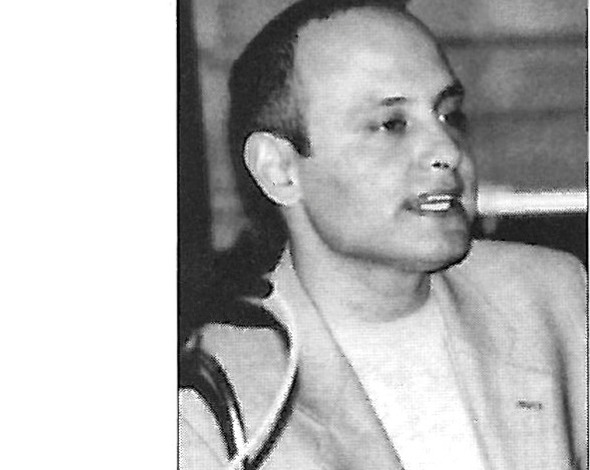
As it was indicated in the previous issue, the Society of Iranian Architects, sponsored by the House of Iranian Artists and the Le Grand Company, from the first to the third of October held a gathering in Tehran in order to present the advantages of the 21st International Congress of Architecture 2002, Berlin. The meeting attracted a large number of students and architects. In this meeting a film of Peter Eisenman's speech in the Berlin congress was shown with Persian subtitles and was analysed afterwards by architects invited by the Society of Iranian Architects, consisting of Dr. Falamaki, Mr. Safamanesh, Mr. Haeri, and Mr. Shokoofi. At the end of the programme, with a proposition by the announcer, Dr. Katoozian and Mr. Daneshmir, who were also present in the hall, expressed their opinions for the audience. The Persian translation of the speech and the subsequent comments are presented here. It might be very interesting for those readers of Memar magazine who have not been able to participate in this meeting to find out about the contents of Eisenman's speech and its interpretations, as he is one of the greatest stars of today's architecture in the world. Considering the vast range of different interpretations made on just one speech, one may wonder: isn't it necessary to limit the vast range of a word's meaning in order to make a discussion possible between two sides?
Peter Eisenman — translated by Shima Khosravi
(The beginning of the tape is unclear)... He said to me: 'We had a film festival in Berlin and all the technical people involved in making the film were there — producer, technical staff, and of course the stars. Don't you find it strange that at an architecture festival, which is one of the very few professions that holds a festival, everyone is present except the main stars?' I did not want to say that I think I am a star myself. Then he said: 'Don't you think the stars are part of the resources?' [a reference to the title of the congress, Resource Architecture]. I said: 'Yes, I think so too.' He said: 'It's interesting, because the major German stars everyone in the world knows — Mathias Ungers, Libeskind — are not speaking at this festival. Do you know why?' I said: 'Yes, it does seem strange, but I think this is your problem, not mine.'
In any case, it seems that the mass media that runs the world doesn't think that stars have much of a place in architecture. That was the first part of my talk. The second part is this: if we want to talk about something other than stars, what counts as a resource in architecture, that I can speak about? Because I don't know much about technology, and I have no expertise in buildings or equipment, ecology, plumbing systems and all those things that are subjects of discussion. Since I very much wanted to take part in this festival, I said to myself that one of the greatest resources of architecture is architectural ideas. The most important thing for me is having an idea. A reporter asked me: 'What do you mean by architectural idea?' I said: let me give you an example. Two weeks ago, when they presented the six proposed solutions for the World Trade Center site, I said all of them were very bad. Someone asked me: 'Why?' I said: 'Because none of them have an idea.' And of course when they were put on public display, people thought the same. I think people are much smarter than we think. They intuitively understand what an idea means.
I said the greatest architects in the history of our profession have endured because of their architectural ideas. For me the issue is this: when we think of the work of the great architects of the past, like Alberti, Bramante, Brunelleschi, Borromini... we don't think about whether their buildings worked properly or not. We don't really care whether Bernini's Quattro Fontane in Rome functioned correctly or not, whether the Pope's palace was suitable for living, or not. No one knows whether St. Peter's worked the way Bramante predicted, or whether the church was satisfied with his work, or whether environmental concerns were properly addressed.
What we remember is something else. What architects do for people is something other than thinking only about function, which we know we have to do. Something more than solving the problem of shelter and making a place. So what I tried to explain to the television commentator was that we do all those things, but we do something else as well — and what makes a work into a great, historic piece is that idea. Because if you ask architects what makes a work into a piece of architecture, many of them cannot answer. Today I am posing this as a question, not as an answer to a question, because after September 11 we, as architects, have been confronted with the problem of how we can now create. How can we represent. This problem has emerged not merely because of the attack on the World Trade Center, but because of the way the media transmitted it.
For the first time we saw an unpredictable event live and simultaneously across the entire world. In fact, I am convinced that this programme was designed as an advertising campaign — for the planes to attack the buildings half an hour apart so that all of us would turn on our televisions and see the event, just like a film. Of course, no film could have been made so well, none could have produced the impact of watching a real event live. However realistic science-fiction films may look, they cannot have the same effect as the live images of the media. For this reason, the role the media played was, for various political reasons that I am not interested in, very important for the whole world. I am more interested in its effects on architecture; in what this event means for architecture, when the media instantly broadcast its images live across the world. Especially because we are working on a project at the very same site. A group of us architects has been asked to design something there, and that is an enormous responsibility.
How can one make a design when the memory of what happened there — the very theme of its memorial — is still in people's minds because of how the media handled it? In other words, many people have seen the event, whereas in most other memorable events, like the Holocaust or Hiroshima and the like, there are not many living witnesses. The memorials we build for those events generally rely on a memory that has remained in people's minds. But when you are asked to build a memorial on the site of the World Trade Center, you are no longer dealing only with a memory but with an actual image. So whatever you build will fall short; whatever you build will lack the dynamism and impact of the immediate presence of those real images, and that is nothing but falling short.
So my argument is this: if we begin with Adolf Loos's saying that 'architecture is nothing but monuments and tombs', and that it is through them that we remember our history and culture, then the question becomes: in the age of the media, how is one to build a monument when all the images have already been made? How can architecture compete with this phenomenon?
I think that representation, which has been bound up with the question of architectural ideas ever since Brunelleschi introduced perspective into architecture, has always been our problem. And if we can no longer raise a monument through pictorial representation, the way we used to before the age of the media, then the question becomes: how does architecture want to deal with the question of representation and image?
And this is exactly the discussion I want to raise as one aspect of the architectural idea. Of course this is not the only architectural idea, but it is undoubtedly something that the entire human community, East and West, has been thinking about: how can one represent one's own culture?
Well, one of the most important issues of architecture, peculiar to architecture, in comparison say with painting, music, or sculpture, is the question of land. Land is almost peculiar to architecture. There is of course land in painting and sculpture too, but by 'land' in architecture I don't mean only the location where the project will be built. The historical record of that land is also part of it. In other words, land in architecture is more like a Palimpsest [an old manuscript that has been overwritten; a manuscript whose original has been erased and rewritten upon] — that is, history is in it. The land is not a neutral surface. I think architecture is always confronted, in a very important way, with this history. In other words, we never simply represent the land; we don't rebuild it, we don't try to imitate it. What we try to do is to bring the land — as Proust says — into the present in order to create the future. So for me, one of the starting points for a memorial, whether in New York at the World Trade Center site, or here in Berlin at the site of the Holocaust — regardless of the present subject of that memorial — is precisely this. Even at Santiago de Compostela, where we are building a cultural quarter (which is not a memorial and is a living project), we have always begun with the land. The land has been a wholly distinctive architectural idea for us. In other words, understanding what it means to build something on a site, and being given a primary site to work with, is itself an architectural idea.
Now, what we architects normally do is to draw the project up out of the ground, and the aim has always been to create an object or an image. My subject today is that we have to think again about the way we do this, because the media have taken over the field of images. The media have made it difficult for architects to build on a site. This problem is too important for me to explain in the half-hour I have, but it is one I want to open up here as an idea, as a resource. In the sense that the land is a resource, the history of that land is a resource — and it is true that our images were also once resources, but I believe that they no longer have the strength to hold their own against the all-pervasive coverage of the media, the totality of media that we, as architects, are up against.
So in all three projects — the World Trade Center, the Holocaust, and Santiago de Compostela, which I will show you very briefly later — we have used the site as a given, with no intention of producing any image. For example, at Santiago de Compostela, we are building an opera house, but we are not building something that has the form of an opera, or a symbol of opera that represents the opera. We want it to take the form of something that has come out of the ground of that particular place, that speaks of its history, of the culture of Santiago, San Diego, San Juan. We tried to build something that is not like anything else. Likewise, in the World Trade Center project, we tried to build something that speaks of its history, without symbolising the disaster, or symbolising something less than the event itself.
Now I want to talk about this particular Holocaust project we are doing in Berlin. We won the competition. The main idea of the project was that in no way would we symbolise the Holocaust. Because whatever we did would turn out to be a cliché if it resembled the Holocaust. We wanted to see what architecture could do with the land. Our intention was to produce an affect, not just an effect, not just to build something functional. We wanted to build something in which the body, the mind and the eye would together arrive at a primal experience, and stepping into this space would be stepping into a place that has no symbolism, no orientation, no purpose or use, and is simply a silent project. Its silence permits anyone to experience an architecture — a three-dimensional environment. The whole idea was that when one enters the Holocaust museum and the camp site, one would internalise that experience, rather than coming away saying: 'What a terrible disaster that was.'
The same claim holds for the World Trade Center. If someone wants to build a memorial there, they should build something that allows the individual to take the experience of that tragedy into their unconscious and internalise it. But I want to say that what we are doing has nothing to do with internalising a painful experience in the unconscious; it is the experience of something new — the experience of being in a space, alone, without knowing where you are, with the feeling of being lost in it. In other words, the realisation of something that architecture does without creating an image, without representing a memory, by producing the possibility of a bodily affect — an experience that links the body, the mind and the eye. This is something the media cannot do. The media do not engage the body; they engage only the eye and the mind, and architecture always engages the body. When you enter a church, you don't merely think about the rite that is performed in it, your body itself is affected sensorially by the space. When you enter St. Peter's Basilica, regardless of whether you are Catholic, Muslim or Jewish, the space affects you sensorially.
[Eisenman points out a few buildings on a plan, such as the Reichstag, and Frank Gehry's bank — and Frank is upset that we are blocking the windows of his building.]
This is the project we won in the competition. A site covered with 2,700 concrete pillars [in the image the pillars are rectangular blocks]. Each pillar is approximately 95 cm wide, 2.38 m long, with a variable height from 1 to 5 m. Between these pillars there is a 95-cm space, wide enough for only one person to pass through, with no centre, no edge, no anything in it but a kind of physical experience of entering a space.
Now look at the section of the project. Here too, as in the plan, you will see that it is the sharp difference between the sections that makes this experience possible. Here there are two topographies: one at ground level, the other 2 m above ground level. This is the topography level with the ground, which you can see is very unconventional. Our main idea was to create a difference between the level of Berlin's ground and the level of the memorial's ground. Once again, you can see that the openings in the ground are where the concrete pillars will be set. You can see that this surface is very undulating.
This other one is the upper topography that sits on top of the concrete pillars. You can see it is completely different from the lower topography. What we did, roughly, was to take the lower topography as one surface and the upper topography as another surface, and to set these points between them. In other words, the concrete pillars connect these two surfaces. Here in this drawing you can see that on the outside this ground rises about 1 m, and as you go down it reaches 4 m and in some places 5 m. Look at this other section. The interesting point is that from the street side you always look down on the upper topography, and both upper and lower topographies — the ground — are visible: a kind of two-faced tablet of two surfaces of ground. We have used the same strategy at Santiago and on the World Trade Center project.
Here you see how this site comes out. The interesting point is that although these look like regular rows, the relation of the two topographies makes some of these pillars take on an angle, with some of them tilted at 1 or 2 degrees from the horizontal. Now you can imagine that when you see one of these 5-m pillars tilted by 3 degrees over your head, especially when you are in a 95-cm-wide passage — which begins calmly but, the further inside you go, the more you feel [the tightness of the space].
I have shown only the Holocaust project, because I did not want you to imagine that what I am saying is unrelated to Berlin. This work is entirely related to Berlin and in fact we are starting construction in the first week of September. I do not want you to think that this work is an answer to the question I posed earlier. It is just a personal attempt to deal with the question of land and what architects can do with an idea. And of course it has nothing to do with the question of function, symbol or image. It is almost a physical fact, which anyone can experience and from which one comes out a different person. Since I have not yet seen anything like this and have not been to such a place, I do not know what kind of experience it will be. I can imagine it will be an unconventional experience, the good and bad of which I do not know. But I know it is an experimental experience related to the encounter between architecture and the media. That has been the case from the beginning — the encounter between representation and image — and as far as I am concerned, now after 11 September (not the event itself, but the event the media made).
In short, I think that if you don't have an idea, it doesn't matter what your work looks like, what its function is or what its symbol is. If you don't have an idea that anyone — architect or not — can grasp at a certain level, the form of your work doesn't matter; because all the forms have been made by the mass media, and now we face another problem: not much is left, not just for making images, but for making ideas; ideas that may or may not be representable.
Mohammad Reza Haeri
Thanks to the dear friends who took part in this gathering, in less than three months what had happened on an international scale was brought to Iran and we too were given a share in the experience of the five thousand world-recognised architects who attended. In my view this speech is one of the strongest and most daring speeches I have ever seen and heard, and I do not think any architect would have the courage to set aside all the references on which we have leaned until today and to speak with such candour.
It seems to me that the subject is like the topography of the ground that Mr. Eisenman has shown — significant on two levels: an upper level and a lower level, both arising from a single reading and a single idea.
The first level is the manner of Mr. Eisenman's speech. In the original tape that I have, it is full of joy and laughter throughout. This matter of laughter and humour is very important, and many of the finer points were brought out during these jokes and asides. Eisenman, who is rightly an architectural star, denies his own stardom, and throughout the speech, with the utmost humility, says that he knows nothing about the environment or structure. It is very important that someone should be able to deliver, to five thousand people, a speech full of joy and life, and at the same time bring out every aspect of the subject, without imposing himself on the atmosphere of the meeting.
Another point: the two interviews with Peter Eisenman that have been translated thanks to Mohammad Reza Jowdat have helped a great deal in introducing Eisenman in Iran. In the late or middle 60s, when Peter Eisenman's name was first raised in Iran, the general impression was that he was a dandy who went here and there in a tie... In Rob Krier's interview with Eisenman, all of Krier's arguments arise from historical and ancient architecture, and Eisenman demonstrates this with full command. In his interview with Charles Jencks, he also says that architecture is not of the substance of words and speech and cannot be expressed in verbal form. In any case, we should engage more with Eisenman's works and discuss how. That is the first level of the discussion.
Now let us turn to the second level. It seems to me this speech is one of the most radical that has been given. For someone to dare to say that form, function, memory and image are none of them criteria, is very important. Eisenman expresses his thought with full force through the de-familiarisation of design. In my opinion, this level needs more discussion.
The most important factor in creating any work is the idea. The idea is the soul of all the things we do. The most striking example of this can be seen in the art of Iranian cinema. Many of our architects think that Iranian cinema, which has been recognised in the world, is some sort of specially-woven exception or that they have been lucky — but it is not so. Iranian cinema is an idea-bearing cinema. Its most important essence and the cause of its success is the idea. And if architecture today is struggling at the lowest levels of construction, it is because of the lack of an idea.
There is the matter of September 11. Naturally architecture too has not been spared from its effects. Around 150-160 internet sites have been set up where various ideas have been put forward as to whether the buildings should be replaced on the site, while the leftists consider rebuilding to be a mistake. In any case the important thing is that the prevailing thinking after the September 11 event has deeply influenced architecture, and the undeniable role of the media in shaping this thinking should not be ignored.
Architectural media in our country are mostly the magazines, and the other general media, apart from a few reputable publications, deal less with architecture. At present the most important issue is our cities, which are very little discussed. The role of the media in shaping thought is very important, and how one can escape from it is a question Eisenman answers.
Another point is that, in my view, in Eisenman's work there is no particular orientation, and no principles upon which one could base a design are visible. Specifically, Eisenman has presented a work that we are all looking for. For years and years we have been looking for architectural references. What reference exists for the Iranian architect? In any case, what Eisenman raises — Architectural Resource and Resource Architecture — both deal with the question of reference in architecture. The discussion of reference in our country is unfamiliar even as a term, but in our architecture, reference is generally absent. We draw without reference, we speak without reference, and everything we have is without reference. The reference we saw today in Eisenman's work — the concept of land — has been very little engaged with, and all the other references have been set aside as well. Although the society in which Eisenman lives is completely different from ours, the thought he raises holds true in our society as well. In our country, apart from space, all the other matters — including architectural reference and the idea — have been, if not negated, then set aside. Because the discussion of the architectural idea cannot be separated from the idea of space. In other words, space, as the most important reference in architecture, still holds. What Eisenman says in describing architecture is the best: the difference between architecture and all the other arts is that architecture takes hold of the body, or, in other words, takes our whole being into itself, whereas the media engage only the mind and the eye.
In my view, this discussion should be continued in another session, with question and answer. My emphasis is more on the question of idea and space. In Eisenman's discussion the question of space was not very clear. Whether the question of the spatial idea is still valid for Eisenman or not is a question that one can take up in a discussion of our own architectural references.
Mohammad Mansour Falamaki
To begin the discussion, one might attend to two notes which are about twenty-five years apart in time: one I am taking from a writing by an earlier architectural critic, and the second I will base on points that Eisenman himself is making these very days. But first, as a brief introduction to addressing our own daily concerns, I have to say that we Iranian architects, in theorising about architecture, should attend to the point that each of the architectural magazines and books and even the television reports has its own particular outlook, which does not necessarily present the subject to everyone in a complete and comprehensive way. The young community of Iranian architects needs a comprehensive and root-deep understanding of the architecture of the more famous architects of today: a place where each architectural work is recognised in its own particular framework. This framework — in the present-day conditions of a spatial economy (or rather, of an economised architectural space) — is not introduced as adequately and as it should be, and many of its indicators are kept out of the sight of architects from the third world. And this is something that, in the countries that are the home and origin of modern architecture, simply does not happen.
But let us return to the two notes I mentioned. The first note I quote from the words of an able architectural critic by the name of Fulvio Irace, who wrote, in Op-cit issue 38 in 1977. In a compressed expression we look at points he set out under the heading 'Updated and unconventional architectural research'.
According to Irace, Eisenman's architectures cannot be understood without taking his own subtle theorising into account. Eisenman's theories are brought back into the formulation of his designs and yield fresh points which, in turn, will be absorbed into his future design work. To understand Eisenman's architectures one must take care that this superficial reading is not adopted: in which one would have to say carefully that Eisenman's architectures are NOT obtained from the intersection of surfaces and floors (or volumes) which mechanically act upon and cut across one another...
Irace sees the generative point of Eisenman's architectural play in this way: the cube, as a building shape for creating a network of spatial lines, horizontal and vertical floors, which combine in pursuit of bringing about a particular order. Columns, which are then taken as the points where spaces are knotted together.
On the other hand, Irace pays attention to Eisenman's architectural language and says that his architectural language is pure and should not be looked upon by architects as the ultimate, pure limit of a system of analytical instruments. A system that emits — out of itself, from within itself — fresher information (and is devoid of any particular flavour or expression).
It is interesting to observe that this very ground and procedure of looking at the structural-volumetric elements which give Eisenman's architecture its final shape, comes out of the very origins on which he is based. And this is a very important point.
Irace says that in the more famous architectures of Eisenman at that time — his five Houses and especially the Frank House — Eisenman tries to keep his architecture away from any attempt at lyricism or poetics: he avoids re-creating the signs that recall memories that would manifest the culture of place.
Now let us attend to that closing portion of our first note: the place where the contemporary critic of the architectural world explains that Eisenman's works (relying on the theories he has expressed and confirmed, as we said) stand on three principal pillars, in this manner:
First — being pragmatic (which is summarised in the relation between use and technology).
Second — being semantic (which looks at the relation of form to meaning and iconography).
Third — being syntactic (which attends to the relation of the convergence of meaning and form — through the use of a structure that relies only on formal dependencies.)
In the essence or deep, ultimate sense of our first note, it can be seen that Eisenman is committed to establishing a connection between theory and design, by way of crossing from the language of philosophy to the language of architecture.
In our second note, we go directly to the text of Eisenman's speech at the 21st International Congress. But before that, in my view, it is necessary that we architects attend to a point that is very important: the modern architecture movement, after its birth, declared the thoughts of the Enlightenment as its starting point, and began its activity. Within a century — a relatively short time — a great movement is born and gives its harvest. The modern architecture movement is powerfully active, and as we say, jokes with no one. All the statements with a human, spiritual, divine and cosmic charge that can be found in the writings of at least the ten CIAM congresses are all influenced by the modern architecture movement. In this period the discussions reach the fullness of their power and develop. According to this movement, the human being is a being with complex feelings; these feelings must be recognised and answered, and the most sacred thing that an architect can do is, with whatever particular artistic vision he has, to be answerable to demands that have a human, social and civic basis.
With the start of the Second World War, the modern architecture movement also faltered. The Second World War caused the labour market for architects and the organised architectural groups to be transformed from the root. A new element entered the world market of architectural production, and the architectural groups that until that time had ordered and perfected their thoughts together, gradually withdrew. Architects were gradually divided into two groups: the first being single architects who do their utmost so that their picture and, every so often, their articles are printed in the most important architectural magazines. The second group consists of architects who work in international trusts and form large contracting groups together with design.
This issue should not be ignored, because it is one of the main reasons for the disregard or undervaluing of the great contribution of the modern architecture movement. But if the modern architecture movement had been able to guarantee its own continuation, it might have reached a place where it no longer regarded the lone architect as the saviour of mankind or of earthly civilisation. Now let us look at the sentences and the message we heard tonight: Eisenman's great daring. It can hardly be said that having daring alone is enough to determine the fate of architecture. Daring is one of the tools that helps the architect to put forward his view, and no more than that.
Eisenman's main argument, from a certain viewpoint, in this report we have been given, was that architecture should be able to affect the mind, the sight and the body of the human being simultaneously. Here, if we look at this question in the modern art of architecture from around 1928 onwards, the scope of the subject becomes much deeper and wider. In one of those at the fourth CIAM there were others. We too have read their writings and learnt. We learnt the mind from others; we learnt from the phenomenologists what it means. If we have worked in this field ourselves, our work is based on the very advanced culture of the West that begins with Hegel and reaches the present.
If you ask my view about positive or active (rather than passive) affecting, the answer will be this: affecting a person through the eye and the mind, without involving the body.
For about half a century, a recognised and well-established branch of architecture has been introducing itself as a means of mass communication, and in those very books and articles it is spoken of, and it is put forward as one of the methods of thinking about architecture. If it is said that architecture can act like a means of mass communication, why should the reverse not also be true? Why can't every means of mass communication do the work of architecture? And this is a discussion that must be taken up further.
In any case, giving an opinion about the project of an architect — and a valuable and great architect like Eisenman at that — is no simple task. But I have the daring for it. Only if dear engineer Shafei and his colleagues would give me 2 to 2.5 months and choose, of their own selection, one of the works of Eisenman, or any other modern architect whose works are printed on the covers of the magazines — I will analyse it within the framework of the experiences of the past 70-80 years of modern architecture, and not be limited to this work alone.
About Eisenman's project too, which we saw briefly today, all the main indicators that are necessary for introducing a project were not put forward. So speaking about a project of which we have only seen a few brief images, and that in a wholly abstract manner, is not possible for me. In this film one cannot observe a tangible architectural work that could help us advance a specific discussion.
It is good to recall too Eisenman's first sentence, when he wants to free himself from all the responsibilities of modern technology: 'I do not know technology and I have no expertise in the environment.' This is a kind of disclaiming of responsibility. Well, if we too want to have a comfortable life without trouble, we can add two or three items to these and make our work easy.
Kamran Safamanesh
In my view, Eisenman's speech, even without containing any new point, is very interesting and valuable. From a busy and well-read architect more than this should not really be expected. This speech, with all its importance, is a speech that should be seen within the overall framework of Eisenman's thinking.
Mr. Falamaki referred to some of Eisenman's statements. It is fitting in this context to recall too his conversation with Eisenman, which is interesting. Over the years I have been able to become more familiar with this person and to realise that, contrary to what I had imagined, he is one of the professional, experienced and well-informed architects who does not feel the need to scatter his thinking by being expert on all matters of technology and the environment, and works in his chosen field, on which he has full command, in a focused way. If we attend to the film of the architect's role that was shown, we see that the rest of the work is done by all the professions working in the team.
Another interesting point: in the 1970s, the issue that architecture was on the verge of decline was much discussed, and the raising of the discussion of communications by our friend Dr. Falamaki is very valuable and important. Because the discussion of information is in fact the starting point of Eisenman's argument. In those very years (1970) I too presented my thesis as a proposal on the phenomenon of communication or the global village, and Mr. Falamaki remembers it. I still work on it and believe that the foundation of everything is communication and that it provides the ground for all transformations. Eisenman expresses this point in the most beautiful way and, to prove it, draws in the most fitting manner on the September 11 event and the destruction of the World Trade Center towers. In another part, he addresses how Brunelleschi's introduction of perspective changed the fate of architecture.
According to Eisenman, the architect's work runs into difficulty when the image overtakes the idea, and architects' work has, as a matter of principle, become very difficult because of the entry of the media into the field of construction. It is the image-makers who are doing the building, and before we even succeed in building, everything has become old and obsolete.
Mr. Haeri raised the point that our architecture, due to a lack of ideas, is at the lowest level. But on the contrary, in my view most of our students have new ideas. As an example, one of the students doing his thesis with me (and who is here too) has devoted all his attention, in creating spaces, to the use of the media and what we refer to as Virtual Reality.
Elsewhere, Eisenman says that architecture must come back and place itself in conditions where nothing other than physical experience is at stake. Here function, symbol and image are not at stake. Eisenman, by raising the matter of physical experience, daringly brings a new kind of architecture onto the scene. Daring of course based on accumulated knowledge.
Elsewhere he speaks of land and site. In this very gathering, I know people who have started their work from the site. Essentially, for a while the site became a fashion in the universities, in such a way that topography became the form-giving factor of the site. Of course this work began earlier than Eisenman.
In 1995 the opportunity arose for me to visit Cooper Union in New York. At the invitation of Eisenman and Libeskind, I sat in on their classes. Eisenman, in his class, with full daring, had presented one of his own projects in execution in Geneva — which had been entered in a competition — as the class subject. One of the students had used, for the first time, software inspired by mechanical engineering. At that time this software was of interest to Eisenman, and I witnessed how Eisenman would ask the student about how the software worked. Now Eisenman himself works with this very software. Since Eisenman and I were collaborating together on a work in Geneva, when that student, using the said software, was completely transforming the land that was in question, Eisenman asked me to explain to the student that he could not, without permission, even touch a tree. With all this, that student had stepped outside the defined area and done something that our students also do, and this is no new thing.
For Eisenman, the land is not like drawing paper to be used occasionally. Here the word Palimpsest is referred to, which in English means a historic tablet that has been overwritten. This tablet differs from an ordinary tablet or a sheet of manuscript paper. In Eisenman's view, the land resembles this tablet rather than a drawing paper. In Isfahan, the antique-sellers paint miniatures on calligraphic papers and old book manuscripts. This work too is called Palimpsest.
In his belief, the site has an inner meaning. In some cases, when architects were doing strange things, I would ask them how, on virgin land — on which no one over the ages and centuries had ever built — they could allow themselves such a transgression. But when we think about this tablet, we understand the meaning that sometimes one can wipe away the abuses and build another building. Like Eisenman, who, in Berlin, on land that has been built upon over and over throughout the ages, does work that lets go of everything. He says: I am confronted with this tablet, and refers only to that particular site, and makes it the principal material of his work, and uses the very software I mentioned for analysis and design.
Whether we accept that one can use the site itself, its history and its topography for such works, and make it the reference, is another discussion. As Eisenman himself says, when he is at work in the Jewish Museum or the Holocaust Museum, he wants to go beyond the boundaries of the image. Because in his view those who perished in the chemical bombing of Hiroshima or in the Holocaust event no longer exist to have a memory. But those who from all corners of the world witnessed the September 11 event do exist and have a memory of it. Here he focuses the difference between the present and the past. So building a building like the World Trade Center towers is wholly different from carrying out a project like the Holocaust. He also says he frees himself from all the matters that may constrain him, and refers only to the site. If I find another opportunity to sit in conversation with Eisenman, I shall certainly raise the point that he too is not free of many things. Because, as he himself says, we architects look at the site from above and build the image there.
I am sure that he too certainly has, regarding the Holocaust project, an idea attached from above to the land. The further question is how he justifies his instrument and how he provides it. I know this point: that one cannot build merely by referring to the site and using a piece of software and the topography of the land. Here another issue arises which Eisenman himself, between the lines of his words, refers to — and which is related neither to function, nor to history, nor to image, nor to symbol, but to something beyond all of these and, in Eisenman's own phrase, refers to 'something else'. According to Eisenman, when we examine the works of Brunelleschi, Bramante and so on, function and symbol are not at stake for us in them. It is space, relation and physical experience that takes on importance. The 'something else' is at stake when an experience is, all at once, raised in a building. Eisenman himself says: 'I do not build my building such that, because it is an opera, it should look like an opera.'
What makes this 'something else'? As we all know, in the arts a totality greater than the algebraic sum is called Gestalt. As an example, consider a room in which a number of musicians are playing different instruments, each playing his own — one piano, one flute, one violin, and so on. It must be borne in mind that the algebraic sum of these notes does not make a piece by Chopin or Brahms. For instance, the algebraic sum of meat and fried herbs and a quantity of oil does not make ghormeh-sabzi stew. It is the Gestalt sum of the elements that makes it. In the world of Gestalt one says, in a manner of speaking, 2+2 is something more than 4. So 'something else' is something beyond the algebraic sum, and is the belief of all of these. In effect Eisenman avoids coding.
Last term, we did an exercise with the students in this way: the students had to deliver to me a project without giving its name, date, memory, image, style or form. As I had told them in advance, whatever they did would fall short and the project would be rejected. But it was a very strange experience, and this exercise is in fact the very work that Eisenman claims to be doing. I certainly do not consider this experience new, because the minimalist architects have attended to it, and I myself, in my recent work, the Mazandaran House, have done the same thing.
Eisenman raised a very interesting and good discussion under the heading that we always know history in relation to the future. Old and ancient experiences always give way to new ones, and I certainly do not consider Eisenman's transformative experiences to be the last word, and I think his experience and that of other modern architects leads us to a place where we realise that perhaps these arrivals at, and breakings from, the references is a periodic, cyclical habit. But the attainment of a Silent project is still a reflection of what has accompanied architects since the 18th century, and architects are still seeking an answer to it. In all this, modern architecture was one of the very, very firm answers to this question. Whereas the returns of post-modern architecture and its reflections distanced us from it.
Mohammad Reza Javadi
My discussion today is in fact a comparative discussion between two kinds of architectural literature which an architect uses at two different stages of his professional life, fifteen years apart; and the importance of architecture's referability to its own essence and to nothing else outside its own field is the conclusion I am pursuing. The day I first saw Eisenman's speech, apart from the important subjects he raised — including idea, land and the mass-communication apparatus — two points caught my attention: one was the architectural literature, and the other was the design method that Eisenman set out in his speech. I immediately began comparing these definitions in my mind with what I had in mind of Eisenman's architectural literature and design method. Perhaps you also know that Eisenman has had a professional collaboration with a philosopher named Jacques Derrida, and has tried, in collaboration with this philosopher, to manifest in his work a series of philosophical fragments — which one might say did not even add up to a complete philosophical system; or, in other words, to create parallels of architecture in philosophy, or conversely, of philosophy in architecture. The word Palimpsest is a central word that Eisenman used in his speech. This word is not a new word that is being mentioned for the first time at the Berlin Congress. Eisenman has been using this word, in the past 15 years, to explain his projects.
Now let me come to the difference of usage of this word at each phase — where it has been, and to what extent. This word was in fact a favourite word of Jacques Derrida. As was said, a Palimpsest, in the course of time, can be overwritten, and one can, in place of the vanished Greek texts, write medieval texts. At the same time a Palimpsest can be a metal commemorative tablet placed on a building, which over time, due to the fading of its inscription, is overwritten again, or its back is used for writing.
In 1985 Eisenman designed the Parc de la Villette project and competed in the competition; he did not win. But in the idea he had presented for the competition — and a model of which exists — he had drawn inspiration from the concept of the tablet, and intended to use this philosophical concept in architecture as well. So, in order to find old foundations in the land, he set out searching, in order to build a new architecture upon these foundations. If we look at the model, a portion of the old wall of Paris has been reconstructed in the lower part of the model, whereas in fact the old wall of Paris has never existed in that part of the land. If I am not mistaken, the Parc de la Villette is located in the eastern part of Paris, and is much further away from the part where the old wall was. In other words, Eisenman, only in order to realise the concept of the tablet, introduced and created an element that had never existed at the Parc de la Villette site.
Another example in this regard is a residential project, Block No. 5 in the area of Checkpoint Charlie. This area was in fact the very American watch-post area which had on one side the Soviet sector and on the other the American sector — and now is a geometric tourist neighbourhood that has turned around. The explanation Eisenman himself gives of the first project is that they searched for the 18th-century wall, but there was no wall. So they themselves placed an 18th-century wall and then a 19th-century wall and then built the building on top. This means forcibly making architecture referable to an element outside its own field — namely philosophy.
Now let us turn to the architectural literature that Eisenman used today. He absolutely did not enter a field outside architecture — space and the means of defining space — but addressed the topography, and gave attention to the lower and upper topographies whose linking elements are the concrete pillars, and to the width of these pillars. In the project for the Frankfurt Centre for Biology, he raises the shape of a gene (i.e. an element from outside the field of architecture) as a subject for explaining his project. Just like the very work he had done on the other two projects. But this time, in this new project, he repeats the very old idea of the tablet with a real manifestation; that is, the underlying topography really did exist. The land that you saw was the site of the camp and the crematoria, which has now been demolished and nothing remains of it but a meadow with a gentle slope. The very reality that is also seen in Eisenman's project.
In this speech Eisenman himself confesses that he does not intend to symbolise the Holocaust project — that is, the very work that fifteen years ago he set out to do. Because in his own view, if he tried in any way possible to symbolise the Holocaust, this symbol would never have the strength of that real image. So this time he no longer searched in the land and did not try to artificially generate the form of the Holocaust — that is, the very work he had done on the Block No. 5 Checkpoint Charlie project. This time he only added the engraved side of the tablet, which also existed in the real land, as a second topography on top of the first topography. Here Eisenman referred to space and the elements that define space, and said that when one is lost in these 95-cm passages, that feeling of loneliness and a feeling similar to that of the victims of the crematoria, who were unaware of their own fate, comes over him.
This issue, namely making architecture referable to something outside its own field, is also seen in Iran. Something that Eisenman, in pursuit of a serious transformation, avoids. In my view there is no need at all that art in general, and architecture in particular, should be referable to various sorts of philosophy or ideology. Because architecture is greater than ideology. The greater has no need to be made referable to the smaller. Art comes into being before philosophy, not after it.
Reza Daneshmir
Before anything else, I hope this discussion continues and that this session is not the closing session.
What I gathered from this film can be summarised in three points that Eisenman raised. One is that the disarming of the architect or of architecture is a very important subject, and how one can confront it. Eisenman goes on to explain that the advertising media — given their productive capacity, their informational power and their direct influence — have drawn all attention to themselves and have left no room for the architect or architecture, and so a solution must be thought of. This issue exists for all of us and at present, as students, architectural teachers, or professional architects, in the pursuit of our aims and in dealing with the client and so on, we have little capacity, and on the other hand architecture finds itself in a lowly position.
The second discussion is the discussion of the idea. My inference from Eisenman's words is that the architectural idea in the contemporary period is quite different from the idea of the modern period. Here Eisenman raises the idea of the field, in contrast to the modernist idea that is based on the object on the ground.
And the third point is that electronic technology has solved the principal issue of modern architecture, namely organisation. In my view, the basis of modern architecture is not regarded as resting on an artistic or intellectual function. In fact, according to Eisenman, the new technology makes it possible — through electronic communication — to do without the need for the side-by-side placement of the various spatial factors (which in the past was of great importance in modern architecture), and architecture is approaching art. Eisenman tried to explain that architecture has a particular property that art lacks — I did not understand this part well. But in an overall summary one can say that there is a branch of art called installation, and what Eisenman did in the cemetery is in a way an installation.
Shahab Katouzian
In my belief, Eisenman is one of the most modern architects in the world. Among the moderns, he is the most modern of all; he is continually destroying his own previous ideas wherever he arrives, and again raising a new idea. Perhaps this is the reason why in the past 20-30 years, any work inspired by Eisenman has been accepted. In the work we saw today, in my view this has not happened, and the idea raised in it about dealing with the land is not something entirely new.
For example, in Farshid Moussavi and Zaera-Polo's Yokohama port terminal work, the land is folded and spaces are created in these folds. So this particular example of dealing with the land is not peculiar to Eisenman; many architects have attended to it, including these two who have produced a very original work. The same idea is seen in the famous Washington Esplanade project. This project is a hill against which a sunken surface has been created. When one enters it, one is faced with the names of those killed in the Vietnam war, which begin from two names and continue until, at the lowest point, they reach 5 to 20 thousand names. When one comes up from the other side, the names again become fewer and fewer until they reach two. In my belief, Eisenman has always wanted to have the leading role, and indeed has had an important role in the transformation of architecture. But in this latest project I feel he does not have the former power. But we expect him to find that power again.