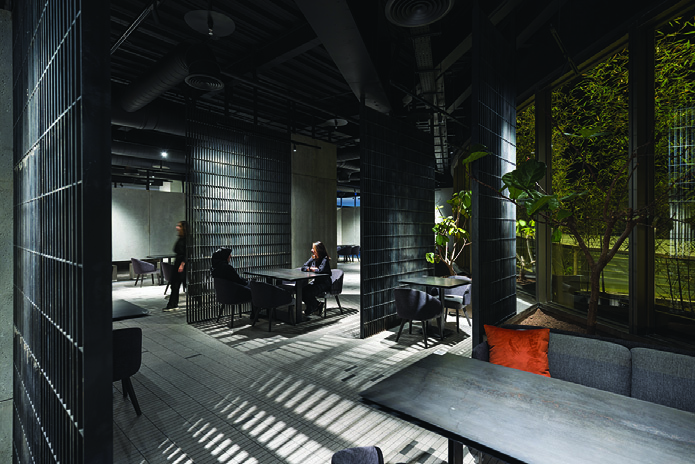
The First Conference of Concept in Architecture was held on 2–3 Azar 1384 (23–24 November 2005) in Tehran. It was organised by the students of the Faculty of Art and Architecture of the Islamic Azad University, Tehran Central branch.
The Idea and the Traditions of Thought — Bavand Behpour
The Concept in Architecture conference was held on the second and third of Azar in Tehran. Its programme included the presentation of a number of papers by their authors; discussion sessions in the form of panels made up of architects active in the field of architectural theory; the announcement of the results of the sketch competition together with explanations by the winners and the academic committee; a training class; and the screening of films and lectures held in parallel in three halls — the Yousef Shariat-Zadeh hall, Conference Hall 1 and Conference Hall 2 of the National Library of Iran. The organisers were students of the Faculty of Art and Architecture of the Islamic Azad University, Tehran Central branch, with the collaboration of the Iranian Society of Architects and Engineers and the support of the SuperPipe International Belgium companies. The conference met with a good reception from students of faculties across the country as well as from architects and experts of the professional field.
The speakers and panel members were: Ms. Dr. Dadkhah and Nasrin Faghih; and Messrs. Darab Diba, Behrouz Mansouri, Arash Mozaffari, Hamidreza Naser-Nasir, Hossein Sheikh-Zeineddin, Dr. Ayvazian, eng. Javidi-Nezhad, Shahab Katouzian, Iraj Kalantari, Farhad Ahmadi, Behrouz Ahmadi, Ali Kermanian, Babak Naderi-Azad, Dr. Hashem-Nezhad, Dr. Nasir-Salami, eng. Fayyouzi, Dr. Matin, Kamran Afshar Naderi, Reza Daneshmir, Dr. Keynoush, Kourosh Rafiei, Dr. Bazrafkan and Mansour Falamaki. Abstracts of the selected papers were distributed among the participants, and the full collection of papers is to be published separately and made available to those interested.
Although the very holding of a conference on the subject of ‘concept’ in Iran — and, as one of the speakers said, perhaps elsewhere in the world too — is novel, and mounting a conference of this scale by students is commendable, what cannot be overlooked is the disorder of concepts and architectural discourse in our educational and professional spheres. A glance at the collected abstracts shows that paper-writing in Iran — especially in the field of architecture — has not yet become a mode of thinking. An abstract that is meant to invite the reader to read the paper instead quickly puts them off, because it plainly shows that the author is themselves lost in this valley: one places a few pages from Deleuze’s Anti-Oedipus, on capitalism and schizophrenia, into their abstract.
Other authors try to find their way through the complexity of Western professional jargon — jargon which is often abstruse by way of translations that are themselves abstruse. What one sees above all is the collision and intermingling of orphaned concepts that have sprung from different intellectual traditions. In the course of a faulty translation, torn from its own intellectual context, a term loses part of its semantic charge, and is then joined together with words that Persian-speakers have either not yet reached a precise agreement upon, or whose referents they have not experienced or lived through. As a result, the explanations of the speakers — who often try to clarify concepts in plain language and to explain non-existent, un-lived intellectual traditions and professional practices — prove very useful. Inevitably the immediacy and primacy of speech over writing is maintained (something whose opposite is usually favoured in the scholarly domain): a paper is presented in order to clarify what has been written, rather than writing being undertaken to lend precision to what cannot be precisely expressed in speech.
This ambiguity and disorder, and that need for simplicity and explanation, reflect a cultural condition rather than necessarily a problem of the conference organisers — a culture that seeks to absorb the products of the world’s vast cultural and intellectual apparatus, while, on account of its lack of participation in and distance from that apparatus’s productive fields, it is unfamiliar with the glossary needed to decode it and is obliged to assemble that glossary gradually for itself. This familiarity cannot, in any case, be attained by any other route: the traditions of thinking must be learned and practised, even if by way of the product — for the product bears upon it the trace of the process of its production.
Concept in Architecture — Ali Kermanian
The theoretical discussion of ‘concept in architecture’ was raised early this year by a group of interested students of the Azad University, Tehran Central, as the subject of a seminar. It was eventually held by these same students, with the least possible assistance from the university, on the second and third of Azar at the National Library.
The presence of a large number of architecture students from numerous public and Azad faculties across the country reflects the thirst of these young people to learn matters whose absence they have perhaps felt in these very universities, and they turn to a more collective movement in order to devise a remedy within the country’s architectural education system.
After two days of the conference, the academic architecture professors of Iran effectively announced, as their conclusion, that there was no need to provide a definition of ‘concept in architecture’; in effect they declared that they had no definition for this subject. Up to this point there is not only no objection to them, but this very honest admission could perhaps have opened the way forward for the country’s talented young people. Unfortunately, the distressing issue is that the professors tried to justify their conclusion by presenting arguments and claims based on the merit of not defining and of preserving a state of ambiguity — one that, they suggested, would bring about the growth and elevation of the country’s architecture. This amounts to saying, or showing, that ‘we do not know,’ and then bringing convincing reasons that this ignorance is a good thing! Sadly it seems that these slogan-like justifications of managers, which we have witnessed over the past few decades, have also penetrated the country’s academic culture.
Would it not have been better to admit that, because of the distance that has opened up between us and the rest of the world over the past few decades, grasping the new concepts expressed mainly in English is beyond the ability of many of us, and that we have the least familiarity with them? If our architectural community had had the necessary awareness of the subject at hand, it should in fact — instead of a single definition — have offered several definitions of ‘concept,’ as many as the number of invited professors, so that in the closing sessions of the conference, or on later occasions, these definitions could be compared and exchanged and could serve as a basis for beginning a dialogue. What distinguishes us from advanced societies is precisely this: that, rather than shirking the burden of responsibility, they make their utmost effort to set matters down in writing very clearly and simply, so that through a dialogue based on determinate writing — not a dialogue based on hot air — they can reach results and take a step forward. By repeating this, they continually build launch-pads for themselves and attain intellectual, scientific and artistic progress. Unfortunately, with the approach we displayed at this important conference, we will never build a launch-pad for ourselves from which to ascend.
With this critique I in no way belittle the efforts of the organisers and planners of this valuable movement, nor do I wish to leave the weariness of it upon their shoulders. On the contrary, I thank them, for they cause the existing problems in the country’s architecture — from education to practice — to be brought to light, and by doing so they render a great service to the future of the country’s architecture at this beginning.