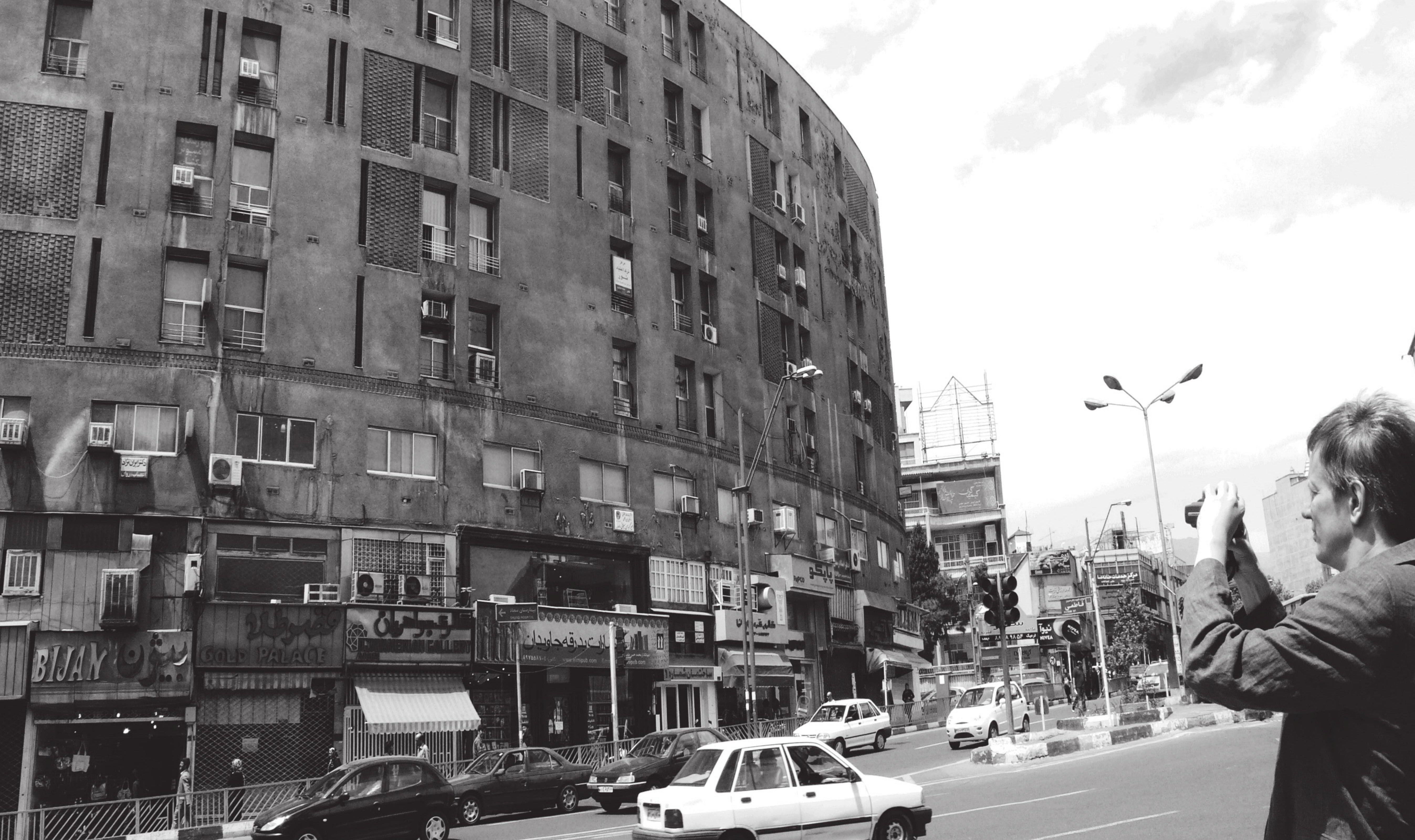
The visiting architect, coming to Tehran from central Europe, knows about the city built along the Alborz Mountain slope. Assuming some research prior to departure, the visitor expects an extraordinary array of architectural forms, the thorough geo-political mix of Asian, North African and Western motifs. Upon arrival in Tehran the city seems to display a rather unassuming contemporary urban fabric. Another city victimized to car traffic and commercial necessities. Soon the visiting architect has to revise: Tehran is a quintessential modernist city.
The streets are brim with Bauhaus-style buildings. We are inclined to modify: flat roofs are a natural fit in a semi-arid climate, so what? But how to conceive the striking abundance of discreet details of modern architecture? Not only is there a multiplicity of slender window frames and decorative mullions, playful door designs and door knobs, beautiful façades including joints and articulations, plus plastic balconies that seem to work perfectly with the fundamentally rectangular building schemes — they surprisingly, or rather naturally, merge with vernacular motifs. Did the curvy Persian language, offered in rectangular displays like shop windows and traffic signs, help to shape modern Tehran architecture as a particular combination of curviness and straightness?
Suddenly the city commemorates and exemplifies quintessential modernist experiments like the Baba Housing Estate in Prague (1932). Hans Scharoun’s organic modernism comes to the mind. Parallels to the metabolism movement in Japan pop up: flat, yet sculptured architecture that achieves the rare balance between compatible urbanism, architecture that fits the street without making noise while the structures are uniquely detailed. Such individualism stands out in front of the clones of the “international style”, that called for simplification and the ban of ornaments.
The crux: can that substance be appreciated without the connotation it comes with? The built-from-scratch city matter originates from the 1920s when the rulers wanted to reinvent the city. In these days, and that is by no means a Tehran singularity, modern architecture seems to be outdated if only because it wasn’t maintained all that well over the years. While dilapidation always decreases the appreciation of architecture, as if the architectural quality would stand for the state of construction, modern architecture in Tehran is additionally endangered because it stands for an unwelcome past, the period prior to the “Islamic Revolution”.
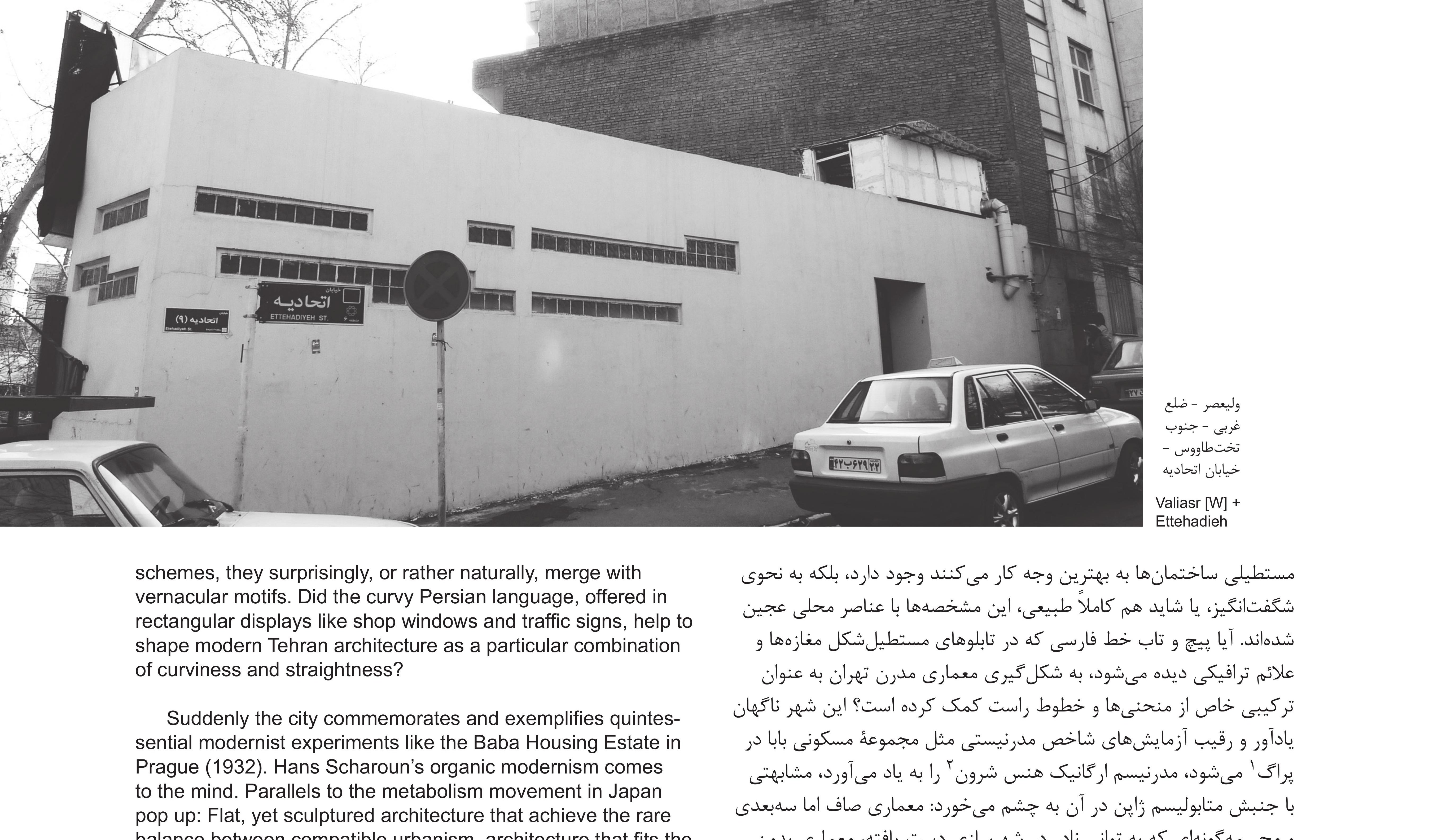
There comes a three-part threat: after 50–80 years the lifespan of many buildings is reached. Modern architecture, with its horizontal canopies, adventurous caulking and its peculiar extension joints, usually comes with a set of serious structural damages. The third part is related to moral exhaustion: modern architecture belongs to the twentieth-century optimism, prior to the Club of Rome’s 1972 publication on the “Limits to Growth” and the 1973 oil crisis.
In Germany, the remains of the 1920s modern architecture — the buildings that have survived WW II — have become landmarks. They are conceived as an integral part of the mixed cultural heritage of the twentieth century. I hope that such critical appreciation will be established in Tehran and other Iranian cities as well.
Notes: 1 — Baba Housing Estate, Prague (1932), listed for preservation in 1993 (K.M.). 2 — Hans Scharoun.
Niels-Christian Fritsche — architectural studies, Dresden University of Technology, Germany, 1985–90, PhD 1995. Architect with DTA in Chicago, 1995–2000. Since, architect, curator, illustrator, publicist in Dresden, Professor, Chair of Presentation Methods, Dresden University of Technology: “Applied representation, the visualization of information for communication purposes, is introduced as a switchyard where aesthetic creativity and creative problem solving are constantly rearranged. In order to be successful, the original design impetus has to be transformed into a working habit that mediates between intent, knowledge and aesthetic fundamentals.” He visited Tehran in May 2008.



