



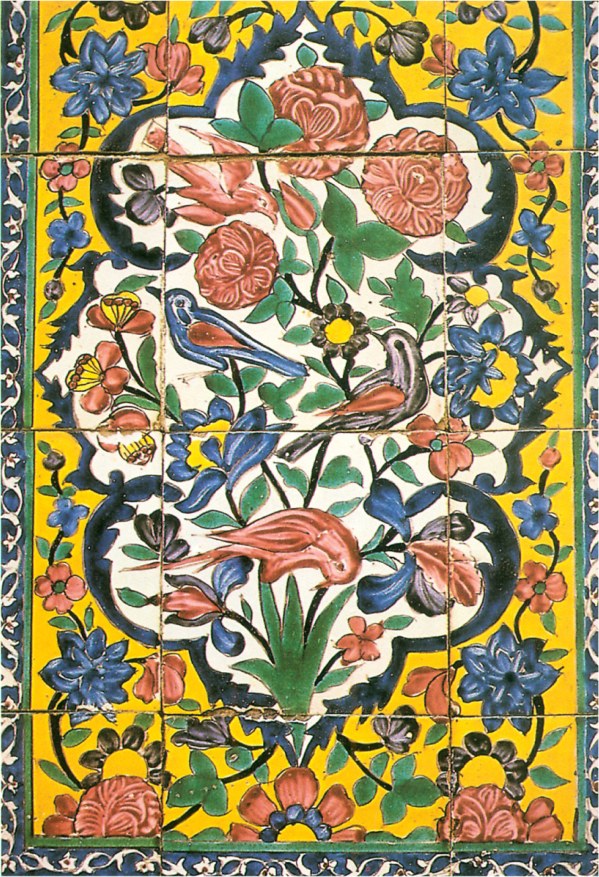
Floor and wall coverings have a special importance in architecture. The quality of interior space depends greatly on these two elements. Throughout history, coverings have played an important role in defining architectural space and giving it form. In Iranian architecture from the Mongol period through the Safavid era, the structure and main body of the building were increasingly hidden beneath a decorative layer of tile. Iranians have paid less attention to the covering and decoration of floors than the European peoples — probably because of the use of brightly coloured, richly patterned carpets to entirely cover the floor — but in the decoration of walls with coloured tiles they have surpassed the European peoples, and tile became one of the distinctive elements of Iranian architecture in the Islamic period of the 10th to 18th centuries CE.
In contemporary residential architecture, where space is limited and volumetric inventions can hardly find expression, coverings take on a particular importance. Beyond the aesthetic questions that arise, ceramic coverings are unrivalled in the construction of kitchens, bathrooms, swimming pools and other moist spaces — for their resistance to wear and moisture and their non-absorption of greasy and polluting substances. Lightness, relatively low cost, speed of installation and variety make tile preferable to stone in projects that lack luxury. Today tiles come in various designs, colours, sizes and patterns and are therefore very suitable for creating particular designs according to personal taste. Yet, in spite of the potential of this material, designers seem to have placed the design of ceramic floor and wall coverings less often on their agenda, and ceramic is treated as a general, characterless covering.
The aim of this article is to present construction ceramic as a principal material for floor and wall coverings, with attention to its history in ancient Iran and to today's developments in the market. Along with this, the article explains key technical points concerning the choice of ceramic and its use.
History
The Farsi term "kashi" is derived from the name of the city of Kashan. In the Ilkhanid period Kashan was one of the important centres for producing this building material, and the term probably came into common use at that time. In Latin-rooted languages the term "ceramic" derives from the Greek word keramos, meaning baked clay — although today, in the making of ceramic, only clay is no longer used. Glazed ceramic is one of the most ancient building materials produced by mankind, and its technology probably passed from pottery into architecture. One of the oldest specimens found of coloured glazed brick belongs to the Chogha Zanbil ziggurat, 1250 BCE. At Susa and Persepolis, beautiful relief glazed tiles have come down from the Achaemenid period. These tiles depict part of a large panel showing the soldiers of the Achaemenid era. In these works, blue, white, yellow and green were used.
Although at the beginning of the Islamic period the use of coloured tile was set aside in buildings, in the late tenth century CE and the early eleventh century CE single-colour turquoise glazed tile combined with brick became common. One of the earliest examples of the use of monochrome glazed tile is to be observed in the historic city of Gorgan. In the minaret of the Friday Mosque of Damghan (1058 CE), monochrome tile was used to a considerable extent. The use of glazed tile in architecture increased steadily, and in the Ilkhanid and Khwarezmid periods came to a balance between brick surfaces and tilework. From this period onward the presence of tiled surfaces in public and religious buildings surpassed brick, and in the Safavid period tile covered most of the interior and exterior surfaces of the mosques.
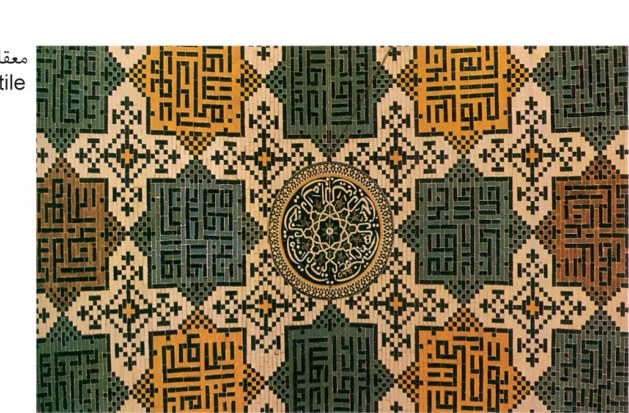
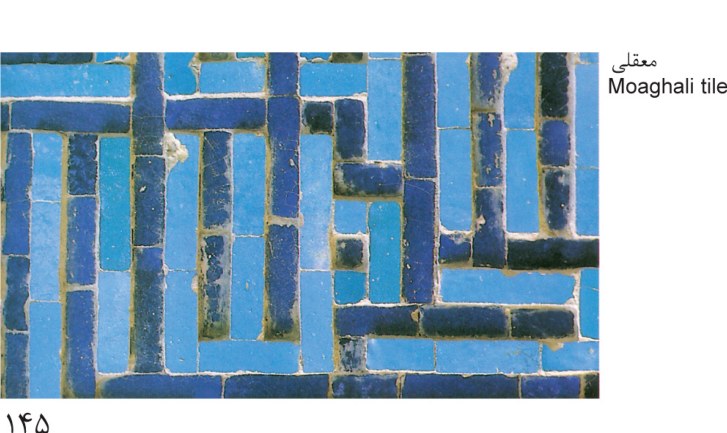
In the thirteenth century CE many workshops were formed in Kashan for the production of tile. The tiles produced in this city were of very high quality and were exported. One of the most important historical treatises on the art of tile-making belongs to Abolqasem Kashi (1301 CE). He was from a great family of craftsmen who created the most beautiful tile decorations of that era. The mihrab of the shrine of Imam Reza (1215–1216 CE) is attributed to this same family (the Taher family). The art of mosaic (moarraq), or the joining together of monochrome tile pieces (in terms of shape and colour) so as to form a geometric or floral design, took shape in the late Ilkhanid period and reached its peak in the Timurid era.
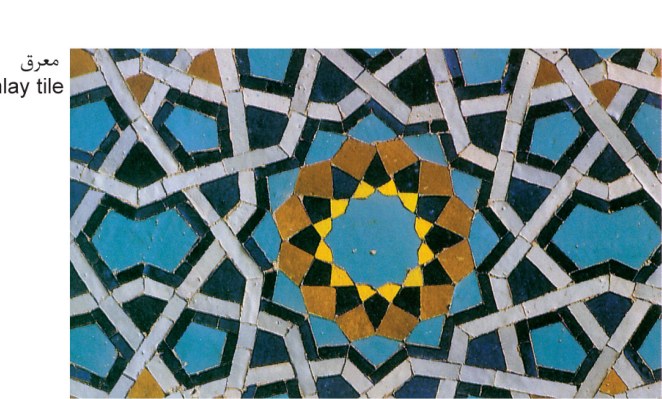
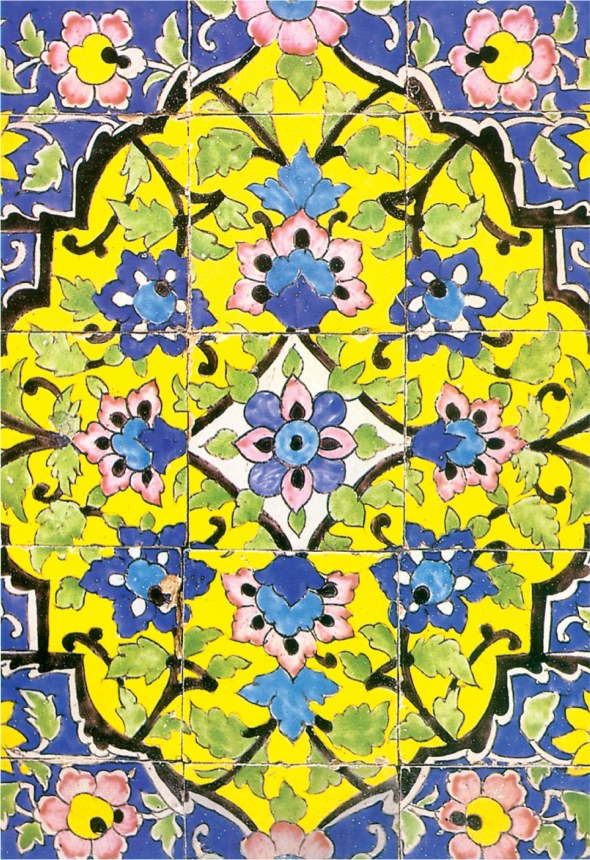
In the Timurid period the use of tile in buildings increased and the inner and outer surfaces of particular buildings were covered with this material. Cobalt blue is the dominant colour of this period, clearly visible in the Blue Mosque of Tabriz (1465 CE). The tiles of the Timurid period have been so artistically done that John Hoag, the historian of Islamic architecture, has said: "No style in Europe has succeeded in using colour to a degree of skill that could be compared with Timurid architecture." In the late Timurid or early Safavid period, the seven-colour tile (haft-rang) was invented. In this kind of tilework, each tile is composed of several different colours, and the combination of tiles next to one another forms a larger image — composed of human, animal, plant, or geometric motifs (or a combination of these).
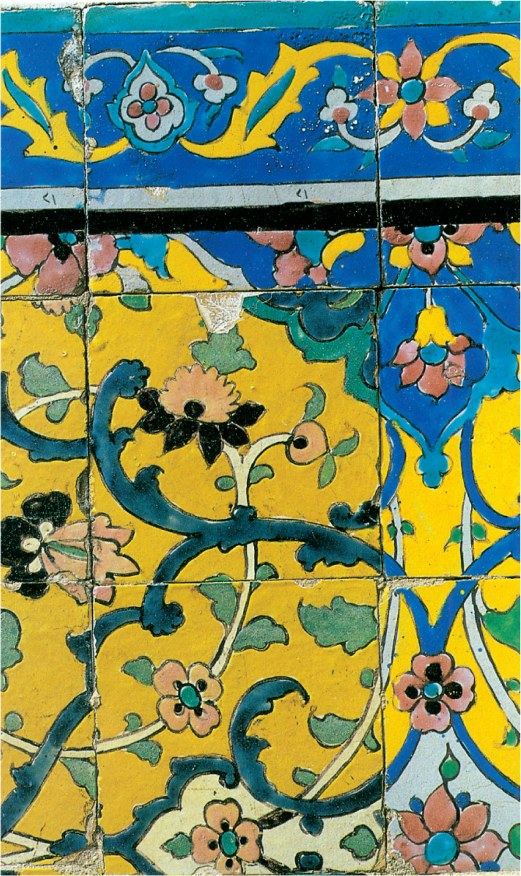
Today, in regions such as Isfahan, Kashan, and Yazd there still exist traditional tile-making workshops. But the main market belongs to the modern ceramic industries, which first took shape in the Pahlavi period through the import of technology from the West. Although the quality of Iranian products is still not comparable with that of advanced countries, in the past two decades the boom in the construction industry has brought about a transformation in the ceramics sector of the Iranian market, and a considerable qualitative improvement and variety can be observed in Iranian ceramics. Currently many factories are engaged in producing various kinds of construction ceramic — among the well-known names: Marjan, Behsaram, Teksaram, Alvand, and Yazd.
Technical Characteristics
Tiles are produced from clay or from clay mixed with other ceramic materials. Oxides are used to create the coloured glaze of tiles. Beyond aesthetics, the rate of water absorption of the tile — which is related to its degree of cohesion and its microscopic porosity — is an important factor in choosing a tile. The water absorption of floor tiles is about 2 to 5 per cent, while wall tiles absorb about 12 to 15 per cent water. If a tile absorbs less than 2 per cent water it is also suitable for the exterior environment and does not deteriorate from frost.
Types
In terms of the process of firing in the kiln, tiles are generally divided into three types:
- 1) Single-fire tiles — tiles that, like brick, are fired in the kiln without glaze. Such tiles (like terracotta tile), because of their high permeability, require continuous waxing and anti-permeation materials after installation.
- 2) Double-fire tiles — the same glazed tiles, where first their body (biscuit) is prepared in the kiln, and then they are fired again with the glaze.
- 3) Triple-fire tiles — tiles that, after being produced with a uniform glaze colour, are painted again, or decorated with embossed designs, and therefore placed in the kiln a third time. The Cermaice company is one of the producers of this kind of tile.
Glazed tile — In Iran, for wall tiles, which generally have a thickness of about 4 mm and are soft and relatively porous, the very term kashi is used. But the floor tiles, which are 6 to 8 mm thick, absorb less water and are harder; these are called seramik (ceramic). Floor and wall tiles can be glossy or matt; the matt kind naturally absorbs more dirt and stains. Rustic1 (mosghali) refers to the uneven type of tile. This type of tile appears antique or hand-made.
Tile sizes are highly variable. Wall tiles are generally 10×10, 15×25, 20×25, 20×20, 20×30, or 20×40 cm; floor tiles are 10×10, 20×20, 30×30, and 40×40. Currently in the Iranian market there are also tiles of 60×60, 70×70, and 100×100 cm, which are mostly imported from China. The price of these tiles is 20,000 to 25,000 toman per square metre. Iranian products are generally priced at 5,000 to 17,000 toman per square metre, but imported products are much more expensive. European tiles imported into Iran are most often made in Spain, with a price between 15,000 and 30,000 toman.
- Mosghali (Rustic)
- Grees
- Trios
- Haber
- John D. Hoag, Architettura islamica, Electa Editrice, Milano, 1978.
- Sheila S. Blair & Jonathan M. Bloom, The Art and Architecture of Islam 1250-1800, Yale University Press, New Haven and London, 1995.
- "The Splendor of Iran", volume III: Islamic Period, Booth-Clibborn, England, 2001.
- H. Leale Simmons, Construction Principles, Materials and Methods, John Wiley & Sons, Inc., New York, 2001.
- Mohammadreza Haeri Mazandarani, Ceramic Coverings in Iranian Architecture, Tehran, Shahidi Press, 1380 (2001).