Contemporary Architecture

From Form to Space

Kamran Afshar Naderi·Memar 5
From Form to Space

Architecture by its contemporary concept, which is usually expressed as form, content in "idea" and ends in "building". Therefore, architecture is a process from abstraction towards objectivity. Preliminary sketches, which are abstract geometrical motifs, turn into real living spaces. Design has played an important role in architecture. Since renaissance, Wooden model, plan and elevations were some means to determine the building specifications accurately before its execution. Today, in spite of spectacular advances in the field of graphical software and virtual reality, architecture is still much dependent on design, and mold making is an inseparable stage of the architecture's production process.

The past vernacular architecture did not need such expensive means. Each individual could build his own dwelling in accordance to his needs and based upon the cultural objective patterns he was living with. Through this process one creativity creates a new objectivity. The building elements, doors, windows, counts and walls were not just mere forms, but emotional presences, and had a defined and specific relationship with the living of the individuals.

Modern Architecture, particularly the Functionalist Architecture, weakened this relationship for two reasons: first, using abstract and pure formal elements such as line, plane and volume, instead of meaningful elements, in order to make a physical rather than intellectual impression on users; and secondly becoming dependent on design and model in an exaggerated manner.

Both mentioned reasons lead us to the fact that architecture is about designing rather than its broad meaning. A totally Functionalist Encyclopedia defines form, in incomplete. An accurate model is formally incomplete with a building. Form has many more and distinct components: first, abstract elements including line, planes and second, structures including axis, the grid on which the form is designed, repetition and order; and third, aesthetics including unity, plurality, harmony, contrast and so on.

All these three groups of indicators are presentable in a model as much as they can be realized in a building. The model is the presentation of a building volume in a smaller scale. Today, the issues of form and particularly volume, which has a more limited conceptual existence compared to form, are the main topics in architecture.

1-4-1: Space for Physical Functions

As mentioned before, human senses directly affect our understanding of space which is due to intimateness human perception. The most important factors affecting architectural perception are as follows:

1-4-3-1: Directions

In example 1-1 the "direction" changed, in addition to the change in physical condition. Therefore, we saw that architectural space is related to our concept of human orientation in one of these relationships. Up, down, left, right, forward and backward posses different qualitative values. In human language up has a more important value than down. In architecture also a higher place is more significant. Backward represents past and forward implies to future. In designing museums and shopping centers special care is taken that people do not move backward, avoiding all chances of repetitive spaces. Cardinal points: north, south, east and west also hold qualitative values. East is where sun rises and is connected to birth and life. Moonlight sometimes sunset and the ending of all objects and death Qebleh for the muslims and east for the christians resemble the supreme direction.

Vertical and horizontal dimensions also affect our visual sense differently. The impact of a 300 metre building culture is much stronger than a building with 300 meter length.

1-4-2: Movement

Movement is an important factor for sensing the space and has two characteristics: speed and trajectory.

Speed: Imagine a street. The space of the street for a pedestrian and a driver varies completely. The driver is sensible toward visual signs and therefore, his sense differs from a pedestrian. By accelerating the speed, the attention is devoted to form in its macroscale feature which is the "structure of the form", and in slowing down, form is seen in its microscale feature which are details and textures, although in both conditions form is a three dimensional phenomenon.

Trajectory: Trajectory is the mechanism by which the space is explored and it is as important as the physical structure of a space. The richest one is actually consists of a simple space, conceivable from all points, but the instantaneous concept of space is different for the spectators due to the performances.

In the film The Dead Poet Society, the leading actor - the teacher - encourages the students to stand on his desk and explore the classroom from angles they have never seen before. To enrich the architectural spaces, it is more important to create possibilities for exploring space rather than making a variety of forms.

Some architectural works, such as the Buddhist Water Temple by Tadao Ando, is a simple element which is the pool display a number of spectacular views.

In Guggenheim Museum, Frank Lloyd Wright, organizes a simple volume in a manner which is explorable from various points. Symbolic architecture, such as Centre Sydney, directs the spatial understanding of individuals towards unity and uniformity by narrowing down the freedom of spatial exploration and leading the viewers along a predetermined route.

1-4-2-6: Light

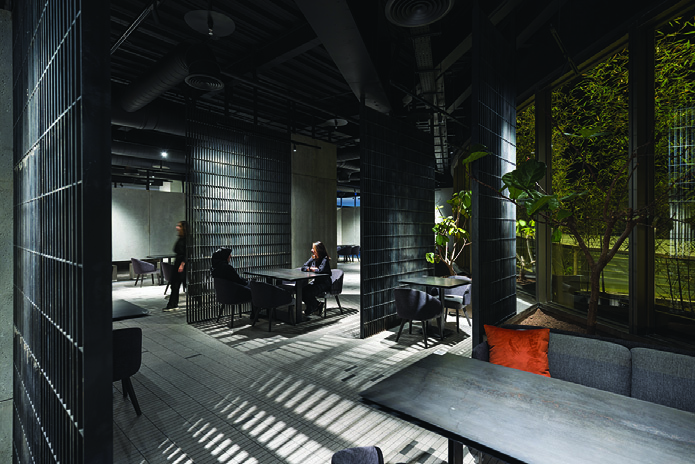
Without light, color and form are meaningless. By change of light, they both change as well. Because of the expensive power of light and its capability to create "character" and space, in cinema and theater light is being widely used. For example, it is film light which is casting fear behind a violent character in a horror movie in manner to be spread. In fact, atmospheric very much from day to night. Tehran's nights are more wonderful than its days.

1-4-2-5: Sense of Smell, Touch and Hearing

Sense of Smell: Today cities are tending to just possess one smell. The only cities strong and familiar smells belong to bazaars and holy places. This is to say that the communicative capabilities of spaces are reducing. Parks being proper places for arising the sense of smell are gradually changing into decorative beauties with no particular smell.

Sense of Touch: Sense of touch is more strong on the sole and can gather many messages from the environment continuously. But in today architecture and urban design it has totally been ignored. In European cities stone pavements inform the blinds about the routes of automobiles and trains, are only sensitive alternatives against solid and flat pavements.

Sense of Hearing: Sound is an element creating space without occupying it. Sound can determine the "domain" and the "direction" and give identity, richness and attractiveness to the space. In old Persian Gardens natural sounds played significant roles.

Today, in developed countries there are laboratories experimenting sound effects in spaces, according to their architectural characteristics.

1-4-2-5: Dimension

Perception of space and even the aesthetic sense are dependent on the dimensions. A form being proportional in one sense may seem nonsense when getting larger or smaller. The problem of architectural design is that of recognition of the exact dimensions of space if not controllable in design phase, by making models and drawing forms, things could be controlled, but not the size. Recognition of size is a matter of experience, and designing +/- if one copy-pasting means creating a space never experienced before.

Model, as a reliable mean of controlling form, is completely deceiving for recognition of space. Vernacular architecture, dealing with objective space, had no use for the model at plan level, but always succeeded in determining dimensions correctly. In addition to the very different "human position", represented by models and plans, there is a certain mathematical both obscuring our perception of space through models: the proportion of surface to surface (facade) and the volume in similar forms with different scales varies radically. The proposition of surface to volume in a cube that each side is 1, is 6:1. This proportion in a cube with the dimension of 10 is 600:1000 that is 0.6. So the variation is not implicit, but is based on scientific reasoning.

The sense of dimension changes with age too. Children not the spaces larger than what the adults see. The people who go back to their childhood places find them much smaller. Spaces in a house seem very large and inappropriate for the children and they make temporary smaller houses for themselves with what they have at hand. Basically, one's space was much smaller than the indoor spaces. A plot of 500 sq. m. land looks much smaller than a hall with the same dimensions.

The reason is the comparative relation in perception of dimensions. Our eyes recognize large and small proportions better than what is proved by the absolute values of measurements. An uneducated individual can not tell the elevation of a building by seeing it, but he can surely tell which building is taller. Comparison is not just related to the instantaneous perception, but its impacts may last over time. Sense of dimension varies when one enters a new environment, depending on the dimensions of his previous environment. The glorious view of the dome in Sheikh Lotfollah mosque is to certain degree due to the narrowness of its entrance corridor.

1-4-2-6: Cultural and Individual Patterns

So far universal characteristics related to the physical mind of human beings were discussed, nevertheless, each culture has its own spatial patterns. These patterns are affecting the perception of space which in fact is an interaction between the space structure the mind receives and the objective patterns we have already in mind. A 10 storey building in Iran is considered a tower whereas in Japan it does not seem tall at all. Different cultural patterns are responsible for the creation of a variety of spatial patterns; e.g. Javaherian is one of the Iranian spatial cultural patterns.

Individual patterns also affect the perception of space. For example, an architect receives more messages from a work of architecture when compared to other individuals.

1-4-3: The Existential Space

During early ages of life, one of the primary explorations of human being is that further than the continuous changes of perspectives and images which appear and disappear, there are constant elements. One can relate different images to these constant objects. children draw a table or a garden in the form of a rectangle where as they can never see them from an angle in a complete rectangle. People try to understand the structure of objects and environment and keep a constant image of them in mind. Kevin Lynch believes that, the people have a work a sense of security.

The existential space is a perception of a more or less constant image man has gained from his environment, and this in turn is a collection of transitory and fragmentary sensations that universal, cultural and personal patterns and hypotheses are processed upon.

The space of existence is not necessarily in conformity with the form of the space. For example, we all have an image of the structure of the city we live in, and by this subjective structure, we move in the city and reach our destination, but when we are asked to draw a general plan of it, we hardly succeed.

Many designers are seeking impressive volumes to enable them make attractive renderings and models. Nevertheless, the primary objective of this article is to show architecture is an issue completely different from the topic of volume and that dependency on design and model could be as destructive. The secondary objective is to discuss the issue of functional prevalence over architecture and to critically review this method. The statement that "form follows function", expressed by Louis Sullivan in the early years of the present century, has clear resemblances in imam ships and trains with their functions being compatible to their forms. Le Corbusier who had been inspired frequently in his projects by this symbolism of modern civilization stated that: "house is a machine for living". As much as a manufacturing part was designed for a particular function, architectural element and their relationships were to be designed in accordance to their function. Based on this approach, the architectural spaces tend to be specialized and functional. Functionalist approach has since been criticized over and over. What I intend to add is that the fact that place is more significant than the function and exaggeration in specializing spaces is a coextensive within with no reason extends to the volume. And one more topic to discuss is about Iranian architecture as a distinct remembrance of space and place which could pave our way towards the future at the battlefield of architecture of form and function.

The second part of the article deals, then, with a certain position taken against the contemporary architecture, a position against our highly structuralist built environments.

The task of an architect—similar to that of a surgeon in medical elements is to be face a problem with the least possible intervention and injury and it can only be achieved by dealing with main architectural elements, being space and place. The ideas expressed here are not for a prize one contemporary trend over the other, but to iterate that designing in accordance to space and place could fix interpreted variously and lead to different solutions. It is now for a certain time that the study on the design methodology has been commenced by the author in collaboration with Firouz Firouz and Shahab Kazzazian, by discussing architectural design from idea to form. Proper teaching of form is confined to some backgrounds and techniques, we shall hope that the practical work on designing with the ideas of space and place may begin soon. The project our group has in hand is not to design a building itself, but to deal with the main issue of "architectural project". Here, we want to lead the attention of the readers to the issues originated in the culture of Iranian Architecture, on one hand, and related to the contemporary life and its condition, on the other. All these reflections, ideas, studies and designs, based on two main factors of space and place, might become a new trend in architecture.

1. Volume or Space

It is a fully known that space is not the volume, but because of their interactions in architectural design, no attempt has been done to accurately differentiate them. If volume and space are completely independent, we would be able to presume that modification of one does not necessarily affect the other.

1-1: Constant Volume, Constant Space

Consider a hollow volume of cotton or the dimensions that one can easily walk below it. The height the diameter are about 3 to 4 meters. Now imagine this zone in two different positions over the base is located on the ground and the other time the top is pointed down, and in both cases someone is in it. The volume of the cone is the same in both positions but the space inside differs.

1-2: Constant Space, Variable Volume

Spontaneous and natural growth of plants and trees in a forest makes each point unique, because the volume of trees and their arrangements are never repeated, but the spatial sensation of forest would be same in many points.

1-3: Space and Volume

So far, in discussing the contrasts, the word sensation was the only concept that space is related to the same "sensation" transferred to human mind by various senses. Unlike volume, the objective space is not a constant and absolute issue. The volume itself is one of the instruments for making space but the characteristics of volume could be studied scientifically and separate from variable human senses. The volume indicators are quantitative but the space indicators are qualitative. Volume can be conceived by human senses and man can understand volume through a complex of sensitive controls. The architectural space is the sum total of these networks of relationships.

1-4: Architectural Space

Architectural space is created by a number of different spaces, each being the subject of a separate study. Christian Norberg-Schulz, in his book, Existence, Space and Architecture, has offered a certain categorization of spaces.

Related in Architecture Database