



Recently — in 1999, that is — a book has been published in England, in two volumes, under the name Architectural Theory, written by David Smith Capon and issued by John Wiley and Sons. The bibliographic record of the book in its original language is this:
Each of the two volumes has, besides the general title «Architectural Theory», a particular title of its own: volume one, The Vitruvian Fallacy: a History of the Categories in Architectural Philosophy; volume two, Le Corbusier’s Legacy: the Categorised Principles of Twentieth-Century Architectural Theory.
The author says in the preface to the first volume: «The chief aim of this book was the investigation and the discovery of the principles and doctrines that have governed twentieth-century architectural theory in the Western world.» And he adds: «In order that the structure of the subject be built up in a logical manner, it was necessary that the concept of the categories itself be examined in the very order in which it has been realised both in architectural theory and in Western philosophy.
… For the definition of architectural theory there are two methods, each of which has its own methodological base. In the first method the basis of architectural theory is those things that people have said or written about the subject. In that case the appropriate foundations will consist of: the gathering and examination of texts, the interpretation of the various statements in the context of the writing, and the drawing of conclusions according to the relative value of the statements made — which counts as a historical approach to architectural theory.
In the second method the basis for the definition of architectural theory is the manner in which the various principles and doctrines converge. In this case the appropriate methodological base will consist of conducting a series of rational discussions within each particular theoretical structure, and of building a hierarchy of concepts for the understanding of the subject — which counts as a philosophical approach to architectural theory.
Nevertheless, a book about architectural theory need not be wholly the one or wholly the other, entirely history or entirely philosophy. The two approaches reflect two faces of a single subject, which in the final analysis is inescapable. They are as though the form and the content of one thing. To discuss the history of architectural theory without examining the construction of the concepts is just as impossible as to discuss the construction of the concepts without examining how those concepts have been used. We therefore resolved to take a twofold approach: not with a complete separation between history and philosophy, but with the application of a particular methodological base in which there is a permanent collaboration between these two aspects.»
The author then insists upon three points: «First, that this book is not a history of architectural theory in the shape of a chronological list of those who have written about architecture, together with a summary of the concepts discussed under each of them. It is rather a book about the principle of the concepts themselves and the manner of their emergence and their spread, such that the absence of a concept is more a cause for regret than the absence of the name of a writer whose words have been quoted. Second, that no personal preference will be given to any one of the concepts or of the doctrines that arise from them. If there is a distinguishing quality in this book, it is the very ordering and arranging of the concepts and the doctrines…. Third, that if there is talk of ordering these concepts, it must be known that there is a meaningful difference between classification and categorisation. In this book nothing beyond the primary concepts and the doctrines arising from them will be classified; and like others, we too are opposed to placing architects and their buildings simply in the cells of a table.»
Of the motive for the book and its background he says: «The work of study began with a thesis that was one of the conditions of advancement in the degree of architecture at the University of Edinburgh. One of the reasons for the choice of Edinburgh was that it afforded a two-year opportunity for the study of philosophy and literature. The idea of writing the book was the suggestion of Professor Gay Oudi, head of the school of architecture, after my graduation in 1974. Some of the early ideas had been published in 1983 in an article under the title Categories in Architectural Theory and Design, which led the late Professor Barry Wilson, the first vice-chancellor of the university, to recommend the writing of the book to me once again. More recently Professor Robert Tavernor, who was for a time Forbes Professor of Architecture at the University of Edinburgh and who at the time of the writing of the book is director of studies at the school of architecture in Bath, wrote: there is no doubt that it is necessary, especially as an aid to teaching in courses on the history and theory of architecture, that a book containing the categories of Western philosophy be written.»
In the first volume of the book, which is given over to the history of the categories in architectural philosophy, no more than 8 illustrations are used; while in the second volume, which treats of the principles of twentieth-century architectural theory, the pictorial evidence — which runs to 55 — plays a far larger part. On the whole, however, as the author himself says: «The greater part of the book is words. The aim has been that these words should above all present the kinds of things that can be said about architecture. On the other hand, that they should likewise present the kinds of things the architect has in mind when he designs a building.» He then adds:
«We know that words often do not have exact meanings, and for that very reason we stand in need of a clear understanding of the principles that build up the substructure of the categories. Hence, besides words, diagrams too must be drawn upon to assist the understanding of the subject.»
The diagrams play an important part in explaining the matter of the book, and almost everything, after being stated in words, is explained with the help of a diagram as well. All the diagrams have a single structure, which the author introduces in the preface to both volumes: «Each diagram is made up of a centre, a circle around the centre, and a number of radii drawn from the centre towards the circumference of the circle and cutting it.
The centre represents the case or the thing under discussion. It may be, for example, a particular building or the subject of architecture itself. The circle represents the whole of the possible knowledge about that thing. It may be thought of as made up of points, each point standing for something that can be said about it. The radii represent relations between the case or thing and the concepts around it. In fact the radii that are drawn do not indicate particular relations, but show kinds of relations, each of which looks to a spectrum or category of concepts.»
The author, as he himself says, had in view in the choice of the structure of the diagrams the world-view of ancient Greece, according to which «every object in the world may be held to be connected to other objects in the world by various kinds of relation. Our awareness of a particular object may be represented by a circle around that object, which can then be looked at apart from the rest. Every object may be analysed, consciously or unconsciously, by categorising or grouping the surrounding objects according to the kind of dominant relation. The resulting diagram may then be simplified, by reducing the number of connecting lines to one line, so as to arrive at a clearer picture of the concepts that make up each category.» And after a fuller account of the diagrams he concludes that «we must attend not only to the "content" of architectural theory by the mediation of words, but also to the "structure" of architectural theory — not only in diagrammatic form but likewise by the mediation of words. The words that are used in this latter sense belong more to the field of general theory than to architecture itself.» He then defines the ten key words element, object, relation, representation, conception, concept, idea, category, principle and doctrine in the manner in which he uses them in the book.
The author’s aim in the first volume, to which he has given the subtitle «The Vitruvian Fallacy: a History of the Categories in Architectural Philosophy», is to state that the interpretation of the three famous principles of Vitruvius — firmitas (durability), utilitas (utility) and venustas (beauty) — as construction, function and form respectively is a mistaken and fallacious interpretation. This is so in the light of the contents of the ten books of Vitruvius, who under the head of firmitas discusses materials and construction; under the head of utilitas, the kinds of buildings and their uses; and under the head of venustas, ornament and the theory of proportion — and who thereby brought into being, in the modern period, the three chief tendencies of functionalism, formalism and constructionism; and it is mistaken because those three are not principles or supports of equal rank, such that the whole weight of architecture could be laid equally upon them and every other principle and support dispensed with. Using the centre–circle–radius diagram, placing architecture at the centre and conceiving the circle as architectural knowledge, he holds the three categories drawn from the three Vitruvian principles to be three categories, or three radii, which cannot divide the circumference of the circle — that is, the whole of architectural knowledge — equally among themselves. This inequality, or the insufficiency of the three Vitruvian principles for the exposition of architectural knowledge, he has shown in the form of the diagram below.
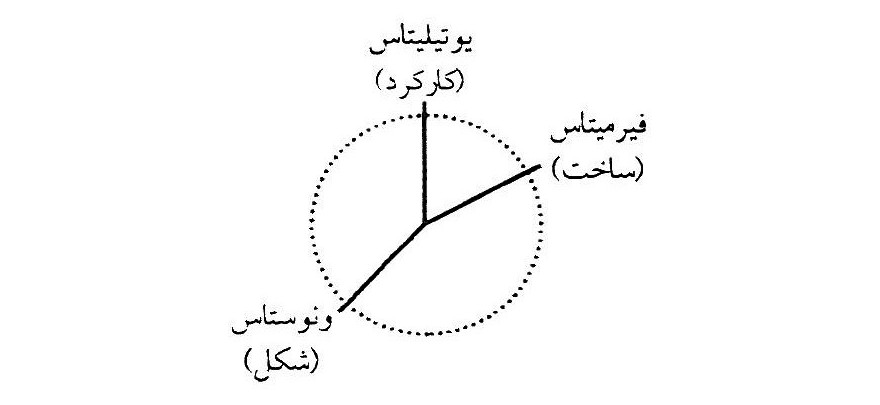
In this diagram form and function stand at a suitable distance from one another, but construction is nearer to function and further from form. In fact the three principles function — construction — form have neither the comprehensiveness nor the balance for a complete exposition of architecture. To solve this problem the author draws upon the higher philosophical categories so as to be able to find the correct place of these three principles and also the empty place of the principles that complete them. And he divides them into two groups, the primary categories and the secondary categories, according to the pattern of the diagram below:
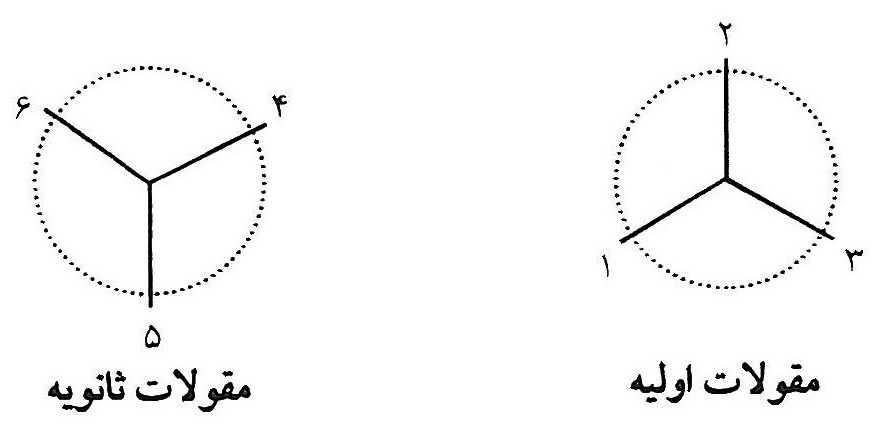
From the combination of the diagram of the primary categories and that of the secondary categories there results a six-category diagram, in which, of the three Vitruvian principles, the two principles of function and form fall in the group of the primary categories and the principle of construction in the group of the secondary categories.
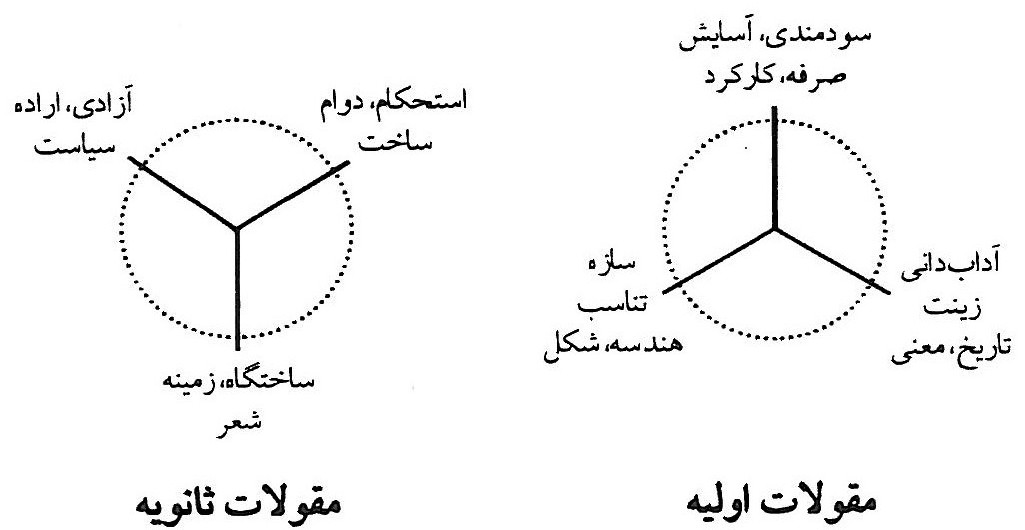
After examining the interpretations and theories bound up with the Vitruvian principles, he chooses form, function and meaning as the primary categories, and construction, context and will as the secondary categories, and explains them as follows:
The primary categories
(1) Form, arising from the Vitruvian category venustas: which represents not only geometry but likewise those aspects of beauty that are bound up with symmetry and proportion.
(2) Function, arising from utilitas, which has also been translated as commodity or comfort, but which carries very strongly the «social» character Schinkel had in view. Durand’s understanding of economy (thrift) is also in question in it.
(3) Meaning, which again arises from venustas, but which represents those aspects of beauty that are bound up with taste, decorum and ornament. The «historical» character Schinkel had in view must also be added to it.
The secondary categories
(4) Construction, arising from firmitas, of which various translations such as firmness, durability and integrity have been made. Vitruvius’s placing of it at the head of his own list may stem from its affinity with form, or from the plain fact that its chief bearing is upon the building.
(5) Context, a complex category which Fremin indicates by the expression «lieu (surroundings)», but which also embraces the «poetic» character Schinkel had in view — like the two concepts of place and feeling that come together in the doctrine of the picturesque.
(6) Will, a category whose importance was on the increase in the nineteenth century, but with regard here to the concept of freedom in Schinkel and to other concepts of a more political character.
This examination and its conclusion are summarised in the diagram below:
The author has likewise not accepted construction directly as a category, and has placed it under the logical category of modality. He has then prepared a small dictionary of synonyms for these six categories, containing the kinds of categorisable concepts used in the literature of architecture, which is repeated in the introduction to both volumes for the reader’s guidance. The synonyms of each category are arranged in nine lines, each line generally having six or seven synonyms. The ninth line contains the schools or doctrines belonging to each category. Thus under the category of form stand the schools or doctrines of formalism, minimalism, mannerism, structuralism; under the category of function, functionalism, utilitarianism, grougour (brutalism), rationalism, systems theory; under the category of meaning, historicism, the academic style (academicism), post-modernism, symbolism (simbolism), semantics, surrealism; under the category of modality, which has been chosen in place of construction, constructivism, Arts and Crafts, organic theory, neo-Gothic, metabolism, and high tech; under the category of context, contextualism, regionalism, the new vernacular (neovernacular), the picturesque; and under the category of will, modernism, futurism, utopianism, fundamentalism (radicalism), and the avant-garde.
The author sets out the matter of the first volume in three parts: the categories in architecture, the categories in philosophy and literature, and the categories in architecture and philosophy. The first part contains the chapters on the introduction and on the Vitruvian categories; the second part contains the chapters on the Greek categories, the categories of the Middle Ages and the modern categories; the third part contains the chapters on the nineteenth- and twentieth-century categories and the conclusion.
The conclusion the author reaches is that behind the apparently conventional principles of Vitruvius there lie natural principles, and that these natural principles are contained in those same logical categories of ancient Greece which later drew to themselves the attention of all the philosophers. These categories are so general that they can explain not only architecture itself but aesthetics and ethics as well. To grasp the general concept of «good architecture» it must be known that the categories that constitute the concept «good» are the very categories that constitute the concept «architecture».
By using the relation between the elements, the causes and the principles in Aristotle — after defining the elements of architecture and finding the causes that in some manner constitute goodness — the principles of good architecture may be obtained from the combination of the two.
The number of the categories in Aristotle was ten, but by the end of the classical period it was reduced to six: substance, relation, quantity, quality, action and passion. These categories correspond to the six constituent elements of architecture: substance with construction and materials; relation with context; quantity with form; and quality with meaning. Plotinus reduced the categories of action and passion to a single category, although in the light of the development Kant and Hegel brought about it is better to use two separate categories: efficacy, which bears upon the function of the building; and agency, which bears upon the will, or the spirit that creates the motive force towards the subject. These six elements may be set against the six categories as follows:
The primary categories
| Greek categories | Architectural elements |
|---|---|
| quantity | form, pattern, structure, geometry and the like |
| efficacy | function, needs, effects, exchange and the like |
| quality | meaning, association, resemblance, style and the like |
The secondary categories
| substance | construction, materials, design and the like |
| relation | context, community, nature, feeling and the like |
| will | spirit, power, politics, viewpoints and the like |
The elements are in themselves neutral, and the value of the building cannot be apprehended through them. For the discussion of value, help must be had from the general concept of the causes. Aristotle wrote in his treatise on ethics: «If we wish to know what the good man is, we must first see what man is made of.» The same may be said of good architecture. Aristotle’s point is that the various kinds of goodness spring from these same elements. Durability, utility and beauty, for example, may be supposed to be values arising from the quality of the elements of construction, function and form. Or, to put it otherwise, a building must be well built, must work well, and must have a good form to look at.
Following Aristotle in his exposition of human goodness, we must say that in order to know what good architecture is, we must first see what the good itself is made of. Then, on the basis of a categorial approach, we may say that the kinds of goodness that belong to man correspond in general to the kinds of goodness that belong to the building.
The most philosophical part of the discussion lies just here, where the author attempts — drawing on moral philosophy among the Greek philosophers and on professional ethics in the architecture of today, with reference to the rules of professional conduct of the Royal Institute of British Architects (RIBA) — to establish a correspondence between the moral virtues and the professional values, and to tabulate them too, like the table of correspondence between the logical categories and the architectural categories, in six primary and secondary categories.
The second volume of the book, which is about one and a half times the size of the first, has no division into parts and is written straight through in ten chapters under the headings introduction; the primary and secondary categories; form and formalism; function and functionalism; meaning and historicism; construction and constructivism; context and contextualism; will and modernism; general and composite theories; and the principles of architecture.
The sources of the book in both volumes show that the author, besides examining a mass of architectural writings, has also had recourse to, and quoted from, a wide range of sources in both ancient and modern philosophy.
So that the reader may become acquainted with the course of the development of theoretical concepts in twentieth-century architecture, a translation of the index at the end of the second volume is given below:
Index
The Vitruvian categories have dominated architectural theory from more than 2,000 years ago, when they were compiled. The original terms firmitas, utilitas and venustas, after the change Alberti made in their order, were interpreted by Henry Wotton as «commodity, firmness and delight».
The thirty examples below are arranged more or less in chronological order, and contain extracts from the literature of twentieth-century architecture that have used terms capable of being matched with the Vitruvian categories.
| firmitas (firmness) | utilitas (commodity) | venustas (delight) |
|---|
(1) Geoffrey Scott (1914): «Criticism must be based on three separate patterns: the first based on construction, the second based on comfort, the third based on aesthetics»
| construction | comfort | aesthetics |
(2) Auguste Perret (1923): «Living architecture is that which is the truthful representative of its own age. We seek it in every domain of construction. And from among them we choose those works that have strictly followed the use expected of them, that have been built with judiciously chosen materials, and that have attained beauty through the fitting combination of the necessary elements.»
| materials | use | beauty |
(3) Le Corbusier (1923): «The profile and the contour are the architect’s touchstone …. There is no longer any need to ask about drawing, tradition, construction, or conformity with the needs of occupation.»
| construction | the needs of occupation | drawing / tradition |
(4) Le Corbusier (1923): «Architecture is something other than the display of construction and the answering of needs. (By “needs” I mean use, convenience and practical comfort.)»
| construction | needs | mathematics / harmony |
(5) Le Corbusier (1923): «We must create the mass-production spirit: the spirit of building mass-production houses, the spirit of living in mass-production houses, the spirit of accepting mass-production houses»
| building | living | accepting |
(6) Le Corbusier (1923): «Perhaps for the first time the accumulated problems of architecture were solved with a modern spirit. Economics, sociology, aesthetics: a new solution by means of a new method»
| economics | sociology | aesthetics |
(7) Walter Gropius (1924): «Fundamental reforms are needed. The subject must be looked at simultaneously from the three angles of economy, technology and form; all three are bound to one another.»
| technology | economy | form |
(8) Walter Gropius (1924): «… the simultaneous integration of design, construction and economy … the regarding of the three elements design, construction and economy as one inseparably bound entity»
| construction | economy | design |
(9) Walter Gropius (1924): «The social element carries more weight than the technical, economic and aesthetic elements …»
| technical | economic | aesthetic |
(10) Walter Gropius (1924): [some pages after the discussion — integration and coherence] «… all the social, technical and aesthetic elements»
| technical | social | aesthetic |
(11) Walter Gropius (1935): «The aesthetic satisfaction of the human spirit is quite as important as the materials. Both elements find their complement in that unity which is life itself. More important than this, the structural economy and the functional emphasis of it are an intellectual achievement that has made a new spatial vision possible.»
| structure | function | intellectual growth |
(12) Ludwig Mies van der Rohe (1928): «The economic, technical and cultural conditions have changed fundamentally»
| technical | economic | cultural |
(13) Ludwig Mies van der Rohe (1938): «We must lead our students … from materials to function and from function to creative work … we must know the forces and the impulses of our own age and analyse their structure from the three points of view of the material, the functional and the spiritual»
| material | functional | spiritual |
(14) Ludwig Mies van der Rohe: «The problem of modern housing, in respect of its technical and economic aspects, is in the first place an architectural matter.»
| technical | economic | architectural |
(15) Snova (1931): Ladovsky’s ideology concerning Soviet constructivism was presented in this way: that architecture must be the combination of the three factors of technical honesty, economic feasibility and plastic expression.
| technical honesty | economic feasibility | plastic expression |
(16) Nikolaus Pevsner (1943): «It must not be supposed that the development of architecture arose from function and construction. The artistic style belongs to the world of the mind, not to the world of matter»
| construction | function | style |
(17) Reyner Banham (1960): «The root of all these tendencies goes back to the nineteenth century, and they may loosely be summarised under three heads … first, the architect’s sense of responsibility towards the society to which he belongs … second, the rationalist or structural approach to architecture … and third, the tradition of academic instruction»
| structural | social | academic |
(18) L. Benevolo (1960): «Modern architecture was born of the technical, social and cultural changes that arose from the industrial revolution.»
| technical | social | cultural |
(19) Christian Norberg-Schulz (1963): «Most authors have used the traditional distinctions between the functional, the technical and the aesthetic.»
| technical | functional | aesthetic |
(20) Christian Norberg-Schulz: «Our criterion of comparison is the physical, social and cultural cases.»
| physical | social | cultural |
(21) Christian Norberg-Schulz: «We may perhaps reach the conclusion that the quality of perfection in architecture depends upon three fundamental criteria: the building’s role, form, and techniques … It is of course necessary to think also about the reciprocal relations among the criteria … questions of semantics … style too belongs to the criterion bearing upon form.»
| techniques | the building’s role | form / semantics |
(22) Robert Venturi (1966): «Architecture, by virtue of its inclusion of the traditional Vitruvian elements commodity, firmness and delight, is of necessity complex and a gathering of opposites. And today the requirements of programme, structure, mechanical services and architectural expression are, even in single buildings of simple fabric, so contradictory and in such conflict as no one in the past would have imagined.»
| structure | programme | expression |
(23) N. L. Prak (1968): «Each of the three aspects [function, construction, aesthetics] is a world of its own … which, if confined to itself, has no relation to anything. It is in the work of architecture that they meet … In general, the Vitruvian division is both necessary and sufficient for our purposes. But our chief subject [aesthetics] must once again be divided [into formal and symbolic aesthetics]»
| construction | function | aesthetics |
(24) N. L. Prak (1968): «Discussions have been held for distinguishing at least three kinds of space — physical, behavioural and conceptual.»
| physical | behavioural | conceptual |
(25) George Baird (1969): The three terms «form, function and technique … now appear a desperate effort and a worn-out idea»
| technique | function | form |
(26) Charles Jencks (1969): In the same book Jencks discusses semantic space and the three criteria of form, function and techniques, within which architecture takes shape.
| techniques | function | form |
(27) L. Ligo (1974): Ligo, on the first page of his book entitled Functionalism, translates the three Vitruvian terms as form, function and techniques.
| techniques | function | form |
(28) David Canter (1977): «What is meant is that every place is the product of the correlations between actions, concepts and physical attributes. That is, a place cannot be fully defined unless we know (a) what kind of behaviour will belong to it, or what it is that is expected to be established in the supposed place, (b) what the physical characteristics of the environment there are, and (c) what the attributes or concepts are that people hold for that behaviour in that physical environment.»
| physical attributes | actions | concepts |
(29) R. Krier (1982): «Function, construction and form are of equal value and together bring architecture into being. None has precedence over another.»
| construction | function | form |
(30) M. Foster (1983): Foster, in the book Principles of Architecture: Style, Structure and Design, said of the Vitruvian categories: «To this day no one has produced a better rule than this.»
| structure | design | style |