



distinctive buildings on street corners and along avenues represented new definitions of architecture that left their mark on the cityscape of Tehran. In these buildings, above all else, the volumetric compositions of the exterior facades hold importance. Abkar, like Willem Marinus Dudok and Robert Mallet-Stevens, employed primary geometric blocks in a balanced state, in horizontal and vertical compositions with receding and projecting planes on brick facades—influenced by Dutch Expressionism and the De Stijl movement—and in the elongations around entrance areas, recalling Streamline movements. The elements and details of Abkar's brick buildings are influenced by the Art Deco style, and his interior architectural design likewise harmonizes with this approach. The architectural style of Abkar's brick buildings is also observable in his early-period public buildings, such as the Jahan building. Throughout his career, Pol Abkar consistently welcomed new materials, equipment, and construction methods, and was among the vanguard of design with new details and materials, and shifts in the architectural tendencies of his time. In the building at the corner of Takht-e Jamshid (Taleghani) and Roosevelt (Mofateh) streets, the elongated curved lines, continuous windows, transparent shop spaces at sidewalk level, and the reinforced sense of horizontal movement bear close affinity to the design approach of Erich Mendelsohn. Cinema Niagara, one of the most modern cinemas of the capital, was built in 1957 by Pol Abkar, and with its artistic facade—which continued to move away from Abkar's earlier architecture and, despite Streamline movements. Pol Abkar and the Tehran Wireless Radio building. Pol Abkar in his office. One of Pol Abkar's villas in Tehran.
Building in Tehran. Abkar's second phase work. Catholic Armenian church. Building at the corner of Takht-e Jamshid (Taleghani) and Roosevelt (Mofateh) streets. One of the buildings from Abkar's second period. Armenian Catholic Cemetery Church.
and horizontal elongation, shifted direction toward a latticed stillness covering a major portion of the facade—created a transformation in Tehran's urban landscape, and this cinema can be considered among the forerunners of the tendency toward the style of Le Corbusier and Oscar Niemeyer's buildings. In designing public buildings and the headquarters of the General Treasury offices, Abkar placed the shift toward post-World War II architecture—namely Le Corbusier's works and the International Style—at the forefront of his practice. Likewise, after the 1960s, he applied conspicuous differences in the external volume, facades, and elements and details used inside and outside his residential buildings, compared to the brick or cement buildings of his first period: projecting eaves, expansive terraces, emphasis on the dominance of horizontal bands in the facade, and the resulting chiaroscuro—all reminiscent of Richard Neutra's villas in California, which, in addition to horizontal elongation, share such characteristics as large floor-to-ceiling glass panels, stone chimneys, and cantilevered staircases that ultimately suggest the suspension and lightness of the building. Pol Abkar was among the rare architects of the early century who, beyond the architectural design of buildings, showed interest in the interior design of spaces down to the smallest elements and components. Furniture design and interior decoration were among the services he offered. He also personally executed the designs and details for metal latticework on doors and railings, and the custom relief sculptures specific to each building. He designed several tombstones—including those for his father and mother, a Christian cleric, and a friend—which were executed with complete attention to detail. Given the design tendencies of the Saint-Luc-Schaerbeek school—from Neo-Gothic to Modern—Abkar had acquired thorough knowledge of these tendencies in the field of interior architecture and furniture design. When clients gave him free rein in designing the building and all interior elements and details, he pursued his preferred stylistic tendencies in furniture design, from Art Deco to Modernism. The architecture of Pol Abkar narrates a significant portion of three decades of architectural change and transformation in Iran—from the architectural tendencies of the early twentieth century, including the Art Deco style, to the comprehensive expansion of International Style architecture in the two periods before and after the Second World War. Over three decades, Abkar left behind his distinctive approach to the design of brick buildings—an approach that, while influential in the trajectory of contemporary Iranian architecture, also constitutes unique works in the cityscape of Tehran. However, many of these works have been demolished under the pretext of renovation, and their destruction continues to this day. Pol Abkar, after years of professional activity, passed away in May 1970 in Tehran and was buried in the Dolab Armenian cemetery. Footnote: 1- Bijan Shafei, Sohrab Sourushiani, and Victor Daniel. The Architecture of Pol Abkar, Series on Architecture of the Transformation Era in Iran, Tehran, Bijan Shafei, 2015. Appendix: The book on the architecture of Pol Abkar has been prepared in three languages: Farsi, English, and French. The Farsi section comprises 503 pages and the other sections 65 pages. A distinguishing feature of this book is its reliance on documented, registered, and precise information. The Farsi table of contents is organized in five main chapters: Biography; Influential Contexts on Pol Abkar's Architecture, including domestic contexts and world architecture contexts; Architectural Works: First Period—earliest works (Wireless Radio, cemetery church), residential brick buildings (Baher, Babajanian, Mirdamadi, Mosaddegh, Ibn Sina, Boulevard), examples of other residential buildings (Forsat, Warsaw, Moradian), examples of other buildings (Jahan, St. Gregory Church, Isfahan Treasury); Second Period—commercial-public buildings (Shatikian 33-34, Cinema Niagara), residential buildings (Vazgen and Ema Sarkissian, Stepanian), examples of other buildings (Leross bookstore, Avdissian), examples of treasury buildings (Arak, Qazvin), final designs (Chilovian, City Hall Palace competition); Interior Architecture and Decorative Elements in Pol Abkar's Works; The Architecture of Pol Abkar. The English section includes four main chapters and the French section three chapters. Interior view of furniture and interior decoration. Furniture design and interior decoration of a residential building.
Guevrekian's rendering of the proposed design for the Justice Palace. Participants at the first International Congress of Modern Architecture (CIAM), 1928, Switzerland.
Ministry of Foreign Affairs, Tehran (former Police Palace). Building No. 7. Justice Palace, Tehran.
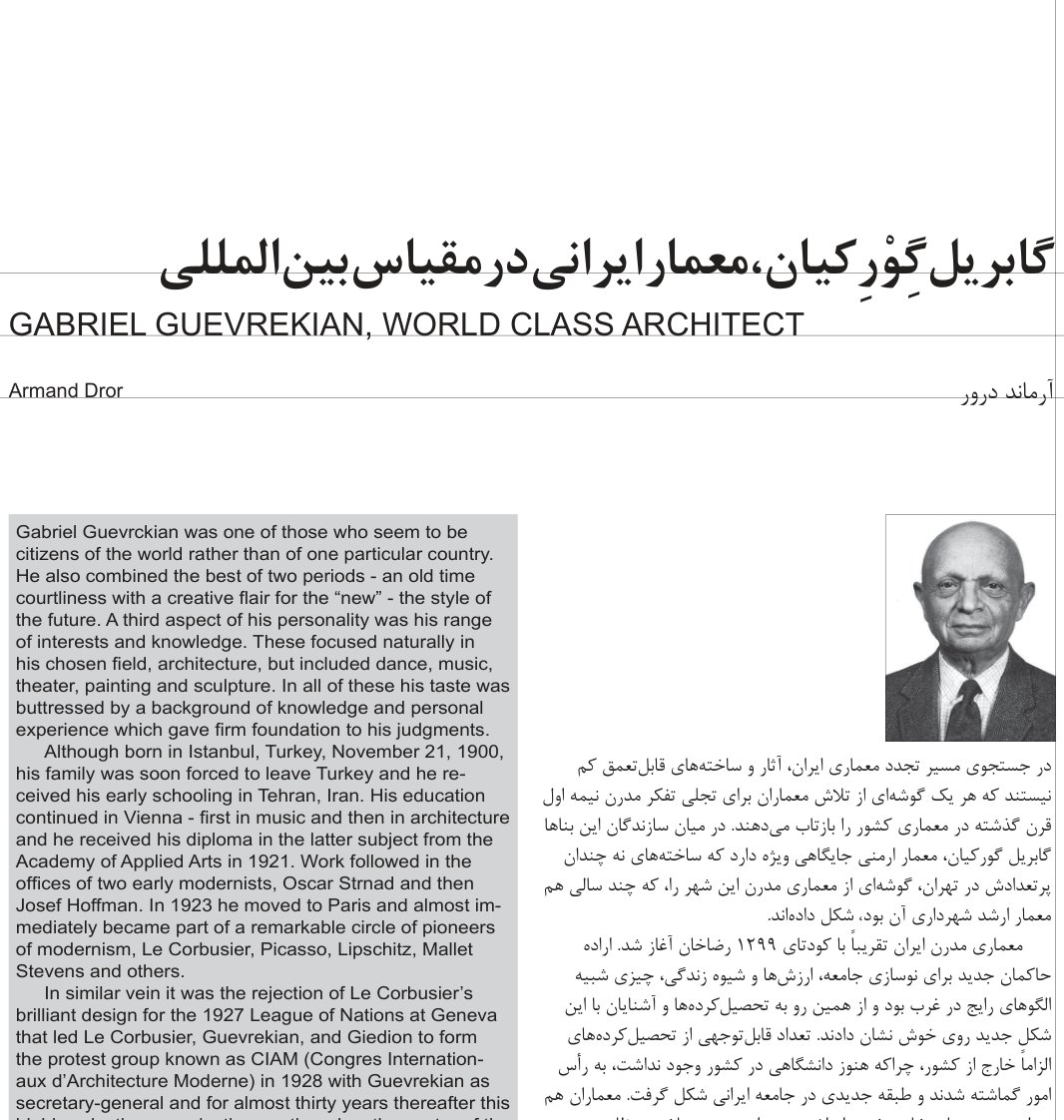
we must pay attention to the role of Iranian-Armenian architects in this trajectory. In this regard, many names come to mind: Vartan Hovanessian, Pol Abkar, Markar Galestian, Kristapor Tadeossian, and Gabriel Guevrekian, among others. But without doubt, Guevrekian was a key figure among them. He was not only one of the driving forces behind the establishment of the foundations of modern architecture in Iran, but had essentially played this role in the formation of modern architecture in Europe and the world as well. Despite his short working period in Iran, his influential role in the country's architecture is clearly visible. The Guevrekian family were Armenians from Istanbul, Turkey, who a few years after Gabriel's birth (1892) were forced to leave the country due to unfavorable social conditions and emigrate to Iran. His father, Simon, was a jeweler who was able to continue his profession at the court of Mozaffar al-Din Shah. Guevrekian learned Persian well in Tehran and completed his studies. After that, together with his architect uncle, Alex Galoustian, he went to Austria to continue his education. In Vienna, he entered the field of music, but very soon realized that despite his great interest, he would get nowhere in music and preferred to change his field of study to architecture. In 1921, Guevrekian received his diploma from the Vienna School of Applied Arts, which had considerable connections with the studios of two famous Viennese modernists, Oskar Strnad and Josef Hoffmann. In 1923, Guevrekian's important decision to go to Paris forever transformed his social and professional future. Shortly after arriving in the new city, the young architect began working as an architect in Robert Mallet-Stevens's office, and thus entered the circle of pioneers of modern art in Paris, which included figures like Le Corbusier, Picasso, Lipchitz, Mallet-Stevens, Calder, and others. Their meeting place was Alexander Calder's empty studio or the cafés of the Montparnasse neighborhood, where their endless discussions were always underway. Guevrekian recounted that sometimes at night he would play basketball with like-minded friends, including Le Corbusier and his cousin Pierre Jeanneret. He recalled Le Corbusier's strange appearance during the games, wearing a wire-mesh guard to protect his famous glasses! The general public in Europe of the 1920s not only did not accept the innovative ideas and works of these modernists, but even disliked their built works. For example, the aristocratic and stubborn uncle of one of Guevrekian's clients, for whom the architect had designed and built a modern building, refused to set foot inside it. Only five years later, the excitement of seeing his niece's newborn child finally compelled him to visit the house. This building and its interior furnishings, designed by Guevrekian, remain highly regarded today for their creative use of materials, cube-like volumes, and flat roof, and are preserved as part of the history of modern architecture. In a similar response, the jury of the League of Nations building competition in Geneva did not look favorably upon Le Corbusier's design, and this event led to the formation of a group of protesting architects by Le Corbusier himself, Guevrekian, and Giedion, who a few months later organized the International Congress of Modern Architecture (CIAM), with the participation of like-minded architects and urban planners, in Switzerland. Gabriel Guevrekian was elected as the secretary of the first congress. For three decades thereafter—until 1959, when its activities ceased—CIAM was the beating pulse, driving force, and strategic engine of the modern architecture, urbanism, and urban planning movement. Despite the public's lack of acceptance of plain flat surfaces, flat roofs, and elongated ribbon windows and other elements of modern architecture in the 1920s, in 1925, the garden that Guevrekian had designed for the International Exhibition of Modern Industrial and Decorative Arts in Paris drew considerable attention. The following year, he designed another garden in the city of Hyères for one of the pioneers and patrons of modern art, Vicomte Charles de Noailles, which gained worldwide fame as the Cubist Garden. In 1930, Guevrekian was invited, along with a group of modernists, to participate in the International Werkbundsiedlung in Vienna. For this event, he designed a building containing two housing units. This modern building. Siasi House, Tehran.
was the product of the architect's thinking about creating a model for low-cost buildings with high-quality living spaces that could be built at a large scale. By this time, Guevrekian was fully recognized as a thoughtful and influential architect of modern architecture, and he joined André Bloc in launching the first and most important architecture magazine in Paris, publishing the inaugural issue of Architecture d'Aujourd'hui. In late 1932, he completed the construction of a three-story villa in Neuilly for Jacques Heim, which is today considered one of his most important built works. That same year, this building was exhibited at the first exhibition of modern architecture organized at the Museum of Modern Art (MoMA) in New York as one of the selected works from France. In 1933 (1311 SH), Guevrekian returned to Iran at the invitation of the government and shortly after began working as the senior architect of the Tehran Municipality, while also establishing his own architecture office. The presence of a world-renowned and influential architect in Tehran was a significant event. He participated in the design of several government buildings, including the amphitheater of the Military Academy, the Ministry of Justice building known as the Justice Palace—whose architecture can be considered Neoclassical (a version of Guevrekian's proposed design for it currently hangs on the wall of the Dean's office at the Faculty of Fine Arts). Some private houses, Tehran. Panahi House, Tehran. Khosravani House, Tehran. Malek Aslani House, Tehran.
the Ministry of Foreign Affairs building, which was initially constructed as the Police Palace, and the Officers' Club, which Vartan Hovanessian completed, as well as a design for the Ministry of Industries and Mines building, designed in 1936 but never built. During his stay in Tehran, he also built a number of modern villas and houses, known by the names of their owners. In some writings, the number of Guevrekian's executed residential projects in Tehran has been cited as up to 20 buildings, but only 6 buildings have been identified. These houses had a significant impact on the architecture of residential buildings in Tehran. The choice of an architect who had come from the West to build a house in the modern style held a special appeal for the educated and cultivated class of the capital. Perhaps had Guevrekian's stay in Tehran been longer, his impact on the country's architecture could have been far deeper—in the same way that Vartan Hovanessian and Pol Abkar, two prolific architects of that period, became influential. In any case, one cannot overlook Guevrekian's influence on his contemporary architects in Iran, which carried far more weight than his direct impact on the country's architecture. An interesting point about Guevrekian is his retention of Iranian citizenship and his identification of himself as an Iranian architect, which he insisted upon throughout all the years after leaving the country. Although in 1955 he obtained American citizenship, in that country he was known as an Iranian architect—an architect who was fluent in six languages. Villa in France. Villa in France. Villa in France. Perspective drawing of the Heim Villa, drawn by Guevrekian. Model of the Noubar Pasha Villa in Saint-Cloud, France, 1932. Another view of the Noubar Pasha Villa model in Saint-Cloud, France, 1932. Cover of Architecture d'Aujourd'hui magazine. Credit page of Architecture d'Aujourd'hui magazine with Guevrekian's name.
Guevrekian departed Tehran for London in 1936 (1315 SH) and after three years, at the height of the World War, moved to Paris, where he spent difficult years. In 1946, he became the head of the architecture section of the French Academy in Saarbrücken, and alongside George Henry Pingusson, took up teaching while simultaneously serving as the city's municipal architect. Two years later, at the invitation of the Alabama Polytechnic Institute, he emigrated to America and began teaching. The following year, he accepted a teaching position at the University of Illinois, which he held until his retirement in 1969. Through Guevrekian's efforts, the University of Illinois's architecture department established its first overseas study program at La Napoule, France, where he taught as one of the inaugural professors. Throughout his teaching career in America, he was a visiting professor at the University of California and numerous architecture schools, as well as at Salzburg. During his time at La Napoule, Guevrekian purchased an apartment in Antibes, France, to spend his retirement. Guevrekian's proposed design for the Ministry of Industries and Mines building. Guevrekian's class at the University of Illinois. Gabriel Guevrekian's design for the Ministry of Industries and Mines building, which was never built.