



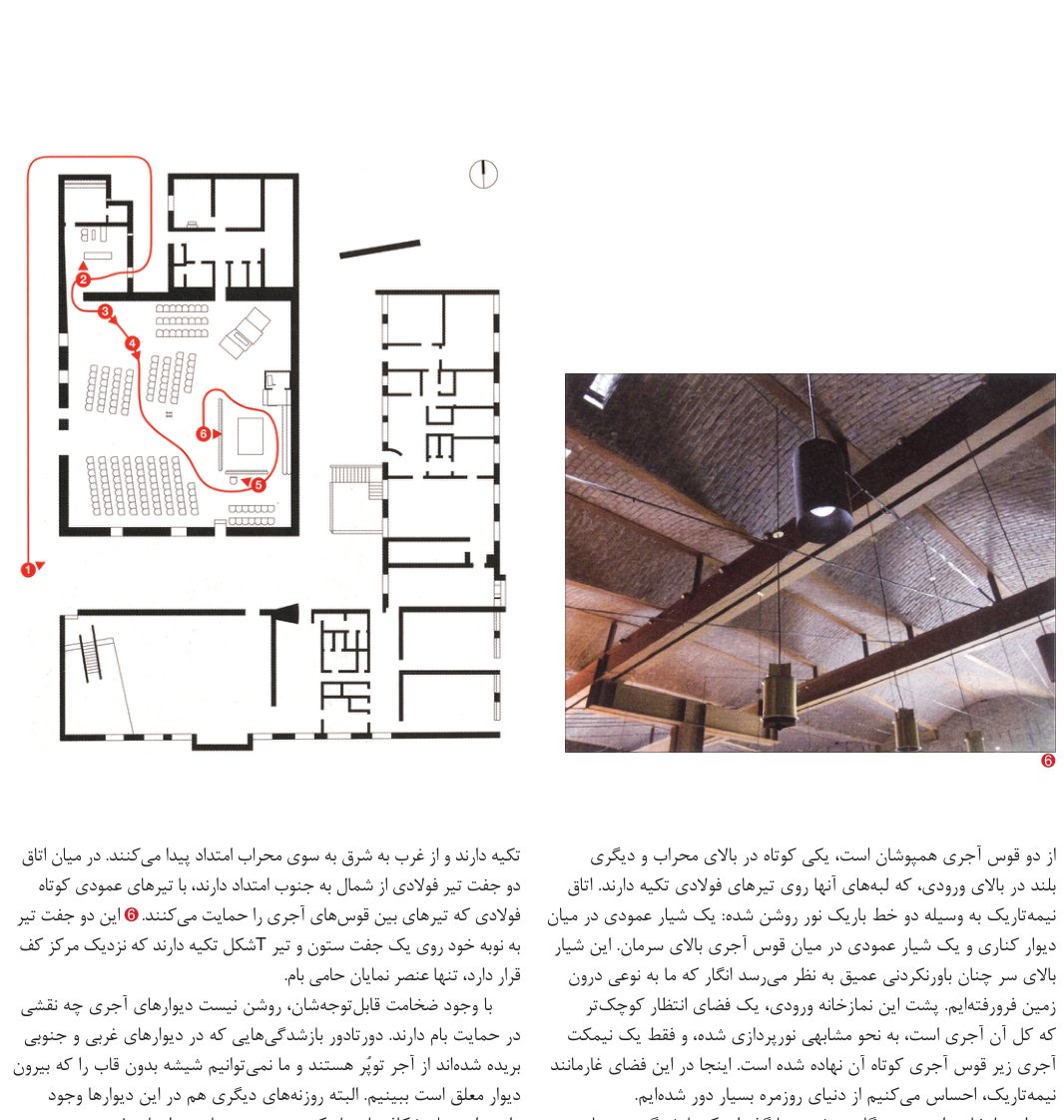
consists of two overlapping brick arches, one short above the mihrab and the other tall above the entrance, whose edges rest on steel beams. The semi-dark room is illuminated by two narrow lines of light: a vertical slit in the side wall and a vertical slit in the brick arch above our heads. This overhead slit appears so incredibly deep that we feel as though we have somehow sunk into the earth. Behind this entrance chapel, a smaller waiting space, entirely of brick, is similarly lit, with only a brick bench set beneath its low brick arch. Here, in this cave-like semi-darkness, we feel we have traveled very far from the everyday world. From the chapel we enter the nave, passing through an opening between the north and west walls. Now we stand in the corner of a large square room (60 by 60 feet, 18 meters). The semi-dark space before us receives light from several openings in the west wall to our right, while the space on the east side remains entirely in shadow. We pause a moment to find our balance, because the brick floor on which we stand is not flat but slopes slightly upward, toward the east, forming an interior topography. Nearby, we see half of a large shell held above the floor by a curved black steel frame, and water pours from a metal pipe above it into the shell—this is the baptismal font. Then, simultaneously, we see and feel the brick floor rising and swelling in front of the shell, providing a place for a child to stand. Now we notice a long opening in the floor, a cross that marks the priest's position on the lower side, with bricks projecting like fingers at each end. Staring into this opening in the darkness, we cannot discern its depth. We hear the sound of water trickling and echoing—not the water falling into the shell, but the sound of the shell's water falling into this subterranean holy basin. And now we can make out the roof overhead, built entirely of brick, intricately folded and curved—a row of narrow brick arches whose shared edges rest on steel beams,
extending from west to east toward the sanctuary. In the center of the room, two pairs of steel beams run from north to south, with short vertical steel members supporting the beams between the brick arches. These two pairs of beams in turn rest on a pair of T-shaped columns and beams near the center of the floor—the sole visible element supporting the roof. Despite their considerable thickness, it is unclear what role the brick walls play in supporting the roof. The openings cut into the west and south walls are of solid brick throughout, and we cannot see the frameless glass suspended on the exterior. Of course, other openings exist in these walls, including narrow vertical slits in the west and south walls, opposite the organ and choir loft, for acoustic modulation. In addition, other shallow openings have been cut into all the walls, revealing their double-layered construction, with an empty cavity between the two layers that permits the retention of warm air in winter. The monolithic altar, the bishop's throne, the priest's bench, and the pulpit—with its slightly rotating base for the Holy Book—are all built of brick and set against the east wall, the only wall without openings. Two deep light channels carved into the roof create a transparent wall or vertical curtain of light that cascades down at the junction of the nave and the sanctuary, marking the priest's path from the threshold of the sacristy into the nave and defining the sacred space of the sanctuary. The Church of St. Peter exemplifies a method in which building materials can be employed to shape and give presence to the rituals of daily life, allowing the human actions performed within to reveal themselves while architecture recedes as a background or frame for experience. In this way, as Walter Benjamin wrote, architecture is not the object and focus of our visual attention; rather, we apprehend it through tactile appropriation, realized not so much by attention as by habit and familiarity—through use, movement, and touch, a tactile inhabitation of a familiar place.
The caryatids bear the weight of the Ionic structure with dignity, performing the load-bearing function of columns. In Greek architectural columns, the act of bearing weight is abstracted, yet we still sense it through our bodies. The Erechtheion, Acropolis, Athens, Greece, 421-407 BC.
The Gothic church expresses vertical upward movement through a quasi-vegetal manifestation of structure. The image shows a rhythmic series of compound piers, alternating between round piers with four octagonal attached shafts and octagonal piers with four round attached shafts. Chartres Cathedral, Chartres, France; after 1145, rebuilt over 26 years following the fire of 1194.
The psychology of that which makes us heavy, tired, sluggish, and unsteady on our feet—there is no way to understand the psychology of gravity except by referring it to the psychology of weightlessness and the longing for lightness. —Gaston Bachelard
Two forces govern the universe: light and gravity. —Simone Weil
Lightness is born of heaviness and heaviness is born of lightness, simultaneously and reciprocally, creation in exchange for creation, gaining power in the same measure that they partake of life, and advancing in life as they advance in motion. Simultaneously they destroy one another, fulfilling a mutual enmity, proof that lightness is created only in relation to heaviness, and heaviness only where lightness follows. —Leonardo da Vinci
Architecture is the art of ordering space. It expresses itself through structures. —Auguste Perret
Force, form, and architectural structure occur under the laws of physics, and typically display these constitutive physical forces in a calculated manner. Meaningful architectural structures are not arbitrary formal inventions or embodied whims; they arise from physical, material, cultural, functional, as well as mental causalities, and transform these realities and conditions into architectural metaphorical expressions. All physical structures are bound to honor the force of gravity. A load-bearing structure is the primary source and the most effective expression in architecture. As Auguste Perret says, "Structures are the mother tongue of architecture... the architect is a poet who thinks and speaks in terms of structures." He understood the frank expression of structure in moral terms. "The builder who conceals part of the building's framework is discarding the only acceptable and simultaneously the most beautiful ornament. He who hides a load-bearing column errs. He who erects a false column commits a crime." While structural forces are inescapable physical realities, they provide the grounds for a heightened sense of reality; every architectural approach that aims at precise structural expression becomes a form of poetic realism. The entire history of architecture can be interpreted as the evolution of building materials and ideas of enclosing and covering space. Buildings must not only fight gravity,
they must withstand the variable forces of wind, weather, and earthquake, as well as structural loads arising from their use. This narrative encompasses the Egyptian pyramids, Greek temples, Roman arched spaces, and Gothic cathedrals, through modern structures of concrete, steel, and glass, to today's advanced architecture built from man-made metal alloys, plastics, and composites. The Greek column and beam, the Roman arch, the Gothic pointed vault and ribbed vaulting, as well as the modern engineering structures of Robert Maillart, Luigi Nervi, and Buckminster Fuller—all clearly and openly express, in a poetic manner, the logic of structural forms and their dialogue with gravitational forces. The bond of the Roman column with its base pedestal, the entasis, convexity, capital, and abacus, as well as the intersecting network of ribs, the arched vaults of the Gothic cathedral, are eloquent expressions of the gathering and directing of gravitational forces through the architectural system of structure and language. The spatial structure of a building inhibits or accommodates specific activities, where proportions and the juxtaposition and composition of parts convey experiences of delicacy and beauty. The logic of building is not limited to the load-bearing structure, because the entire process of construction—detailing, joining of units, sequencing of tasks, and so forth—demands its own particular rationality. The architectural expression founded upon these constructional and technical realities, the various craftsmanships of building, is most often referred to as the laws of "tectonics." The tectonic language of architecture shows how a building is constructed, and how different elements and units are joined together to form a complex structure. Tectonic expression is, by necessity, in dialogue with the force of gravity and the other causalities of the physical world. This constructional entity can be regarded as the natural language of architecture. Historically, engineering innovations have developed hand in hand with the evolution of architecture; one of the finest examples being the superb nineteenth-century engineering structures, including the Crystal Palace (1851) in London by Joseph Paxton, and the Gallery of Machines at the Paris International Exposition (1889) by Contamin and Dutert, which
served as powerful catalysts for the emergence of modern architecture. Architecture, too, can influence engineering. One of the outstanding structural masterpieces of architecture is the dome of the Duomo in Florence by Filippo Brunelleschi. The architect, in addition to inventing the novel structural system of the double dome as a method for spanning the largest space up to that time, devised means for transporting stone over long distances to the construction site, as well as machinery for hoisting enormous pieces to the vertiginous height of the dome. The architectural struggle against gravity reflects humanity's fundamental yearning for liberation from the constraints of matter, for weightlessness and flight—a duality reflected in Bachelard's phrase, "the psychology of gravity." The history of architecture reveals a general tendency toward the reduction of mass and weight, though stylistic tastes have from time to time dictated a kind of "counter-evolutionary" structural expression that reinforces the sense of mass and gravity. For example, the works of Louis Kahn reintroduced archaic images such as brick arches and concrete vaults into modern architecture, restoring a sense of gravitas. From an engineering standpoint, the means of combating gravity are the materials and structural engineering forms that direct gravitational forces downward, into the earth. The need for windows, doors, and other openings, and the growing tendency toward transparency and the reciprocal connection of interior and exterior spaces, have progressively reduced the solidity and density of walls, leading to framed structures that can be perforated at will. Antoni Gaudi discovered the inventive forms of his organic, fluid structures—which reversed the direction of gravity—through physical models; gravitational compression was transformed into suspension. He photographed canvas-and-wire structures hung from small bundles that supplied the weight, and used these structural lines and forms as the basis for determining the form of stone vaults. Gaudi's structures confront the force of gravity with the same imperceptibility and clarity as biological structures, and the sense of weight and mass
A weightless horizontal slice of a stone structure in mid-air. Filippo Brunelleschi, Foundling Hospital, Florence, 1419-1445 (Brunelleschi's name appears in the building's records only until 1427).
The Crystal Palace, designed and built in an extremely short period for the Great Exhibition in London, is one of the most astonishing construction projects in history. Sir Joseph Paxton, Crystal Palace, London, 1851.
A vast steel assembly space to accommodate 50,000 people, with a span of 216 meters and a height of 33 meters. Mies van der Rohe, Convention Hall, Chicago, project, 1953-54. One of the projecting corners — a model of the facade.