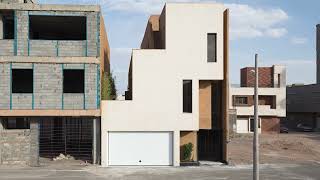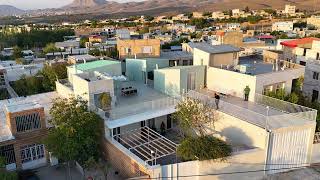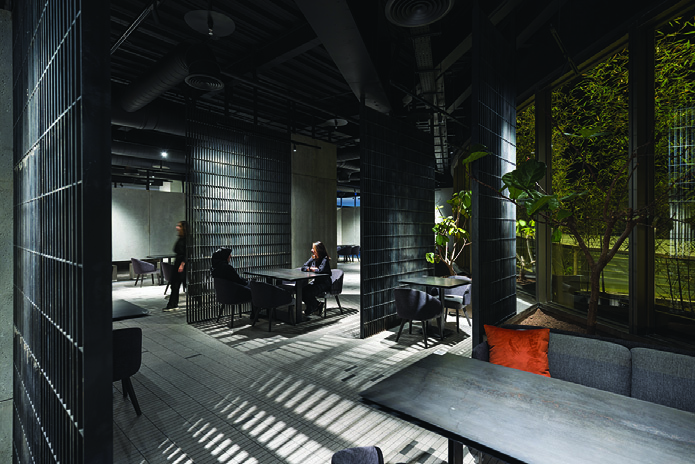
For several years now, the construction of residential and commercial urban units has become one of the country's main industries, absorbing a large part of its workforce and output. Architects, structural engineers and mechanical engineers of reasonable and middling grades are, through numerous projects, striving to display their art and skill. Every day we see new architectural schemes built, and all kinds of structural skeletons used in the many tall buildings with domed roofs or other novelties appearing one after another. Façades — once reduced to a uniform three-centimetre brick skin — have now turned to glass-and-stone or stone-and-glass compositions; and all of them, from high to low, from the central block to the third-class speculator's building, have façades that look alike.
Structural skeletons, too, have undergone change. Instead of the steel skeleton with saddle-girder beams that was current for many years, one now sees a wide range — from steel skeletons with saddle girders all the way to moment-connected assemblies with very detailed bolted or welded joints. All kinds of concrete skeletons, from post-and-beam to shear-walls and even composite steel-and-concrete frames with concrete cores, are visible around the city. Everything suggests that new architectural ideas and the technical knowledge of structural engineering are gradually spreading. Even in the mechanical field we see the use of all kinds of packaged MEP units in residential units — cooling units, hot-water units, and finally combined hot-and-cold units.
But amidst all this, the thing that has been completely forgotten and is no longer attended to is the heavy interior build-out of the building. The architect is thinking about beautifying the building; the structural engineer is thinking about the building's strength; the mechanical engineer is thinking about the mechanical services. Yet if you visit any building that has finished its structural phase and begun its interior build — from the most expensive down to the ordinary ones — you will see unchecked use of stone on floors and walls, use of construction rubble to create level differences between floors, partition walls left unconnected to the structure at top, bottom or sides, floor levelling with heavy materials, many false ceilings with large decorative volumes, and ordinary glass with aluminium doors and windows.
Developers and sellers of residential units in tall, expensive towers advertise glass-and-stone façades, stone floors, and stone walls — especially granite. Well-off buyers, too, boast to friends and acquaintances: "The whole floor is granite."
In several reputable buildings under construction in north Tehran, I have come upon the use of construction rubble to create floor-level differences. On the first-floor ceiling (above the ground floor), I have seen, on one side, a false floor filled with rubble and, on the other side, a false ceiling more than one metre deep. In many buildings — especially government buildings — massive stone slabs cover not only the floors but also the walls of the corridors.
Do the builders of urban buildings know that the use of glass on a façade with ordinary aluminium door-and-window details is wholly wrong, and that this must be done with special, very expensive safety details? In the past fifteen years, the codes for earthquake mitigation have been fundamentally transformed around the world, and for this reason, in earthquake-prone regions, buildings designed and built under the old codes are gradually being repaired and strengthened. Among these changes, in some buildings, is the removal of heavy interior walls and their replacement with light partitions. Where such repairs and strengthening have been done — as in the cities of Japan or the United States — severe earthquakes have occurred over the past few years, and the absence of widespread destruction has demonstrated the correctness of the repair and strengthening path. It is precisely in these conditions that, despite the strict prohibition of the earthquake codes, the use of very heavy decorative materials in our buildings nullifies the whole effort that the structural engineers have put into making the building safe.
This issue — that during the interior build-out the structural engineer is usually not present on site — must be kept in mind, because: first, the primary principle in the drafting of earthquake codes is to make the building lighter, while the dead load of the building is actually imposed on it during the interior build-out; second, the structural engineer, during design, considers only the building's overall loads, not the small loads that may gradually be added to the global ones as the work proceeds. These small loads are precisely the ones that pile up, bit by bit, during interior build-out in every corner of the building.
Third, in earthquake-prone Iran and especially in Tehran, what matters is the lightness of the building, not its elegance. Granite — the most expensive stone — is, because of its high specific weight, the greatest defect of tall buildings. It must be remembered that stone applied to the walls of tall buildings, in an earthquake, becomes a person's tombstone.
Fourth, using construction rubble to create level differences in apartment floors concentrates stress at a single point in the building and renders the structural engineer's calculations void. Ordinary glass with aluminium doors and windows on a building's façade is like using a cold weapon lying in wait for an earthquake so that it may be flung in every direction and endanger people's lives.
According to the data from the recent earthquakes in Tokyo and Los Angeles, more than a third of the damage sustained by the city was the fall, breakage or damage of items placed on shelves inside buildings. For this reason, in those cities — which today have safe buildings — devices have been made and brought to market that, during an earthquake, hold shelves and the items on them in place and prevent them from falling and breaking. These safety devices can protect anything from a vase of flowers on a table to books, computers, porcelain ware and so on from the risk of a fall. We, on the contrary, line our luxury apartments in north Tehran with the heaviest first-grade granite — just so that they may fetch a higher price!