It is perhaps only seldom that an architect is afforded the precious opportunity to gain access to the most private space designed by a great architect such as Yousef Shariatzadeh — to become intimately acquainted with his living space and that of his family, to be present within its expanse, to walk through it and sit upon a sofa, to examine its interior details, to contemplate the photographs and paintings hung upon its walls, and to experience glimpses of his artistry in creating an environment for his dearest ones. When, through the kindness and efforts of Dr. Maryam Shariatzadeh, one of his relatives and a dear classmate of mine, I was introduced to Ali Shariatzadeh, the son of this distinguished architect, and circumstances arose in which the other residents of the beautiful residential complex he had built consented to a visit, I was delighted that after several rounds of requesting and entreating, I had at last fulfilled my student-years dream of seeing this building and entering it.
I believe only architects and artists familiar with the characteristics of architecture from the 1950s and 1960s (solar calendar) will, upon encountering this complex, be able to correctly discern its difference from the vast multitude of commonplace buildings — and if so, it will be accompanied by a long pause before this work, gazing upon it.
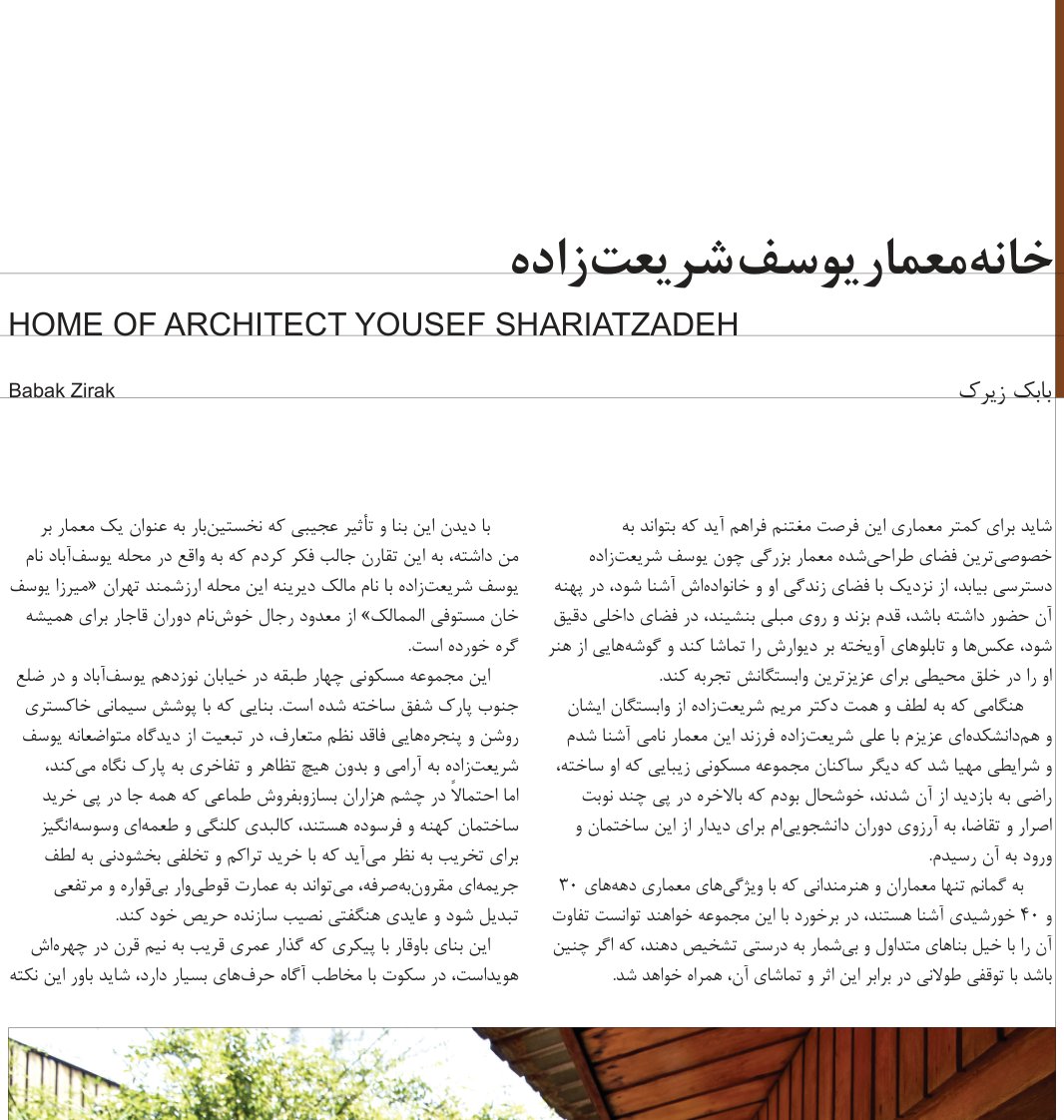
Upon seeing this building and the strange impression it left on me as an architect for the first time, I thought of the fascinating coincidence that in the Yousefabad neighborhood, the name of Yousef Shariatzadeh is forever linked with the name of the neighborhood's longtime owner, Mirza Yousef Khan Mostofi al-Mamalek, one of the few men of good repute from the Qajar era. This four-story residential complex was built on Nineteenth Street of Yousefabad, on the southern edge of Shafaq Park. A building clad in light gray cement plaster with windows lacking any conventional order, in accordance with Yousef Shariatzadeh's modest outlook, it gazes quietly upon the park without the slightest pretension or ostentation. Yet in the eyes of the thousands of greedy speculators who are everywhere on the hunt for old, dilapidated buildings to purchase, it probably appears as a teardown ripe for demolition — a tempting prize that, with the purchase of additional density rights and a forgivable violation settled by an affordable fine, could be transformed into a boxy, misshapen high-rise that yields a handsome profit for its rapacious builder. This dignified building, its visage bearing the passage of nearly half a century, speaks in silence to the discerning viewer of many things. It may be difficult to believe, but over these years I have repeatedly asked many architects about a notable residential complex in the Yousefabad neighborhood, and nearly all of them — despite their considerable claims regarding knowledge of contemporary Iranian architecture — had not the slightest awareness of this remarkable building's existence. A complex that is among the rare buildings none of whose residents have been willing to sell and leave, nor are they now. This complex comprises six apartments, large and small, each designed from the outset for the architect's family, close relatives, and friends with particular care and meticulousness, no two of which resemble each other, and each of which in its own right constitutes a fresh work. Each apartment — from a very small one-bedroom unit to a three-story triplex — possesses a unique atmosphere and special value. For the architect, the provision of direct southern light and a northward view toward the small and intimate Shafaq Park for all units was a priority of great importance. The feeling of being in each one is certainly very different from the others, and it stirs in an eager observer like myself the wish that circumstances might have allowed me to reside in each of them, however briefly, and to experience the pleasure of living in such varied spaces. I began my visit with the residential unit of Ali Shariatzadeh — a two-bedroom apartment of utmost simplicity and composure, with rooms proportioned toward the sun and a relatively large living room on the northern side, opening onto a balcony with a pleasant view, facing the trees of the park. Beside this living room, a delightful kitchen has been fitted in the form of a long, narrow strip. With the goal of economic efficiency, the kitchen of the neighboring eastern unit has also been placed adjacent to this one. In the apartments of this complex, kitchens are not particularly large; they are typically just a place for cooking, and the dining area is situated in the closest possible proximity. These kitchens, in contrast to the conventional open kitchens of today — not with counters and serving tables — are usually separated from the adjacent space by large sliding wooden doors. Doors with a lattice of small glass panes that can close the kitchen off from the reception room during cooking without severing the visual connection between them. These movable partitions, however, are open most of the time and perhaps are closed for only an hour when guests are present.
The reception spaces in the units on the first, second, and third floors have a wide balcony before them facing Shafaq Park, and the architect has artfully allocated the windows as large, fixed transparent panes without the possibility of opening, set in frames of squared timber, solely for the provision of view and scenery — perhaps, in his conception, these windows are frames for capturing the park's landscape in different seasons. Furthermore, these windows are connected above and below by wooden panels to the ceiling above and the floor below; in other words, a skin of wood and glass separates the reception space from the outdoors with great finesse. Beside each of these large, single-pane glass frames is a narrow ventilation slot, covered on the outside by a wooden shutter, with a fine screen installed between the operable window and the shutter to allow air circulation while preventing the entry of insects. In this regard, the architect has cleverly eliminated the element of the screen on the large window panes, which typically gives an extremely unattractive appearance to the exterior facade and openings. The details designed for the balcony doors are also very much worth seeing: the balcony doors are entirely wooden and opaque, designed with great care and finesse, divided into two separate, vertically stacked leaves. In effect, one can keep the lower half of the door closed to prevent a child from inadvertently accessing the balcony, while leaving the upper
half open at a higher elevation for better ventilation. This arrangement, according to the architect's son, also applies to the southern side, who describes the southern view of the units: "When this complex was built, the large windows of the bedrooms on the south side also framed an attractive view of the densely packed trees lining Valiasr Street. Unfortunately, today a jumble of secondary facades from four- and five-story buildings in the ugliest possible form is visible in the frame of these windows." In every corner of Ali Shariatzadeh's small apartment, a memento from his artist-father delights the eye: the design of the beautiful and proportionate wooden sofas of the reception room and the decorative bookcases flanking them, the wardrobes and delicate shelving in the bedroom walls — all are the work of the building's architect. A masterful portrait of Yousef Shariatzadeh drawn in pencil by the renowned photographer Ahmad Aali, together with several black-and-white photographs of him and his wife — each of which one could contemplate for hours — leaves an unforgettable memory of this small apartment.
During my visit to the first, second, and third floors, I saw various apartments in each of which the architect's powerful hand has artfully displayed difference and variety in the design of apartments of differing sizes, while in each and every one of them a particular attentiveness and meticulousness toward the conditions and needs of the residents is evident. It must be explained that constraints such as the narrow width of the plot and the necessity of dividing each floor into two separate units required a slender staircase with an elevator to be placed precisely at the center of the plan, and all sanitary facilities to be situated in the middle zone of the apartments — and perhaps necessarily, a guest lavatory was not installed near the entrance of the units either. One of the interesting aspects of consolidating the services in a specific zone is the provision of
a space for the placement of evaporative coolers. Typically, in conventional units, coolers are placed either on the roof or on the facade, giving the building an extremely ugly appearance, and apart from that, rendering the roof an unsuitable space for residents' use and effectively devaluing the building's fifth facade. But in this residential complex, the method of accommodating the cooler space inside the apartment is itself an innovation. Rather than having the coolers work on the rooftop under the sun in an unfavorable environment, with the cool air they produce losing a significant portion of its cooling effect while traveling through vertical ducts to the floors below, the coolers have been connected at the closest possible point to horizontal ducts within the false ceiling. In this way, each apartment contains a dedicated cooler space — akin to a utility room — with proper insulation, water piping, and a drainage channel in the floor, plus a wide duct beneath the ceiling of one of the rooms that connects to the building's facade, responsible for supplying the cooler's fresh air intake. With this ingenious device, the cooler operates in a sheltered environment without sun exposure or energy waste, with greater efficiency, while the usual difficulties of placing coolers on the roof of the top floor or on the facade and their attendant challenges are entirely resolved. Later, upon seeing the beautiful rooftop of the top floor, I better understood the wisdom of this masterful innovation by Yousef Shariatzadeh.
With the coordination of the architect's son and his accompaniment, I finally reached the uppermost and largest unit of the complex, which the architect had designed for his own and his family's residence with extraordinary meticulousness, tailored to their circumstances and temperaments. The current occupant of this unit is Mostafa Dashti, the well-known painter and longstanding friend of Engineer Shariatzadeh. This three-story apartment, at its lowest level, contains a large entrance hall and three bedrooms — two on the south side and one on the north, the latter now serving as this painter's studio. Bathrooms and lavatories are situated, as usual, in the center of the plan. What astounds the visitor upon entry is the image of a profoundly different space visible in the floor above: the ceiling of the semi-dark entrance hall appears to gape open, displaying in a luminous space a massive wooden sculpture — which is in fact a suspended staircase and a beautiful composition of interwoven beams, delicate connections, and wooden trusses.
When I reached the upper floor, I became even more aware of the grandeur of this accomplished architect's work: a vast salon lay before me, on one side a great window offering a soothing view toward Shafaq Park, and on the other, multiple windows overlooking a verdant and refreshing green space that, at that height, could only inspire wonder. A spacious garden with old trees — a tall cypress some seven meters high, perhaps forty years old or more; a robust palm tree with a trunk diameter exceeding half a meter; graceful olive trees laden with fruit; shorter plants such as Indian carnation, yellow jasmine, and swamp palm; and finally, colorful flowers of all kinds at ground level! For years, from the highest point in Shafaq Park, I had studied the facade of this building and noticed green patches on its roof, but what I now beheld up close was beyond belief — a tree-filled space atop a rooftop. It was as if Shariatzadeh had first built a three-story house with a beautiful courtyard at ground level, opened all the reception, dining, bedroom, and kitchen spaces onto it with consummate artistry, and then — with extraordinary audacity — uprooted the whole thing and installed it on the roof of a residential complex! The main space and the greater portion of the apartment on this middle floor is devoted to a spacious reception area, its walls — particularly on the south and west — covered with large and small paintings, most of them works by Mostafa Dashti, so that upon entering, one has the impression of being in an art gallery.
On the whole, the sloped ceiling covered with wide, regular planks, a structure composed of several large wooden trusses, and a mezzanine that floats suspended in space present an image that is very different from a conventional residential unit. The perimeter of the open stairwell between the lower floor and the middle floor of the unit has been enclosed with latticework wooden railings of elaborate detail, creating a decorative ensemble with ornamental shelves, a small table, and shelving serving as a bookcase. Truly, the delicate wooden joints, the vertical stays extending to the ceiling, and the details executed in the stair structure and the suspended wooden ceiling of this unit's upper floor are remarkably elaborate, precise, and artful. Wood occupies a special place in the architecture of Yousef Shariatzadeh; the architect has rightly exploited the capability of large wooden partitions in many of the spaces. The bedrooms of parents and children in this unit are separated by a large, movable wooden partition that easily allows the space to be unified. The architect has made maximum use of every opportunity to make the spaces functional. For instance, on the south side of the kitchen, there is a small space for a washing machine, dryer, and ironing. A small door in this area also provides passage to the adjacent green space for hanging washed clothes to dry, and once again, large sliding wooden doors allow this space to be separated from the kitchen. On the southern portion of this floor, as on the floor below, two bedrooms and a bathroom are situated, and on the mezzanine — which, reached by a wooden staircase, forms the third level of this large apartment — the architect has designed, in addition to two small rooms, a beautiful space with an appropriate overlook onto the middle floor as a sewing room for his artist wife.
I left the building still entranced by the artistry of Yousef Shariatzadeh. For a long time I gazed at the different floors and the further details of its unadorned exterior, camouflaged by the tall trunks of plane trees. In truth, apart from the top floor — where the north-facing balcony has given way to a large courtyard on the south-southwest side of the building — the balconies on the other floors are unexpected hollow volumes that appear to have been carved from the building's mass by a skilled sculptor, after which light and beautiful skins of glass and wood have found the opportunity to serve as the intermediary between the interior spaces of the units and the outside environment. In the same manner in which each of these balconies opens toward Shafaq Park and its beautiful greenery, in an exceptional gesture, the park's enclosure wall has also, in deference to this valuable work, receded with the utmost delicacy before it, creating an expanse that invites passersby and viewers to contemplate this rare legacy.
Finally, I am convinced that the forms designed by this highly prolific and yet modest and astute architect are the fruit of a conscious understanding of people's needs in their living spaces, and of his artistic innovations in the refinement of space and his effort in the creation of introverted architecture. Among the writings of Yousef Shariatzadeh, I came upon this captivating and wise passage, where — like the creators of the great works of Iranian architecture — he thinks of the functional quality of spaces more than their outward appearance, and speaks thus: "I am not a form-giver; I am a form-finder." And in another passage, he expresses his poetic view of architecture: "Architecture is the stage of life — a quiet text upon which the turbulence of life unfolds. Nothing is uglier than a building that seems to want to flaunt itself before people. The beauty of architecture is the reflection of the beauty of the soul of the individual or the nation that built it."
Now, nearly nineteen years have passed since the sorrowful death of Yousef Shariatzadeh in November 2001. Truly, if we were to set aside his numerous works and consider only this residential complex as his sole creation, it would still suffice for his name to shine among the foremost influential contemporary Iranian architects. Would that in this domain there existed a proper mechanism whereby this building — like the Koohbar House by Mehdi Alizadeh, another authorial architect and his contemporary — could be registered among Iran's modern heritage works, and preserved forever from the ravages of time and the avarice of profiteering non-architects.



