Structure: Mohammadreza Kamranian · Construction builder: Alireza Akhavan
Electrical and mechanical: Alireza Nader Tehrani · Supervision: Hossein Soodavi
Photography: Deed Studio · Graphic: Arefeh Aliakbari
Total built area: 180 m² · Site area: 1,200 m²
Experience Studio — A box set down in a garden, with its head and tail removed.
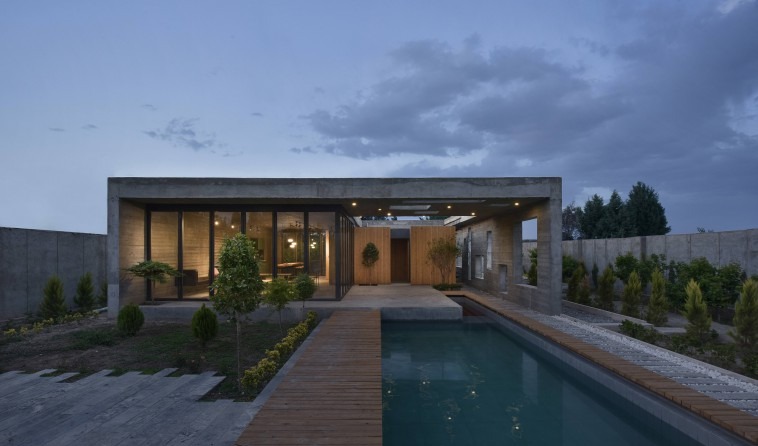
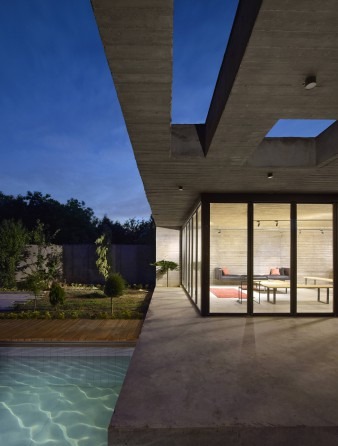
Twilight frontal view of the project: the concrete frame reads as a single horizontal mass, the long timber deck and pool stretching forward into the garden as the building's open face glows from within.
The client's brief was a small weekend villa with a pool that doubled as a water reservoir and a place to swim — a space whose enclosed core could be inhabited in winter and whose open expanse could serve as a sheltered loggia in summer, and the view of the garden was the most important of the client's requests. The vegetative texture of the site and the kind of trees already present pushed the designer toward preserving the garden as much as possible — to keep the project a garden rather than convert it into a villa — and this attitude shaped the project's initial concept. The box, as a simple geometry whose head and tail can be removed, opens the project completely along its north and south faces, granting an uninterrupted view of the garden in every interior space. It is as if a box has been set down in the garden and the garden then passes through it. Sub-functions that needed a more enclosed boundary were placed in firmer secondary boxes inside the main transparent box, and the residual space between these sub-boxes became the entry corridor. The headless-tailless box is a self-standing structure without any columns or supports; the demand for spatial continuity, material honesty and a particular formal expression brought the project to an exposed concrete structure.
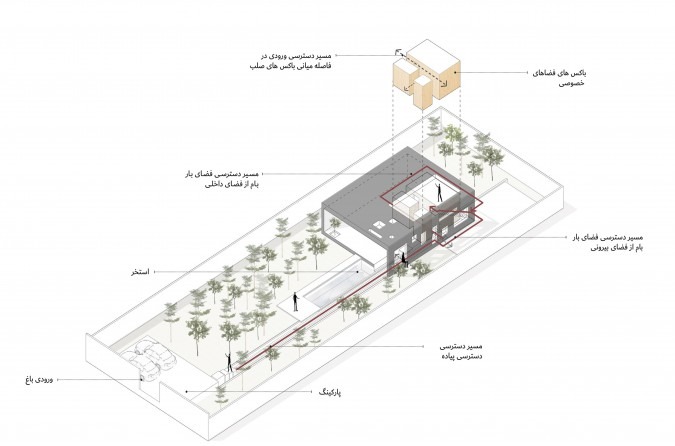
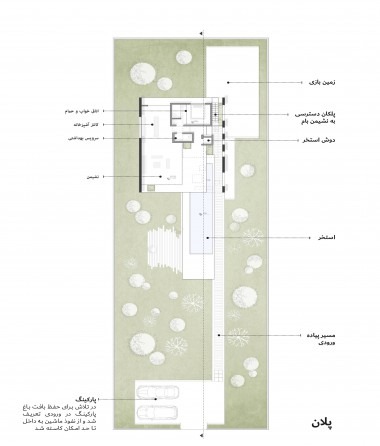
Site axonometric of the long north–south plot: the garden entry and parking at the south, a pedestrian path running the length of the orchard, and the cube placed at the northern end with the pool stretching out toward the trees.Floor plan: the master bedroom and bathroom and the service core hold the closed side at the west, while the living space opens fully to the pool and orchard at the east; the pool and a long timber deck reach southward across the garden.
The duality the client sought was achieved through a thin transparent boundary — glass — that runs through the solid sub-boxes and through the main transparent box, producing two entirely different spaces at the closest possible distance from one another. Because this central glass boundary can be folded away, the duality can also be momentarily collapsed into a single unified space. In effect, taking up the client's two bounded requirements — a winter space and a summer space — the architect, by reducing this boundary to its absolute minimum and by giving it the ability to slide aside and disappear, has tried to produce a particular kind of spatial interweaving.
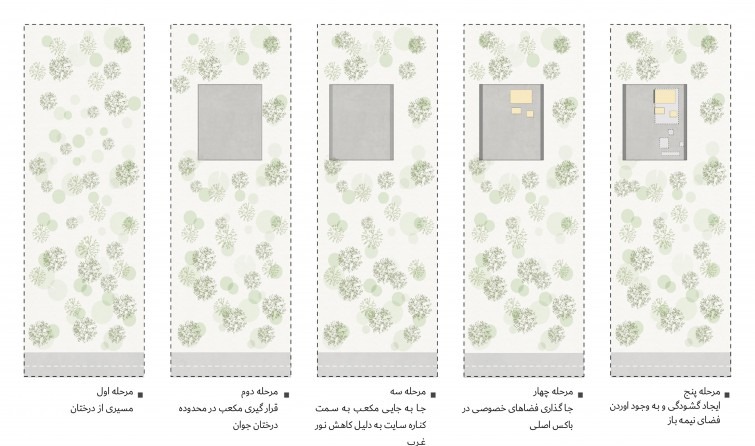
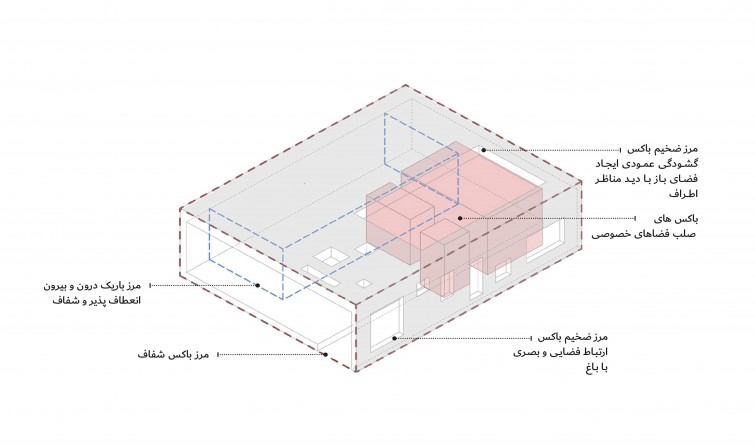
Five-stage concept diagram: starting from a path through the existing trees, the cube is placed within the young-tree zone, shifted toward the western edge to reduce west-facing sun, fitted with internal private boxes, and finally opened along its head and tail to produce a semi-open central space.Concept axonometric of the box-in-box scheme: the thick concrete shell with its long opening for spatial and visual links to the garden, the thin and flexible glass boundary that mediates inside and outside, and the cluster of solid sub-boxes that hold the private functions.
A thin boundary between inside and outside; the eastern wall pulled wide and made transparent (the eastern boundary); the opening of the box at the roof level above the solid sub-boxes so that views of the surrounding garden can be borrowed at height; and finally the very placement of the solid sub-boxes inside the transparent box — these are all gestures aimed at intensifying the spatial interpenetrations the architect was after.
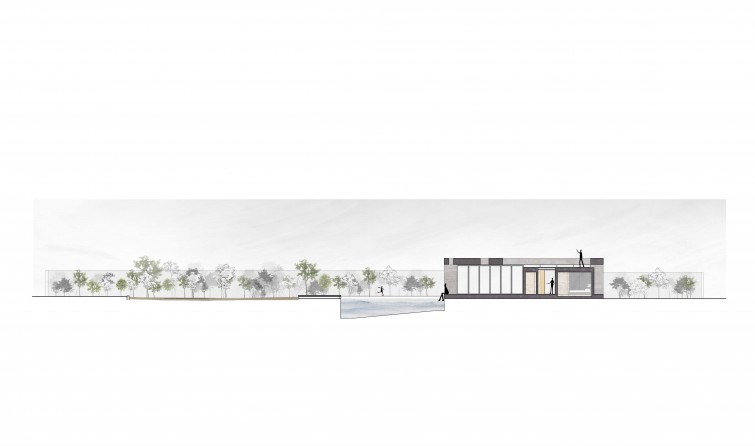
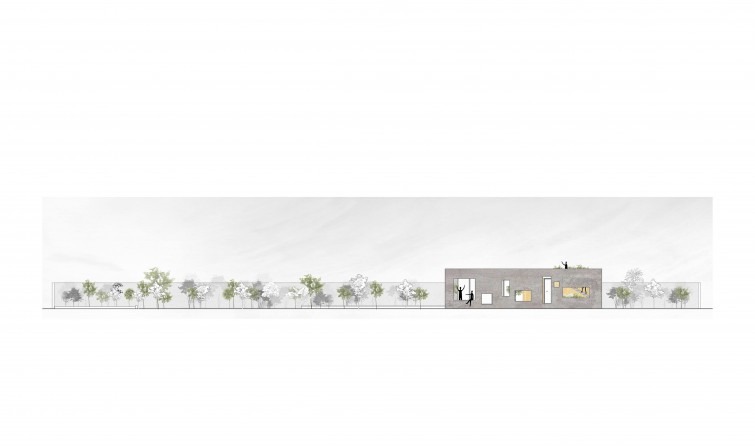
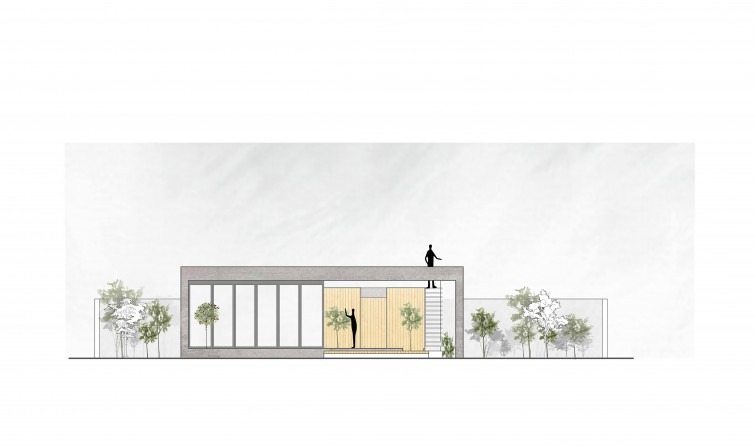
Long section through the pool and the main space: the box is occupied at one end, while the pool slips beneath the slab and projects into the garden, anchoring the indoor and outdoor in a single horizontal gesture.North–south long elevation through the orchard: the concrete frame sits as a single horizontal mark within the tree line, its punched openings and warm wooden insert reading as quiet incidents along an otherwise green horizon.Short elevation of the east face: the heavy concrete frame is cut to reveal a wood-clad insert and a tall opening, while a person on the roof signals the rooftop terrace gained through the staircase inside.
This kind of spatial interweaving, which the architect kept in view throughout the design, in fact attempted — by making and reshaping the project's inner and outer boundaries — to overlap several dualities at once: inside and outside, open and closed, transparent and opaque. 'In-between' — binabin — is perhaps the best word that can be imagined for spaces of this kind.
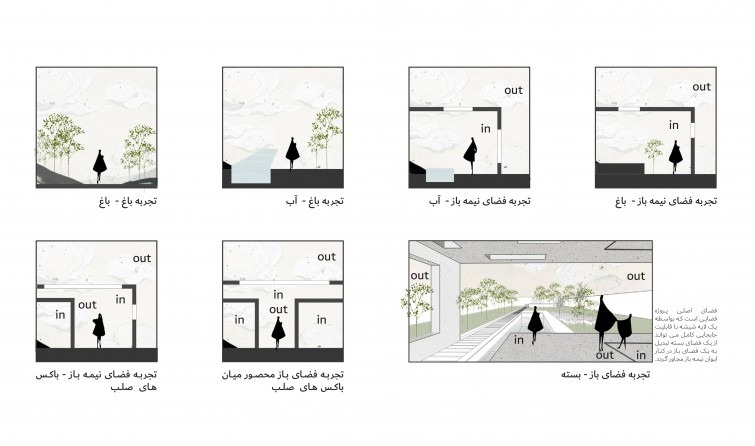
Experience-typology set: the visitor's status flips between in and out across eight conditions — garden/garden, garden/water, semi-open/water, semi-open/garden, semi-open/solid boxes, open between solid boxes, open enclosed by solid boxes, and finally the open/closed pairing of the project's main space.
From the very entry into the garden, through the entry path and into the interior, the project is an attempt to manufacture varied spatial experiences and interwoven dualities — inside and outside, open and closed, transparent and opaque — and to deploy thin and thick, defined and indeterminate boundaries that work together to place the visitor continuously within these intentional spaces. In effect, the visitor will not be able to detect a sharp threshold between spaces or between the different experiences. The principal interior space, by means of a fully retractable layer of glass, can be transformed from a closed room into an open one adjoining the semi-open iwan beside it.
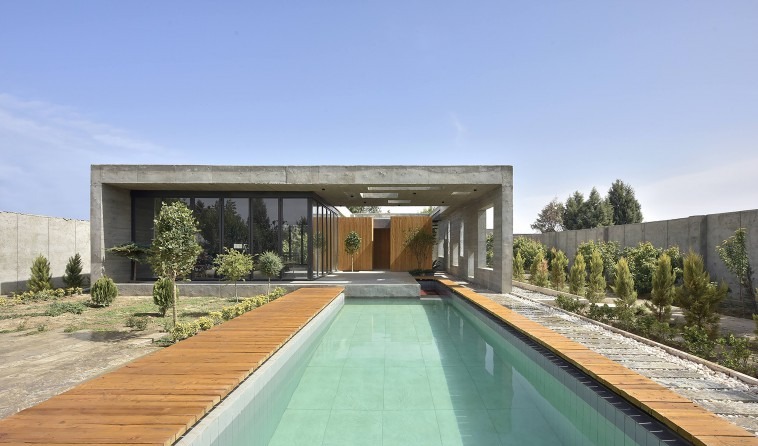
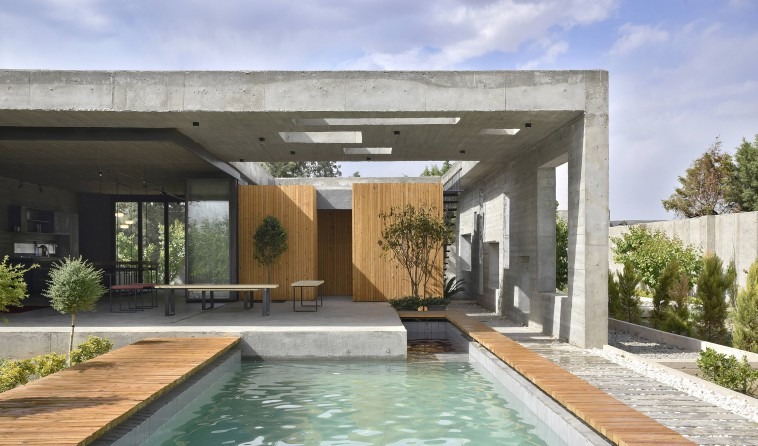
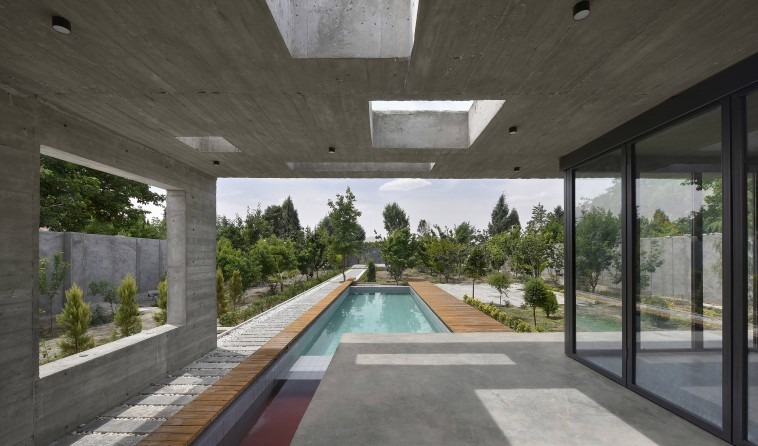
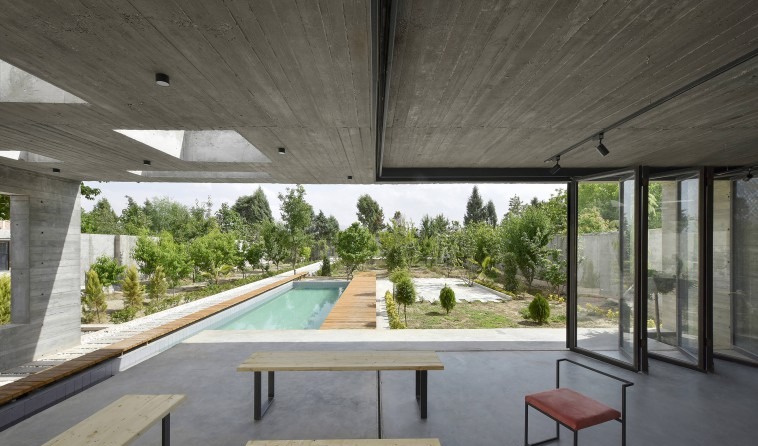
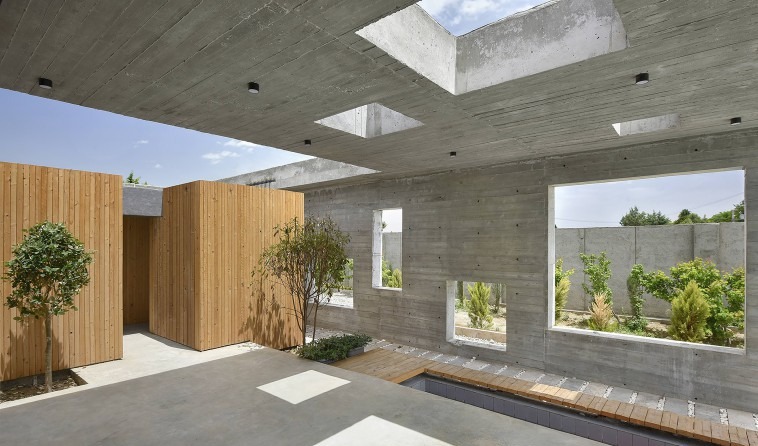
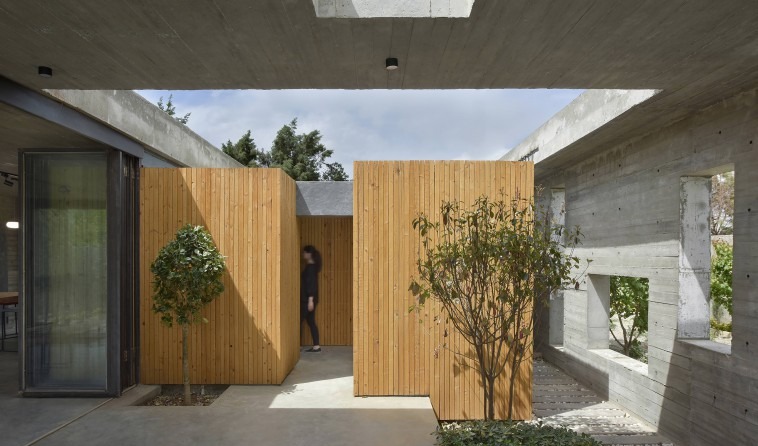
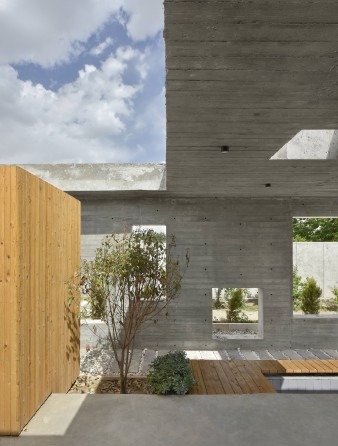
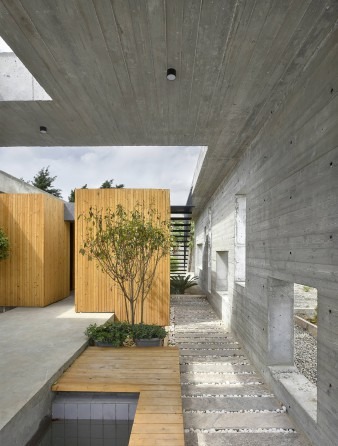
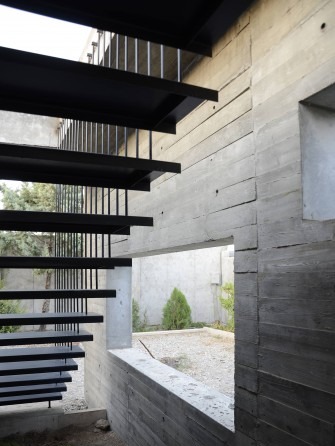
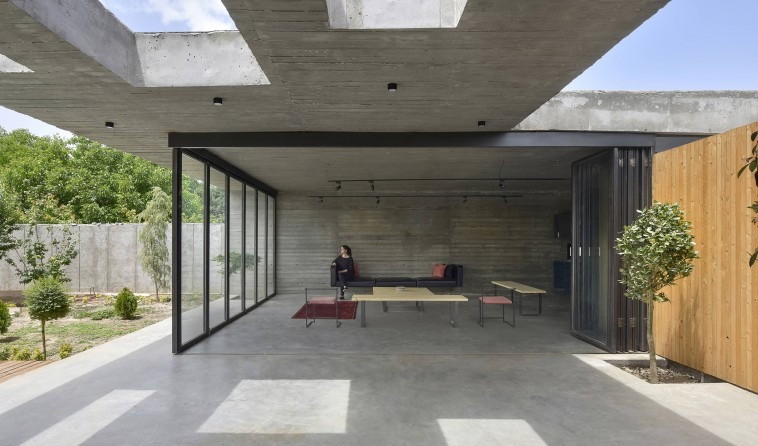
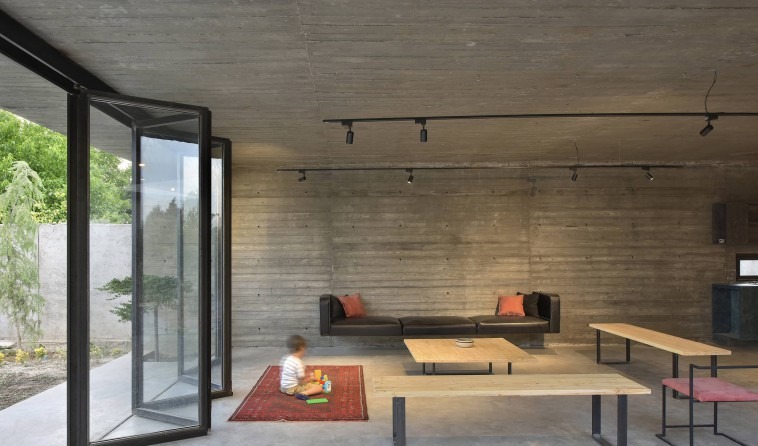
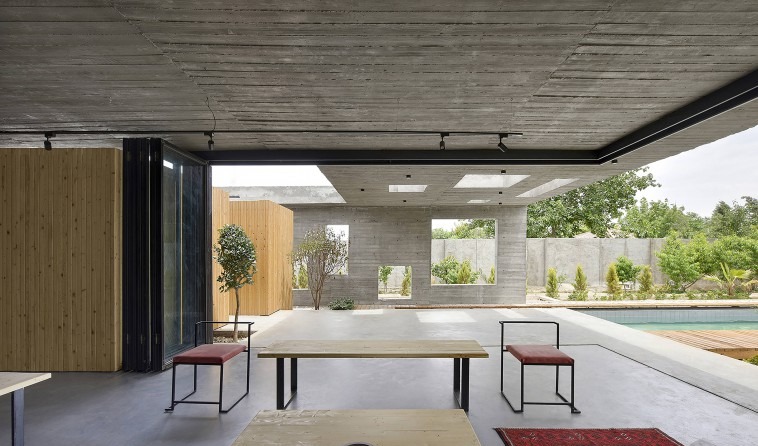
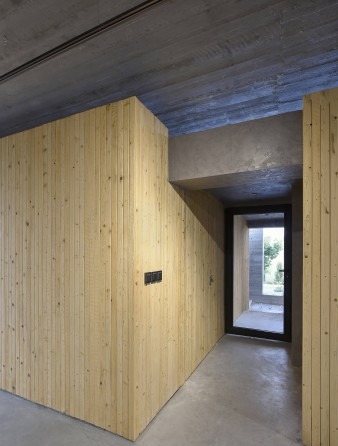
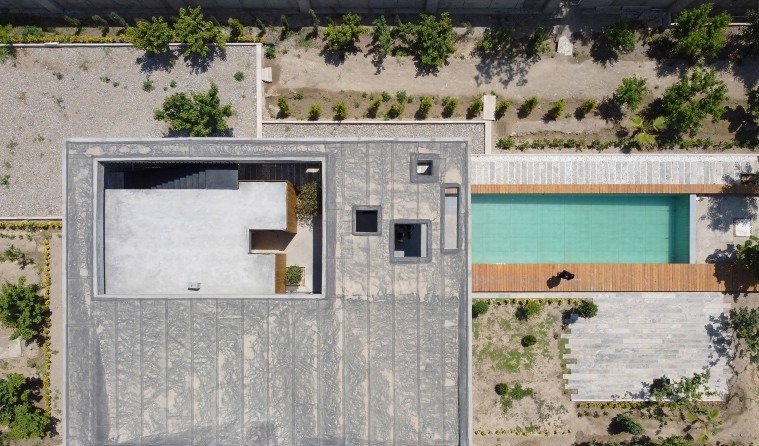
Daytime hero view from the south: the deep concrete frame projects over the pool, the long timber deck lining the water, with the glazed living space and the wooden private boxes set back beneath the slab.View from the pool deck looking back toward the wooden private boxes: skylights perforate the heavy ceiling above the semi-open court, daylight pooling on the polished floor and the timber surfaces.From beneath the slab outward: skylight cutouts puncture the concrete ceiling and frame an open view of the orchard, the pool and the wooden deck holding the foreground.Inside the main space with its retractable glass folded away: the project's principal interior can become an open loggia opening onto the pool and the trees beyond.The semi-open central court: wood-clad service boxes face the bare board-formed concrete of the outer shell; cube-cut windows in the concrete edit selected pieces of the garden into the room.Two wood-clad private volumes facing one another across the court: a figure slips between them, the seam between boxes becoming the entry corridor described in the brief.Detail of the board-formed concrete wall punched with three openings: the timber-clad private box pushes forward from the right, and a sliver of orchard appears in each cube window.Looking past the wood-clad volume toward the long perforated concrete wall: the gap of stone gravel between deck and wall reinforces the perimeter as a thin garden margin rather than a finished surface.The floating black steel stair against the rough board-formed wall: the only vertical move in the project, leading from the semi-open court up to the roof terrace.The main interior in its open state: the steel-frame sliding doors are folded into the corners, joining the floor of the living space and the floor of the courtyard into a single plane.A child plays on a red Persian rug in front of the concrete wall: the project's heavy materials soften under the everyday occupations of family life.Looking from the living space toward the semi-open court: the retractable glass leaves only a thin black mullion line between inside and outside, the pool and orchard visible past the wooden boxes.The narrow entry corridor between two wood-clad volumes: the project's threshold is not a door but a slot of wood within concrete, with light coming from the far end.The same view at twilight: the living space glows warm through the glass, while the pool catches the last of the sky and the concrete dissolves into deep blue around it.Aerial view: the sunken roof court above the wood-clad volumes reads as a stepped void at the cube's centre, while the timber-edged pool and the second courtyard extend the project's east–west cross-axis into the orchard.