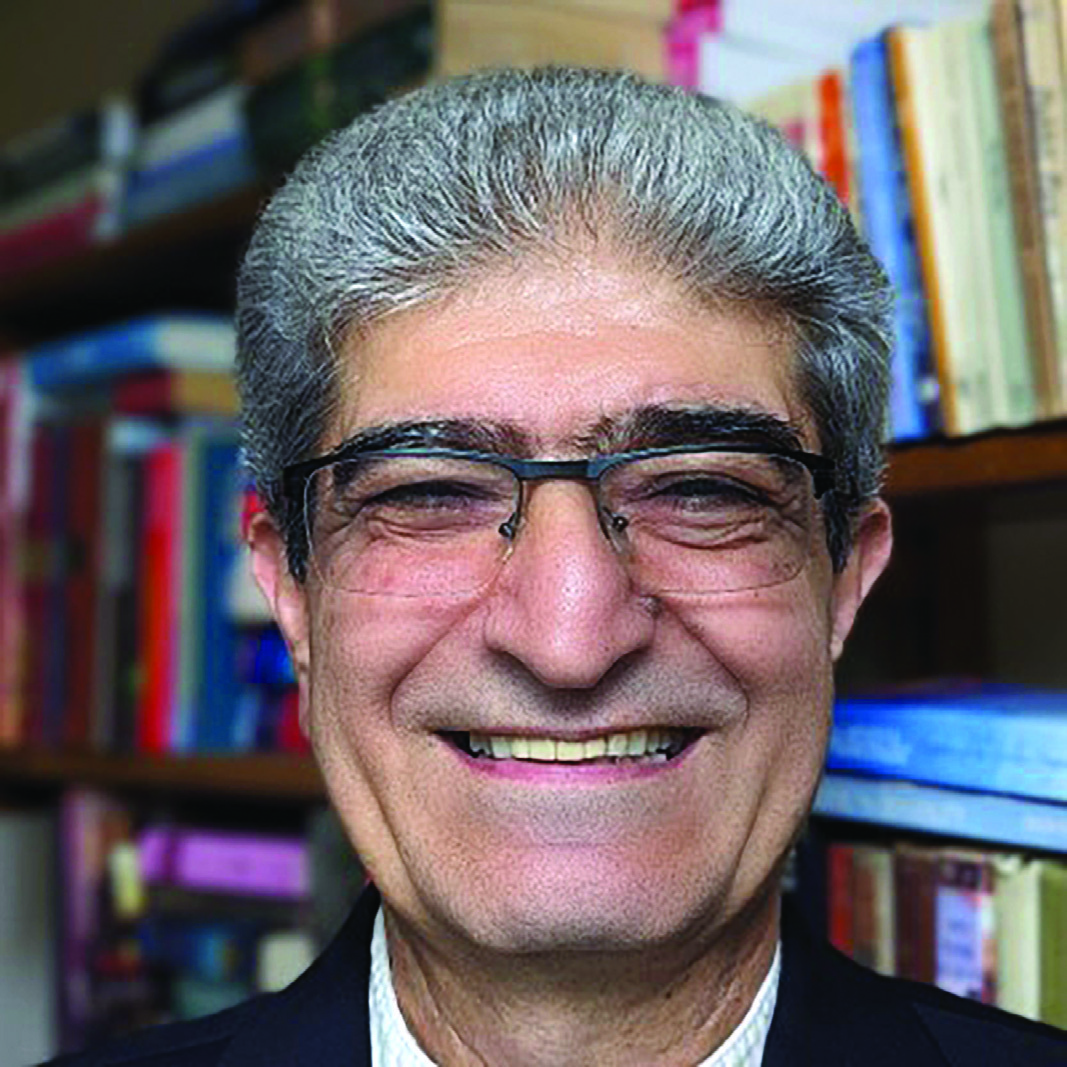
The late Yousef Shariatzadeh was perhaps the most low-profile architect of his time. In the words of the late Engineer Heshmatollah Monsef, one of the great figures of the country's mechanical engineering profession: "He shunned the assembly and ceremony halls — which are the showcases of oratory, performance, and self-display." He never agreed to interviews. He would not even agree to write articles. The only article of his that I know of was a written sparring with Jalal Al-Ahmad about the architecture of the 1340s SH (1960s) — and even that, he wrote at Al-Ahmad's own insistence.
With all this, among all those who, between the 1330s and the 1380s (1950s–2000s), had any sort of dealings with architecture, one can find very few who were not acquainted with his name and his work.
One reason, in my opinion, is that he was among the most prolific architects of his time. Over the course of nearly fifty years of continuous professional activity, he designed more than three hundred works, large and small. Indeed, the volume and variety of his projects are astonishing: from the Gendarmerie Hospital and Labbafinejad Hospital in Tehran to the machine-building and tractor-manufacturing complexes of Tabriz; from the Rivoli (Sahra) Cinema to the banknote-printing house of the Central Bank; and from the university campuses of Kerman (Shahid Bahonar and Kerman University of Medical Sciences) to the National Library of Iran.
But for those who deal more seriously with architecture — and even for the non-specialist viewer — what attracts attention more than this volume is that, despite the creation of new forms and masses (which have made almost no two of his works resemble one another, either in form or in materials), there is yet a tangible common quality in his works that the viewer immediately recognises as a design of Yousef Shariatzadeh.
The question is: for an architect who did not consider himself the owner of, or even a follower of, a style — and who was averse to style-making — what was the thing, or things, that shaped this common quality?
I will refer to some of them briefly.
Human-Centered Functionalism
Some have called Shariatzadeh a functionalist. Indeed, the function of each building was of fundamental importance to him.
For Shariatzadeh, the beginning of design was the understanding of the phenomenon that was meant to "take place" in that building, and that the building should make the fulfilment of that function possible. In other words, for him a project was not a vehicle for personal display, or a pretext for embodying preconceived ideas and masses — but a professional commitment to the client and to the society that, in seeking to satisfy a specific need, had embarked on the investment. If a university was to be built, the first step for him was the complete understanding of the phenomenon of university teaching, its physical requirements, the spaces needed for it, and so on. In this course he sought to obtain and study the latest information and sources, so that he could prepare and present the most up-to-date answers within the framework of the client's budget and technical and financial means.
But for him "function" was not limited only to the technical and organizational aspects of the phenomenon. "The human being" was at the centre of his attention. For example, he did not see a faculty as a collection of lecture halls, laboratories, and offices in which his work could be considered complete by optimising the spaces and their interrelations. He saw a professor who, more than half of his waking hours, was occupied in those spaces with teaching, research, study, and discussion. Or he imagined a student who, perhaps for the first time, not only had left his parents' home but had probably come to a new and entirely unfamiliar city, and a mixture of excitement, homesickness, hope, and worry was flowing through his soul — and was setting foot in grounds and spaces in which he would, for years, spend the most important moments of his life. In all these conditions, Shariatzadeh tried to see the world and the spaces from the eyes of these human beings, and to build spaces in which this life (these lives) would flow, of which they would be the backdrop, and which would facilitate and improve them.
This very human-centered functionalist approach brings us to the second matter.
Form-Giver or Form-Finder?
For Shariatzadeh, the understanding of the function of what was meant to take place in a building, and likewise the understanding of the needs of the human beings who would be at work and living in that building, was the starting point of design. In truth, he was not among those architects who, more than and before anything else, thought of the volume and shape of the building, free of the requirements of its function, and first worked out a volume and then tried to fit the needed spaces inside it. Shariatzadeh said explicitly: "I am not a 'form-giver,' I am a 'form-finder'" — though he insisted that his meaning was not that the architect plays no role in shaping a building and merely places, side by side, a set of spaces that the physical programme and the functional requirements have catalogued.
I encountered this concept for the first time in my adolescence, and it would not be without merit to recall a memory. Engineer Shariatzadeh was the favourite of all the young people of the family and of friends both close and distant — owing to his good humour, his good company, his open countenance, his great patience, and his sense of humour. In the first years of high school, when I had become acquainted with technical drawing, one day, with firm resolve, I took up the drawing board and the tee-square and the set-square and the protractor, fixed a sheet of tracing paper, first drew in pencil a three-bedroom house, and then completed the drawing with a Graphos pen (the name of which I doubt anyone under fifty has even heard) and even wrote the dimensions on it. On a day when he had come to our house, I showed him the drawing with great pride. First he raised his eyebrows, gave the drawing an admiring look, and asked: "Did you draw it yourself?" Then he listed the spaces one by one and offered well-dones, on how precise my work was. But suddenly he paused, knitted his brow, and asked: "Did you draw it with a ruler?" I was not expecting this question. With caution I said: "Yes. Should I not have used a ruler?" He replied: "No. I never use a ruler. Don't you see how all my drawings are crooked and skewed?!" Even in my adolescence I understood that this joke held a deeper meaning, but I naturally did not grasp it. Years passed until, in the Pir-Raz firm, I had the honour of a ten-year period of collaboration with a group of the most able architects and engineers in the various relevant specialised fields — at the head of all of whom was Engineer Shariatzadeh. In this period, my understanding of the meaning and significance of design gradually broadened and deepened.
For a real architect, a house is not a collection of bedrooms, living rooms, lavatories, bathrooms, and kitchens that we may place side by side — even if logically — and be done with! But it is also not, at the same time, a venue for the architect's self-display, free of needs! It is a living and dynamic collection of spaces whose placement in a design depends on very diverse factors. From location (city, village, and geographical region) and the dimensions and geographical orientation of the land, to the client's budget; from the available building materials and substances to the executive capacity of the constructors; and from the cultural characteristics of the client and his family to their specific needs — all are involved in this design. Naturally, in public projects — such as hospitals, universities, libraries, and research centres — many more diverse factors enter as well. From structural and mechanical-service considerations to the matters of the use-phase, repairs and maintenance, future changes, and the necessity of phasing the construction.
When all these factors are not the same in two apparently identical projects (for instance two hospitals or two universities), it is natural that the form of the work will not come out the same — though this not-being-the-same does not mean that those forms are arbitrary either.
For large and complex buildings — which made up the greater part of Shariatzadeh's projects — reaching the point where the architect can begin to design with relative confidence in his understanding of the requirements demands the expenditure of much time and heavy study. This was itself among the prominent characteristics of Engineer Shariatzadeh. We had a fine-spirited colleague who, in the rare free moments that came his way, drew caricatures of colleagues. His caricature of Engineer Shariatzadeh was a work desk with columns of books that completely concealed the person seated behind the desk, and only above the books one could make out the smoke of the pipe! From the view of all the colleagues, no one spent as much time as Shariatzadeh on reading and understanding. And truly, the breadth and depth of his knowledge — not only of architecture but of the other related building specialisations and also of cultural and social matters — were extraordinary.
I learned from Yousef Shariatzadeh that, when one has gained command of all the technical and functional requirements of a building and has understood the spiritual needs of its users as well, then it is the architect's taste and art that blends these together in a pleasing form. This is a form that has not been imposed upon the building, but has found its form from within the needs of the building and its users, and has then been polished! And truly, by experience I have seen that this approach is much more difficult than that other approach, in which an architect designs a form that he himself likes and then he and the other engineers strive to "embed" the programme's needs within that form.
About how, in Shariatzadeh's view, the architect's role in finding and polishing these forms is expressed, and the sources of its nourishment, there is much to say — and little space. In my final year at Pir-Raz Consulting Engineers, I encouraged him to put his views in writing; and after much pursuit and great insistence, he finally agreed. Years after his passing, friends sent me a copy of these handwritten texts — which amount to about two hundred pages (and I still do not know whether they include all of the manuscripts or not) — which, if time remains, should be tidied up and edited and made available to young architects. As far as I know, only a small portion of these writings was published after his passing, thanks to the efforts of Ms. Mahdavi, who was among those active at the magazine Abadi, under the title "Moderation between Tradition and Innovation in Architecture," in issue 19.
I close this writing, finally, with two memories.
There are those who have called Shariatzadeh's works "modern" (in the sense of modern architectural style) and even "international"; but the degree of use, very delicate and substantial, of Iranian architectural traditions in his works, and his mastery of their history and qualities, were of such a magnitude that I can claim that he has few comparables. I remember that, in the course of designing the National Library and preparing the related reports, I had a discussion with him about the manner of the controlled use of natural light in the reading halls. He explained that many of these methods of bringing light into a space have a long tradition in our architecture. Then, to demonstrate this point, he took a sheet of paper and — simply from memory — drew the Sheikh Lotfollah Mosque and the details of the dome, and then showed the manner of side-lighting from the drum of the dome. Then he drew another sketch, of a hypothetical form of the audience hall of Marvdasht (Persepolis), to show the manner of side-lighting from the apertures of the walls. Many of his designs are filled with these fine details from the architectural traditions of this land.
The other memory is from Engineer Nosratollah Majlesi, the managing director of the Atec firm. He — who in the years of his student days, and perhaps one or two years afterwards, had worked at the Banyan firm and had closely observed the working manner of Engineer Shariatzadeh — used to say: I have not yet seen any architect with his capability. His brain works like a "virtual reality system." Unlike others, he first completely builds the space in his mind, walks within it, looks at it from various angles, edits and corrects, and then, when he is satisfied, he brings to paper that which he had seen in his mind. For this reason, too, all his works have a human scale, and when they are built, they sit well with the heart.
I am entirely in agreement with this assessment. But I must add something to it as well. Talent is necessary, but it is not sufficient. Without perseverance and discipline, no talent unfolds completely. What distinguished Shariatzadeh from many others was not only his talent, the breadth, variety, and depth of his studies, but also his perseverance, discipline, and iron-clad order.
May we be able, by introducing him, to build a model for the young architects of our homeland.



