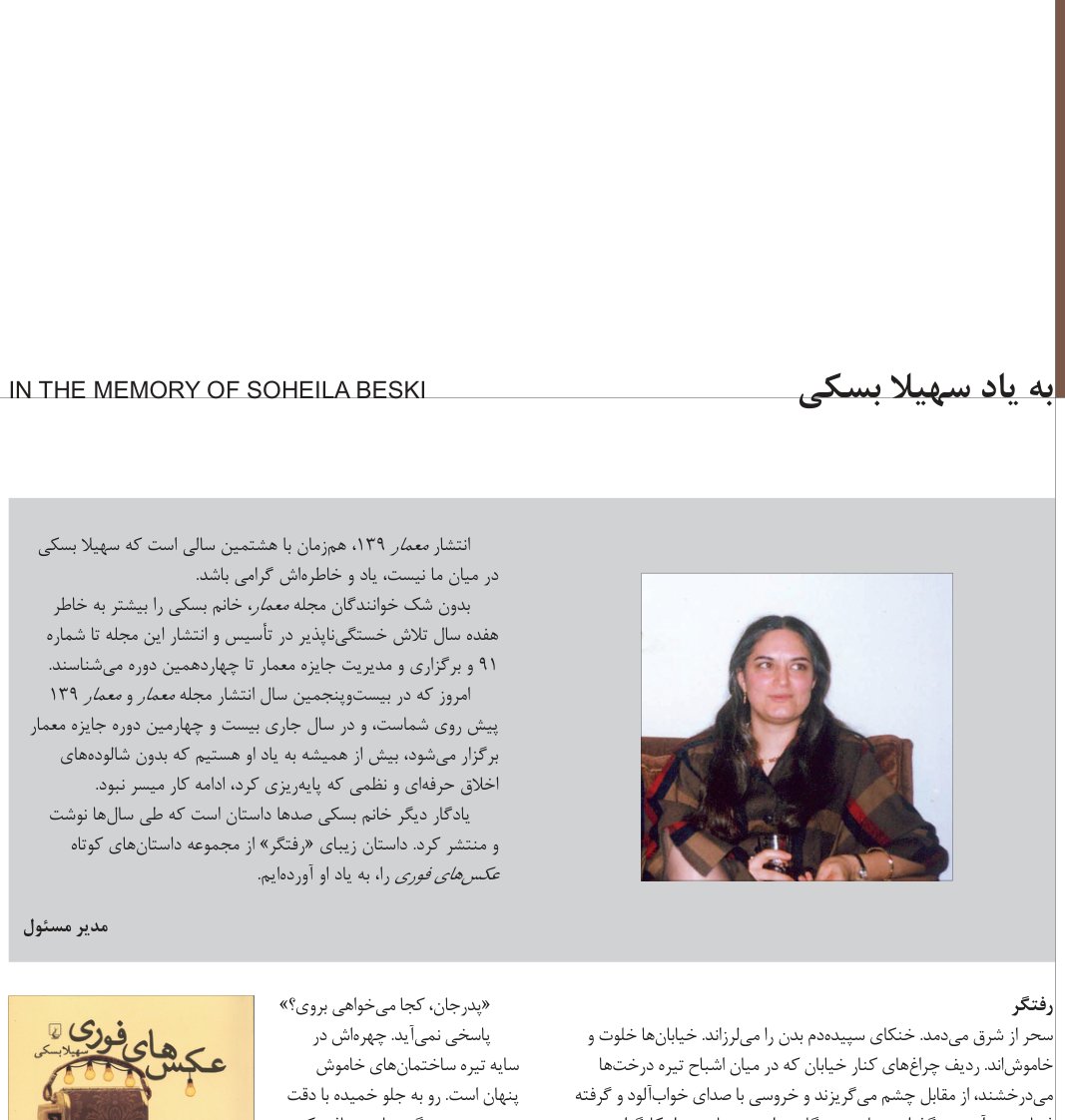
Eight years have passed since Soheila Beski left us. Each year, as the anniversary approaches, we find ourselves returning to her words — not as memorial exercises, not as performances of grief, but because her words continue to offer something. They remain useful. That is the measure of genuine writing: not that it endures, which any text can do, but that it continues to work on its reader, continues to open toward meanings that the passage of time reveals rather than forecloses.
This issue of Memar carries, alongside its architectural content, one of Soheila Beski's short stories. It comes from her collection Instant Photos — brief, compressed fictions that she wrote during the years when the magazine consumed most of her working hours. They are not the work of a writer who had set aside architecture to pursue literature. They are the work of someone for whom architecture and literature were always aspects of a single attention: the attention to how people move through space and time, how they inhabit the world they have been given, how they make meaning from ordinary moments.
The story printed here is called "The Street Sweeper."
The Street Sweeper
Soheila Beski
Before the city fully wakes, before the sound of traffic has risen to its daytime pitch, a man moves through the street with a broom. He is not young. His movements carry the economy of long practice — the particular efficiency of someone who has done a thing so many times that it requires no thought, allowing the mind to go elsewhere while the body continues its work.
The street is his at this hour. The shopkeepers have not yet arrived to roll up their shutters; the schoolchildren are still at breakfast; the civil servants are still on the bus. He sweeps in the direction of the slope, moving the accumulated debris of yesterday — cigarette wrappers, vegetable peels, the fine grit that settles on every surface in this city — into orderly piles at the curb.
A car stops beside him. The window comes down. A woman is driving — alone, at this hour, which is unusual, or perhaps it is simply unusual enough that he notices it. She asks if he needs a ride. He looks up, surprised by the offer. He is going, he explains, to the corner of the next street — only a short distance, not worth her trouble.
She insists. He folds himself into the passenger seat with some awkwardness, holding the broom upright between his knees because there is no other place for it. The car moves.
On the radio, a voice is reciting. It is a poem, or a passage of Quran, or the kind of measured, elevated prose that exists at the boundary between the two — the kind of language that the radio uses at early morning and at prayer time, when the city is not yet fully itself. The sweeper listens. The woman drives. Neither of them speaks until she stops the car at the corner he had named.
He gets out. He thanks her. She says it was nothing. He watches the car until it turns the corner and disappears, then picks up his broom and continues.
The city, by now, has begun to wake.



