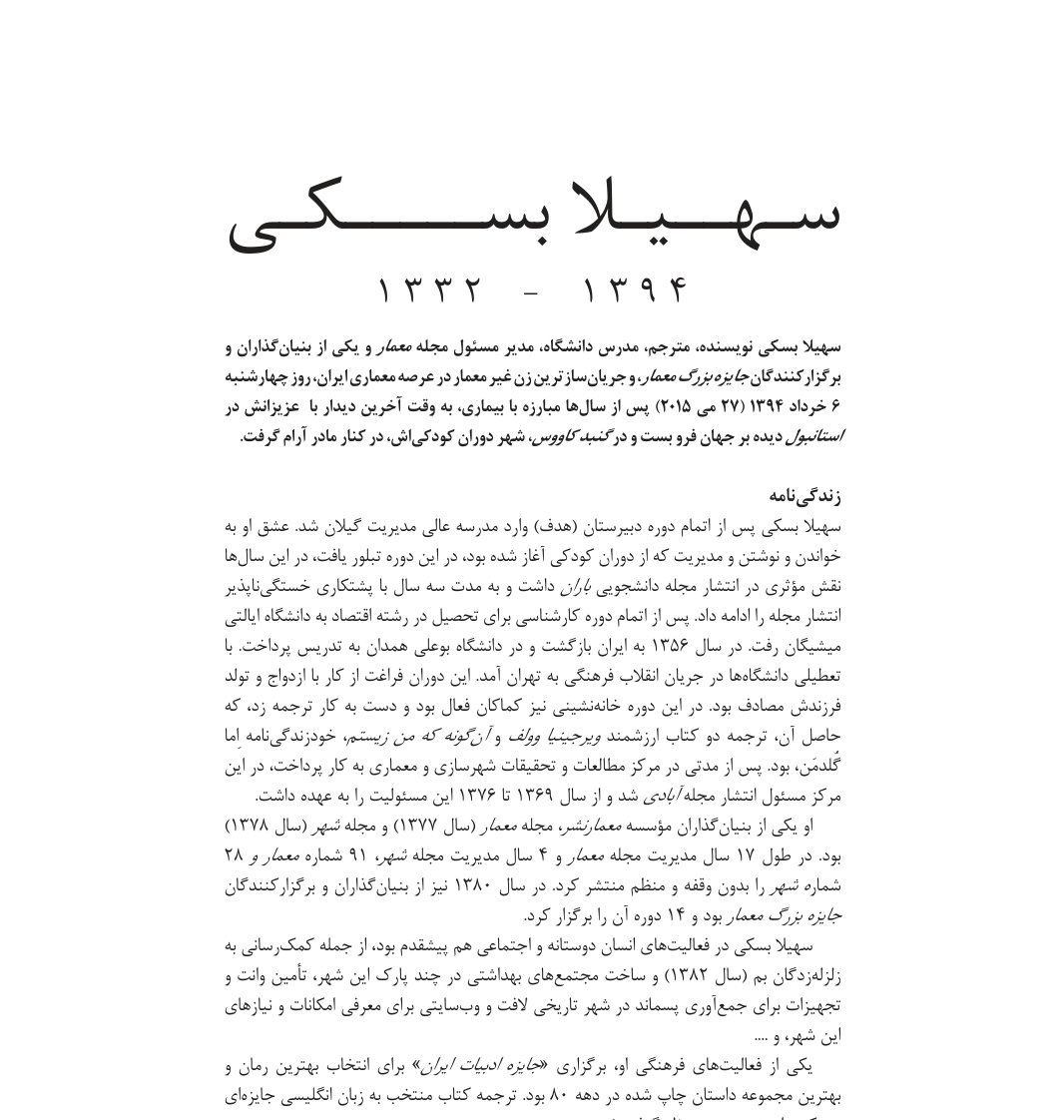
Soheila Beski: writer, translator, university lecturer, managing director of Memar magazine, one of the founders and
organizers of the Grand Memar Award, and the most influential non-architect woman in the arena of Iranian architecture, passed away on Wednesday,
the 6th of Khordad 1394 (May 27, 2015), after years of battling illness, at the time of a final visit with her loved ones in
Istanbul. She was laid to rest in Gonbad-e Kavus, the city of her childhood, beside her mother.
Biography of Soheila Beski: After completing high school (Hadaf), she entered the Guilan School of Management. Her love of reading, writing, and management, which had begun in childhood, found its expression during this period. In those years she played an effective role in publishing the student magazine Baran, continuing publication with tireless perseverance for three years. After completing her bachelor's degree, she went to Michigan State University to study economics. She returned to Iran in 1356 (1977) and began teaching at Bu Ali University in Hamadan. With the closure of universities during the Cultural Revolution, she moved to Tehran. This period of forced hiatus coincided with her marriage and the birth of her child. Even during this period of being housebound, she remained active, turning her hand to translation, the fruits of which were the translations of two valuable books: Virginia Woolf and As I Have Lived, the autobiography of Emma Goldman. After some time, she began working at the Center for Urban Planning and Architecture Studies and Research, where she became responsible for publishing Abadi magazine, a position she held from 1369 to 1376 (1990-1997). She was one of the founders of the Memar-Nashr Institute, Memar magazine (1377/1998), and Shahr magazine (1378/1999). Over the course of 17 years of managing Memar magazine and 4 years of managing Shahr magazine, she published 91 issues of Memar and 28 issues of Shahr, without interruption and on schedule. In 1380 (2001), she was also among the founders and organizers of the Grand Memar Award, overseeing 14 editions of the event. Soheila Beski was also a pioneer in humanitarian and social activities, including relief efforts for the victims of the Bam earthquake (1382/2003) and the construction of sanitary facilities in several parks of that city, providing a van and equipment for waste collection in the historic city of Laft and creating a website to introduce the city's resources and needs, and more. One of her cultural activities was organizing the "Iran Literature Prize" to select the best novel and best short story collection published in the 1380s (2000s), a prize intended for the author, with the winning book to be translated into English. She also won the Golshiri Prize in 1382 (2003) for her short story collection Pareh-ye Kuchak (A Small Fragment). The body of Soheila Beski's work in literature consists of a collection of published and unpublished stories and novels.
Stories and novels: — Short story collection Pareh-ye Kuchak (A Small Fragment), Agah Press, 1381 (2002) — Short story collection Bibi Peyk, Niloufar Press, 1384 (2005) — In the Tale of Building a Toilet in Bam, Forough Press, 1385 (2006) — Novel Zarreh (Particle), Forough Press, 1387 (2008) — In Limbo, and a Past That Will Not Pass, Niloufar Press, 1388 (2009) — Short story collection Aks-haye Fouri (Instant Photographs), Qoqnus Press, 1393 (2014)
Translations: — Virginia Woolf (biography), by Quentin Bell, Niloufar Press, 1385 (2006) — As I Have Lived (autobiography), Emma Goldman, Niloufar Press, 1388 (2009)
Perhaps her life can be summed up in two words: the passion for living. A passion that even the severe illness of her final years could not defeat, and that kept her, until her very last moments, preoccupied with the future of her family, friends, and colleagues, and with the activities she had set in motion.
The story I hold of her in my mind begins with the Shahnameh and the tales of Zal and Rudabeh; it must have been around that time that the hippocampus of my brain had grown enough to transfer images from short-term to long-term memory, recording photographs, sounds, and kisses on the forehead. She would simplify the stories of the Shahnameh with skill, clarity, accuracy, precision, and coherence, in depth and breadth, on the spot, instantly transforming verses that would otherwise have been incomprehensible to a small child. She was blessed with the gift of eloquence and wielded words with artistry. It was then that I understood she was, above all else, a storyteller; with a photographic memory, she could see beauties and pains alike, whether pleasant or painful. She could imagine the world as it is and as it could be; she was an image-maker. Wherever and in whatever subject she worked, she was without bias and without prejudice: it is easy to be good; it is hard to be just. The background, color, and gender of individuals meant nothing to her. In the creation and management of Memar, and in her personal life, I witnessed that she always maintained a fair process for selecting people and works. She never chose someone merely because that person was more like her or agreed with her. She applied the concepts of fairness, openness, and consistency naturally and without deliberation. She did not let personal judgment interfere with her work, though this may seem strange. Perhaps it was precisely this absence of personal judgment in her work that had transformed her into a person of virtue, morality, and sociability, with fundamental values that transcend any subject or profession and lay the foundation of an institution. The Memar-Nashr Institute, in my belief, is a model in terms of organizational culture. Even among the international companies where I have worked, it stands out as distinctly exceptional, and in my view it is one of the rare institutions that has established a sound organizational culture. From those days when I was small and she would take me to the offices of Abadi magazine, to when she decided to found Memar magazine, when she was writing books, or when she was busy building toilets in Bam: it was always fascinating to me how much she loved her work, how much she loved good work, how much she loved the people who do good work, and ultimately, how much she loved people themselves. I was young when I understood that she was more than a mother, and I have always been proud—and remain so—that beyond being my mother, she was Soheila Beski, and perhaps a strict mother to many others. I had never thought of Soheila Beski as an ordinary human being. I was shocked when I saw that her breath had grown short and she was struggling to climb the stairs. After Nowruz, her body could no longer meet her demands, but she never gave less to her work and her family. She wanted to live. She wanted to live long enough to see her Memar Award one more time and to see her beloved grandchild; for this she moved mountains. And when the time came to go,
she accepted that she could not win this battle, but she had no fear; she still spoke of her work and its future, still worried about the colleagues and the people she was leaving behind. Through her life, she proved to us that she was always watching over us, and her memories remind us how much she loved us. Soheila Beski is the strongest and most courageous person I have ever encountered, and I can say with certainty that no one can inspire me the way she did. She was a powerful, intelligent, and unpretentious person who did not want to be anything other than herself; the complete woman: perhaps a being superior to the complete man, on account of a mother's tenderness. Mother! I search for you walking the uneven sidewalks of Tehran; walking past the notices on the walls of that never-ending construction that teaches us how not to waste water, and past patches of grass that have consumed the underground water, or alongside the ugly electronic billboards that consume energy as though tomorrow does not exist. I am still searching for you amid the discordant, rootless, contextless streets of Tehran; amid the ultra-modern, mismatched structures and the ugly postmodern buildings with crenellated facades surrounded by Roman columns with traces of the Achaemenid era; amid the smog that had made breathing so difficult for you. Mother! Finding you in this city grows harder by the day. But I find you in the full moon, in the red branch of a pine tree in the slow summer of my balcony. I see you in the innocent eyes of my son. In everything that is still pure and simple. I find you on the beautiful brick walls of Negarestan and in the wondrous fragrance of that rare phenomenon called the Persian garden; in the calloused hands of an old man who wept honestly for you, and in the young generation you brought together and who love you from the depths of their hearts. Fewer and fewer things in this city lead me to you. But everything that is beautiful: fragrances, lights, bricks, woods, stones, and good people—they are vessels that carry me to small islands belonging to you and bring me back. Every day I loved you. And now, every day, I miss you. You still remind me that being alive requires far more effort than the simple reality of breathing.
Soheila Beski has departed, but the impact of her positive presence in the worlds of literature, culture, and architecture endures. Few people can, during their lifetime, leave a part of their soul within others. Today, we—the friends and colleagues of Soheila Beski—feel that a part of her lives on in us and in the culture of our society. This is how great figures become immortal. Soheila Beski was a great and influential cultural figure, an excellent writer and journalist, a capable and tireless manager who, until the very last moments of her life, despite severe illness, maintained her presence at the magazine's offices and steered its affairs. Ms. Beski was bold, straightforward, and without pretense, with a sharp and direct tone in both her speech and her writing. Colleagues and the architectural community, knowing of her honesty, regarded this trait as an asset. She was extraordinarily perceptive and often foresaw impending issues before anyone else, possessing a remarkably sharp instinct for evaluating both texts and people. It was for this reason that, during her years of activity at Abadi and Memar magazines, most of the country's prominent experts and finest architects collaborated with these two publications or had their works featured in them. She was hardworking and exacting, and more exacting with herself than with others. Beski believed in wisdom and what she called "taking signs seriously." Her discernment allowed us to manage Memar for years in a moderate and inclusive manner. The story of our acquaintance goes back many years, to 1374 (1995). I had published my first architectural essay in Farsi, with great difficulty, in the journal of Architecture and Urban Planning. One day, Ms. Beski, whom I did not know at all, telephoned me and said she had been searching for two years for someone with my writing style to do architectural criticism. In this way, our collaboration first began at Abadi magazine, and then together with Seyyed Reza Hashemi we published Memar magazine. Ms. Beski was always opposed to any form of monopoly. After Mr. Hashemi's departure, two other capable and valued partners joined the magazine's partnership: Armand Daroor and Mohammadreza Qane'i. Of course, throughout these years, the heaviest burden of responsibility and work always fell on Ms. Beski's shoulders. Her presence fostered the growth of the magazine's staff. When working with Beski, I always felt that an eye was watching over every aspect of the work, and this gave me the freedom to express any idea or thought freely. The best teachers are not those who simply transmit information to others, but those who teach a way of seeing and an approach to problems. Beski was such a colleague. If I have achieved any success in architectural writing, I owe it to Soheila Beski. Beski was a capable manager. Like a good coach, she was able to prepare the magazine's staff as a football team, such that many of the activities ran on their own, and even now the work continues in the same manner and at the highest level. Beski, as the magazine's managing director, never made exceptions or granted special privileges to anyone.
Regarding the publication of works and articles, the institute's partners and others always stood on equal footing. Of course, we admired this ethic, which was one of the reasons for our magazine's success. On many occasions, I and other colleagues published our projects in other architectural magazines because of Memar's time constraints and the principle of respecting the queue. Beski was extremely keen-eyed and expert in journalism. Every time she found fault with a draft of my articles, it was accurate and apt. She had very strong analytical ability, but she steered the magazine more with emotional intelligence and a sixth sense. Beski paid very close attention to the personalities of those around her, and for this reason, she would at times raise precise criticisms that always had their roots in reality. She drew upon the characters and stories of friends and colleagues for her fiction. Soheila Beski had a very strong and charismatic yet at the same time humble personality. She never wanted her work to be praised or lauded. Her humility meant that if she sensed she had erred in an opinion or judgment, she would immediately correct herself. For her, the profession was a kind of social duty, and many of her managerial decisions over the course of 20 years of our friendship and collaboration were entirely uneconomical for the institute. Beski's constant concern was the culture and architecture of Iran. With Soheila Beski's passing, the architectural community of Iran lost one of its pillars—someone who was not an architect, yet exerted the greatest influence on Iranian architecture. Her place among us remains empty.