Recently, on a project of mine, I designed a plan and a structure that to my eye seemed very traditional. But on speaking with several friends and teachers I discovered that none of them read the project as traditional, and I — who was attached to it — wrestled with myself and with the design for two whole months in search of why. Some held the form responsible for the strangeness, others the structure; until one friend redirected my attention from volume, plan, and structure to the way forces are transmitted in the various traditional domes and roofs. The answer was right there. In my own design, drawing on the work of contemporary architects, I had used hinged joints and transferred forces from arch-vertex to arch-vertex; whereas in many of the traditional domes and vaults, the load-carrying lines pass close to the corners.
Issue 13 of Memar, when it reached me, drew my attention — beyond articles on interior architecture and industrial design — to the presentation of two projects from the series of Iran's embassies abroad. It seemed that the issue I had been wrestling with was the same: the use of the names of indigenous spaces in place of their essential being.
This is a question whose root one can find in the way teaching is done in our schools of architecture: where unfamiliarity with the essence of spaces (which is shaped in adjacency and in the manner of spatial relations) leads to a superficial attention to vernacular architecture.
Before anything else, let me note that what follows is a discussion within the world of architecture — a discussion of designers' ideas and the products of those ideas, and of nothing else.
The 'dialogue of civilisations' in another's technological tongue
In both embassy projects — Brazil and Sweden — 'the dialogue of civilisations' is the metaphorical idea of the design; it works rather like the physical phenomenon of osmosis, in which whatever has greater density flows from one side to the other, whether the density be that of cultural richness or of advances in science and technology. But what is missing in these two projects is the speaking of the other side's forms and architectural origins in the technological tongue of the other side itself. Mere use, in the project statement, of the titles and the names of indigenous architectural spaces does not, within the project, take the place of a symbolised distillation of those spaces — for Iranian architecture is an essence that must be smelled by itself.
The argument is not over the licence to apply, and to experiment with, contemporary architecture and technology. The argument is over the choice of place for that experiment. Is the mere experiment of another's form and technique, under the pretext of the dialogue of civilisations, and as the symbol and ambassador of a deeply rooted culture, justified?
The Iran-Embassy-Brazil project
At one point in the design statement of the embassy of the Islamic Republic of Iran in Brazil, by Mr. Afshar Naderi, it is said: "Every essential question has a unique core and a conventional shell. The task of architecture is to find that core and to nurture grounds of it... Being a sign of national culture — not in a showy way, but seriously — is, for a country whose indigenous-ness is its most evident global feature, necessary. Architecture is the authenticity of history... Brasília is by nature ahistorical... The way is not findable, it must be invented. The key to the puzzle is the Persian garden."
I do not want to say whether the answer to this question is the Persian garden or not. But, given the above reference, I want to ask: what is the essence of the Persian garden?
Elements of the essence of the Persian garden
Hierarchy; the non-coincidence of the moving axis and the visual axis of the whole, and the balance between the two; the number four in most subdivisions; geometry and order in it; unity; particular attention to inflection points.
Perhaps unity is the hidden — and at the same time visible — element of the Persian garden. In the design of the Iran-Embassy-Brazil project, a strong duality is at work; a duality unaffected even by the place where the project's two arms meet, where the two arms easily slip past one another and depart. In between, a connecting line barely manages to prevent that escape.
Perhaps 'hierarchy' is the only Persian-garden criterion raised in the project statement, with reference to Bagh-e Fin. Hierarchy in Persian gardens is presented in terms of how one approaches the inflection points: as we approach the garden from outside, the first inflection — between inside and outside — is shaped at the entrance arrangement. Inside the garden, the kushk (pavilion); inside the pavilion, the iwans: by turning and steering the guest into the ordered nature of the garden, these are the inflection points of Persian gardens, and water is an important element in those points. In the project at hand, none of these stages of approach or hierarchies of access is to be seen. The building sits not at the highest reach of its grounds but at the lowest part of the site, with no foreground at all.
A geometry based on quadripartite division — both in the site design and in the design of the pavilion — is among the other principles common in Persian garden-making, and one which the project lacks.
In a word, the Persian garden contains all these elements and many further fine and gross points, and the question is: if the resort was to the Persian garden, which of its principles and elements have actually been deployed? Or can the mere placement of a building on the green expanse of a site allow us to call it a derivative of the essence of the Persian garden? And if the basis and the philosophy of the embassy's design were not derived from Iranian architecture, can one not fault the review committee that an unfamiliar intellectual basis has been made the basis for the design of the embassy of the Islamic Republic of Iran?
The Iran-Embassy-Sweden project
Sometimes constraints in many cases lead to the formation of fitting ideas; but in any case those ideas spring from the design principles of each designer. The fact that the designer is forced to keep away from common modes of building can, of itself, be a source of innovation; but before anything else, the dignity and standing of the subject and the context of the project is itself a constraint on the choice of ideas.
In addition, every stage and scale of design demands a certain order of idea — an idea that, by including itself, accompanies the project to the very end of the design, or stops at a certain depth and, to continue, requires another idea matching that level of design.
In other words, in the site design at 1:10,000, structural ideas certainly come into play; at 1:500 and 1:200, where massings emerge, ideas of comparable weight are required; and in the design of details, ideas of much finer grain enter the project. But the idea that runs from beginning to end alongside the project is most often a conceptual idea that, metaphorically, flows from massing into spatial relations, and from form into details of execution. Perhaps, in terms of meaning, 'dialogue' is a fitting strategy for the design of a country's embassy; but is wooden timber an idea of the same standing as the diplomatic representation of a country? Even if the tent-form of the project could have been a better starting point for working out the project's ideas.
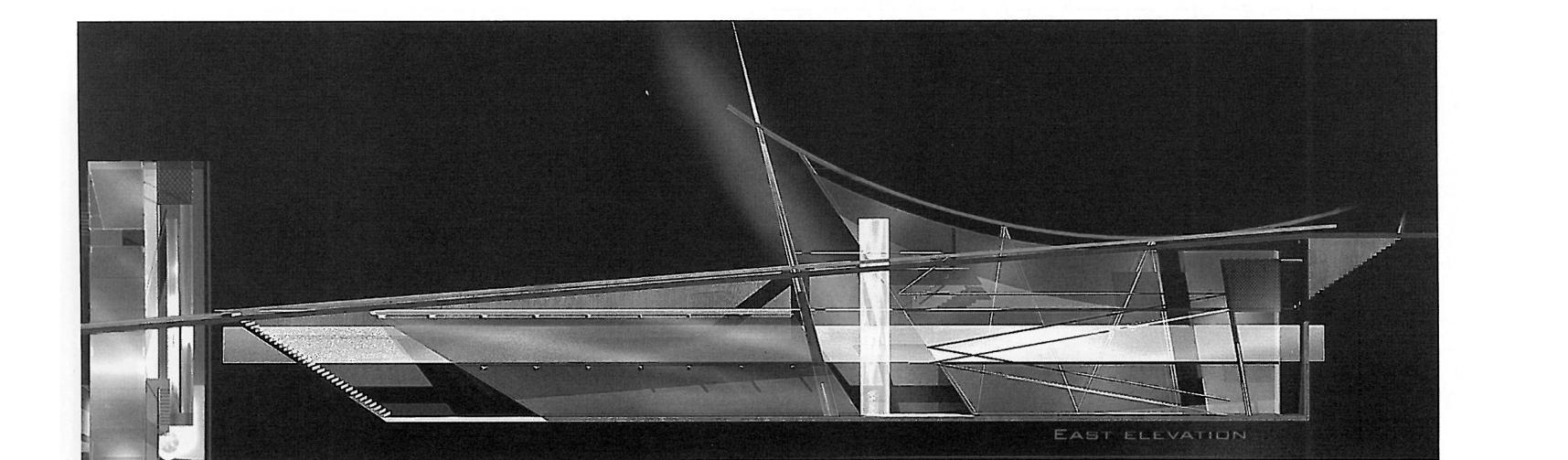
On another front, the use of the names of indigenous Iranian spaces cannot be the proof of the indigeneity of a project's spaces. Here, too, we see the project statement calling the openings created at the angles of the four-season sun-paths a new form of central courtyard. Whereas in the architecture of the desert, the central courtyard takes its life from the water and the light above it.
The central courtyard does not arise from cutting into a complete volume; it is born from the adjacency of several spaces of different qualities that look toward something. And that something is light, and water (and perhaps silence). The intensity with which spaces such as the talar, the shahneshin, and the chand-dari face the middle space is so great that one cannot suppose that something has been removed from the main volume; rather, it is as if something 'extremely valuable is there' and they have all turned to face it.
Without the courtyard, the spaces around it lose their value entirely. It is as if the two — full space and empty space — are, like figure and ground in the works of Maurits Escher, in no way separable: attention to one inevitably leads to attention to the other. Whereas in the project at hand, the full and empty spaces neither face one another nor define one another; rather, each seems imprisoned in the middle of the other.
There is no doubt that, in idea-making, originality cannot be granted to proportions, executive details, façades, and the rest, so much as to the way a space is shaped; otherwise these and many other matters are visible in the central courtyard and the spaces around it — they were visible a thousand years ago, too. To put it better: the central courtyard in Iranian architecture is itself the symbol and the statue of dialogue. A dialogue between the surrounding spaces and the courtyard; a dialogue between the human being and space; a dialogue between the human being and light...
In closing, with thanks for the magazine's manner of presentation and congratulations on its fourth year, I note: the use of poster-like images is effective in introducing a project's mode of presentation, but more important than this is the introduction of the spaces themselves, which must be considered very seriously — for perhaps the most important goal of architecture, in any style and any current of thought, is the creation of space. Therefore it seems that, in addition to modes of presentation, a clear display of plans and sections of the spaces would be more in line with the confrontation of ideas in the Iranian architectural community, and accordingly with the magazine's aims.



