1988-2005, Isfahan International Cultural Center
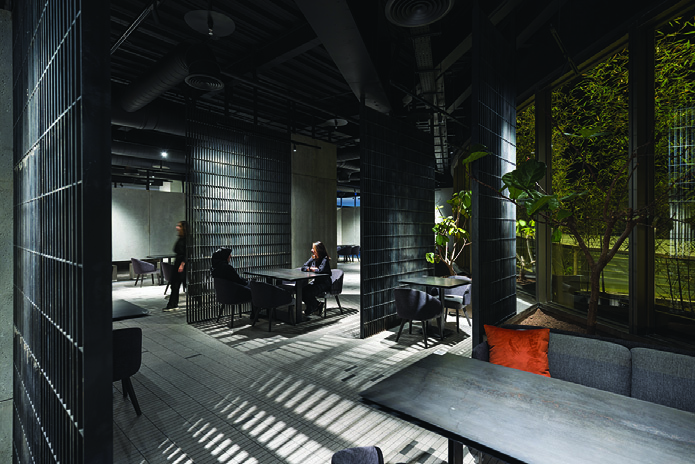
In this design, which possesses strong geometric symmetry, a mass of material at the center of the building has been hollowed out toward the sky, and like a vortex, has first drawn the sky into its center and then plunged it into its depths, while from the other side, the material has risen toward the sky in escalating, stepwise vibrations. This cavity, split in two along the direction of the sun, evokes the myth of the cosmic rift. The stepped surface on the exterior and atop the building provides the possibility of open-air performances and houses exhibition halls beneath it. At the focal point of the halls, an octagonal space rising three stories has been placed, whose lowest layer, like a pool-house, has organized a teahouse space around itself. Above it sits a waiting hall, and finally on the third level, a space with opaque, heavy walls and a transparent ceiling. This elongated space has light at its crown and water at its base, evoking the sacred space of temples of water and light. On either side of this hollow center, semi-transparent spaces are situated through which suspended, transparent bridges pass, connecting to the lateral entrances. Beneath these bridges and along the eastern and western sides, galleries are positioned. These two semi-transparent spaces, illuminated at night with lapis-blue light, create lightweight and shimmering facades in combination with the solid brick structure reminiscent of tilework. On the northern facade of the building, a vast water feature is situated, its surroundings defined by arcades and an art bazaar. After passing through the gateways, visitors enter a central island via two bridges, then cross over stones above the water, symbolically performing the ritual of ablution before entering the hollow central space. Meanwhile, the entrance to the space, through the pavilion and the gateway of the northern facade integrated with the city sidewalk, is positioned along the axis of vision, and as with other historical buildings, access from this gateway to the interior is not possible without traversing the aforementioned path. In effect, this design consists of two sections: the outer and the inner. The outer section encompasses exhibition and presentation functions within the aforementioned spaces, while the inner section, formed on three levels around three continuous central courtyards, each possessing a distinct identity, houses the educational, research, and administrative facilities. Around this vast water feature, four turrets stand at the four corners, and within the central courtyards, galleries are located underground. The squaring of the corners displays guardian angels, an archetypal motif. In conclusion, it can be said that in shaping the relationships of this design, three aforementioned paths have been employed: concepts and meanings, geometry and forms, the type of materials used, and the regional culture. While new building technology in structure and mechanical systems, and the use of materials such as steel, glass, and concrete have been incorporated into the composition, earthen materials, purity and simplicity in spatial structure, and a clear geometric language have been used, thus interweaving global and regional thinking to reveal a contemporary identity in architecture.
The area south of Naqsh-e Jahan Square enjoys exceptional conditions. It has the most important historical landmark building, the Shah Mosque, beside it. At its center lies the Zerehsazan Garden, and surrounding the garden are houses from the Qajar period. This was the first site that could have been worthy of implementing a gentrification plan in Iran historic urban fabrics. Accordingly, a comprehensive plan covering approximately
3.5 hectares has been prepared as a catalyst development plan within the historic fabric. With the implementation of this plan, the majority of which involves restoration and the remainder new construction with the same characteristics, a neighborhood of the city will be endowed with special cultural and tourism facilities that can represent Iranian culture and enhance the economy of this part of the city.
1989, Restoration and Revival Project Behind the Shah Mosque, Isfahan
Project One: Organization and Design of Zerehsazan Garden and Majd al-Olama Garden
Project Two: Revival of the Shariatmadar Complex and Design of a Residential Complex
Project Three: Revival of the Historic Maqsudbeyk Caravanserai and Design of a Special Lodging
Project Four: Revival of the Historic Houses on the Eastern Front of the Garden and Design of Cluster Accommodations
Project Five: Revival of the Historic Saheban House and Design of the Southern Blocks
Project Six: Design of the Ritual Performance Hall and Continuation of the Green Axis to the Farshadi Canal (Approaching the Qajar Model)
Project Seven: Design of the Abbasi Art Museum
Project Ten: Design of the Carpet Museum and Enamel Workshop