Contemporary Architecture

Jahad Metro Station Plaza, Tehran

Mohammad Khavarian, Mehrasa Nikokar·Photos: Mohammad Hassan Ettefagh·Memar 142 — 23rd Memar Award
Jahad Metro Station Plaza, Tehran
Location: Jahad Metro Station, Tehran · Client: Tehran Municipality Advisory Organization · Principal Architect: Mohammad Khavarian · Architect & Project Manager: Mehrasa Nikokar · Design Team: Parto Hedayati, Nargess Hosseini · Structural Engineering: Mohammad Panahi · Mechanical Engineering: Iman Ielbeygi · Brick Facade Engineering: Behnood Goharbin, Masoud Goharbin · Lighting Consultant: Meghdad Amiri · Photo: Mohammad Hassan Ettefagh · Contractor: Zagros Bana Company · Construction: Tehran Municipality Urban Development Organization · Built area: 800 m² · Tehran Plaza Project Definition Team: Ali Aeta (City Council), Saeed Mirhosseini (Project Manager), Reza Basiri Mojdehi & Amir Shafiei (Study & Planning Center), Mohammad Mehdi Moeini & Babak Shokofi (Supervision), Kourosh Asef Vaziri & Ehsan Ranjbar — Tarbiat Modares University (Study Conductors)

Since 1978, with the change in the management model of municipalities, activists in the urban sphere were sidelined from the governance system. One of the significant damages of this was the absence of knowledge in metropolitan management, and one of its consequences was the domination of automobiles in cities and the serious diminishment of pedestrian life. Ultimately, this became one of the important afflictions in all Iranian cities, including Tehran, and led to inadequate livability for pedestrians.

From 1996, we witnessed the entry of a number of specialized urban managers into the body of governance. A comprehensive plan called "Tehran: A Pedestrian-Oriented City" was approved. Jahad Metro Station Plaza was one of the first projects of the "Tehran Pedestrian Pathway" plan, selected as a pilot project — one that, if successful and satisfying to the public, could be expanded across Tehran and other cities of the country. Of course, due to sanctions and severe economic difficulties, these projects had to be built at very low cost.
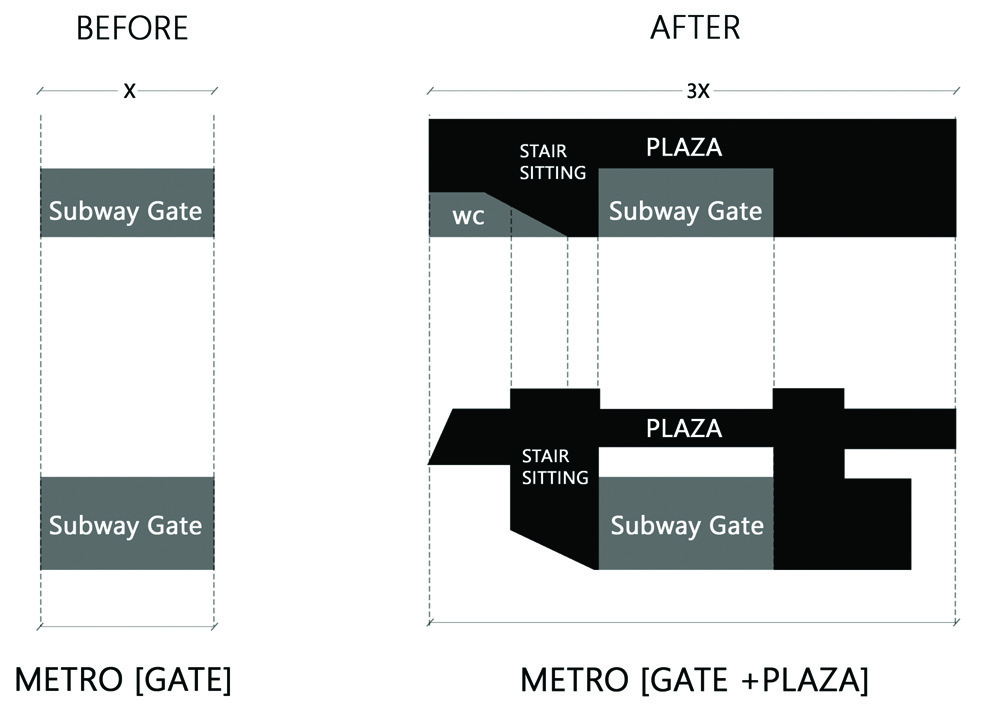
Before and after concept diagram showing the transformation from a simple subway gate to a metro gate plus plaza with stair seating, WC, and expanded public space
Concept diagram — transforming a simple subway gate into a metro station plaza with stair seating and public space
◆ ◆ ◆
Redefining Metro Entrances

First, we prioritized the most critical urban deficiencies in the direction of a "pedestrian-oriented city," and on that basis, we selected metro station entrances as an urban blight for urban regeneration. After that, in numerous meetings with government officials, we were able to obtain approval for its execution from governing bodies, and as a pilot example, we conceived the project with a definition based on the users, the local appendages, and the context of the plan.

Our selection, from among the studied options, was a metro entrance on a triangular plot at the intersection of one of the important and busy streets in the old part of Tehran. This area was one of the early nuclei of the city of Tehran and carried within itself the history of different eras.
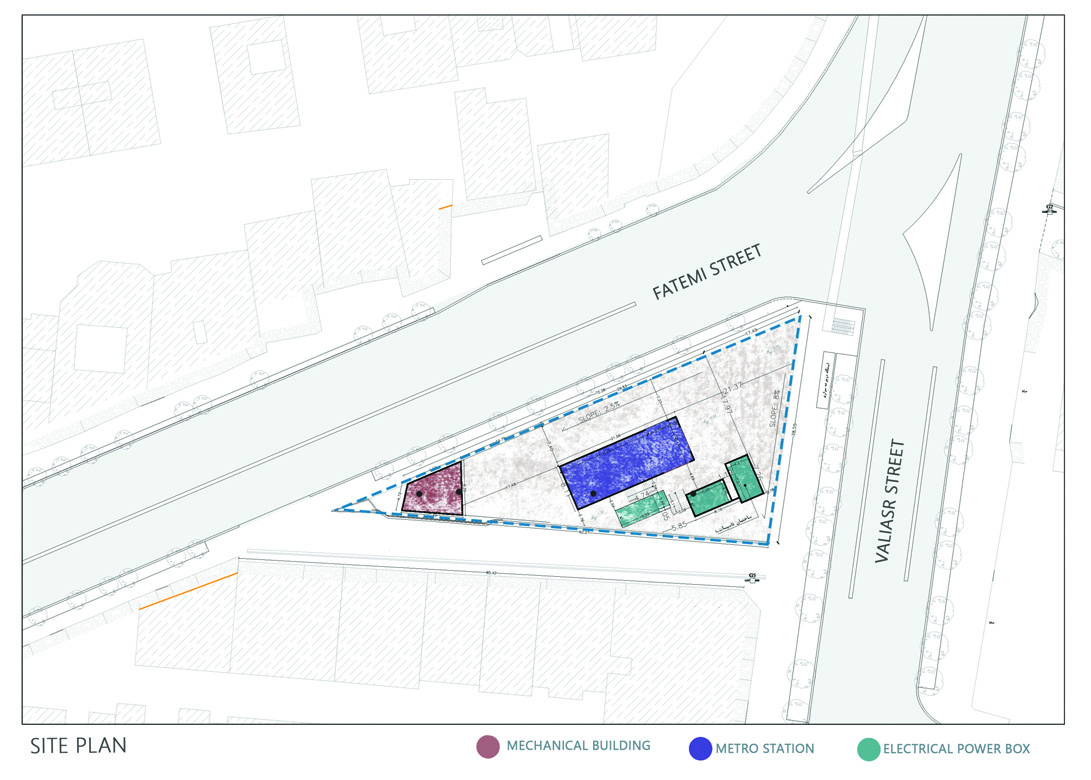
Site plan showing the triangular plot at the intersection of Fatemi Street and Valiasr Street, with the mechanical building, metro station, and electrical power box marked in different colors
Site plan — the triangular plot at the intersection of Fatemi and Valiasr streets, with existing utilities marked

This plot had abandoned urban utilities. Unfortunately, this ugly practice has spread in an identity-less and inappropriate manner throughout the fabric of Iranian cities, causing numerous problems for users and local neighbors.

This project was an effort to redefine metro entrances in the city of Tehran and to define these entrances as a free and definable base for users — for urban events and the regeneration of unusable points for citizens in the direction of the comprehensive plan "Tehran: A Pedestrian-Oriented City."
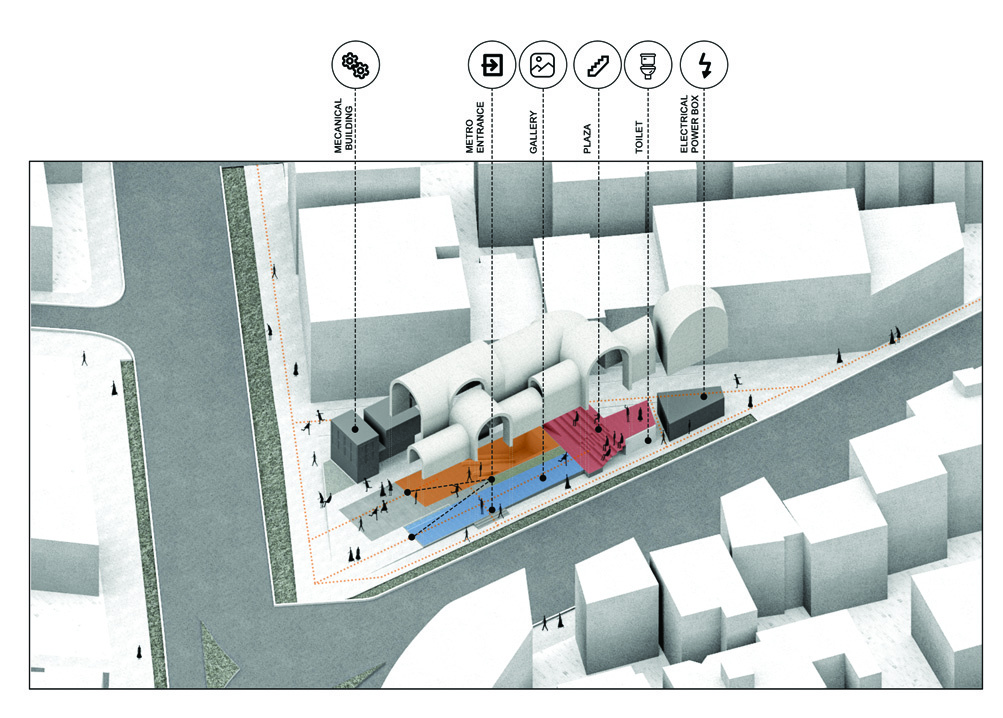
Axonometric rendering of the plaza showing color-coded program zones: mechanical building, metro entrance, gallery, plaza, toilet, and electrical power box
Axonometric program diagram — mechanical building, metro entrance, gallery, plaza, toilet, and electrical power box integrated into a unified design
◆ ◆ ◆
The Arch as Strategy

Our strategy began with the definition of a free canopy without barriers to entry, to define the space beneath it at all hours of the day and night. This canopy generates the definition of the space below it, and due to the harsh climate of Tehran in both summer and winter, provides a place for centralizing the gathering of youth and wandering citizens around the city's inadequate sidewalks.

One of the forms we studied for this decision was the use of the arch form. This form, in addition to meeting the need for a tall and proportionate height at a cost consistent with the project budget and self-supporting, created a roof on structural walls that had a minimal footprint. Consequently, it bore a kind of reference to the architectural past of Iran, and because of the difference in function and the goal of creating a focal point, it had a distinctive, icon-like form compared to the surrounding fabric.
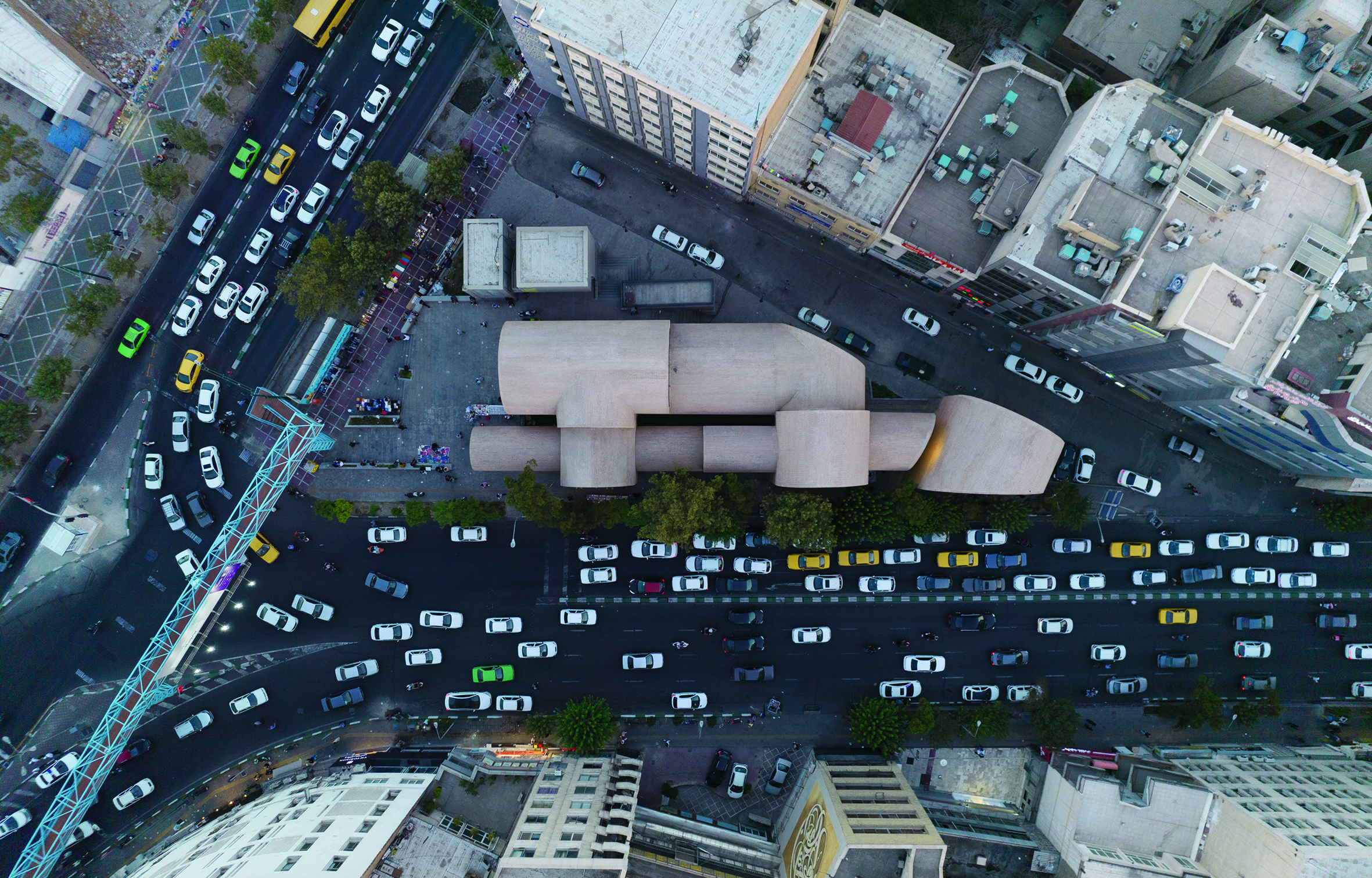
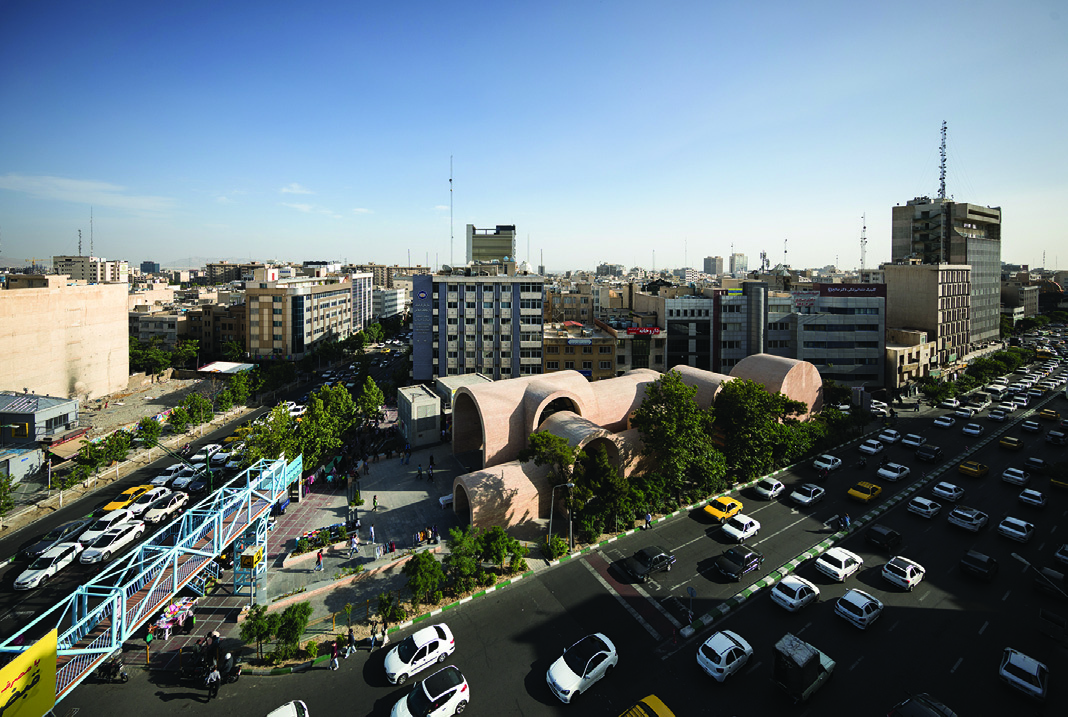
Overhead aerial view of the completed plaza showing the vaulted brick canopy structure on the triangular site, with busy traffic on surrounding streets and a red crane visible
Overhead aerial view — the vaulted brick structure occupies the triangular site between major thoroughfares

Beyond this reference to collective pre-understanding, the marking of this complex and its differentiation were also of great importance to us in the selection of this form. Our decision was a geometry based on the arch form that could, in a contemporary and creative manner, make alterations in the form and the type of use of its geometry. We conceived a labyrinth defined by these arches that, with the help of extrusion, would transform this base form into a new structure.
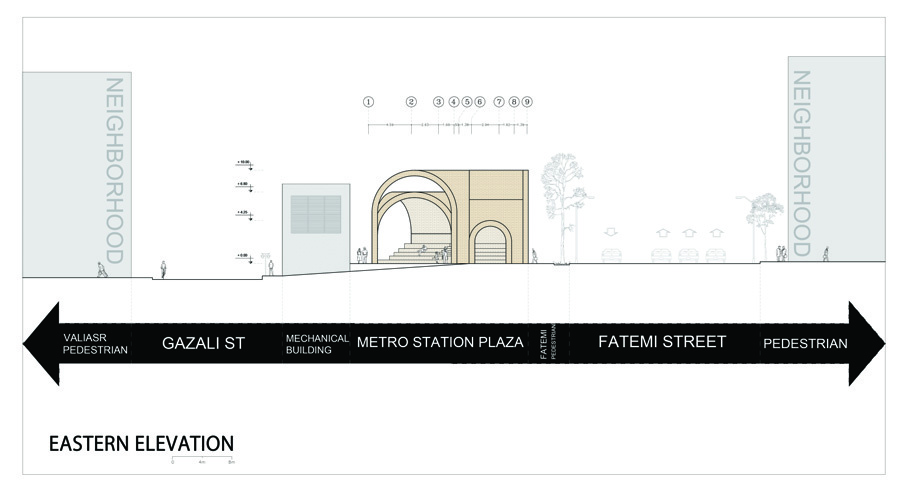
Eastern elevation architectural drawing showing the arched forms, metro station plaza, and context of Ghazali and Fatemi streets with pedestrian pathways on either side
Eastern elevation — the arched forms in context between Ghazali and Fatemi streets
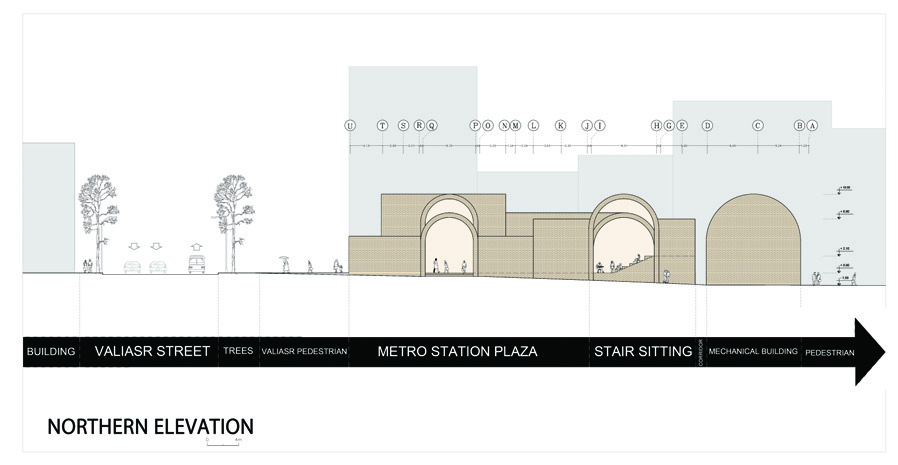
Northern elevation drawing showing the arched structure with metro station plaza, stair sitting area, and the relationship to Valiasr Street and surrounding buildings
Northern elevation — metro station plaza and stair seating facing Valiasr Street
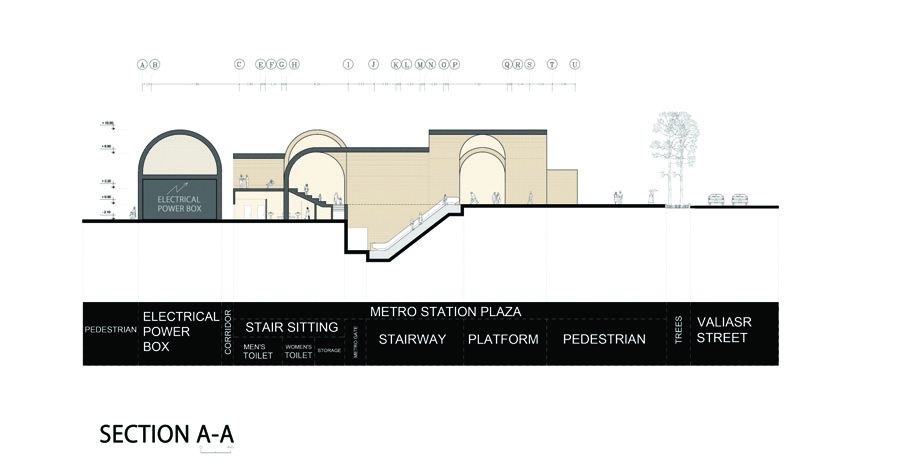
Section A-A drawing showing the interior spaces: electrical power box, stair sitting, men's and women's toilets, stairway, platform, pedestrian area, and the relationship to Valiasr Street
Section A-A — the spatial sequence from electrical power box through stair seating, toilets, metro stairway, platform, and pedestrian area toward Valiasr Street
◆ ◆ ◆
A Democratic Open Space

The metro is one of the high-traffic points that, due to the intellectual gap between the governing forces and the people, has witnessed extraordinary incidents in recent years. The recent protest movements in Iran began from a point in the Tehran metro, and these places are a site of contention in the metropolis of Tehran between the duality of governance and people. For this reason, we thought to transform the client's initial requirement from a "simple entrance" into "a covered urban event space and an entrance within democratic open spaces," and we considered this subject as a new arena for the confrontation of this duality in Tehran's metros.
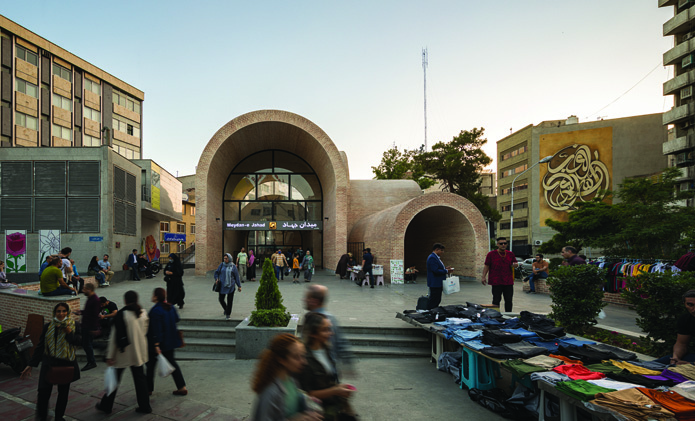
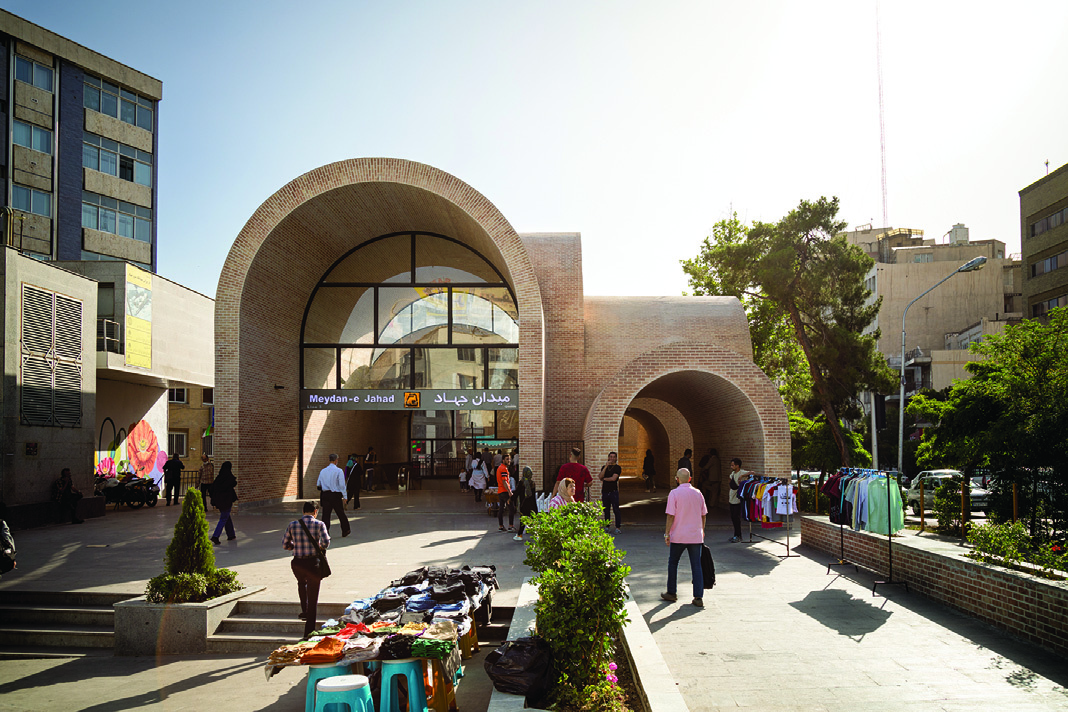
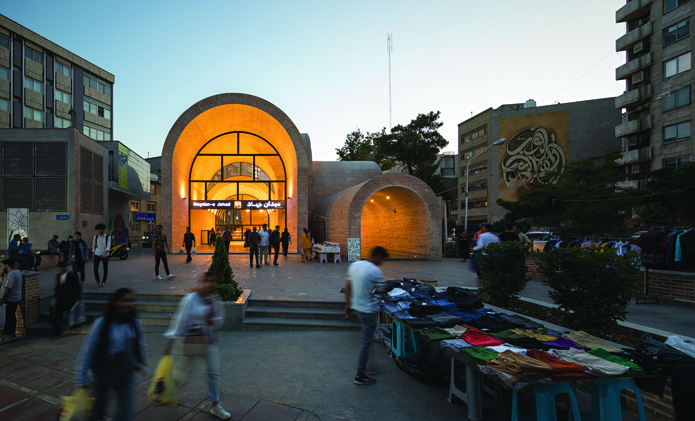
Frontal view of the plaza at dusk showing the main arch with glass wall glowing warmly, the metro entrance signage reading Meydan-e Jahad, pedestrians, and street vendors in the foreground
The plaza at dusk — the main arch glows warmly as pedestrians and street vendors animate the public space
Street-level view of the metro entrance with the Meydan-e Jahad sign, brick arches, pedestrians entering and exiting, street vendors with goods displayed on tables, and green landscaping
Street-level view — the metro entrance has become a gathering place framed by brick arches, street vendors, and greenery
Dusk view of the plaza entrance with warm lighting illuminating the arched canopy, pedestrians with shopping bags, and vendors displaying clothing on tables
Evening activity — vendors and pedestrians beneath the arched canopy
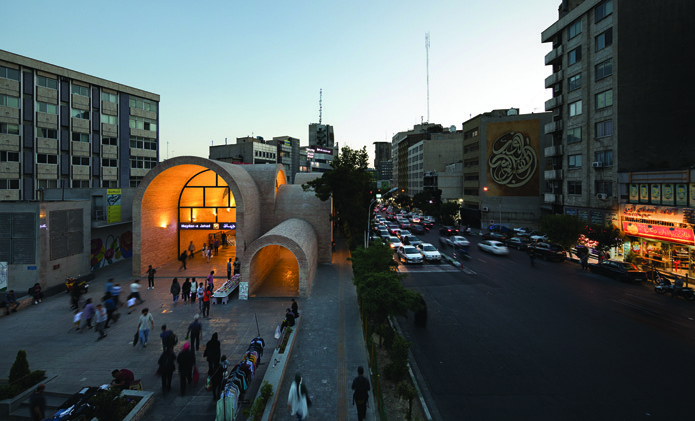
Night view of the lit plaza from across the street showing the glowing arched structure, traffic, and the urban context of surrounding buildings
Night view — the lit arches mark the plaza as a focal point in the cityscape
◆ ◆ ◆
The Brick Labyrinth
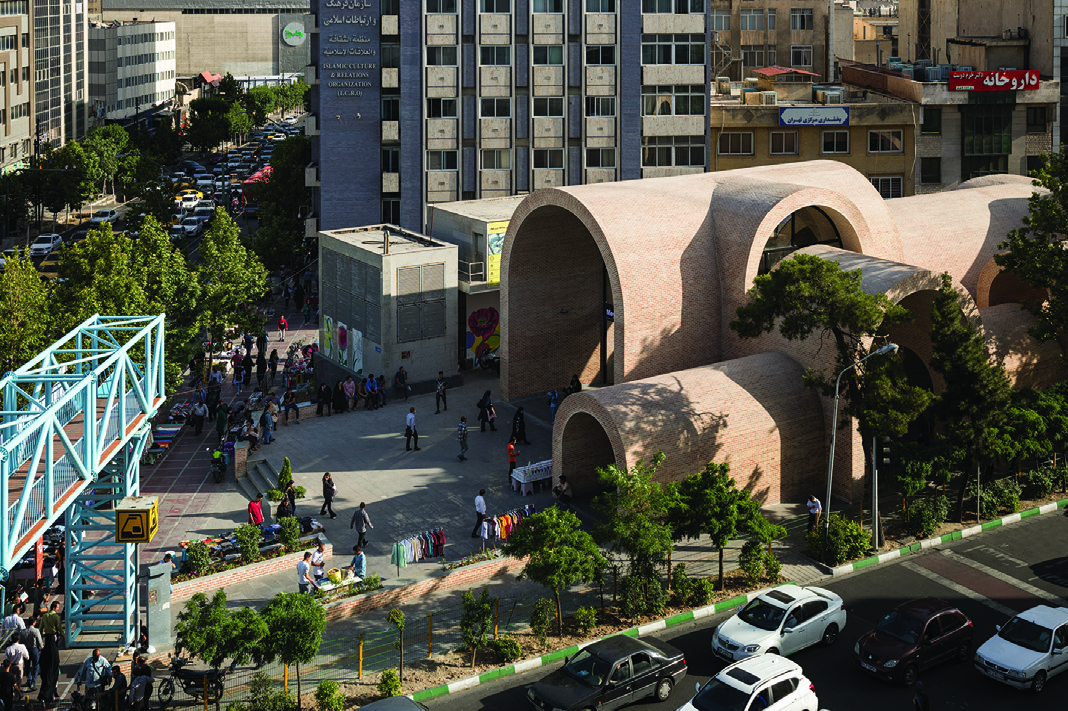
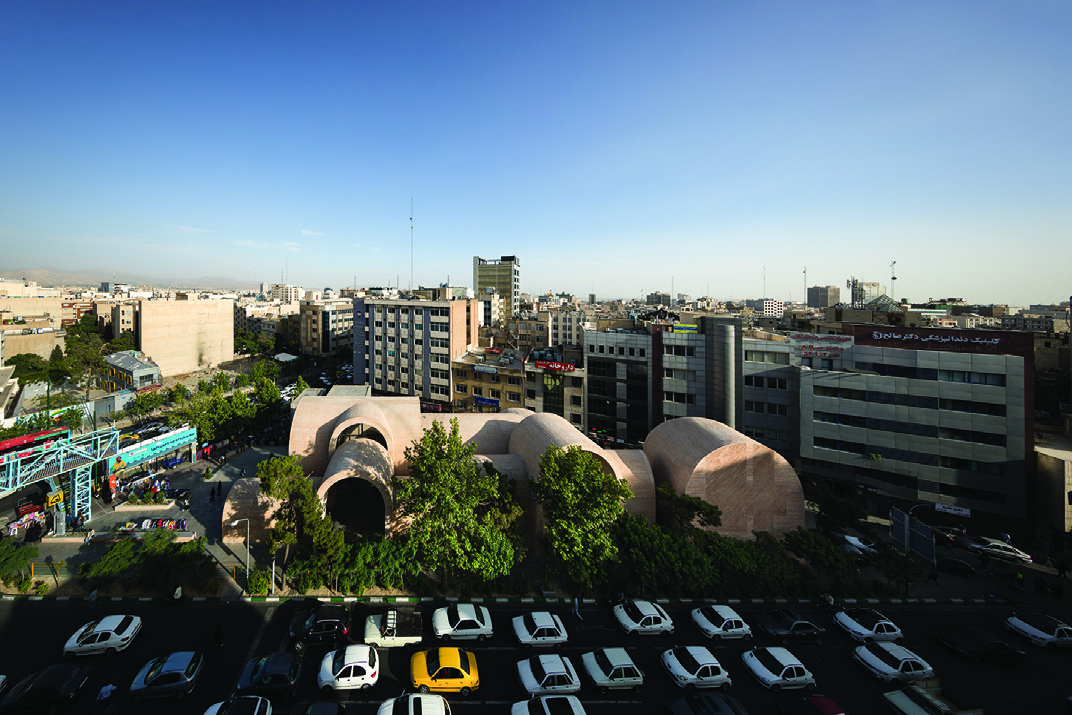
Elevated view showing the full extent of the vaulted brick structure with multiple arches of varying sizes, the pedestrian bridge on the left, and the dense urban fabric beyond
Elevated view — the vaulted brick labyrinth in the heart of Tehran's urban fabric
Aerial view of the vaulted brick structure showing the undulating roofscape of interconnected arches creating a labyrinthine canopy over the plaza
Aerial view — the undulating roofscape of interconnected brick arches
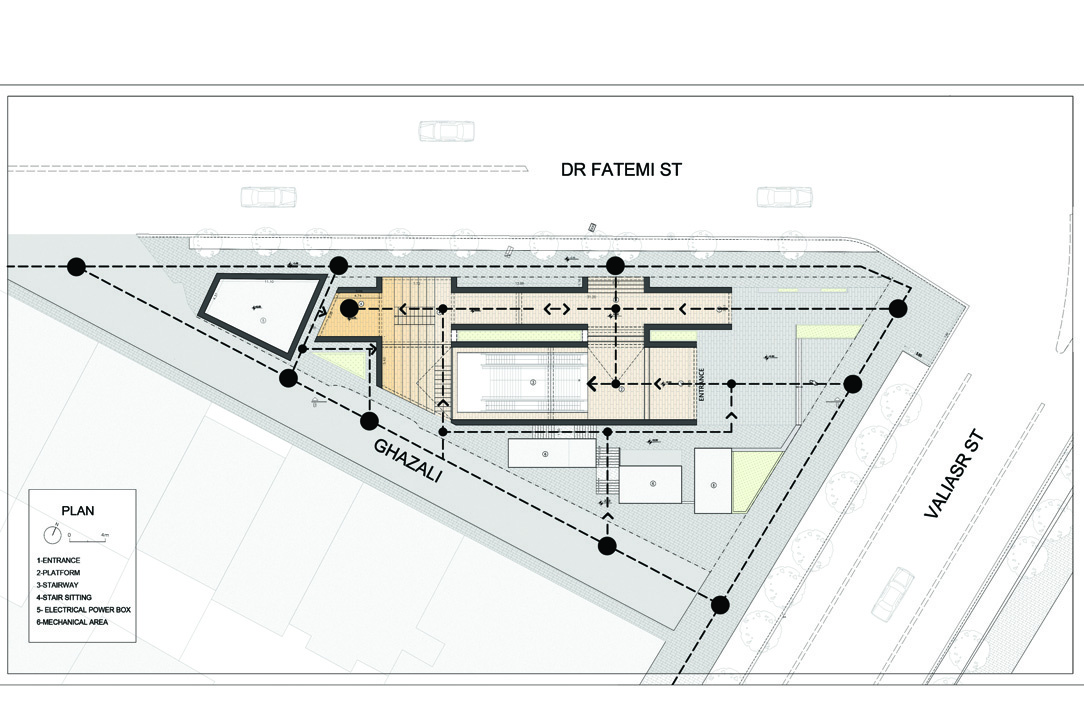
Floor plan showing the circulation pattern through the labyrinthine structure with entrance, platform, stairway, stair sitting, electrical power box, and mechanical area labeled
Floor plan — 1. Entrance, 2. Platform, 3. Stairway, 4. Stair Sitting, 5. Electrical Power Box, 6. Mechanical Area
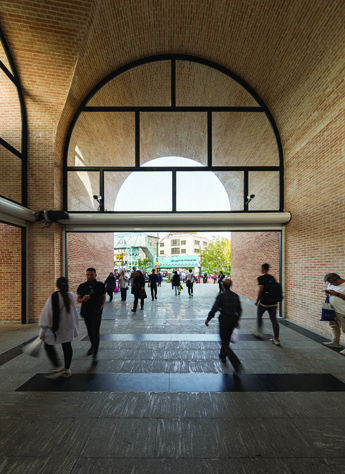
Interior view through the main arch with a large glass wall, pedestrians passing through, and the urban scene visible beyond
The main arch — a glass wall frames the city beyond
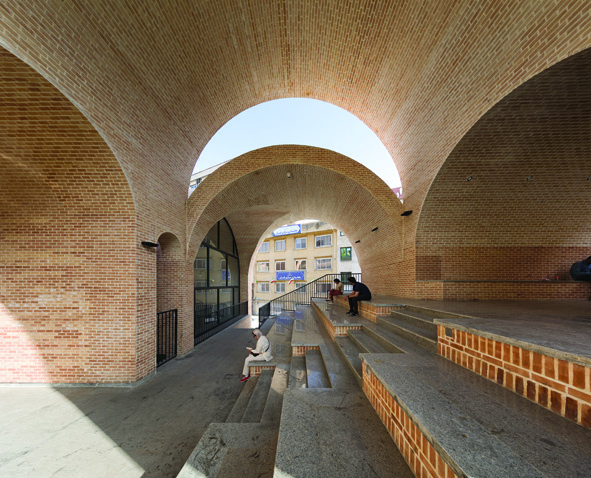
Interior view showing intersecting brick arches with stepped seating, an open skylight, and people sitting and reading
Intersecting arches with stepped seating and an open skylight
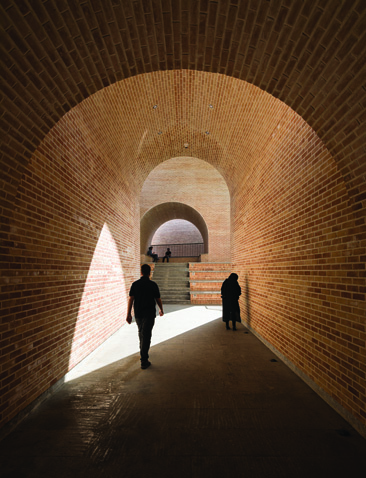
Interior brick vault corridor with dramatic light entering through a side opening, silhouettes of two pedestrians walking through the passage
The brick vault corridor — light carves through the passage
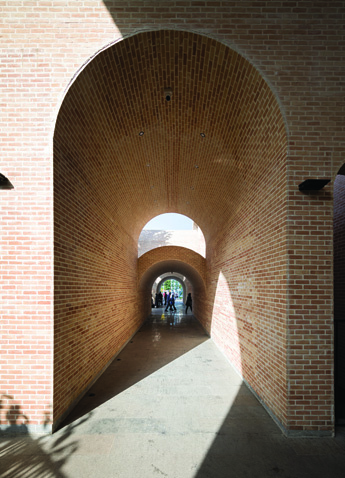
View through a tall narrow brick vault passage with light filtering in from above, revealing the layered depth of the structure
Passage through the vault — layered depth and filtered light
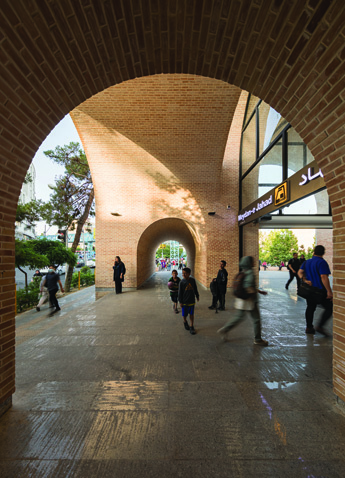
View through a brick arch passage looking toward the metro entrance sign and the city beyond, with pedestrians in motion
Looking through the arched passage toward the metro entrance and the city beyond
Memar Magazine
Iranian Bimonthly on Architecture and Urban Design · Issue 142 · December 2023 – January 2024

Related in Architecture Database