


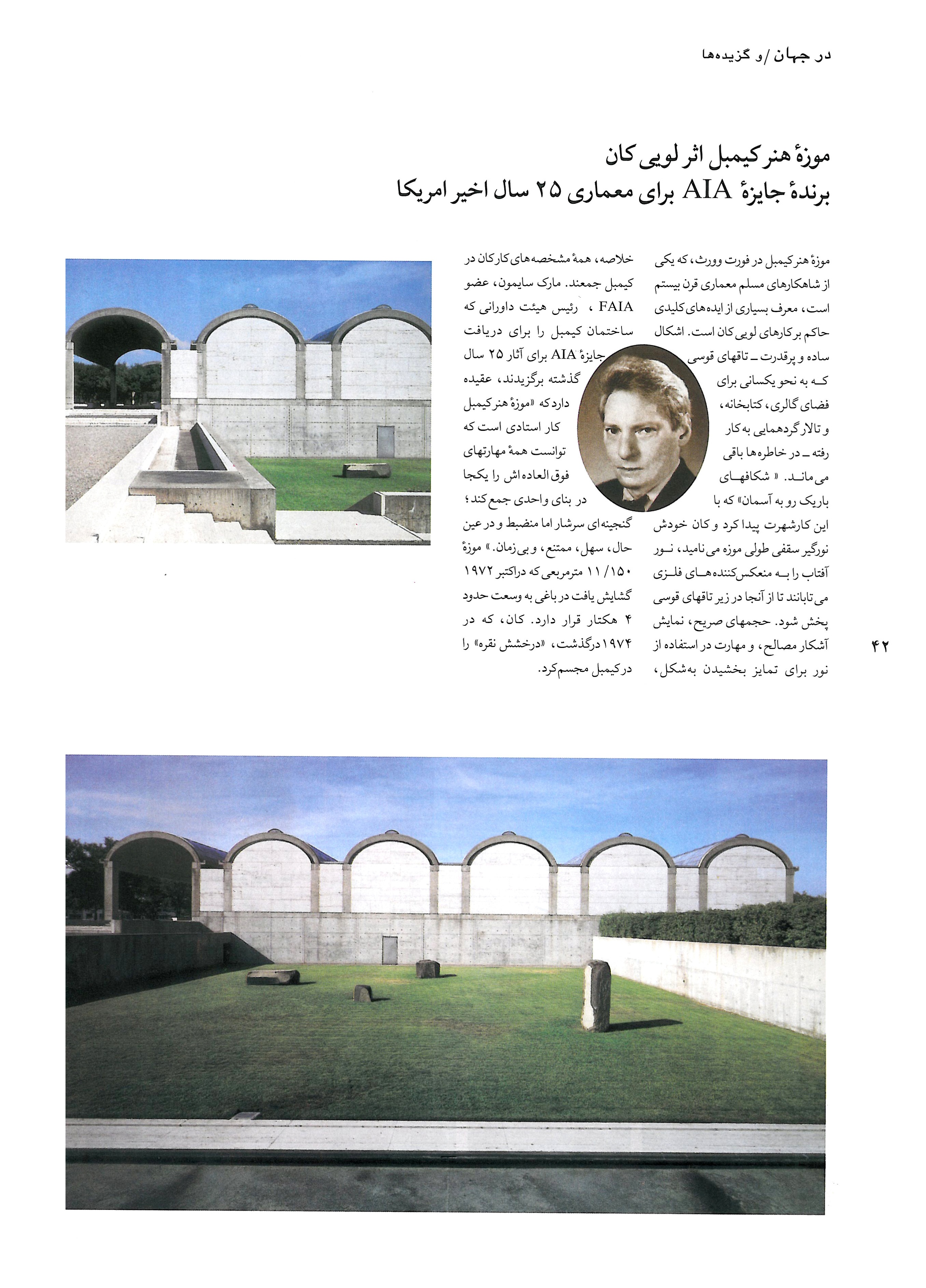

The Kimbell Art Museum in Fort Worth — one of the indisputable masterpieces of twentieth-century architecture — embodies many of the key ideas that govern the works of Louis Kahn. Simple yet powerful forms — vaulted arches that serve equally well for gallery space, library, and assembly hall — remain etched in memory. The narrow slits opening to the sky, which made this work famous and which Kahn himself called the museum's longitudinal roof skylight, direct sunlight onto metallic reflectors that diffuse it beneath the vaulted arches. Bold volumes, the frank display of materials, and mastery in the use of light to distinguish form — all the hallmarks of Kahn's work are gathered together in the Kimbell.
Mark Simon, FAIA, chair of the jury that selected the Kimbell building for the AIA Twenty-Five Year Award for works of the past quarter-century, believes that «the Kimbell Art Museum is a work of mastery that has succeeded in bringing together all of its extraordinary skills in a single building — a treasure-house, rich yet disciplined, and at the same time effortless, deceptively simple, and timeless.» The 11,150-square-meter museum, which opened in October 1972, stands in a garden of approximately four hectares. Kahn, who died in 1974, embodied «the silver gleam» in the Kimbell.


The Kimbell Museum comprises gallery spaces (below), courtyards (opposite page, top and bottom), a restaurant, an assembly hall (right), a bookshop, a library, and operations and office spaces. A building that serves works of art, it is itself a work of art.

