The text below is the statement made by Le Corbusier about his theories and ideas, recorded on 27 January 1959 at Le Corbusier's flat in Paris, and broadcast at 21:00 on 15 March 1959 by a television channel ('Le Corbusier's Plan'). Translation by Parviz Forouzi.
Fifty years of search
I am now 71 years old. After fifty-five years in which I have given myself to drawing, painting, and to the work of building, I have continued, through fifty years that have always been close to adventures, to difficulties, to disasters — and at times to success.
My investigations, like my feelings, lean toward that phenomenon which is the principal value of life, and whose name is poetry. Poetry has its place at the heart of man and lends him such a capacity that he may look into the depths of his actions and behaviour, and walk in step with his own original intent.
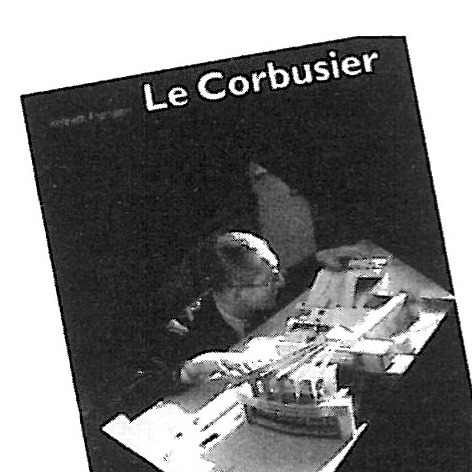
Objectivity and real design
I am a concrete man — that is, a man who works with his eyes and his hands, who draws his soul and his life from the labour of design, and who shapes a real architecture, a real urbanism and a real territorial planning.
The term Ville Radieuse (Radiant City) I myself coined — a term which, as I have been told, has no equivalent in English. But architecture and urbanism (or urban design and territorial planning) are not separate categories, but in truth forms of one and the same connected problem; they call for one single solution, and that solution can come only from one profession.
The cities I propose
The cities I propose are green and full cities, with the houses I have in mind: sun, space, and greenery. But to attain such a richness of life — sun, space, and greenery — it is necessary that, for a community of 2,000 people, a single great dwelling be built, with only one entrance for the whole 2,000, so that they may, through it, reach their own houses immediately — houses which, in spite of the simultaneous presence of a population of 2,000 souls, enjoy total silence and total privacy.

The seclusion and the independence of each housing unit are well secured by means of four 20-person lifts for the vertical traffic, seven horizontal corridors stacked one above the other, and the fact that each unit borders on only four other dwellings (above, below, and on either side); none of the residents can hear the others, and so the private individual life and the shared use of public facilities can both be made possible.
Under such conditions, distances are shortened, journeys are ordered, and the routes of the car and the pedestrian will be separated.
The shortcomings
But there are also shortcomings: modern society, which is gripped by daily problems, has forgotten this 'simple matter':
A man. A woman. A child. They sleep in their beds. They wake up and go to work. Then they come back home, to sleep again in their beds.
Whenever these matters come within the field of attention, the problem is solved on the spot. But these matters do not enter the attention of the responsible authorities, the engineers, the architects, and the people themselves.
In practice, millions — even billions — of men, women, and children of the world rise each day to a frenzied rush whose only result is the wasting of modern life. They live in places not fit for living, and they work in places not fit for working.
The problem of today and tomorrow
And so our problem becomes, in practice: how can we again come to natural conditions? Finding the answer to this question constitutes the most important difficulty of our today and our tomorrow. The answer is the fitting occupation of the land, attention to the fact that the earth is a single, integrated planet.
On this globe, the great task before us is to distribute the population in a wide-spread way — and that means ordering the three working institutions:
shared productivity from agricultural produce; the establishment of concentrated cities for trade, intellectual, and governmental activities (that is, exchange).
And please notice that, at the start, only two working institutions existed: agriculture, and trade. There was no industrial institution, since fundamentally there was no industry.
The three industrial periods
The first industrial period began a hundred years ago, attended by turmoil and chaos. The second industrial period was that of harmony and adaptation. And now (please attend), the world is ready to enter a third period — a period not the result of economic activity, but the result of a readiness for adaptation and form-bearing.
Paris, 27 January 1959 — Le Corbusier.



