


The nature of traditional bazaars is such that each row belongs to a particular guild. Any intervention that disregards the genetics of traditional bazaars diverts the complex from what it was originally meant to be. Consequently, if an approach to revenue generation and the entry of the Sa'd al-Saltaneh Caravanserai complex into the economic cycle at city, provincial, national, and international scales is to exist, the principles of restoration and the principles of economics must advance entirely in step. This complex was restored and revitalized with the assistance of the Qazvin municipality, and had it not been restored, it would certainly have become yet another abandoned and ruined building in the city, one that even the city's own residents could not enter. But following the restoration and revitalization of this complex, citizens and tourists now visit it on various pretexts, and this successful experience managed to rescue the Sa'd al-Saltaneh building—once condemned to oblivion—from destruction and return it to the life of the city. The restoration and revitalization of the Sa'd al-Saltaneh Caravanserai stands as one of those successful examples that can serve as a model for all of Iran's historic buildings. In light of this experience and drawing upon theoretical discussions, it is necessary to plan for synergy regarding the operational and practical strategies for the objectives of this research. Restoring a historic building and subsequently revitalizing it in tandem with its preservation is a worthy endeavor for the development of indigenous urban planning culture in this land. It is proposed that we design a scenario for the process of revitalizing historic buildings and, accordingly,
arrive at practical guidelines, not merely strategic ones. The movement from restoration to revitalization requires different modes of thought that are well understood in interdisciplinary discourse. In the diagram on the previous page, five stages within a scenario for optimizing the revitalization process have been proposed.
References: Habibi, Seyyed Mohsen and Maqsoudi, Malihe, Urban Restoration, 3rd edition, Tehran, University of Tehran Press. — Habibi, Kiumars, Pourahmad, Ahmad and Meshkini, Abolfazl, Rehabilitation and Renewal of Old Urban Fabrics, 1st edition, Tehran, Entekab Press. — Dabirsiaqi, Seyyed Mohammad, A Historical Survey of the City of Qazvin and Its Buildings, 3rd edition, General Administration of Cultural Heritage and Tourism of Qazvin. — Fereshtehnejad, Seyyed Morteza, Dictionary of Architecture and Architectural Restoration, 1st edition, Arkan-e Danesh Press. — Falamaki, Mohammad Mansour, Revitalization of Historic Buildings and Cities, 7th edition, Tehran, University of Tehran Press. — Golriz, Seyyed Mohammad Ali, Minudar or Bab al-Janneh Qazvin, 1st edition, Qazvin, Qazvin Province Cultural Heritage and Tourism Organization. — Mojabi, Seyyed Mehdi, In Search of Qazvin's Urban Identity, 1st edition, Tehran, Center for Urban Planning and Architecture Studies and Research. — Antoniou, Jim, "Historic Cairo," Architectural Review, 1998, DC. — Middleton, Michael, "Man Made the Town," 1987, Baltimore Renewal Bradley Head, London. — Norham, Ray M., 1975, Urban Geography, John Wiley, London.
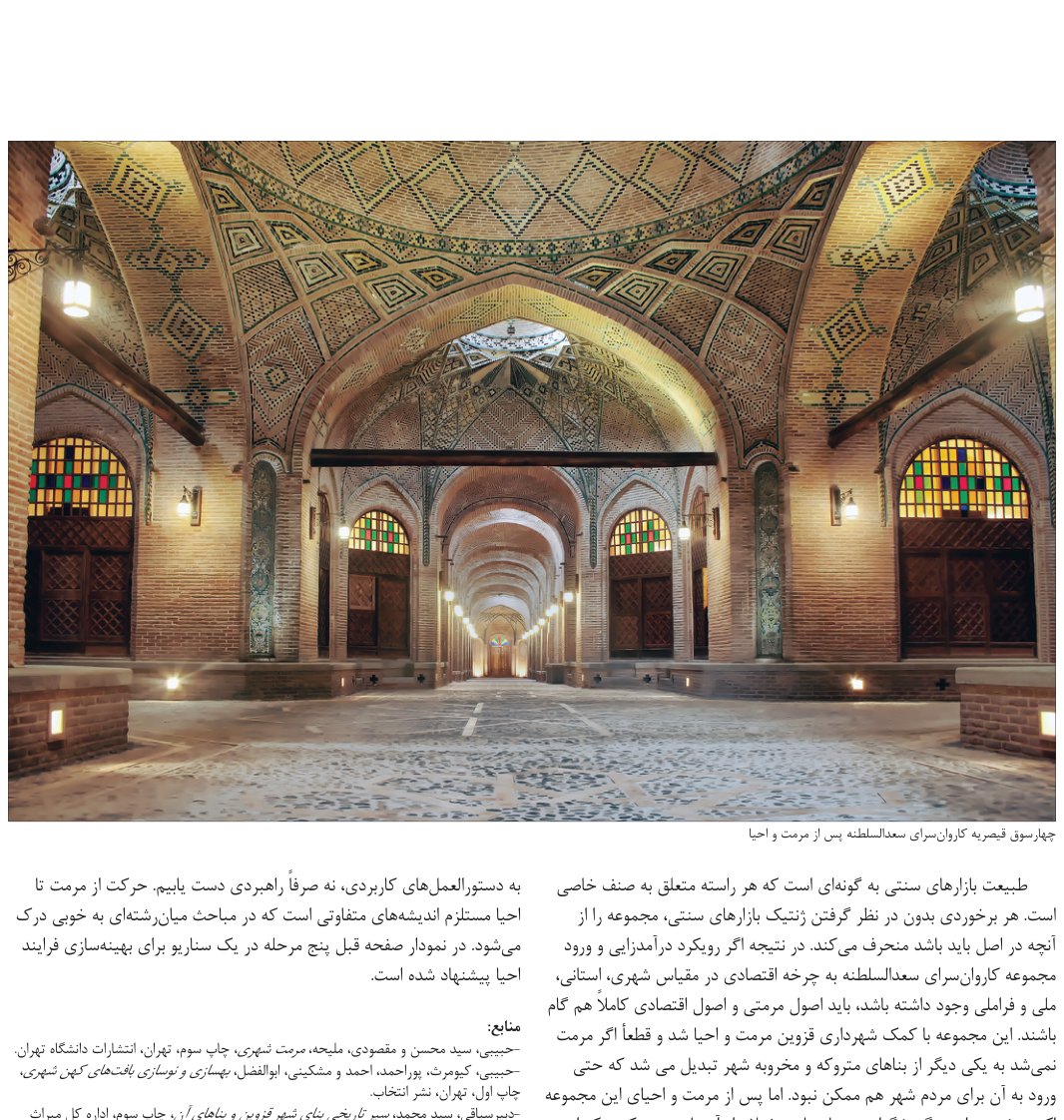
Chaharsuq-e Qeysarieh of the Sa'd al-Saltaneh Caravanserai after restoration and revitalization
Two Villages: Makhunik and Chenesht, Southern Khorasan
The village of Makhunik is one of eight remarkable ethnographically significant villages in the country, alongside Abyaneh, Masuleh, Kandovan, and Meymand, for which the Cultural Heritage and Tourism Organization of Southern Khorasan Province is preparing a book in eleven chapters covering play, recreation, entertainment, agriculture, horticulture, animal husbandry, hunting techniques, handicrafts, communications and transport, aspects of daily life, folk literature, language and dialect, folk beliefs, and rituals and ceremonies. This village lacks the beauty of those other villages named, but the extremely primitive life of its people and their short stature constitute a noteworthy subject for research and investigation. Makhunik is one of 239 villages in the Sarbisheh county, situated in the Darh rural district near the Iran-Afghanistan border. Sarbisheh lies 66 kilometers and Makhunik approximately 143 kilometers east of the city of Birjand. Irregular and organic form is among the characteristics of this village's fabric. The residential buildings are erected on hillside slopes. The building materials in this village are stone and mud, with roofs of thatch and clay. The rooms have no windows, and each room constitutes a household. The ceilings are low and soot-blackened, as fires are lit inside. The household possessions consist of one or two kerosene lamps, a portable camping stove, one or two ewers, and several aluminum bowls and a kettle. In this village, the people's sole objective is survival, and for this reason they live in the most humble dwellings possible with the barest minimum of belongings. Three sample houses in Makhunik have been examined: sample house one (Figure 1) consists of three rooms or units, where the room on the right belongs to an elderly woman, and the two rooms on the left along with a sheep pen belong to another household. Sample house two (Figure 2) also consists of two rooms and a tandoor oven.
Sample house three (Figure 3) consists of a single room and a place for a water tap, with a small unenclosed space visible in front of the house. In sum, one can say that there is practically no difference between the life of a Makhunik villager and that of a human being in the Neolithic era. The height of the houses is approximately one and a half meters, and the height of the door is at most one meter, made of wooden planks. Houses of larger families consist of two to three rooms, and a low wall of about 30 centimeters in height delineates the private boundaries of each house. Every household has a tandoor oven and a latrine. The enclosure walls of some houses rise to about one meter. Animal pens and chicken coops, at a height shorter than the houses, stand adjacent to the dwellings. A large communal stable outside the village serves all the villagers, who clean it out every spring and divide the resulting manure. The people of Makhunik are about 10 centimeters shorter than the average Iranian, but calling this village the land of Lilliputians, as has recently become fashionable, is inaccurate. The short stature is more prevalent among the elderly and middle-aged. Thanks to the attention of health center officials to pregnant women, providing them with iron tablets and iron drops for children, along with other measures, the height of the younger generation and adolescents has changed and now appears normal. The men of Makhunik wear white shirts and trousers and place white skullcaps on their heads; their shirts are long and slit (pahr) and reach down to the knees. The women also wear skullcaps and headscarves. The people of this village are Sunni and deeply committed to observing the principles and branches of their religion.
For further information, refer to the Cultural Heritage News Agency website.
Makhunik village. Photo: Mohammad Azim Mayeli
Interior of a house and its furnishings
Photo: Sahar Hassanzadeh — Photo: Tahereh Rokhbakhsh
Photo: Mohammadreza Arinpour — Photo: Mohammadreza Arinpour
A Makhunik child in local clothing beside a chicken coop — Figure 3
The Village of Chenesht, situated 38 kilometers east of the city of Birjand on the Birjand-Zahedan road, at a distance of 20 kilometers from Sarbisheh, the road to the village of Chenesht branches southward from the main road, 45 kilometers from the town of Mud. This mountain road is beautiful in all seasons of the year. Winters are snowy, and in autumn the bountiful barberry bushes lend a particular beauty to the surrounding landscape; in spring and summer, the route is relatively verdant, and pine trees, wild pistachio trees, and various desert shrubs can be seen along the way. The villages of Chahkand, Funud, Harivand, and Mazarkahi lie along the route, and in Mazarkahi, the mausoleum of Bibi Zeinab Khatun with its adjacent pilgrim lodge is built atop Mount Baqeran, likely dating to the pre-Islamic era. After passing the observatory, the road forks, and the left branch leads to the village of Chenesht. The inhabitants of Chenesht make their living through begging in Zahedan, Mashhad, Neka, Sari, and even Tehran, and their culture closely resembles that of the Roma. The village of Chenesht features stone architecture with wooden-beam roofing, and the doors and windows of the houses are painted green or blue, much like the clothing of the village women (for
further details, see Bon magazine, issues 71-73, Dey and Bahman 1386). Sample house one is built of stone and brick with a mud-and-straw plaster coating. The roof is covered with wooden beams, and a hearth is placed in the corner of the kitchen. In some parts of the house, natural rock serves in place of walls. The occupants are an elderly couple (Plan 1). Sample house two, the residence of Haj Miri, is two stories. The ground floor contains the entrance and stable (maldan), while the first floor houses the living quarters and the reception area. The house includes rooms, a kitchen, a bathroom, a storeroom, a bread-baking room, and a latrine. The entrance to the guest quarters connects to the alley by four steps; the room niches are decorated and porcelain vessels are arranged on the niches and shelves, clearly indicating that the homeowner enjoys relative prosperity (Plan 2). The building materials are stone and brick, and the roof covering is wooden beams overlaid with plant stalks. The kitchen walls have only a plaster-and-earth finish, while the rooms are whitewashed. The kitchen also features numerous large and small niches and a hearth. The courtyard, which sits above the stable,
Children of Chenesht village. Photo: Ahmad Kashani — Photo: Maryam Al-e Mo'men Dehkordi
is also used for cooking and washing. This village is situated in a valley surrounded by gardens (Plan 3). Due to the mountainous terrain and limited land, the houses are built on the hillside, and in many homes, the mountain itself forms part of the foundation or walls. The village's expansion follows the road to the northeast in a linear pattern. Some of the newer houses, like the older ones, lack courtyards but have porches and are composed of numerous interconnected rooms, adorned with abundant stenciled decorations resembling truck paintings. The primary building materials remain wooden beams, stone, and brick, but the use of steel profiles and sheets for doors and windows, along with stone cladding on the facades of newer houses, signals a trend toward changing building quality. The doors and windows are metal, painted green or blue, borrowed from the old architectural fabric of the village. Due to the limited land, the number of covered passageways (sabat) in this village is remarkably high—nearly no alley can be seen without one—and typically a room is built atop the sabat that belongs to one of the adjacent residential units. The alleys are narrow, and during winter snowfall, residents face difficulties with passage and are eager for the alleys to be asphalted. The fabric of
the village in its old section is extremely dense, and public buildings are rarely seen. The people of Chenesht do not welcome education, and at present the village has only two high school graduates and one law student. The divorce rate here is very high, because men leave for months on end to beg in the cities, and their wives, left alone and swayed by others' promises, separate from their husbands and marry again. For this reason, many households contain several children who sometimes bear no relation to one another. Sometimes these divorces occur before the wedding, and a girl may be contracted and divorced two or three times before reaching her bridal home; sometimes two couples divorce their spouses after one month and swap partners; or a man whose wife has been led astray divorces her and marries his brother-in-law's wife. Among the people, theft during begging is also considered permissible, and the villagers do not shy away from it. Some men take their wives and children along to beg, and a few hire elderly women and young girls from surrounding villages to accompany them, though this is not common practice. Orchard-keeping falls to the women of the village. (Tilling the soil and pruning the trees are men's work, while watering, fertilizing, and harvesting are women's responsibilities.)
Plan 1: Residence of Seyyed Abdolmajid Mohammadpour — Entrance — Kitchen