In recent decades, in many cases, meaning and interpretation have been confused with one another in the writings of architectural critics — one being taken for the other. That may of course be because the definition of each is itself incomplete and misleading.
In our view a precise definition must be given for each. Such a definition may in the first instance be useful to critics, but researchers, designers and students may also find it useful. Failing to notice the distinction between these two concepts, and failing to separate them, leads to a kind of degradation which shows itself in the form of "gaudiness and mannerism," and in childish or imitative-retrograde work — belonging to times other than ours and to cultures other than ours.
Worse, in recent years this lack of distinction between meaning and interpretation also shows up in the doctoral theses of architecture and urban-planning departments in our universities. Even some of the most talented students of these programmes have not been spared its defects, particularly since philosophical concepts — worldwide — have entered the field of architecture, and since the spread of styles and schools such as post-modernism and deconstructivism has opened the door to many misunderstandings.
In our view, meaning in architecture must relate to the qualities and characteristics of architecture and must arise out of it. We do not mean that meaning in this field should be narrow and bounded; we mean that, at its foundation, it must be tied to architecture itself. In the domain of interpretation one can manoeuvre freely from every side, but if the matter is pushed to excess, no room is left for the firmness of thought. In architecture, meaning is prior and preferable to interpretation.
Let us draw the matter out further. If we hand the reins of architecture over to interpretation, then, as the saying goes, no brick stays put on brick. But if we hand the reins of architecture over entirely to the considerations of building, we have only built a building — we have not made architecture. Some authorities — including Eric Gill, and later Chermayeff and Alexander — hold that if a building is well made, especially in terms of functional considerations and the relations of its different parts, "beauty will take care of itself" — the building will itself enter the territory of architecture. This statement is true only up to a point, for considerations of building produce only the functional part of architecture, and the artistic part is, as it were, left behind.
The artistic part of architecture follows its own considerations and criteria — criteria that, in the authorities' words, have been issued as verdicts, or, if that seems too strong, have been accepted and settled. The same holds in literature. No educated Persian-speaker can doubt the eloquence of Sa'di's language, because this language is genuinely fluent, simple and elevated; and if anyone doubts it, they are either unlettered or blind of heart. By accepted and settled criteria, Sa'di's speech has that quality.
The same point is made by Arnold Whittick, who is an authority on art and architecture. We know that judgement of works of art is subjective in Western parlance, not objective; that is, one cannot state a particular formula for proving the beauty of a work of art (architecture, painting, sculpture, music, poetry, literature). Nonetheless, in the acceptance of the greatness or, conversely, the failure of works of art, the subjectivity of the authorities (the experts) plays a decisive role. The English term Whittick uses for the subjectivity of the authorities — after some pause, I think — is universal subjectivity, which one can translate literally as "universal subjectivity"; but further study of his text makes clear that what he means by "universal" is "of the experts." Criteria of course change over time, shift, or lose their credit. Winckelmann, an authority on and connoisseur of classical art in the nineteenth century, travelling by carriage from Vienna to Germany, instructed his coachman to draw the curtains so that he should not witness "the dreadful ugliness of the Alps." Today the beauty of the Alps is a settled and accepted quality.
The reach of interpretation: the Derrida exampleWe said the range of interpretation is very wide. One can also interpret the flight of a fly or the crow of a cock out of season. One of the famous interpreters of our time is Jacques Derrida, whom we know as one of the best-known philosophers of his generation and as the founder of deconstruction, the school that has left its mark on contemporary architecture. He collaborated with Bernard Tschumi and Peter Eisenman on the Parc de La Villette project, particularly with Eisenman; and he it is who, undoubtedly in a mutual admiration, writes of Eisenman: "Pourquoi Peter Eisenman écrit-il si bonnes livres?" (Why does Peter Eisenman write such good books?).
Geoffrey Broadbent cites a note of Derrida's that bears on our discussion and shows how any simple sentence can be interpreted in several hundred different ways. The sentence is Nietzsche's: "I have forgotten my umbrella." Of this simple note — whose very attribution to Nietzsche is in doubt, and which may have been added to his archive afterwards — Derrida writes: "We have no reliable means of knowing in what circumstances Nietzsche wrote this sentence or in reference to what. We shall never know with certainty what Nietzsche meant by this note, or what he wanted to do by it... We cannot even know whether he wanted something at all, or not" (Farsi translation, p. 122).
Derrida then falls into a long chain of mental association that we have no space to quote here in full. But why all this talk about this simple note of Nietzsche's? Why not assume that Nietzsche, like any person of his time, truly took an umbrella with him on a rainy day when leaving home, and, since the rain had stopped by the time he reached his destination, simply forgot his umbrella — and wrote himself a note so as not to forget this forgetting?
Broadbent raises the same question, writing: "All right, then — what does Derrida's interpretation of this sentence actually yield? Intellectual illumination? Not very much. Persuading theorists about the quality of language, meaning and truth? Hardly. A quarrel with received opinion? Certainly..." (ibid., p. 123). But this quarrel with received opinion — in Broadbent's view — replaces the received opinions with other received opinions: ones that make a habit of long-winded and pointless discourse about unimportant matters, and that fuel the pretence and hypocrisy of the world of art and architecture.
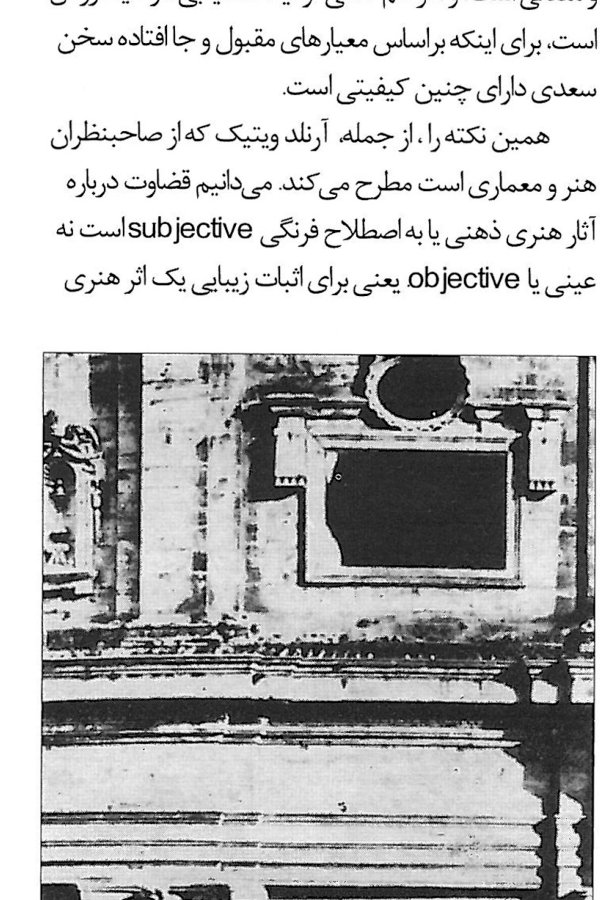
Venturi and Michelangelo's little windowIn the field of architecture, Robert Venturi undertakes a kind of interpretation of this same sort. For instance, when, in support of his own theory and drawing on past architecture, he points to the window on the rear façade of St Peter's Basilica in Rome, built by Michelangelo (Fig. 1), because this window is horizontal in length (rather than vertical, as is customary), it seems smaller! (Earth and the Language of Architecture, p. 178). What a striking example! Is it really worthwhile to bring up Michelangelo and interpret the little window on the rear façade of St Peter's — and to interpret it in this childish way?
Venturi's interpretations become funny when he turns to introducing and praising his own works. When, for instance, he mentions the stairs of his mother's house (Fig. 2), his tongue loosens in its praise, or he claims them as a masterful contrivance — merely because the width at the top and the bottom of the stair is not equal. Is that really the complexity and contradiction Venturi talks of? Or when he compares his own plan (Fig.) with that of Rudolph, and, like the pretentious and thin-skinned students of architectural schools, gives his own work high marks and makes Rudolph's work fail.
Let us exercise restraint and stay silent about those interpretations of architectural works whose basis and substance is simply Platonic metaphysics; for speaking about such interpretations would lead to long and broad discussions that have no place in this article, nor are they suited to a twenty-first century whose appearances we experience day by day and whose bitter and sweet results we are aware of. Better to hum Nima's verse: "How many words one can say / One can, like a piece of smoke / Make an image of doubt on the sky."
What brings about meaning: the designBut what factors produce the meaning of architecture? That question is, or must be, the first question of every piece of criticism worthy of the name about a work of architecture. In my view, the first factor in criticising and evaluating a work of architecture — and from there, in seeking its meaning — is the design. A work of architecture, in the first instance, is worthy of praise and carries meaning only if it embodies a considered design, one measured both against functional considerations and against artistic criteria. But to avoid drawing out the article, we set aside examination of the functional aspect here and turn our attention to the artistic aspect, although in many cases the two aspects — functional and artistic — are so bound together that separating them is all but impossible.
Our attention is rather directed to the artistic aspects of architecture — which themselves have a very wide territory, and which have far more to do with the meaning of works of architecture than the functional ones do. Of the many factors that produce the artistic quality of works of architecture, we have chosen two to speak of here. The first of these is architectural design. In other words: a work of architecture is worthy of praise to the extent that in its design a new path has been opened, or the design has an elevated, masterful quality that distinguishes it from other works of architecture of its kind.
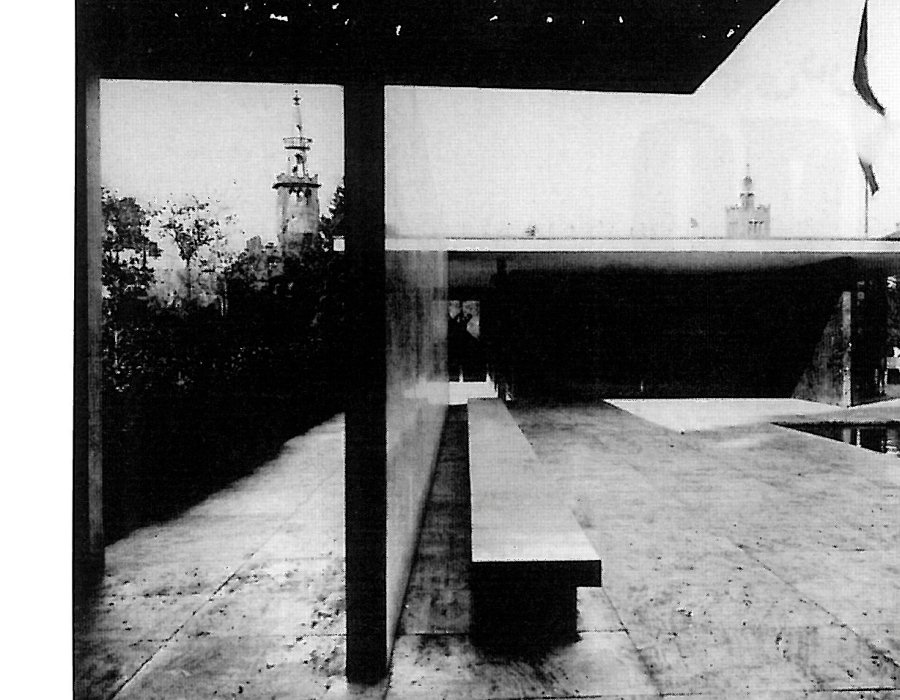
The Barcelona Pavilion of Mies van der Rohe (Fig. 5) won its distinction and its worldwide fame precisely because for the first time in the industrial age the interior and the exterior of an architectural space were joined together and flowed into one another with an unmatched ease; and because the large sheets of glass — whose production in such dimensions was a gift of the new industrial age — gave the building an unprecedented transparency and lightness.
Innovation in architectural design covers, of course, a wide range of qualities; it also has to do with the form of the building and with how it unfolds in space. It is on that ground that Adolf Loos spoke of the Raumplan — the "space-plan" — rather than the two-dimensional plan on paper; and we ourselves have raised the notion of the "beyond-two-dimensional" in urbanism (including in a paper titled "The Body of the City" at the Research Centre of the Ministry of Housing and Urban Development).
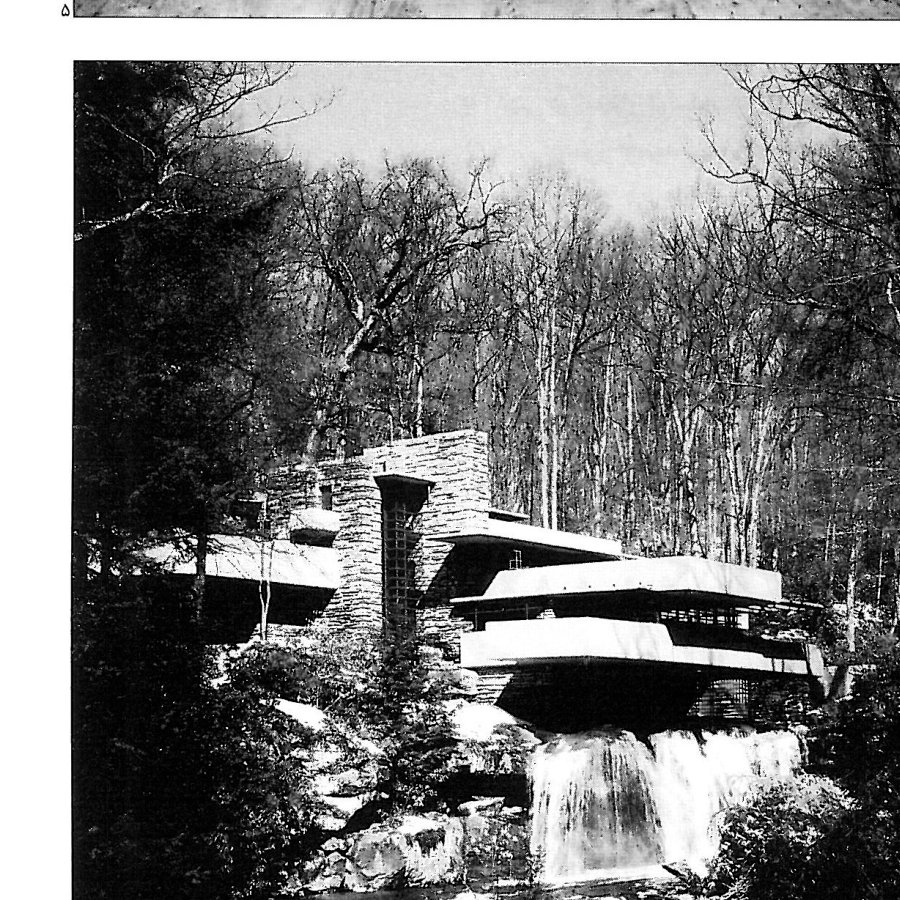
The great part of the praise and astonishment that arose around Wright's Fallingwater house (Fig. 6) in the 1930s was because of the outstanding, sculpture-like quality of the building; because the architect was able to take the design beyond two dimensions on paper into three dimensions and beyond — which is what the essence of architecture calls for. However beautifully a design appears on paper, it is seeable and praiseworthy only when it shows its true nature in space and is faithful to it. The importance of shadows in the Beaux-Arts school's presentation system (rendus), and the preference for the model over the drawing at the Bauhaus, is probably for this very reason. Of course there are limits on innovation in architectural design, and every architect is obliged to draw substantially on the experience of predecessors.