They become disappointed. Second, we must think about our own existential reality, our economic, social, technological, and managerial conditions—we should not live in fantasy and illusion. Given the limited use of this space in terms of time and distance, even from a commercial perspective, one must consider supply and demand and purchasing power. Third, cities like Dubai, which have admittedly been shaped with realistic visions, are heavily criticized from a sustainability standpoint, and we are merely repeating those same mistakes. What was your proposal for the design? My idea was to create an oasis at whose center water—the most important attraction of Kish Island—would penetrate, with hanging garden villas along its edges, so that what the client and participants sought would be reduced to a minimum structural height of one-third. Since the client did not permit seawater to enter the design, a vast artificial water feature was designed atop a low central structure housing commercial spaces. In the residential section, in addition to the hanging garden villas, I designed denser houses beneath them, each with its own small courtyard, so that at least the middle social class would also have the opportunity to be part of this project. The fundamental issue was to provide, as much as possible, the opportunity for users to complete the spaces through their participation. Therefore, the heavy parts of the building—structures, general volumes, and mechanical systems—would be built in the preliminary phase, and the residential units, as three-dimensional enclosures two stories high in various sizes alongside garden alleys, hanging gardens, and the commercial center comprising an access network and intermediate spaces divisible and combinable in three dimensions, could be handed over to users in raw form to be completed by other designers. This approach naturally resulted in savings in initial capital and construction time. The construction method was feasible using the country's existing industry, with prefabrication capability, increasing the quality and speed of building operation. Another point is establishing a connection with vernacular architectural culture, which I have always pursued. Creating central courtyards, garden alleys, using tile and wood lattice patterns for shade structures, employing simple and concise volumes, creating open and closed spaces, and most importantly, hollowing out and organizing the interior rather than composing volumes—these are some of the ideas I pursued in that design. Perhaps it would have been possible to create exciting formal compositions in this project, but despite the ability to do so, I avoided such tricks because of the ideas I follow in architecture. Nevertheless, this excitement exists not in the volumes but in the empty spaces, and like the essence of nature, disorder and non-repetition are abundantly visible. This is also evident in the hotel, which takes the form of an extended garden alley, where irregular volumes are suspended within an encompassing space, providing all users the opportunity to connect with the outside and view the sea. And finally, the relationship with nature and clean energy has been considered in this building, which can generate its own electricity autonomously, and by filtering air through the gardens on its edges and the vast water surface at the center of this oasis, one can help moderate the climate. The nighttime appearance and the glimmer of light on water, which also existed in our past culture, creates a lively space that, by moderating the air when there is no sunlight, produces a pleasant public environment. Design for Kish Competition
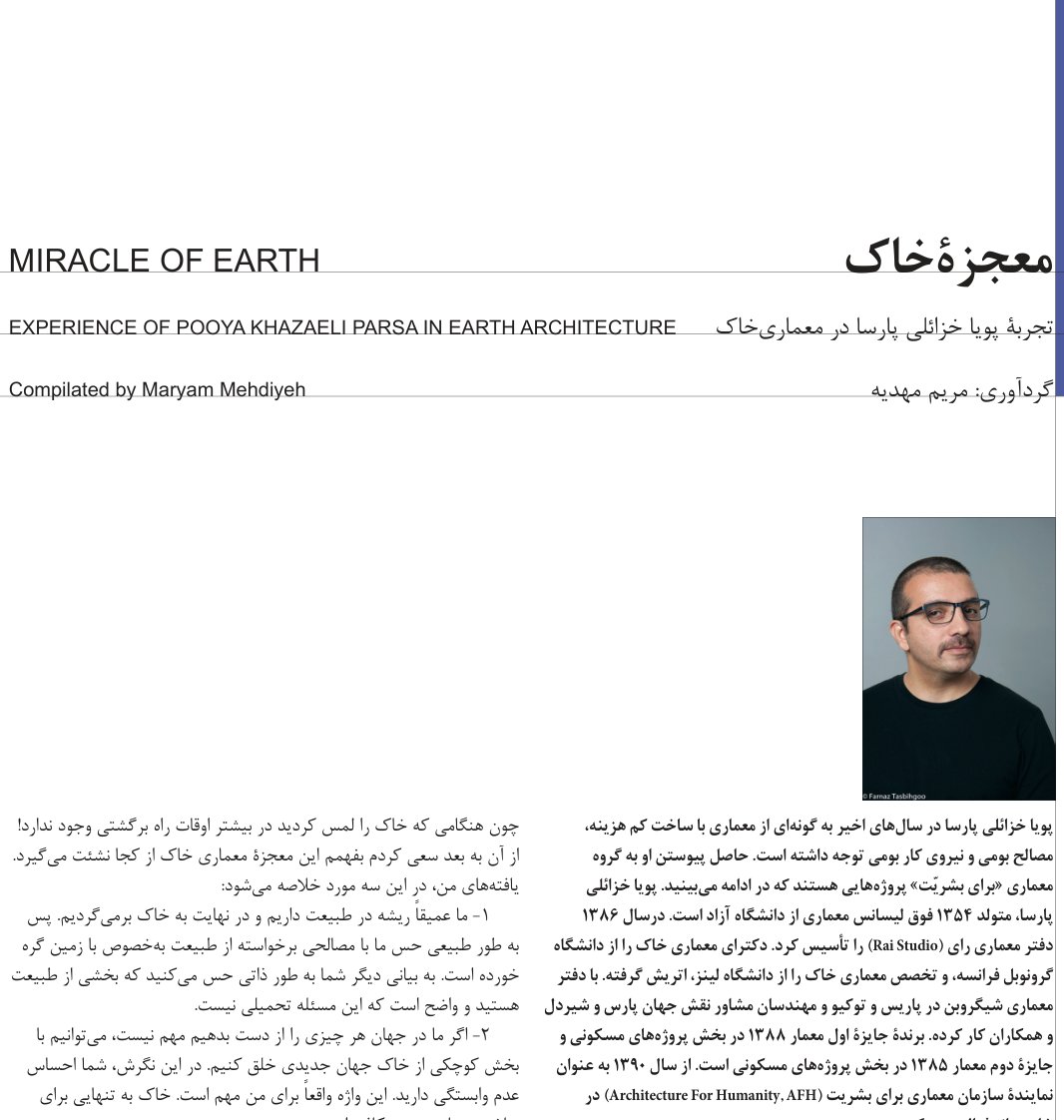
In recent years, Pooya Khazaeli Parsa has been devoted to a form of architecture built at low cost with local materials and local labor. The result of his joining the Architecture for Humanity group is the projects you see in the following pages. Pooya Khazaeli Parsa, born in 1975, holds a master's degree in architecture from Azad University (2007). He founded Rai Studio and received his doctorate in earth architecture from the University of Grenoble, France, and his specialization in earth architecture from the University of Linz, Austria. He has worked with Shigeru Ban's office in Paris and Tokyo, Naghsh-e Jahan Pars engineering consultants, and Shirdel and Associates. He won the First Memar Award in 2009 in the residential projects category and the Second Memar Award in 2011, also in residential projects. Since 2006, he has served as the Middle East representative of Architecture for Humanity (AFH). My perspective on architecture has changed since 2008—a perspective clearly visible in the bamboo structure project, which was executed after the Darwish Abad villa project—and that is the attention to construction technique in architecture and the architect's direct tactile relationship with materials and its sensory impact. I would like to speak about the feeling of architecture or the spirit of architecture. Typically, when we talk about sustainable architecture or earth architecture, our minds gravitate toward environmental issues, budgets, and economic conditions, and most of the time, an important matter that gets overlooked is our relationship with materials and the sensation we experience while working with them. It may seem strange, but for me this is a crucial part of architecture. In fact, the most important quality of any architecture is its sensory impact, and the less connected the architect is to the materials—the less sensitivity one has toward them—naturally, the sensory impact of the building diminishes or disappears entirely. The importance of this becomes clear when we recognize the artistic expression that forms in the dual relationship between the forces generated by the weight of materials and architectural space. A relationship defined not through calculation but through feeling, experience, and trial and error. For this reason, in my projects I advance the architectural design process through building numerous prototypes and physical models (maquettes). I discovered this feeling when I worked with Anna Heringer in Austria. Perhaps that is why, ever since, I have been unable to work with any material other than earth. You must be careful, because once you touch earth, there is usually no going back! From then on, I tried to understand where this miracle of earth architecture originates. My findings can be summarized in three points: 1- We are deeply rooted in nature and ultimately return to the earth. Therefore, our feeling is naturally bound to materials that arise from nature, especially the ground. In other words, you inherently sense that you are part of nature, and clearly this is not something imposed. 2- If we lose everything in the world, it does not matter—we can create a new world with a small portion of earth. In this perspective, you feel a sense of non-dependence. This word is truly important to me. Earth alone is sufficient to build a new world. 3- Buildings made of earth have a cycle of death and life, like trees and the seasons of the year—they die and are reborn. Rain washes the surface of walls built with earth, and the rain-weathered wall must be repaired again. In my view, with this approach to building with earth, you can easily design for the expansion or transformation of a building. In fact, the building can adapt itself to the cycle of death and life. Unfortunately, in concrete construction, the concept of this cycle has been forgotten. In nature, nothing is eternal, and the question of being reborn always exists. Nothing in nature takes on the smell of oldness, because every moment it is renewing itself. With concrete construction, we do something against the law of nature, and that is why we grow further from nature day by day—in truth, this issue comes back to us. Perhaps this is why I cannot work with any material other than earth. In our office, there are others who have also caught the earth virus! Furthermore, I believe we have a long road ahead, in which experience is unavoidable. In this regard, we not only participate in numerous earth-building programs but also organize multiple workshops. I would like to thank the Norwegian Refugee Council, whose support enabled us to experience earth architecture in real life and to build the pilot project. Compiled by Maryam Mehdiyeh. Experience of Pooya Khazaeli Parsa in Earth Architecture: Miracle of Earth
Haris Cattle Shelter (Haris village, a dependency of Varzaqan) •Project Manager: Pooya Khazaeli Parsa •Design Team, Scheme One: Vahid Afsahinia, Mohammadreza Amini, Parisa Bahrami, Sajad Bayat, Masoud Hoseini, Sam Hamidi, Mohammadjavad Abbaszadeh, Soroush Marouf Sahi, Amir Maleki, Amirhesam Valinezhad •Design Team, Scheme Two: Parisa Bahrami, Sajad Bayat, Sam Hamidi, Soroush Marouf Sahi, Amir Maleki. In the summer of 2012, an earthquake measuring 6.3 on the Richter scale shook the Haris region of Azerbaijan province. In this earthquake, 410 villages were destroyed and 60 villages were completely obliterated. Two fundamental problems after the earthquake were, first, the lack of shelter for residents and, second, the lack of shelter for livestock. Some time after the earthquake, while the provision of resident shelters was somewhat underway, a group of students, at the invitation of Rai Studio, began designing shelters for livestock. After presenting various designs suited to the region's needs and existing conditions, project prototypes were built, and upon selecting one of them, construction began in a garden near the earthquake epicenter in Haris. Simultaneously, another prototype was prepared and proposed. In the first scheme, the goal was to use local materials and build livestock shelters in the shortest possible time, because in that region, a major portion of the family economy depended on livestock, and with the loss of animals and the absence of shelter to keep them, lives were at risk. Among the features of the design were a lightweight structure, prefabrication, simplicity of connections, and minimal cutting. After building the first scheme, the second scheme was revised by considering and intensifying the strengths of the previous design. Overall, the following features can be listed for the design: 1- Simplicity and constructability by local residents 2- Use of local materials remaining from earthquake destruction 3- Use of common local techniques 4- Low construction cost 5- Speed of construction, due to the approaching cold season and the urgent need to build shelters for livestock
Afghan Refugee Camp in Bardsir, Kerman •Client: Norwegian Refugee Council (NRC) •Project Manager: Pooya Khazaeli Parsa, Mehrnoush Kholoughi •Design Team: Bahar Amir Inanlou, Nasim Vakili, Mohammad Abdolrezazadeh, Sanaz Jafari •NRC Support: Roberto Villsecuso, Arzhang Abdollahi, Shiva Zandedel •Architecture for Humanity Support: Kate Stohr, Frederica Zipp •Project Associate: Elyas Bagheri •Photographer: Mehrnoush Kholoughi •Site Dimensions: 10 meters by 10 meters •Construction Date: October 2012 •Project Area: 30 square meters •Materials: Sun-dried mud bricks (handmade, sun-dried) •Number of bricks used: 6,000 •Brick Dimensions: 25cm × 25cm × 10cm. The client of this project works to support and realize the rights of individuals who have left their homes and countries. In this project, the primary focus was on social sustainability in the Afghan refugee camp. This meant that, with an understanding of existing conditions, knowledge of culture and social relations, types of private and public spaces, types of materials used, construction techniques, and cost, the shelter design had to be determined. The existing houses had been built with minimal local resources and available materials, which did not adequately meet the residents' needs in terms of quality. The walls of the houses were mainly made of earth using the chineh (rammed earth) technique, and the roofs were built with locally available wooden beams and fabric coverings. To solve the current problems, two fundamental solutions were proposed: 1- Using the type of local technique and materials employed in building the previous houses, so that by improving traditional techniques and finding an easy solution for current problems, the best approach would be offered. 2- Understanding the spatial quality of existing shelters and the functions created by residents, which ultimately led to proposing new architectural diagrams to address the current shelter problems. New measures to solve the current problems included: 1- How to reinforce the shelter against earthquake forces and minimize its vulnerability. The existing examples lacked adequate safety and structural integrity even under normal conditions. 2- How to address erosion-related problems. In the existing shelters, the greatest damage had occurred where the bricks used in the walls were in contact with the ground, where moisture and ground dampness had gradually penetrated up to a certain height in the wall, causing erosion. 3- Preventing the accumulation of rainwater and snow on the shelter roof and waterproofing the roof covering. 4- Providing adequate cooling and heating for the shelter in cold and hot seasons and insulating the roof to retain interior warmth in winter and coolness in summer.



