Designers: Paolo Portoghesi, Vittorio Gigliotti, Sami Mousavi
Structural Engineers: Pasquale Cocomello, Luciano Palozzi
Contractor: F. Federici S.P.A.
A competition held recently under the title "Church of the Year 2000," with the support of the Vatican, demonstrated that even the giants of contemporary architecture face difficulty when designing places of worship. Perhaps because the architect finds himself confronting profoundly important questions whose most essential dimension lies shrouded in mystery; or because religious buildings, throughout history, have always been created with the finest artistry and the most advanced technologies. In the mid-sixteenth century, the Vatican spent the equivalent of building an entire church to commission Antonio da Sangallo6 to construct a complete wooden model of the design for St. Peter's Basilica, measuring 6.28 meters long and 5 meters tall. Building this model took seven years, yet the project was ultimately never approved by the Church. In the roster of artists who worked on St. Peter's, we encounter the names of Michelangelo, Bramante, Borromini,7 and Raphael.
The examples above demonstrate the extraordinary attention that people and patrons of the past devoted to the design of sacred spaces. Another aspect that illustrates the difficulty of Portoghesi's task is that in the past century, the number of churches considered to be works of genuine architectural merit has been extremely limited. Setting this difficulty aside, we must acknowledge that "Islamic" is itself an adjective that certainly does not simplify matters, and for this reason we see that the designer endured a doubly arduous challenge.
One of the initiators of the discourse on "contemporary architecture in Islamic lands" was none other than Portoghesi himself, who in 1982 inaugurated the architecture section of the Venice Biennale under this very title. The works presented — among which the creations of celebrated architects were also visible — all attested to the immense difficulty of bridging the severed tradition of Islamic architecture and achieving a successful synthesis with the architecture of today.
An Islamic identity that has resurfaced after centuries of silence manifests itself in architecture in a far more fundamentalist manner. In Europe today, there is no phenomenon called "Christian architecture," and if anyone were to use such a term, they would certainly mean only church architecture. Yet in Muslim countries, the term "Islamic architecture" is like a canopy spread over every type of building. I even recall that not long ago, a competition was held in Isfahan for the design of an aquarium "inspired by Islamic architecture."
In the project under consideration here, the discussion is not about "Islamic architecture in Islamic lands" but rather about "Islamic architecture in contemporary lands" — in terms of both architecture and technology. This, however, does not diminish the difficulty of the problem, because the project brief introduces the compound adjectives "contemporary" and "Islamic" and seeks to achieve such a combination. This desire stemmed from the client's own wishes.
In 1930, Saudi Arabia expressed its desire to the Italian government to build a mosque in Rome. According to an agreement drawn up during Mussolini's era between the Vatican and Italy, such a purpose required the Pope's permission. Only Pope Paul VI, who wished to open the doors of the Church to other faiths, granted his consent.
In 1974, a competition was announced, which reached its conclusion in 1976. The client's key requirements were: a connection with the environmental characteristics and urban fabric of Rome; a direct relationship with Islamic customs, manners, and traditions; and the creation of a link between Islamic beliefs and the needs of modern buildings through clear and sound methods. At the conclusion of the jury deliberations, Portoghesi's design — alongside several other schemes — advanced to the final stage. The decisive opinion came from a specialist in Islamic culture, who declared Portoghesi's scheme the winner for its proximity to the distinctive features of Islamic culture and traditions.
This building was completed in the late 1980s. Today, with the distance from the mood and atmosphere of the 1970s, the formal language of the Rome Mosque may appear heavy or even in poor taste, but under the conditions of historicism and nativism prevailing in Europe and the surge of identity-seeking movements in Islamic lands, it was unlikely that anyone else could have brought such a difficult project to fruition just two steps from the center of world Catholicism. As it happens, all the prerequisites of the project converged in Portoghesi's professional persona.
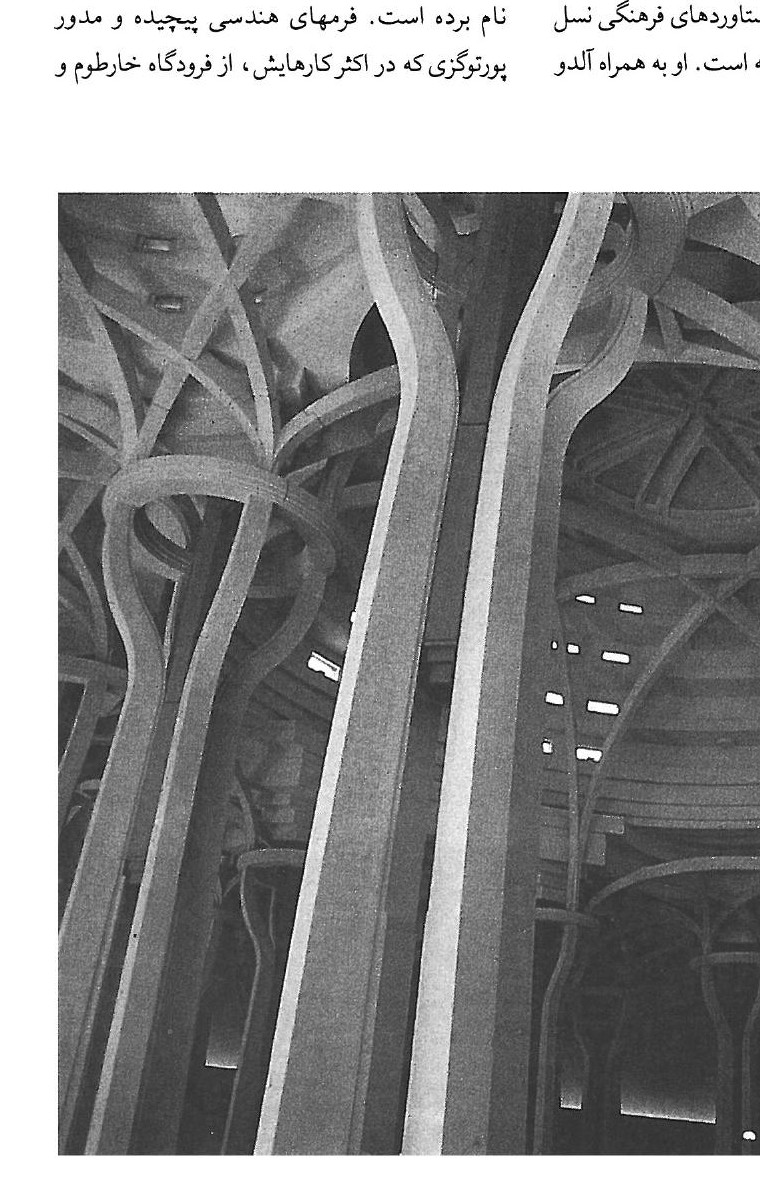
One of the important factors in the design was adherence to the architectural and urban-planning characteristics of Rome. Portoghesi is himself a native of Rome, and his family has lived for five hundred years in a Renaissance quarter of the city. He is a historian and researcher of Baroque architecture — that is, the dominant style in Rome's historic fabric — and has authored numerous publications in this field. Architectural history for him is not an abstract category with rigid chronological boundaries. For Portoghesi, architectural history resides first and foremost in Borromini. He regards Borromini as a kind of personal master:
"Borromini, though distant in time, is for me close in spatial terms. My childhood home stood a few steps from one of Borromini's major works, and as a child, seeing this building — with its enigmatic, captivating quality, a church whose facade resembled residential houses — I conceived the idea of becoming an architect someday."8
Portoghesi's familiarity with the world of Islam also has a long history. In addition to his university-era studies on Islamic architecture, he has designed Khartoum Airport and the Royal Palace of the King of Jordan in Amman, as well as the comprehensive plans for Khartoum and Amman. His extensive studies on complex geometric structures based on concentric circle compositions also connect, in a certain manner, with the spatial organization of the Baroque and Islamic geometry.
Portoghesi, as he himself states, belongs to a generation that viewed the cultural achievements of the preceding generation with skepticism. He, together with Aldo Rossi9 and Giorgio Grassi,10 is among that group of Italian architects who, with an entirely academic orientation, moved toward the discovery of definitive principles and enduring values of architecture — understood as knowledge that grows incrementally through history. This method of working, like the "Tendenza" and "Neorationalist" currents — and influenced by them, though difficult to transmit rapidly — is a kind of all-encompassing architecture, engaged with multiple and sometimes contradictory programs and issues, that rarely achieves spectacular results.
Aldo Rossi and Giorgio Grassi directed their attention to typological analysis and the study of historical works, but Portoghesi also turned to nature as a collection of forms and eternal, perfect geometric patterns. In his latest book, he compares the order within the world of organic forms with the architecture of various eras and cultures, demonstrating that the primordial core of all humanity's formal inventions is found in nature. He appreciates Baroque architecture not only for its regional affinities but also because it draws inspiration from nature — and particularly Borromini, whose source of inspiration he has called nature as "the master of masters." The complex and curvilinear geometric forms of Portoghesi, which appear in most of his works from Khartoum Airport onward, derive from this wellspring.
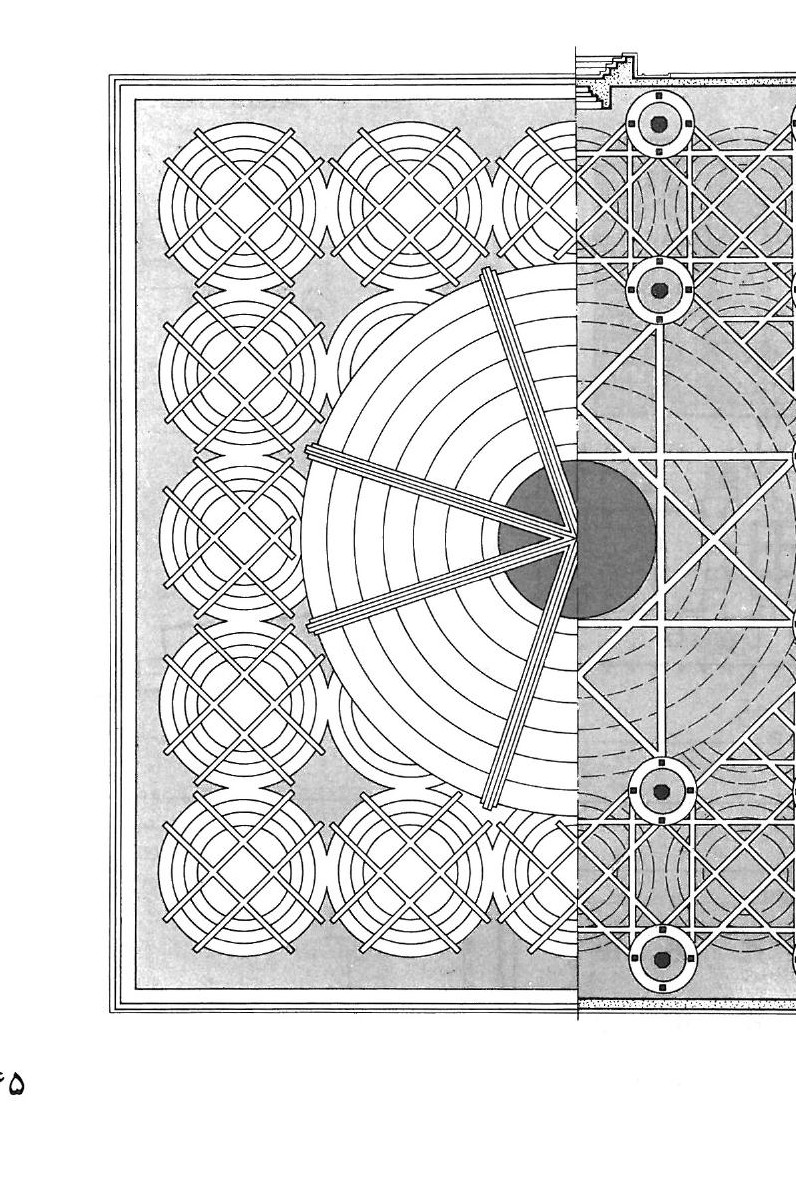
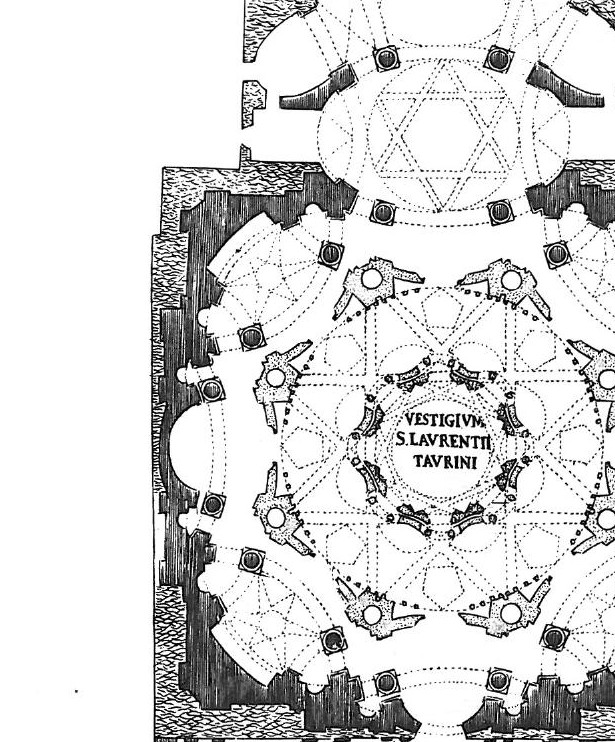
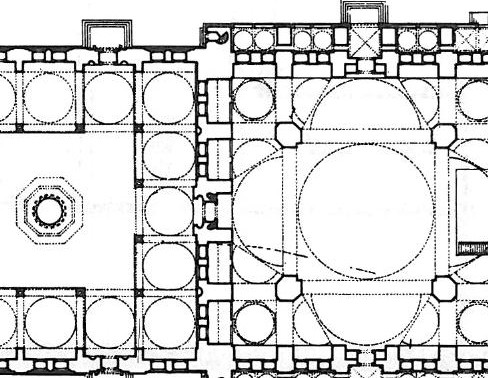
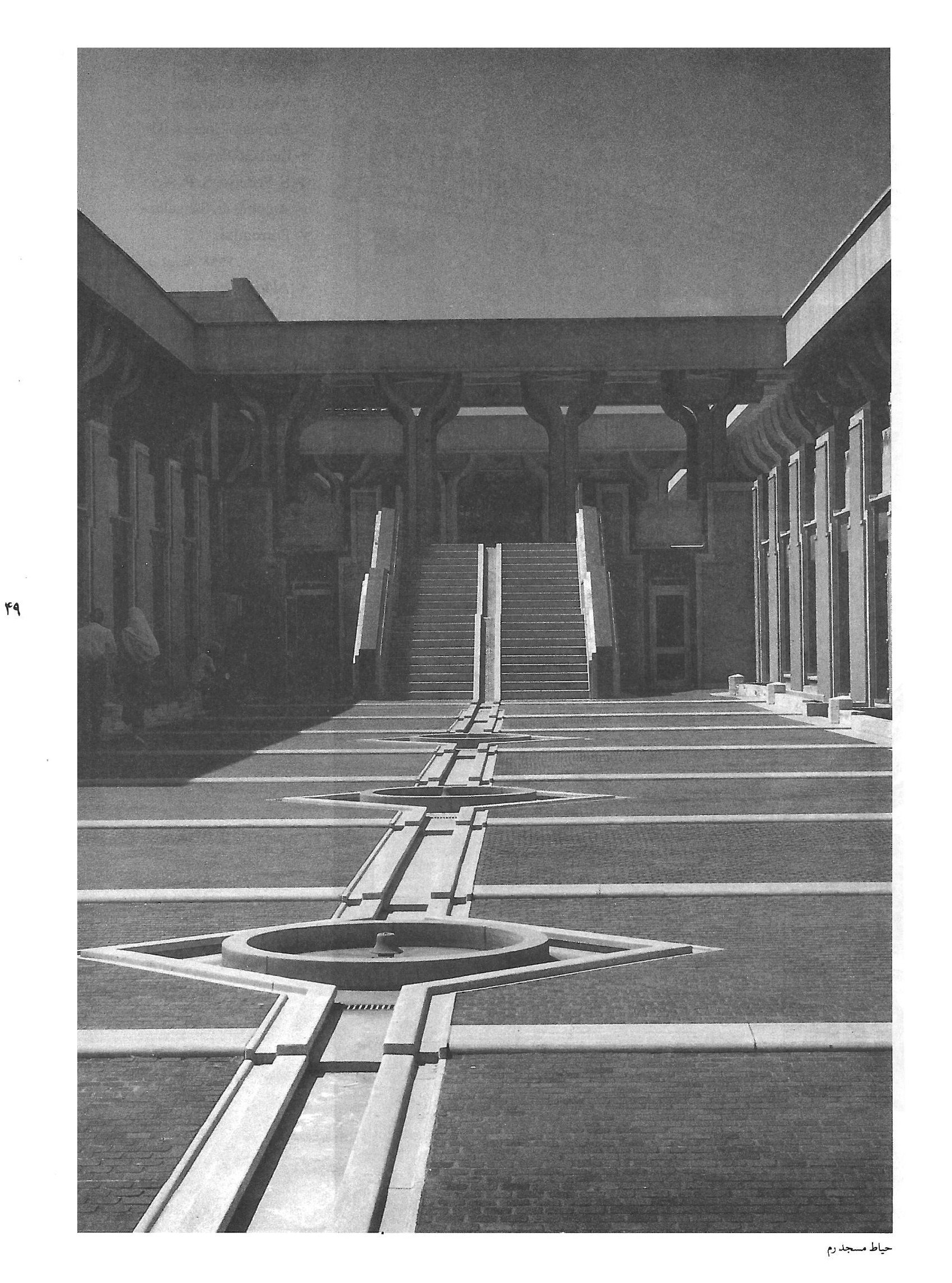
The less conspicuous aspect of the complex — which nevertheless immediately strikes the viewer — is a certain quality that arises from within the very components of the project. The complex in reality consists of the prayer hall, which forms the main core; a surrounding garden; the Islamic center building; management offices; and the residence of the imam. The Islamic center building is organized as two nearly parallel bodies with a central courtyard at its core, containing small pools, decorative plantings, and geometric fountains — all enclosed by two curved structural walls whose convexity faces outward.
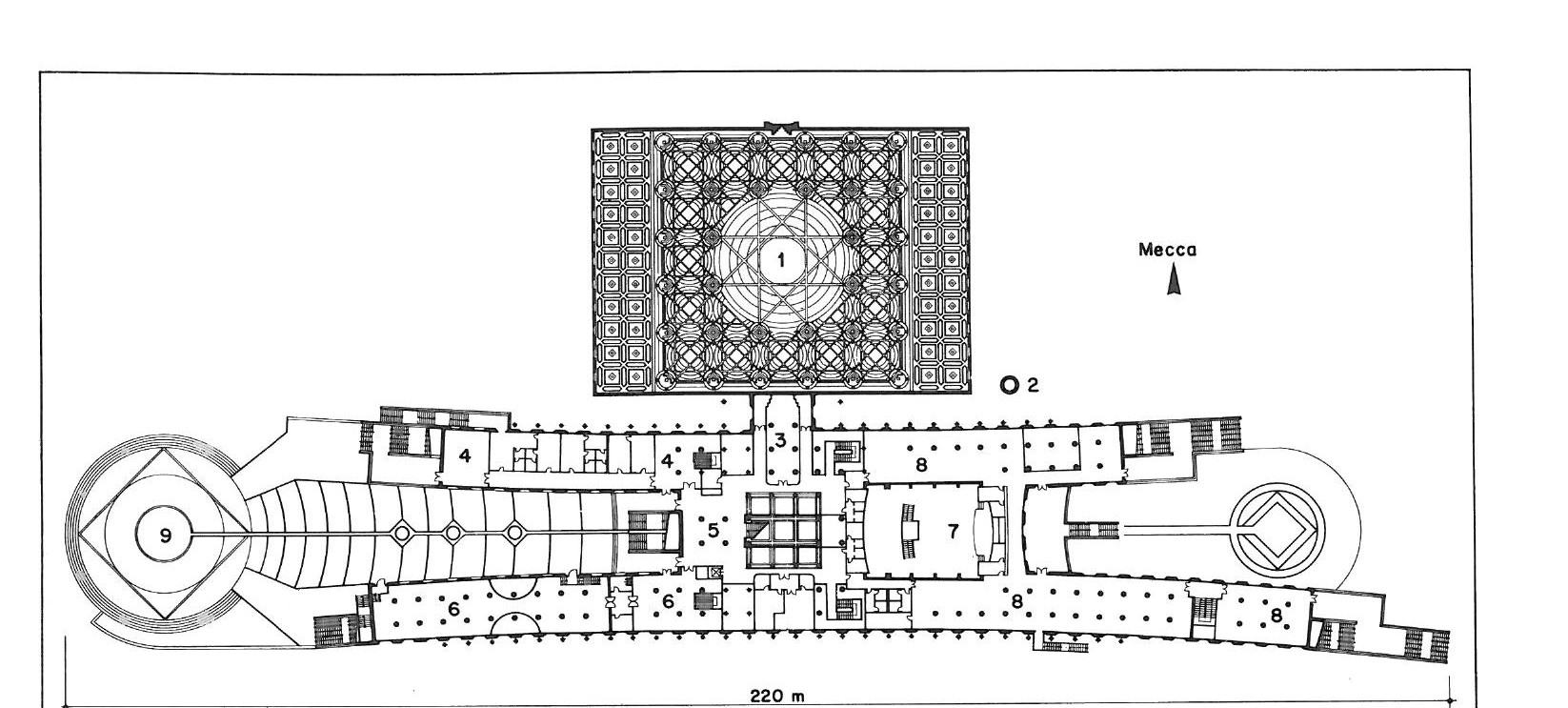
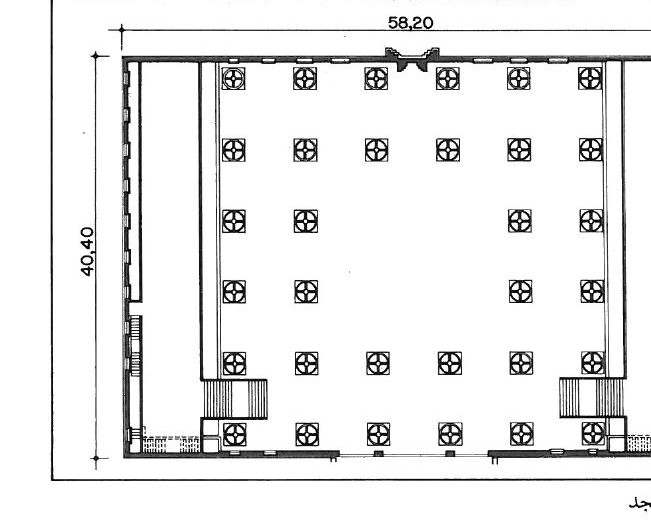
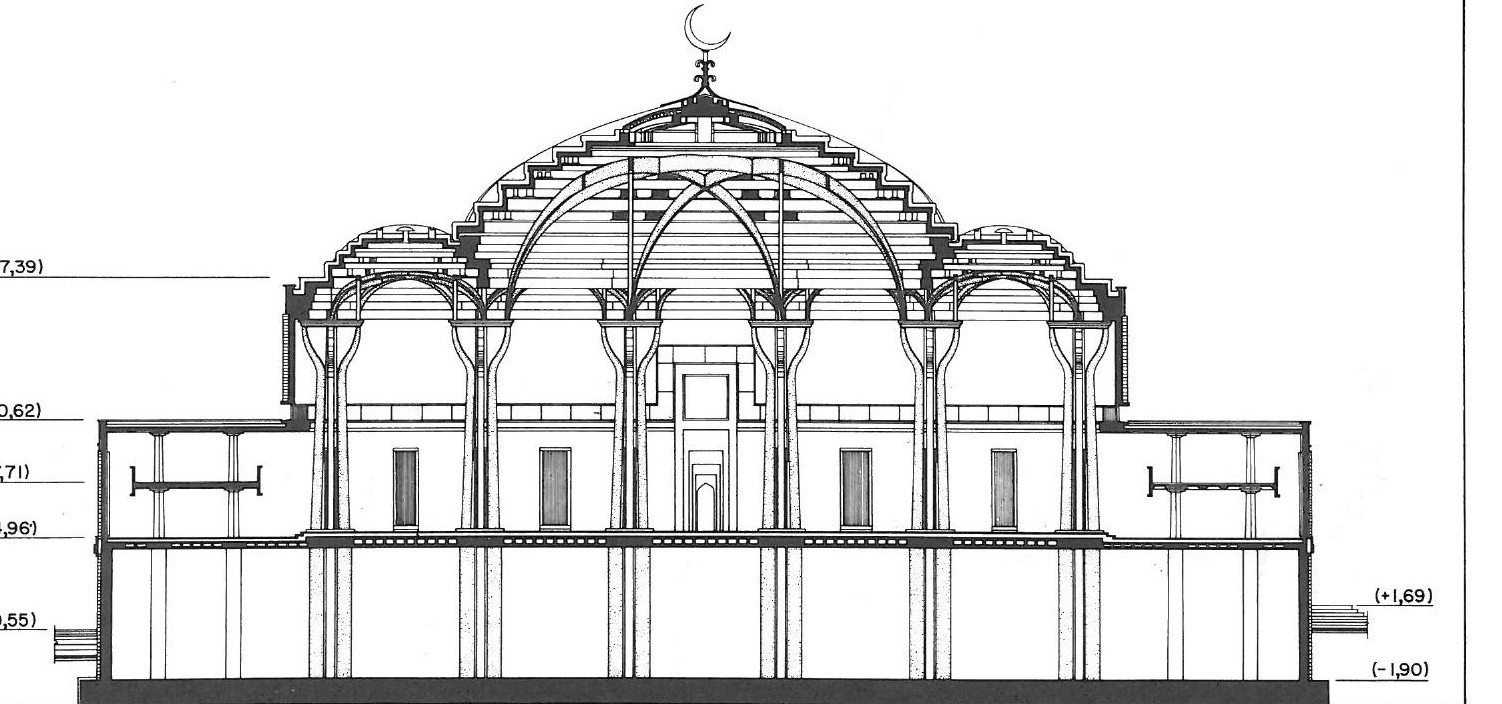
The prayer hall of the mosque is a square space of approximately 40 by 58 meters. This space is organized on two levels: the women's section, located on balconies overlooking the main hall, and the ground-level prayer floor oriented toward the qibla. The columns support 32 interlocking arches that together compose the dome. The manner in which these ribs interlock — they are in fact prefabricated concrete elements — is highly reminiscent of Borromini's geometric constructions, and on the other hand recalls Guarini's13 plans.
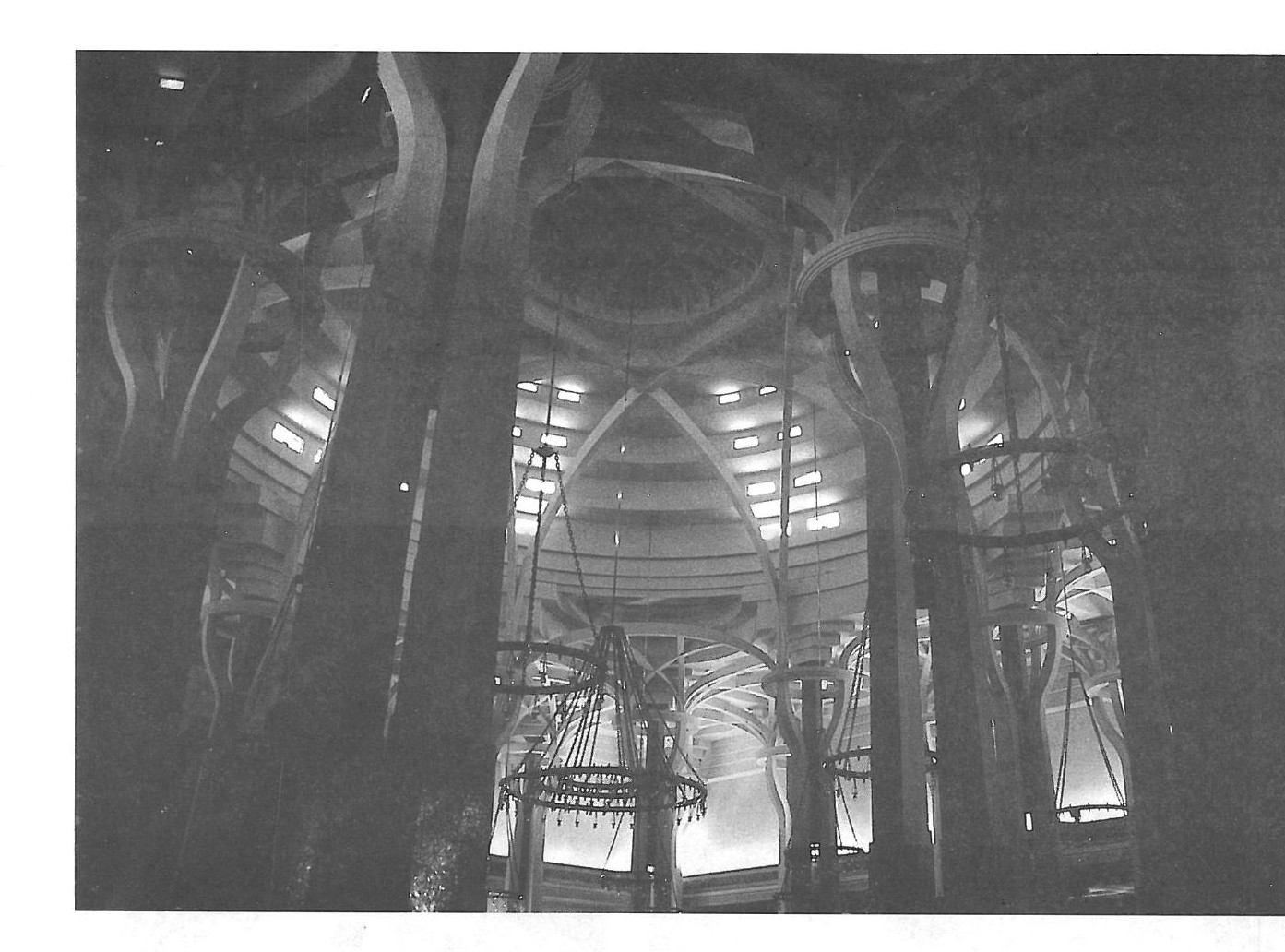
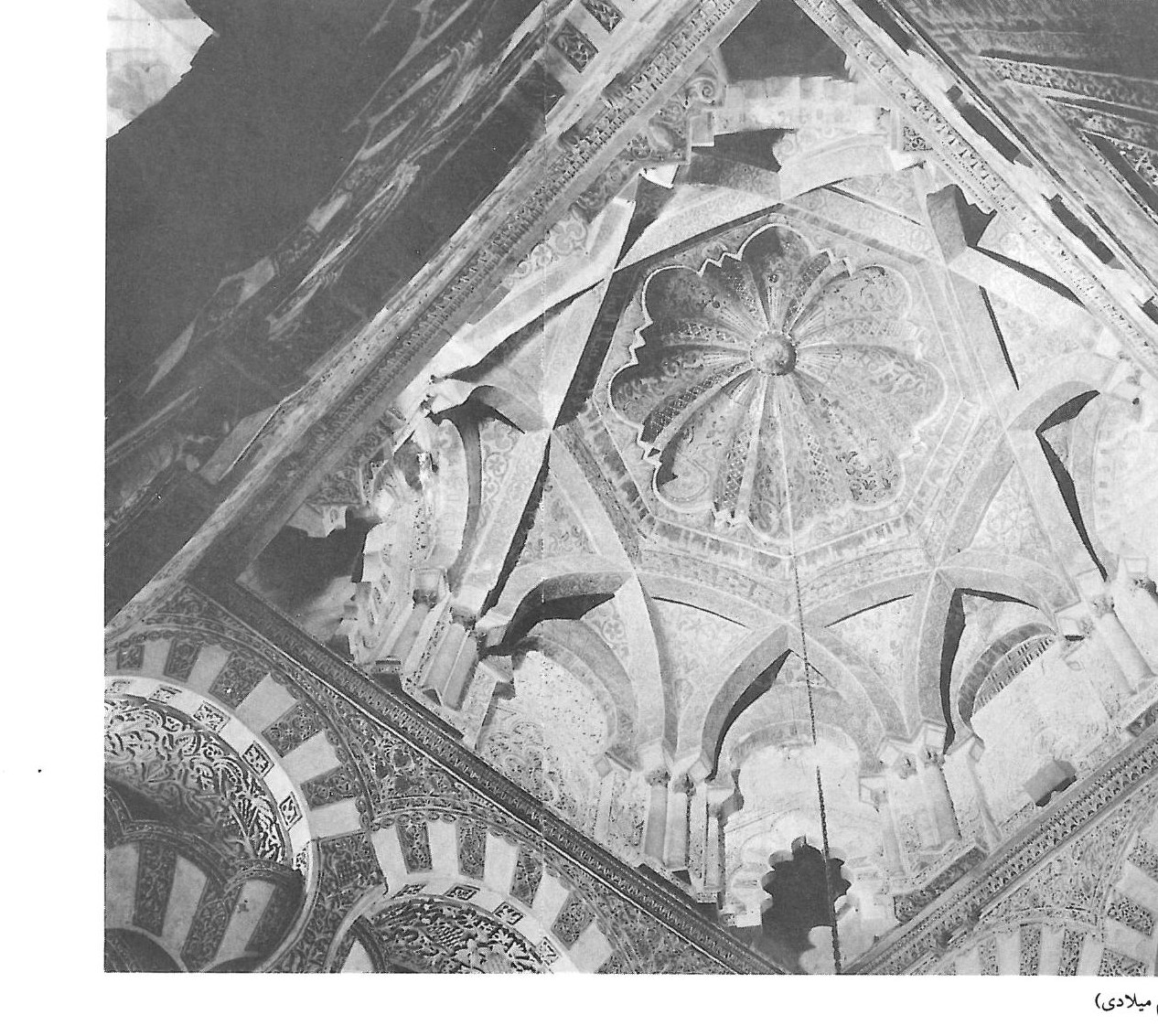
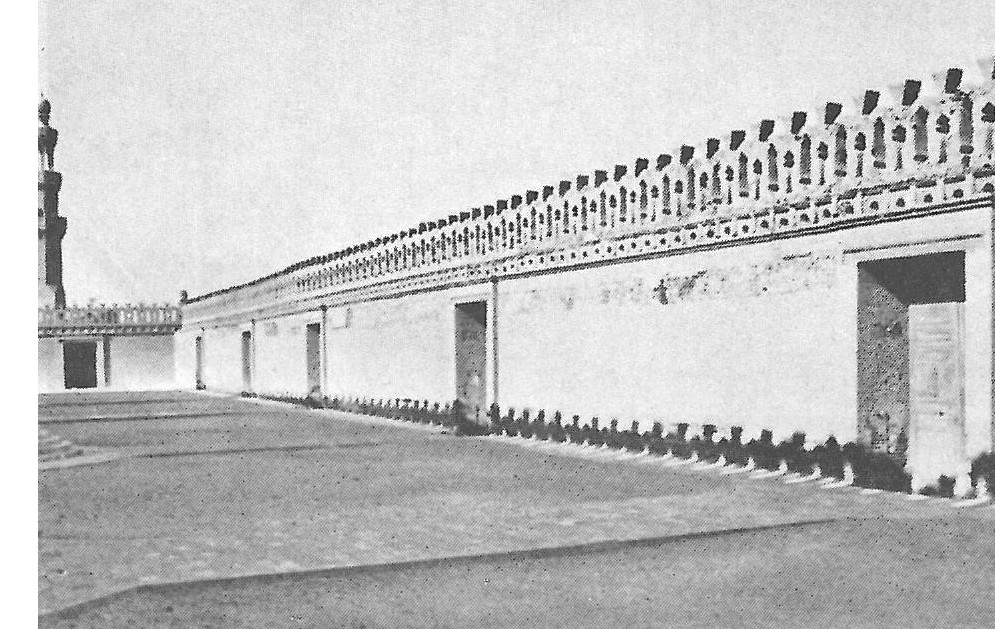
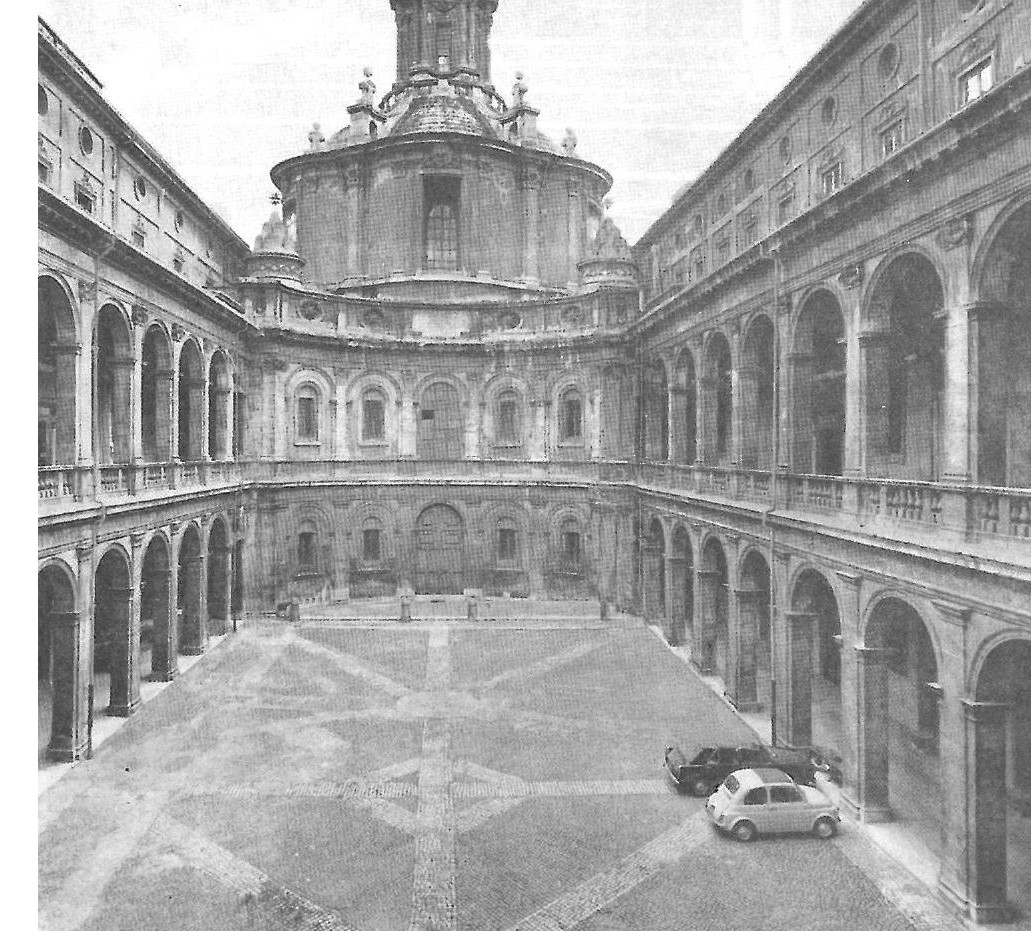
The various elements that one encounters scattered about — Baroque architecture, and especially Borromini and Guarini13 — serve as the common chapter between Islamic architecture and the architecture of Rome, constituting the principal formal ideas. The middle courtyard is a space that simultaneously evokes the Mosque of Ibn Tulun in Cairo, and the celebrated Courtyard of Knowledge at Sant'Ivo14 by Borromini in Rome. The interwoven concrete arches, as if the domes of the main hall of the Great Mosque of Cordoba had been transplanted to the Church of San Lorenzo15 by Guarini, link Baroque and Islamic architecture into a single formal language.
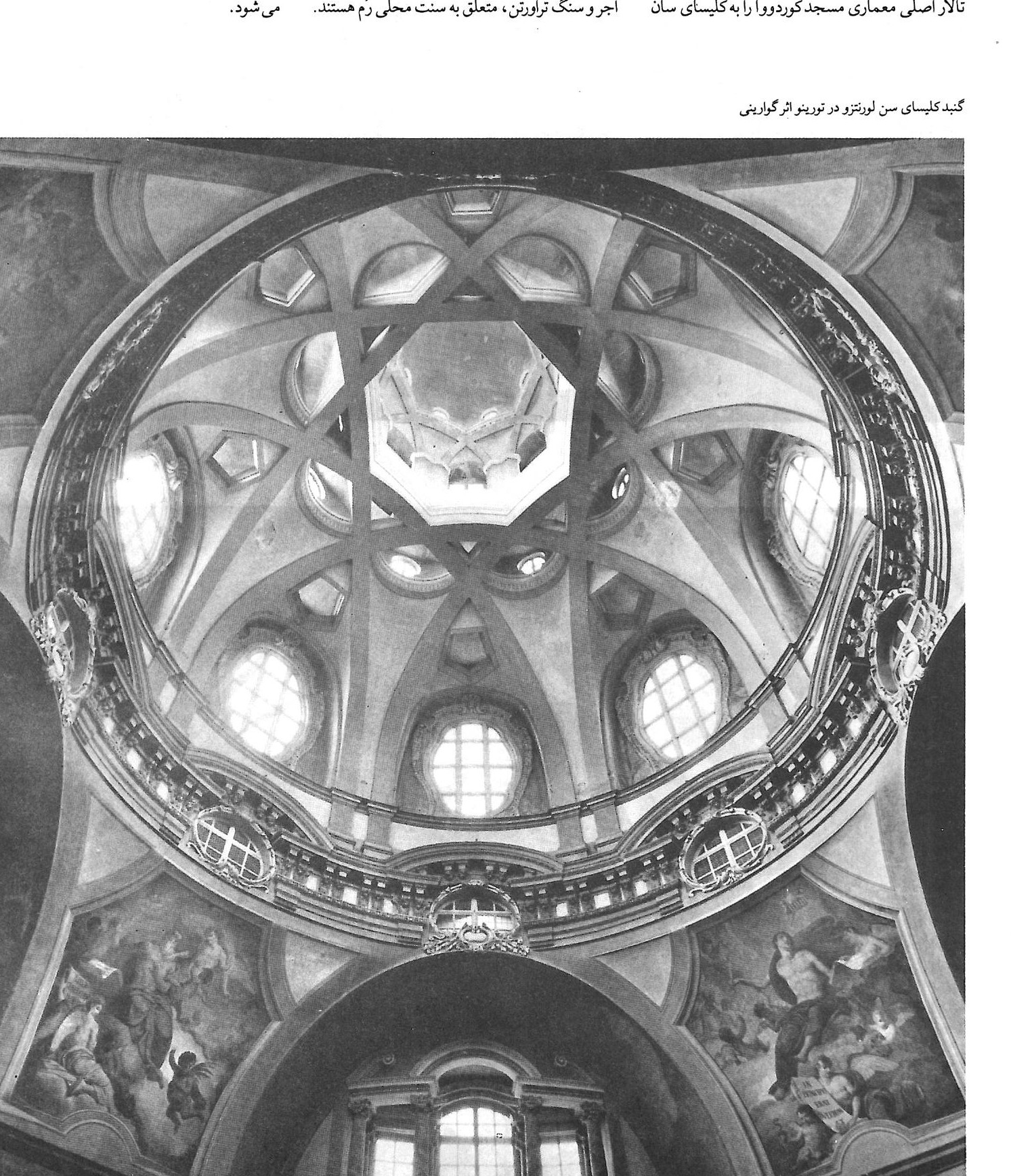
The concentric, interlocking circles also echo the geometric drawings of Iranian muqarnas on one hand, and recall Guarini's architectural plans on the other. The prefabricated concrete arch segments of the roof — which have been bent with the delicacy of hand-wrought iron — reveal Portoghesi's attention to Art Nouveau.16 The facade materials — brick and travertine stone — belong to the local building tradition of Rome.
This syncretic architecture, while not dazzling in terms of volumetric expression, possesses a remarkable descriptive power and conveys many visual messages and meanings to the viewer. Its form and space answer the traditional needs of Islamic aesthetics and the particular customs of worship and prayer. Nevertheless, the complex as a whole is a part of the city of Rome and one of the important landmarks of its architecture.
Notes
1. Paolo Portoghesi
2. Vittorio Gigliotti
3. Pasquale Cocomello
4. Luciano Palozzi
5. F. Federici S.P.A.
6. Antonio da Sangallo
7. Borromini
8. From an interview in the summer of 1998.
9. Aldo Rossi
10. Giorgio Grassi
11. Monte Antenne (site of the mosque, along the Tiber)
12. Tevere (Tiber River)
13. Guarini
14. Sant'Ivo (della Sapienza)
15. San Lorenzo
16. Art Nouveau



