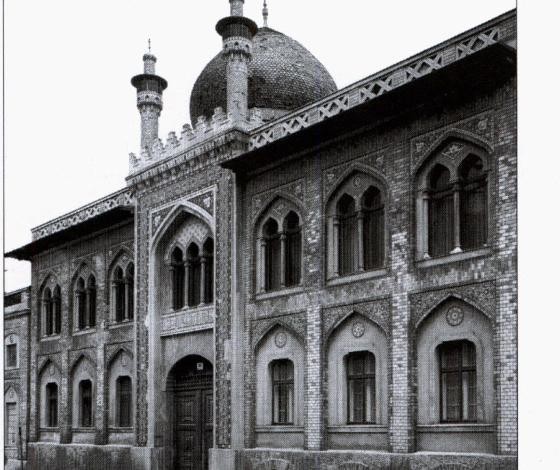
Inspired by functional tendencies, a new trend was shaped in the third decade of the twentieth century in the modern schools of architecture in Europe and North America. Later widely known as "international style," the trend, though initially a transnational solution for the art of architecture in the West, caused a fundamental transformation in the Oriental architecture as well.
In the meantime, architects in the Oriental countries had two choices: yielding to the overarching internationally accepted notions, incorporating a naive collage approach regardless of their substance and real limits, or taking the harder path of mastering the notions and embarking on smart adaptation. It was only natural that the former bring with it confusion and undetermined identity for the succeeding generation of architects, while the latter paved the way for the flourishing of a modernist breakthrough with an entirely different mentality. The essay examines the experiences of Iran and Japan in this regard.
The European Merchant and the Oriental Encounter
In Europe and North America, from the third decade of the twentieth century, the current of new thinking in modern architecture, born of the ideas of functionalism, took shape. This current later came to be known as the "International Style," a title that gained public acceptance despite the fact that it was essentially a transnational solution for the art of architecture — the product of Western civilization. Yet this very current profoundly transformed the history of architecture in Eastern countries as well, uprooting it from its foundations.
Meanwhile, architects of Eastern countries were presented with two paths: to accept the prevailing ideas and theoretical concepts without considering their substance and real constraints — that is, to undertake a naive collage — or to embark on the more difficult path of mastering these ideas through smart adaptation. It was inevitable that the former choice would bring confusion and an undetermined identity to the next generation of architects, while the latter would nurture the growth of modernism with a fundamentally different spirit and mentality.
To better understand this, let us consider the European merchant — specifically the trader who, in the second half of the nineteenth century, was traveling extensively between East and West. Since the criteria of European civilization were the measure of progress, these merchants naturally wished to promote and propagate Western products. They possessed collections of works imbued with the classical international style. The interesting point was that they did not shy from acquiring and incorporating Oriental motifs into their architectural commissions. Many architects, in countries across the world, had been drawn into this whirlpool of advertising and superficial fascination. Thus, some of these architects, through pamphlets and publications, attempted to promote and disseminate their works.
Modernism Comes to the Orient
The advance of modernism in the Orient, particularly in the nations of the non-Western world, deserves special attention. When we expand our view beyond the Western metropolises and look to Tehran, Tokyo, and other Eastern capitals, we find a fundamentally different story of engagement with modernity. In these contexts, the encounter was not merely an aesthetic choice but a profound cultural negotiation.
In Iran, the arrival of modernity was intertwined with the broader project of national modernization that began in earnest during the reign of Reza Shah (1925-1941). The architectural manifestation of this project was visible in the wide boulevards, government buildings, and educational institutions that drew heavily from European models. Yet the adoption was often superficial — a collage of Western forms applied to structures without deeper engagement with the principles that generated those forms.
The Ford automobile factory, with its model T2 production line, had revolutionized not only the automotive industry but also the very conception of space and function. When Le Corbusier articulated his five points of architecture in 1926, he was codifying principles that had emerged from this industrial revolution. Margarethe Schuette-Lihotzky's Frankfurt Kitchen of 1922 demonstrated how modernist thinking could transform even the most intimate domestic spaces. These innovations were not merely stylistic — they represented a fundamental rethinking of the relationship between form, function, and human life.
Japan: The Path of Smart Adaptation
Japan offers a particularly instructive contrast to Iran's experience with modernism. Japanese architects, faced with the same challenge of engaging with Western architectural thought, chose a distinctly different path. Rather than superficially importing Western forms, they sought to understand the underlying principles and find resonances with their own architectural tradition.
The traditional Japanese villa of the eighteenth century, with its sophisticated spatial organization, use of natural materials, and integration with the landscape, contained principles that were remarkably consonant with modernist ideals. Tetsuro Yoshida's Villa Baba in Tokyo (1928) demonstrated how a Japanese architect could engage with modernism while drawing deeply from traditional spatial sensibilities. The harmony between culture, landscape, and architectural ideas — which was the hallmark of traditional Japanese architecture — found new expression in modern forms.
Bruno Taut, the German architect who spent years in Japan (arriving in 1933), recognized this kinship between Japanese traditional architecture and modernist principles. His documentation of Villa Hyuga in Atami (1935) and Villa Okura in Atami (1933) revealed to Western audiences the sophistication of Japanese spatial thinking. Taut famously championed the Katsura Imperial Palace as embodying the very principles that European modernists were striving toward.
Sutemi Horiguchi, one of the pioneers of Japanese modernism, exemplified the path of smart adaptation in his Villa Kikkawa in Tokyo (1928-30). Horiguchi did not merely copy Western forms; he developed an architecture that synthesized modernist principles with traditional Japanese spatial concepts. The result was neither a naive collage of Western elements nor a nostalgic return to tradition, but something genuinely new — a modern architecture rooted in its own cultural soil.
Iran: Between Imitation and Innovation
The Iranian experience, unfortunately, more often followed the path of naive collage. Gabriel Guevrekian's Villa Malek Aslani in Tehran (1933) represented one of the rare exceptions — a work by an architect of Armenian-Iranian origin who had trained in Vienna and Paris and brought a deep understanding of modernist principles to bear on the Iranian context. His work demonstrated that smart adaptation was possible even in Iran, given the right combination of cultural understanding and architectural sophistication.
Yet for most Iranian architects of the period, the engagement with modernism remained superficial. The Vartan villa in Tehran (1940s) shows the typical approach: modernist forms — flat roofs, horizontal windows, white walls — applied as a veneer over fundamentally unchanged spatial organizations. The traditional Iranian villa in Isfahan, with its courtyard organization, sophisticated climate adaptation, and integration of garden and building, contained rich lessons for modern architecture. But these lessons were largely ignored in favor of superficial formal borrowings from the West.
The division of Japanese architecture — as documented in Bruno Taut's famous diagram distinguishing the "modern quality" of Katsura from the merely decorative traditions — suggests a framework for understanding the Iranian situation as well. In Japan, architects were able to identify within their own tradition the elements that resonated with modernist principles, and build upon them. In Iran, this critical discernment was largely absent, leading to what we might call the "naive collage" approach.
The implications of this historical analysis extend well beyond the early twentieth century. Even today, Iranian architecture faces the same fundamental choice: between superficial incorporation of international trends and deep engagement with both global architectural thinking and local cultural traditions. The Japanese example demonstrates that smart adaptation — though more difficult and demanding — produces architecture of lasting significance, while naive collage leads only to confusion and cultural displacement.
As Iran's architecture enters its seventy-fifth year since the first encounters with modernity, it would do well to reflect on these two paths and ask itself honestly which it has chosen, and which it should choose for the future. The answer, this essay suggests, lies not in either wholesale rejection or uncritical acceptance of international architectural thought, but in the harder, more rewarding path of smart adaptation — learning deeply from both global and local traditions to create an architecture that is genuinely modern and genuinely Iranian.
1 Johann Zacherl
2 Karl & Julius Mayreder
3 Martin Wagner
4 Bruno Taut
5 Ernst May
6 Margarethe Schuette-Lihotzky
7 William J.R. Curtis, Architektur im 20. Jahrhundert, 1989, pp. 174-185.
8 Villa Hyuga
9 Villa Okura
10 Hisashi: Difference of cover between the house and the veranda
11 Bruno Taut, Ich liebe die japanische Kultur, 2003, p. 32.
12 Sutemi Horiguchi
13 Kikkawa
14 Baba
15 Tetsuro Yoshida
16 Okada
17 Katsura
18 William J.R. Curtis, Architektur im 20. Jahrhundert, 1989, p. 174.
19 In recent years, the Association of Engineers and Architects of Iran has endeavored to hold official presence in events and congresses. For a more detailed account, see Memar, No. 14, Autumn 1380.
20 From information presented in a talk at Memar, No. 14, Paeez 1380, pp. 33-35.
21 Oskar Strnad
22 For more information, see Memar, No. 14, Paeez 1380.
23 Gabriel Guevrekian, Villa Malek Aslani, Tehran, 1933.
24 See Ershitekt (Architect), Issue 1, 1325/1946, p. 19.
25 See Memar magazine, No. 14, Autumn 1380.
26 Arthur Drexler, Transformation in der moderne Architektur, 1979, p. 6.



