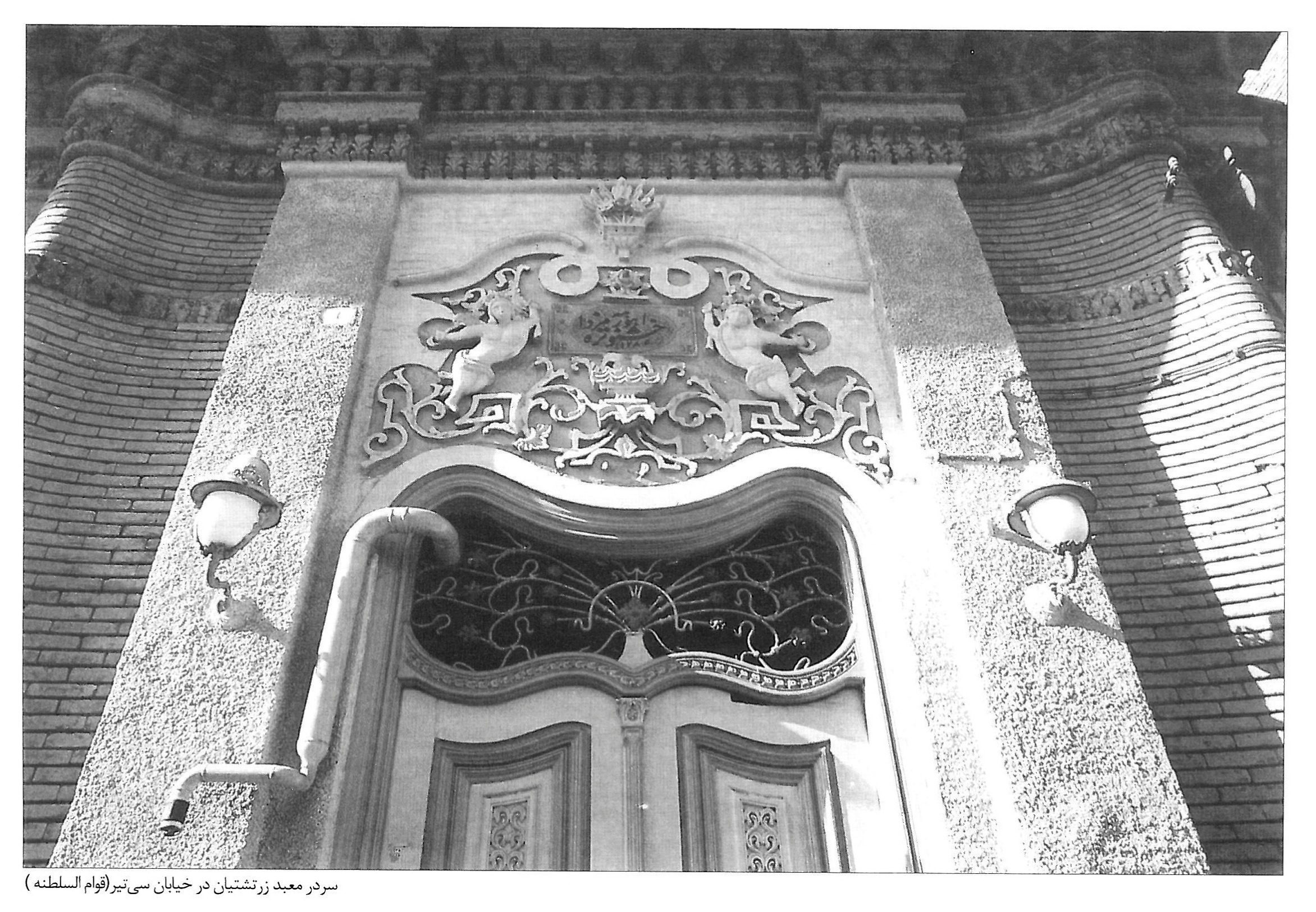
Engineer Farrokh Khadem was the first person who spoke to me about the library of the Zoroastrian Centre. At that time I was researching the architectural history of the public buildings of Tehran, and he, in his collection of dust-covered albums and oversize slides, was searching for old photographs of the Imperial Bank of Iran, the Ministry of Justice, and buildings of that kind. Once, in conversation, between sips of tea, he said that I ought to drop in at that library. The library was very near at hand: a little to the side of Naderi Street, above the old house of Qavam-os-Saltaneh, on the street now called Mirza Kuchak Khan.
But only a few months later, when an appointment I had at Khadem's workshop fell through and I did not know how to spend the rest of my afternoon, I remembered his advice. I went six houses past his workshop, behind the Air France office, past the British Embassy, and reached the Zoroastrian Centre. I asked where the library was. They directed me to a modern building full of old books.
I introduced myself to Mr. Bandari, a retired teacher. I wrote my name in the library's register and was given permission to search through the old shelves — a piece of luck rarely granted at a Tehran library. I saw, with great astonishment, that a notable share of the books carried the former stamp of the private collections of the Parsi community of Bombay, and that the date of many of them belonged to a century earlier. I found myself absorbed in books such as Marvels of Iran, The Adventures of Dunsterforce, Stalemate, and The Tradition of War in Central Iran. At that time, by reason of the difficulty of access to them, I gained more information about that community. By choosing a book from the shelf at random I learned that a group of Zoroastrians had founded the Parsi community in Gujarat, north of Bombay, and had built religious buildings there.
I should say that I was already familiar with pre-Islamic architecture and with that treasury of ancient ruins from the Achaemenid, Arsacid and Sasanid periods that have come down to us. Perhaps the most notable of these buildings is Persepolis. The palaces of Darius and Cyrus and the inscriptions of Persepolis depict all the nations of the civilised world of that day bringing tribute to a king whose realm stretched from India to Egypt. The Medes and the Scythians, the Phoenicians and the Assyrians, with gifts of gold and silver, of horses and rams, of camels and peacocks, are carved upon stone. In the Hall of a Hundred Columns one sees images of unconquerable warriors. Along the way "the stone-eyed lions of Persepolis continue their ceaseless watch over a nation that has fallen asleep but has not died."
But the wonder of it is that, although for various reasons this style was largely consigned to oblivion after the conquest of Alexander, much later — that is, in the years of the 1310s SH and during the reign of Pahlavi II — it was revived. The Parliament, the Post Office, the Police Headquarters and a number of other important buildings were designed in a manner that one may call the Neo-Achaemenid style, and that became known as the "National Style."
This architecture also stirred up a great deal of debate. Everyone fell to thinking about the source of the columns, the details and the styles — a debate that did not reach a decisive conclusion. Archaeologists and historians offered contradictory theories and tried to fit the architecture of Persepolis to vague or wholly similar earlier examples.
But the essence and reality of the architecture eluded them. That Greek stone-cutters or Egyptian craftsmen worked at Persepolis is fully documented. That likenesses to other cultures, empires and civilisations are to be seen there is beyond debate: Egyptian lotuses and Assyrian lions, both in the same proportion, are observed in Persepolis. Perhaps, instead of seeking the source of every one of these elements, we ought to accept that the architecture of Persepolis was the foster-child of a civilisation resting on the arts of a vast land — a land that, on conquering another, took into itself the culture, customs, traditions and art of the conquered.
I had a familiarity with the Achaemenid style and its findings. With the Neo-Achaemenid style and its rather more decisive expression I was also familiar; but, until that day when I went to the library, I had never come across the revived Achaemenid style outside the borders of Iran. Now, here, under the careful eye of Mr. Bandari, the retired teacher, in a book belonging to the Parsi community of India, I was seeing photographs of temples with Achaemenid motifs that had been built at least a quarter-century before the revival of the Achaemenid style in Iran.
The caption of the photograph on page 292 of Delphine Menant's work Les Parsis dans l'Inde (1917) reads: "Iranshah at Udwada." There we learn that this building was built in the name of a Parsi lady, Bai Motabai Mankji Wadia. In the caption of the photograph on the facing page we read that the Bombay Atash Behram association was founded in 1843; I should add, in parenthesis, that the Bombay Atash Behram is said to have cost 210,000 rupees.
I was enchanted by the photographs of these two buildings, which were built in the revived Achaemenid style in Bombay shortly before the entrance of the twentieth century — that is, at least twenty-five years before any building in this style was raised in Iran. It is interesting that, by reason of their sloped roofs, their windows recessed in the wall, their volumes and proportions, both buildings have a European and Victorian design. It is in the ornaments and details that their root and origin show themselves.
The columns, with their double-headed bulls and their stucco lion-brackets, are perhaps the most apparent expression of the Achaemenid; and they bring to mind a phrase by Robert Byron, uttered upon seeing Persepolis: "The columns can be described in a single word. They are interesting, just as the building of Sir Gilbert George's Bombay City Hall is interesting — barren mules: in the broad line of architecture they have no power of fertility and lay down no principle or teaching for it."
Whatever opinion or feeling we may have toward Byron's view of architecture and its broad line, we cannot deny that the style of the Bombay temples owes many of its dimensions to him. The Bombay temples are, beyond doubt, the fruit of a fusion of European architecture with vernacular themes. Throughout the Indian government one sees numerous examples of this fusion of Western and vernacular styles. Terms such as Gothic-Saracenic, Indo-Saracenic, and Indo-Gothic came into currency. In this particular case, the chosen "vernacular" theme was the architecture of Persepolis.
On turning over my notes, I noticed that the Parliament building was among the first Iranian buildings built in the revived Achaemenid style and was not completed until 1312. Hence the non-religious buildings of Iran lag, by comparison with the Bombay temples, by more than 25 years. While I was carried away by the joy of having found in this book interesting matter for the history of my country's architecture, I made the mistake of trying to express my thanks by offering a gift to Mr. Bandari, the retired teacher. Mr. Bandari turned my hand away and never afterwards accepted anything from me as a token of gratitude. In truth, the only gift he accepted, and that on behalf of the library, was a book of poetry, which I was able to make him take only on the day before I left Iran.
These unexpected sources for the revived Achaemenid architecture drew my attention and revived in my mind a hypothesis I had heard from time to time: that prominent members of the Parsi community were invited to Iran for a number of conferences and important undertakings is fully documented. That they were patronised by a king who had taken the name Pahlavi as his family name; that this same man took an excessive interest in the pre-Islamic past — and necessarily in pre-Islamic Iran — is also documented. But that the Parsis bore some particular founding share of the modernisation of Iran is uncertain. Even so, one must accept that their role in introducing a style of architecture is worthy of attention.
The Parliament building too, after the fire of 1310, was rebuilt in a European style with Achaemenid columns and motifs. The supervisor of the rebuilding was Arbab Keykhosrow Shahrokh, the Zoroastrian representative in the Parliament — who, like many of the prominent figures close to Reza Shah, died a doubtful death, although at that time he was the object of his great regard and attention. After a brief search, Mr. Bandari was able to find a copy of his memoirs, in which it was related that Pahlavi I, at the opening of the building, said: "That burning is worth this building."
Bureaucracy — or what in Iran is jokingly called zoorocracy — did not allow me to find the name of the architect who designed the Parliament building. Since the time of my investigations, the building has once again been visited by fire, and perhaps the remains of the archives have been lost. Arbab Keykhosrow Shahrokh was the agent of the rebuilding of the Parliament — that much I am sure of. It seems that he had a hand in the building of the Anushiravan Dadgar School as well; for in that dust-covered, modernist library on Naderi Street, named after Ardashir Yeganegi and run by a retired teacher, Mr. Bandari, I found a brief history of the Anushiravan Dadgar School. The school was built by Anushiravan Ratanji Tata and Iran-doost Tata — in fact the school took part of its name from the first of these two.
The plans and drawings were made in the 1310s by the Belarusian architect Markov, who had built many of the lasting buildings of his time, from palaces to prisons. He had also spent a brief but sufficient time in the Indian sub-continent. In 1313, when the first brick of the school was laid (in the presence of Arbab Keykhosrow Shahrokh), the necessary funds were raised, and the school was opened in 1315. It is said that the agent of construction was Mirza Ardashir Khan (Kiyamanesh). The revived Achaemenid columns, similar to those of the Parliament building, rest on a core of clearly Victorian style.
Perhaps the knowledge of this point — that the Anushiravan Dadgar School precedes the Parliament by one or two years; or perhaps the fact that Arbab Keykhosrow Shahrokh could not have been unaware of the Bombay buildings; or perhaps any one or all of the things that I did that afternoon, under the eyes of Mr. Bandari, following Khadem's advice, passing in front of the British Embassy and reaching a library named after Ardashir Yeganegi — led me to the belief that the Parsis of India may have played an effective part in the revival of the Neo-Achaemenid style in Iran.
Owing to the disorder of preparations for my departure from Iran, I was never able to find the history of the Bombay temples, or the architectural drawings of the Parliament or the schools. Nor was I able to ask the sons of Kiyamanesh about their memories surrounding the building of the school. I left this duty to my friends and, for that reason, was never able to go beyond the circle of conjecture and side issues and reach a more historical understanding of the recovery of the Achaemenid style in Iran.
But even if those plans and drawings are never found, and those memories are not preserved anywhere, one astonishing element in the discovery of Neo-Achaemenid buildings in Bombay before the revival of the National Style in Tehran exists, which in itself is important. That the Parsis of India and the Zoroastrian community of Iran took part in the building of similar structures in Tehran is worthy of attention and very curious. But what would be still more astonishing is that the Bombay and Tehran works should have been carried out independently of one another — that the architects and builders of the Tehran buildings should have been wholly unaware of the earlier ensembles in Bombay, and that the Achaemenid style, after centuries, should have raised its head from the dust at two points, in the Iranian plateau and in the Indian sub-continent. At each of these two points, for reasons of its own, it has been able to find supporters and executants. Yet both Parsis and Iranians, in carrying out what was made in the Aladdin and Thousand and One Nights cinemas, in the ministries, in the Ekbatan Hotel — even by imitation of the Cecil B. DeMille ensembles — endure in our memory.
In the revival of the Achaemenid style in Iran a wonderful story is hidden; but its origin is itself a more delightful story. To this day, even in this unhappy flowering, traces are seen of the essence of a nation that wanted to harmonise its art not only with the nations it conquered but also with the nations that conquered it. (Interestingly enough, in this particular case, the art that it chose to imitate was its own.) This story is written not only on those stone bulls, stucco lion-brackets and sloped roofs, but on every building of the streets of Tehran.



