1 — A Report on the XXI World Congress of Architecture, UIA Berlin 2002, in Tehran
Iranian Artists' House — 1-3 October 2002 (9-11 Mehr 1381)
From 1 to 3 October 2002, the Iranian Society of Architects, with the support of Iranian Artists' House and the Legrand company, held a programme to present the achievements of the XXI World Congress of Architecture, Berlin 2002. The event, which drew a wide audience of architects — particularly young architects and architecture students — was, after the Grand Memar Award 80, the second instance of cooperation between non-governmental cultural and industrial bodies and private-sector producers in mounting a cultural programme. The venue, the Iranian Artists' House, was opened first by the efforts of the Iranian Society of Architects; with the design and execution of the beautiful landscaping of the surrounding garden, it has now become an important centre for cultural programmes — particularly the visual arts — for Tehran. In a future issue, parts of the programme will be printed for those readers who could not attend. A small booklet entitled Articles from the XXI World Congress of Architecture was also published by the Iranian Society of Architects for the occasion.
Daily programme
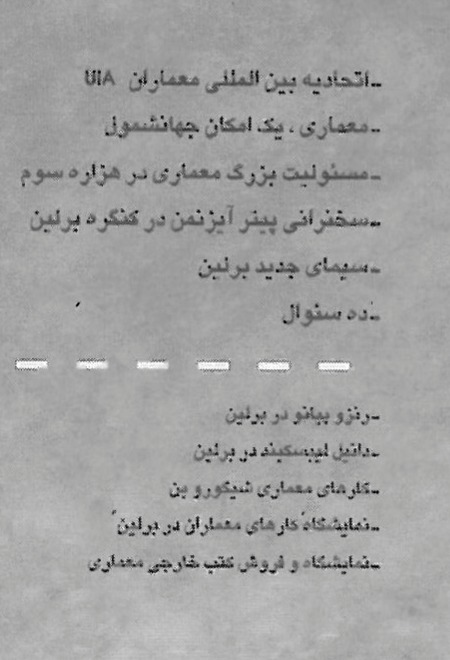
Day 1 — Tuesday 1 October 2002, opening at 5 pm: Screening of the film 'A Look at Berlin Today'; welcome; introduction of the Iranian Society of Architects; refreshments; opening of the exhibition 'A Look at Berlin Architecture'; foreign-language architecture-book exhibition and bookshop; tribute; introduction of Potsdamer Platz in Berlin; screenings of 'A Look at Berlin Today' and 'The Architect Recovers His Role'.
Day 2 — Wednesday 2 October 2002, programme 6 to 9 pm: introduction of international architecture organisations UIA and ARCASIA; screening of 'The XXI World Congress of Architecture in Berlin'; report on side exhibitions of the Berlin Congress and the role of sponsors; screening of Peter Eisenman's lecture on the Congress theme; the 'Look at Berlin Architecture' exhibition; the architecture-book exhibition and bookshop.
2 — International Seminar 'Architecture for a Changing World' — Yazd & Tehran, 12-16 October 2002
From 12th to 16th Oct. 2002, Tehran Museum of Contemporary Art, Iranian Cultural Heritage Organization, and Iranian Ministry of Housing and Urban Planning, together with Aga Khan Award for Architecture, held a seminar under the title of "Architecture for a Changing World". Some of the world's most well-known figures of architecture in the fields of criticism, analysis, theory and design — such as Charles Jencks, Michael Sorkin, Peter Davey, Philip Jodidio, and Arata Isozaki — participated in that part of the seminar held in Tehran Museum of Contemporary Art, which lasted for 3 days.
An analytic survey of the viewpoints expressed in this seminar and also some special interviews with Michael Sorkin and Philip Jodidio will appear in the next issues of Me'mar magazine.
Subjects discussed included Yazd and its historical sites, the Aga Khan Awards, conservation case studies in other countries, new architectural paradigms, new urban centres in Iran, recent currents of contemporary architecture, and the work of certain world architects. Among the seminar's organisers were Sami Azar, director of the Tehran Museum of Contemporary Art; Pirouz Hanachi, deputy minister of Housing and Urban Planning; Suha Özkan, secretary-general of the Aga Khan Award for Architecture; Darab Diba; Iraj Etessam; and Manoocheir Mozayyeri. A large body of teachers, architects, and students of the country took part. By way of an introduction to subsequent articles, the participating critics are briefly introduced below.
Charles Jencks
One of the well-known contemporary modern theorists. From the early 1970s he raised his critical view of the modern movement. In the late 1970s he turned to theorising the post-modern movement. His Language of Post-modern Architecture (1977) is one of the best-selling books of this manner of architecture. Architecture Today, in the early 1990s, examined the various existing tendencies and their features. With Architecture of the Jumping Universe (1995), Jencks responded to the new generation of architects fascinated by paradigms drawn from the new sciences and design methods influenced by non-Euclidean geometry. In this book Jencks theorises ways of architecture that have generally arisen with such tendencies. His recent lecture, 'The New Paradigm of Architecture', continues the discussion he had opened seven years earlier with The Jumping Universe; in March he gave another lecture under the same title in Sydney. The matter of these lectures is bound up with his most recent book, The New Paradigm of Architecture, published in 2002.
Peter Davey
Editor and contributor of Architectural Review since 1982, he has authored several books — among them Arts and Crafts Architecture and the monograph on Peter Zumthor (1998), and on Heikkinen & Komonen. He is also an adviser to RIBA and has served on the juries of several international architectural competitions.
Michael Sorkin
One of the most controversial architects, urbanists, teachers, and writers of today. His works are sharply contested, fanciful, and at times even satirical. His talk, though it had a definite theoretical content, dealt mostly with several recent urban projects of his. Sorkin is one of the few designers whose work has both theoretical and practical force.
Philip Jodidio
A critic and researcher of the younger generation, who has worked with the French magazine Connaissance des Arts since 1980. His recent important books — Architecture Now! and Building a New Millennium from Taschen — have been translated into several languages, and have now been published in 13 languages. Trained in art history and economics, Jodidio examines architecture from a wholly different and particular point of view. His lecture, 'Architecture Now', tied to the matters of his recent books, presented this view.
Notes: 1. Modern Movements in Architecture; 2. The Language of Post-modern Architecture; 3. Architecture Today; 4. Architecture of the Jumping Universe; 5. Arts and Crafts Architecture, the definitive history of the key Turn-of-Century movement (1980); 6. Peter Zumthor; 7. Heikkinen & Komonen; 8. Architecture Now!; 9. Building a New Millennium; 10. Architecture Now 2.
3 — UNESCO Asia-Pacific Heritage Conservation Awards 2002
UNESCO has announced the winners of the 2002 Heritage Conservation Awards in Asia and the Pacific. The UNESCO regional adviser for cultural affairs in the region awarded the principal Heritage Award to the Ahhichatragar Mansion in Rajasthan, India. Two Awards of Distinction went to Australia Hall in Sydney, and to mosques in Ganish, Pakistan. Among them, the Polshir House from Iran won an Award of Merit.
These awards are given for the efforts and achievements of individuals and organisations in the conservation and rehabilitation of buildings and complexes more than fifty years old; joint projects of the public and private sectors are also eligible. In 2002, forty-six projects from fifteen countries of Asia and the Pacific were entered. A jury of international heritage-conservation experts — with backgrounds in architecture, urbanism, and landscape — judged the submissions over three days. The winners were chosen for their grasp of cultural and social issues and of historically and architecturally important buildings; for the restoration and rehabilitation of a valuable structure; for the use of special techniques, artistic methods, and appropriate materials; for a desirable and visible effect on the surroundings; and for sharing in the cultural and historical continuity of society.
UNESCO holds that recognising successful efforts at heritage conservation — protecting buildings often endangered by unchecked development, neglect of historical and cultural values, and unsuitable use of historical heritage — leads to the spread of further projects in the same communities and calls forth a culture of conservation that uses appropriate methods and techniques.
The Polshir House, Isfahan — Award of Merit
The Polshir House, in the Jolfa quarter of Isfahan, is a 300-year-old historical building. The buildings on three sides of the courtyard of this old house belong to the Safavid, Zand, and Qajar periods. The particular architecture and special decoration have placed this historical building on the cultural-heritage register. Its principled, in-depth restoration and the change of use of this valuable building — from residential to the office of an architecture and urbanism firm — and its remarkable effect on the surrounding environment, won this work an Award of Merit from the UNESCO regional office for Asia and the Pacific.
Jury comment on the Polshir House: The restoration of the 300-year-old traditional Iranian courtyard house demonstrates an exemplary conservation approach by remaining faithful to the original building. The project adheres to all aspects of best conservation practice, with the result that the existing historic building fabric is surplusly maintained while the exquisite jewel-like interiors are restored to their original vibrancy. By choosing to adapt an old building for modern use, the project team is to be highly commended as their efforts sets a technical benchwork for conservation and gives momentum to private-sector conservation in Iran.